
And why they matter more than the National Reserve. A ranked, honest guide to the seven conservancies that define the Mara ecosystem — what each does best, which camps to choose, and who each one suits. With the conservation claims handled accurately rather than repeated as marketing.
Why the conservancies matter more than the national reserve
The Maasai Mara National Reserve is one of the most famous wildlife areas on Earth. It is also, in a specific and important sense, often the wrong place to stay. Not because the wildlife is poor — it is not. Not because the scenery disappoints — it is extraordinary. But because the rules governing the reserve (no off-road driving, no night drives, no walking safaris, uncapped vehicle access) create a visitor experience that is systematically more constrained than what the surrounding private conservancies offer, frequently at comparable total cost once park fees are factored honestly.
The conservation backstory is genuinely impressive, and The 7 best private conservancies in the Maasai Mara guide tells it accurately rather than repeating the inflated version. Lions in the Mara ecosystem were severely depleted by the mid-20th century through hunting and retaliatory killing. The community conservancy movement, beginning in the mid-2000s, brought Maasai-owned land into the protected system through lease agreements that pay landowners to keep their land as wildlife habitat. The Maasai Mara Wildlife Conservancies Association reports that land under conservation grew from 33% to 64% of the ecosystem as the model spread — arguably the single most important and best-attributed statistic in the whole story.
For visitors, this matters in the most practical possible way: the conservancies are where the animals behave most naturally, where your guide can follow them off-track, where you can be one of only a few vehicles at a sighting, and where you can take a night drive to discover what Kenya’s wildlife actually does after dark. Below are the seven best conservancies in the Mara ecosystem, ranked — what makes each distinctive, which camps to choose, and who each one suits best. Where a conservation statistic is solidly evidenced, this guide states it plainly; where a figure is widely repeated but weakly sourced, it says so.
Pick the conservancy first; pick the camp second. The right conservancy at any price tier produces a better safari than a famous reserve camp constrained by reserve rules. These seven define the ecosystem — and choosing among them comes down to your specific priorities, not someone else's ranking.
| OFF-ROAD DRIVING Conservancies yes · National Reserve no | NIGHT DRIVES Conservancies yes · National Reserve no |
| WALKING SAFARIS Conservancies yes (with ranger) · National Reserve no | VEHICLE LIMITS AT SIGHTINGS Conservancies 3-5 max · National Reserve uncapped |
| LION DENSITY Comparable to or higher than reserve (MMWCA: 14% higher; MPCP 2025: comparable) | ECOSYSTEM-WIDE LION DENSITY ~16.85/100km² — among Africa’s highest (Conservation Biology 2016) |
| LAND UNDER CONSERVATION Grew 33% to 64% of ecosystem (MMWCA) | BEST-VALUE CONSERVANCY ENTRY From ~$240 per person per night (Ol Kinyei) |
A note on the conservation statistics in this guide
Before the rankings, one honesty note. Several statistics circulate widely in safari marketing about the Mara conservancies — that they hold ‘83% of large mammals in 25% of the area,’ that lion numbers ‘tripled in ten years,’ that densities are definitively ‘higher than the reserve.’ These capture real patterns, but the precise figures range from solidly evidenced to weakly sourced.
The Mara Predator Conservation Programme’s most recent (2025) reading describes conservancy lion densities as ‘comparable to’ the reserve rather than clearly higher, and a 2025 Aarhus University study found camp density can locally suppress lions. The conservation case for conservancies is genuinely strong; this guide states the strong version accurately rather than the inflated version confidently. Where you see a precise-sounding statistic elsewhere, treat it as approximate unless it carries a primary citation.
How the seven rank — and why ranking conservancies is partly subjective
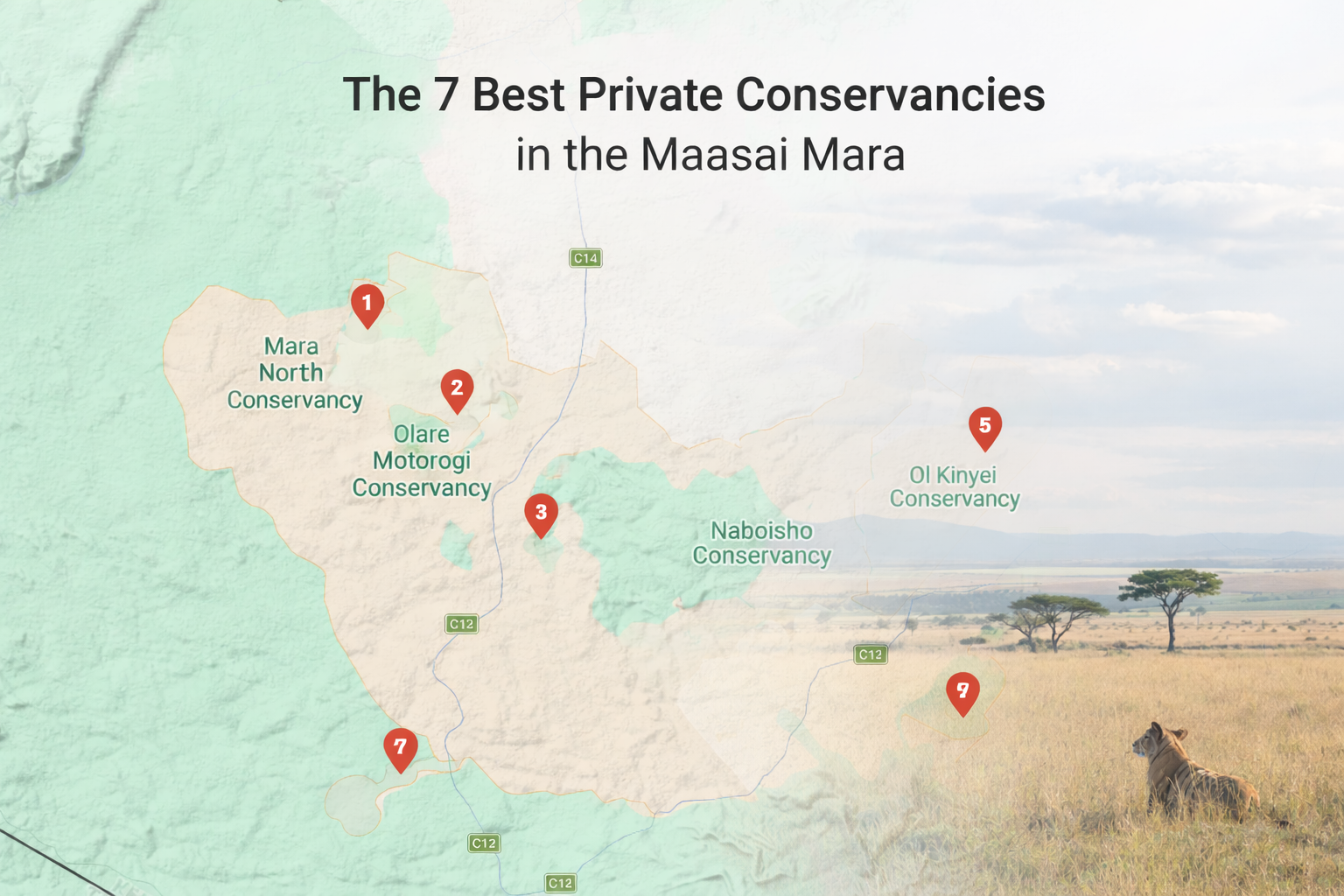
This ranking weights documented wildlife quality, the strength of the conservation and community model, the visitor experience (vehicle density, activity range, exclusivity), and value. Reasonable people weigh these differently — a photographer prioritising big-cat density will rank Olare Motorogi first; a budget-conscious traveller will rank Ol Kinyei first; a migration-focused traveller will rank Mara North first. The order below reflects a balanced weighting for a typical discerning visitor, but the per-conservancy detail matters more than the ordinal position.
1. Olare Motorogi Conservancy
33,000 acres, northeast of the national reserve. Olare Motorogi is the most celebrated conservancy in the Mara for one reason above all: big-cat density. The 2016 Conservation Biology study that estimated the Mara’s ecosystem-wide lion density at around 16.85 lions per 100 km² identified Olare Motorogi as one of the highest-density areas within the survey. This is a peer-reviewed anchor rather than a marketing claim. The conservancy spans acacia woodland, the valleys of the Olare Orok and Ntiakitiak rivers, riverine forest, and a dramatic escarpment. Until the mid-2000s much of it was heavily overgrazed and depleted of wildlife; the lease model and rigorous management produced one of Kenya’s fastest documented recoveries.
Olare Motorogi enforces among the strictest vehicle limits of any Mara conservancy — often only two or three vehicles permitted at a single sighting, actively enforced rather than aspirational. A cheetah hunt in Olare Motorogi may be watched by two vehicles; the same cheetah in the reserve might attract fifteen. The behavioural difference is immediate: the conservancy cheetah hunts without modifying its behaviour; the surrounded reserve cheetah frequently abandons the attempt.
Best for: guests whose primary goal is the highest-quality predator encounters — particularly lions and cheetahs — in the least crowded conditions in the ecosystem. Key camps: Mahali Mzuri (Richard Branson's Virgin Limited Edition property, from ~$1,250 pp/night), Mara Plains Camp (~$1,500 pp/night), Kicheche Bush Camp (~$680 pp/night, and home base of the Mara Predator Conservation Programme), and Porini Lion Camp (~$520 pp/night). Note: andBeyond Bateleur Camp, sometimes listed under Olare Motorogi, is actually in the Mara Triangle concession near Kichwa Tembo — a common error worth correcting.
2. Mara North Conservancy
74,000 acres, north of the Mara River — the largest conservancy in the ecosystem, created through partnerships with over 800 Maasai landowner families. Mara North’s scale means it contains the full ecological range of the Mara: open savannah plains for cheetah, riverine forest for leopard, the celebrated Leopard Gorge (one of the most reliable leopard-watching locations in the ecosystem, regularly featured in wildlife documentaries), extensive elephant and buffalo habitat, and substantial Mara River frontage.
For Great Migration river-crossing access, Mara North is the optimal conservancy. Its northern river boundary gives conservancy camps private-track access to crossing points that bypasses the reserve road entirely — meaning conservancy guests reach crossing locations without joining the vehicle queues that form at the main reserve crossing points during August and September. This combination of year-round wildlife range and migration positioning makes Mara North the most versatile conservancy for any time of year.
Best for: guests who want the full combination of excellent year-round wildlife and the best migration positioning. The most versatile choice in the ecosystem. Key camps: Saruni Mara (~$850 pp/night, the most dramatic views), Serian (~$1,100 pp/night), Karen Blixen Camp (~$680 pp/night, river frontage), and Offbeat Mara (~$480 pp/night). Note: Mahali Mzuri is in Olare Motorogi, not Mara North, despite occasional misattribution.
3. Naboisho Conservancy
50,000 acres, east of the national reserve. Naboisho — ‘come together’ in the Maa language — is the most cited example of the conservancy model as community conservation success. Over 500 Maasai landowner families collaboratively manage the area through the Naboisho Conservancy Trust, which directs a significant share of lease income toward community infrastructure including schools, water systems, and health facilities. This is conservation as economic development rather than as exclusion, and it is the conservancy most often studied as a governance model.
The lion record at Naboisho is among the most monitored of any Mara conservancy. Population figures circulate (the conservancy and immediate surroundings hold a substantial resident lion population, with the often-quoted figures of roughly 50 within the conservancy and around 110 in the surrounding cluster appearing in safari literature). These specific numbers should be read as approximate rather than audited — lion counts vary by survey, season, and method. What is well-supported is that Naboisho’s lion density is high by any African standard, sustained by the combination of vehicle limits (three vehicles maximum per sighting), active monitoring, livestock-compensation schemes that remove the incentive for retaliatory killing, and the lease income that gives landowners a financial stake in lion survival.
Best for: guests for whom the conservation and community story matters as much as the wildlife encounter. The most community-rooted conservancy in the ecosystem; outstanding specifically for lion and cheetah. Key camps: Encounter Mara (~$820 pp/night), Mara Naboisho Camp (~$750 pp/night), Kicheche Valley Camp (~$700 pp/night), and Basecamp Eagle View (~$480 pp/night).
4. Olderkesi Conservancy (Cottar’s)
7,600 acres, southeast of the ecosystem near the Tanzania border — the most remote of the major Mara conservancies, operating on an exclusivity model that makes everything else look busy by comparison. The entire concession is available to the guests of a single camp, Cottar’s 1920s Safari Camp, with a maximum capacity of roughly 20 guests. In practical terms you may be the only vehicle in an area the size of a small town. Big Five sighting rates here are reported among the highest in the ecosystem — a direct consequence of exclusivity and the complete absence of vehicle pressure at sightings.
The Cottar family has operated safaris in East Africa for over a century, making this one of the oldest and most deeply experienced safari operations on the continent. The camp’s 1920s aesthetic — canvas director’s chairs, kerosene lanterns, dark hardwood, period photographs — is meticulously maintained while the guiding and infrastructure are entirely contemporary. An all-female conservation unit conducts anti-poaching and wildlife monitoring within the conservancy, a distinctive feature that sets it apart operationally as well as aesthetically.
Best for: guests for whom absolute exclusivity, the highest Big Five rates, and a century of accumulated safari knowledge are the priorities. The most private major Mara conservancy experience available. Key camp: Cottar's 1920s Safari Camp (~$995-1,800 pp/night, all-inclusive).
5. Ol Kinyei Conservancy
Approximately 65 km² (around 18,700 acres), northeast of the reserve — and historically significant as one of the first fully community-owned conservancies in the Mara, established in 2005, predating the current proliferation and setting the model others followed. Ol Kinyei occupies a specific and important position in this ranking: it is the best-value private conservancy in the entire ecosystem. From around $240 per person per night all-inclusive, guests access night drives, walking safaris, off-road vehicle access, and outstanding wildlife in a private area with vehicle limits — dramatically undercutting the luxury conservancy tier while delivering most of the same experiential advantages.
The landscape of savannah, riverine forest, and acacia woodland is particularly productive for cheetah — the combination of open terrain and low vehicle pressure creates conditions where cheetah hunting behaviour is routinely observed at close range. The conservancy also holds a resident lion pride, leopards, elephant, and buffalo. For travellers who want genuine conservancy access without the premium pricing, Ol Kinyei is the clearest answer in the ecosystem.
Best for: budget-conscious travellers who want conservancy advantages without the luxury price; first-time Mara visitors who want the off-road, night-drive, and walking-safari experience at an accessible price point. Key camps: Ol Kinyei Tented Camp (~$240 pp/night) and Porini Mara Camp (~$420 pp/night).
6. The Mara Triangle
The Mara Triangle is technically part of the national reserve, not a private conservancy — but it operates under a separate, far more rigorous management regime, run since 2001 by the Mara Conservancy, a non-profit. Twenty-four years of active management show: the Triangle has the most effective anti-poaching programme in the ecosystem (thousands of snares removed and a substantial number of poaching arrests since 2001 — the often-quoted figure of 3,415 arrests should be read as a cumulative operator-reported number rather than an independently audited statistic), the most reliable black rhino sightings in the Mara, and significantly lower vehicle pressure than the central and eastern reserve sections.
The Triangle is bounded to the west by the Oloololo Escarpment — the dramatic landscape feature that frames Angama Mara and the Out of Africa filming location. The escarpment views across the Mara plains are the most spectacular single landscape feature in the ecosystem. The Triangle is also where migration herds first arrive from Tanzania, and where the season’s first Mara River crossings typically occur. Its inclusion here, despite technically being reserve land, reflects that it delivers a conservancy-like experience in vehicle density and management quality even though reserve rules still prohibit night drives, walking, and off-road driving.
Best for: guests who specifically want black rhino sightings, the most dramatic Mara scenery, and lower vehicle pressure than the main reserve — and who don't require the conservancy activities (night drives, walking) that reserve rules still prohibit here. Key camps: Angama Mara (~$1,450 pp/night, escarpment position), andBeyond Bateleur Camp (~$1,245-2,595 pp/night, in the adjacent concession), Little Governors' Camp (~$760 pp/night), and Mara Serena Safari Lodge (~$400 pp/night).
7. Lemek Conservancy
Northwest corner of the ecosystem, bordering the Mara Triangle and the Oloololo Escarpment. Lemek is the least visited of the major Mara conservancies — a characteristic that makes it distinctive rather than limiting. Guests in Lemek regularly experience near-complete vehicle exclusivity at sightings: being the only vehicle watching a lion pride for an extended period, or following an elephant herd for two hours without another vehicle in sight. This level of exclusivity is increasingly rare even in the most prestigious conservancies during peak season.
The wildlife mix is particularly strong for elephant — the northern section of the ecosystem, bordering the Loita Hills, hosts large elephant herds that move through Lemek regularly. Lion prides are resident and well-studied. The modest visitor numbers mean animal behaviour is genuinely natural; the wildlife here shows less vehicle habituation than in more heavily visited areas, which paradoxically often produces more dramatic encounters because animals go about their business without awareness of observation.
Best for: guests who want genuine remoteness, complete exclusivity at sightings, and excellent wildlife at an accessible conservancy price point. The least-marketed but often most rewarding experience for travellers who know what they want. Key camps: Lemek Conservancy camps and the adjacent Serian Nkorombo (~$880 pp/night), plus mobile and seasonal camps that move within the conservancy.
How to choose the right conservancy for you
| Priority | Best conservancy | Why |
| Lion and big-cat encounters | Olare Motorogi | Among highest documented densities; strictest vehicle limits. |
| Migration river crossings | Mara North | Largest river frontage; private-track access to crossing points. |
| Community conservation story | Naboisho | 500+ Maasai families; most community-rooted governance model. |
| Absolute exclusivity | Olderkesi / Cottar’s | Single camp, ~20 guests, entire 7,600-acre concession. |
| Best value conservancy access | Ol Kinyei | From ~$240 pp/night with night drives and walking safaris. |
| Scenery and black rhino | Mara Triangle | Oloololo Escarpment views; most reliable black rhino in the Mara. |
| Remoteness and elephants | Lemek | Least visited; complete vehicle exclusivity regularly possible. |
What all conservancy guests experience that reserve guests don’t
Regardless of which conservancy you choose, every conservancy guest receives access to activities simply unavailable in the national reserve at any price. These three are the structural reasons the conservancy experience differs from the reserve experience.
- Night drives. The Mara after dark is a completely different world from what daytime drives reveal. Serval cats emerging from long grass, aardvarks digging at termite mounds, white-tailed mongooses hunting in pairs, porcupines along dry riverbeds, and lions substantially more active than during daylight. Night drives consistently produce encounters guests describe as among the most memorable of their trip — wildlife they had not known existed in the ecosystem.
- Walking safaris. Moving through the landscape on foot with an armed Maasai ranger and an experienced guide creates a completely different quality of attention from any vehicle-based experience. The sounds, the smells, the physical presence of being in the bush rather than observing it from a moving platform are irreducible aspects that game drives cannot replicate.
- Off-road driving. Following a cheetah into the long grass as it positions for a hunt; approaching a leopard from the angle that gives the best view; reading the landscape directly rather than from a fixed track. Off-road access is what separates a guide who knows where the animals are from a guide who can actually take you to them.
FROM THE FIELD “We had four nights in the reserve at the start of the trip and four nights in a conservancy at the end. I kept telling my husband we should have booked the conservancy the whole time. There is simply no comparison.” — A guest describing the experience gap that nearly every traveller who does both notices immediately.
Frequently asked questions
What is the difference between a conservancy and the national reserve?
The national reserve is government-managed public land (Narok County) with open access, uncapped vehicles, and rules prohibiting off-road driving, night drives, and walking safaris. A conservancy is Maasai-owned land leased to tourism operators who cap visitor and vehicle numbers and permit the full activity range. The conservancy model also pays lease income directly to Maasai landowners, making it both a better visitor experience and a conservation mechanism.
Which Maasai Mara conservancy is best for first-time visitors?
Mara North for versatility (year-round wildlife plus migration access), or Olare Motorogi for the best big-cat encounters. Both deliver the full conservancy experience. Budget-conscious first-timers should look at Ol Kinyei, which delivers genuine conservancy access (night drives, walking, off-road) from around $240 per person per night — dramatically below the luxury conservancy tier.
Are the conservancies more expensive than the reserve?
On headline rate, yes — but the gap narrows substantially with honest accounting. Conservancy rates are usually all-inclusive (activities, meals, drinks, conservancy fees), while reserve guests pay $100-200/day in park fees plus drinks and activities on top of accommodation. A conservancy camp at $600 all-inclusive and a reserve camp at $400 plus fees and extras often reach comparable total cost — while the conservancy delivers night drives, walking, off-road access, and lower vehicle density.
Can I visit a conservancy on a day trip from the reserve?
Generally no. Conservancies restrict access to guests staying at conservancy camps — that exclusivity is the entire point of the model and is what keeps vehicle density low. To experience a conservancy, you stay at one of its camps. Many conservancy camps do, however, offer day excursions into the adjacent reserve (for migration crossings, for example), giving you both experiences from a conservancy base.
Do all conservancies allow night drives and walking safaris?
All the private conservancies in this guide (Olare Motorogi, Mara North, Naboisho, Olderkesi, Ol Kinyei, Lemek) permit night drives, walking safaris, and off-road driving. The Mara Triangle is the exception — it is technically reserve land under separate management, so reserve rules still apply there (no night drives, no walking, no off-road), even though its vehicle density and management quality are conservancy-like.
Honest limits to this ranking
Three caveats.
- First, the ranking is partly subjective — weighting wildlife, conservation, experience, and value differently produces a different order, and the per-conservancy detail matters more than the ordinal position.
- Second, the conservation statistics throughout have been stated at their well-evidenced strength rather than their marketing maximum; precise lion counts, lease aggregates, and the ‘83% of mammals’ type figures should be read as approximate.
- Third, camp pricing shifts through 2026 and camps occasionally change operators or close seasonally; confirm specific rates and operators at booking. The conservancies themselves are stable; the accommodation landscape within them moves.
THE HONEST PICK For most discerning first-time visitors: Mara North for versatility or Olare Motorogi for big cats, at whatever tier your budget supports. For value with full conservancy access: Ol Kinyei. For exclusivity: Olderkesi/Cottar's. For black rhino and scenery: the Mara Triangle. The wrong choice is defaulting into a reserve-only stay without realising the conservancies were available at comparable total cost — that is the single most common Mara booking regret.
Who this article is for, and who should look elsewhere
Travellers choosing where to stay in the Maasai Mara — this guide ranks and differentiates the seven conservancies so you can match one to your priorities. Combine it with the guide on private conservancy vs national reserve for the structural booking framework.
Travellers who want the conservation story behind the conservancies told honestly — the companion article on how conservancies saved the Mara’s lions handles the evidence in depth, including where the famous statistics are solid and where they’re soft.
Travellers wanting specific camp recommendations within each conservancy — the article on best lodges in the Maasai Mara 2026 profiles twelve specific properties across every tier with verified pricing.
Travellers committed to a reserve-only budget safari — the conservancies may be out of reach, and that is a legitimate choice. The reserve still delivers the wildlife; you trade activity range and vehicle density for lower nightly cost. Just make the choice knowingly rather than by default.
Tell us what you are looking for, and we will tell you honestly whether we can deliver it — and if we cannot, we will tell you who can.
RELATED READING
- Best time to visit Kenya: when to experience these conservancies at their best
- Mara River Crossing: How to Be There at the Right Time
- Private Conservancy vs National Reserve Kenya: The Complete Honest Guide (2026)
- How Conservancies Saved the Mara’s Lions -and what it means for your visit
- Maasai Mara, Kenya — Destination Guide | Nova Expedition Kenya
- Maasai Mara vs Serengeti: Which African Safari is Better? (2026 Honest Guide)
- Best Lodges in the Maasai Mara 2026: From Ultra-Luxury to Best Value
- Maasai Mara Lodges and Camps — Reserve vs Conservancy