
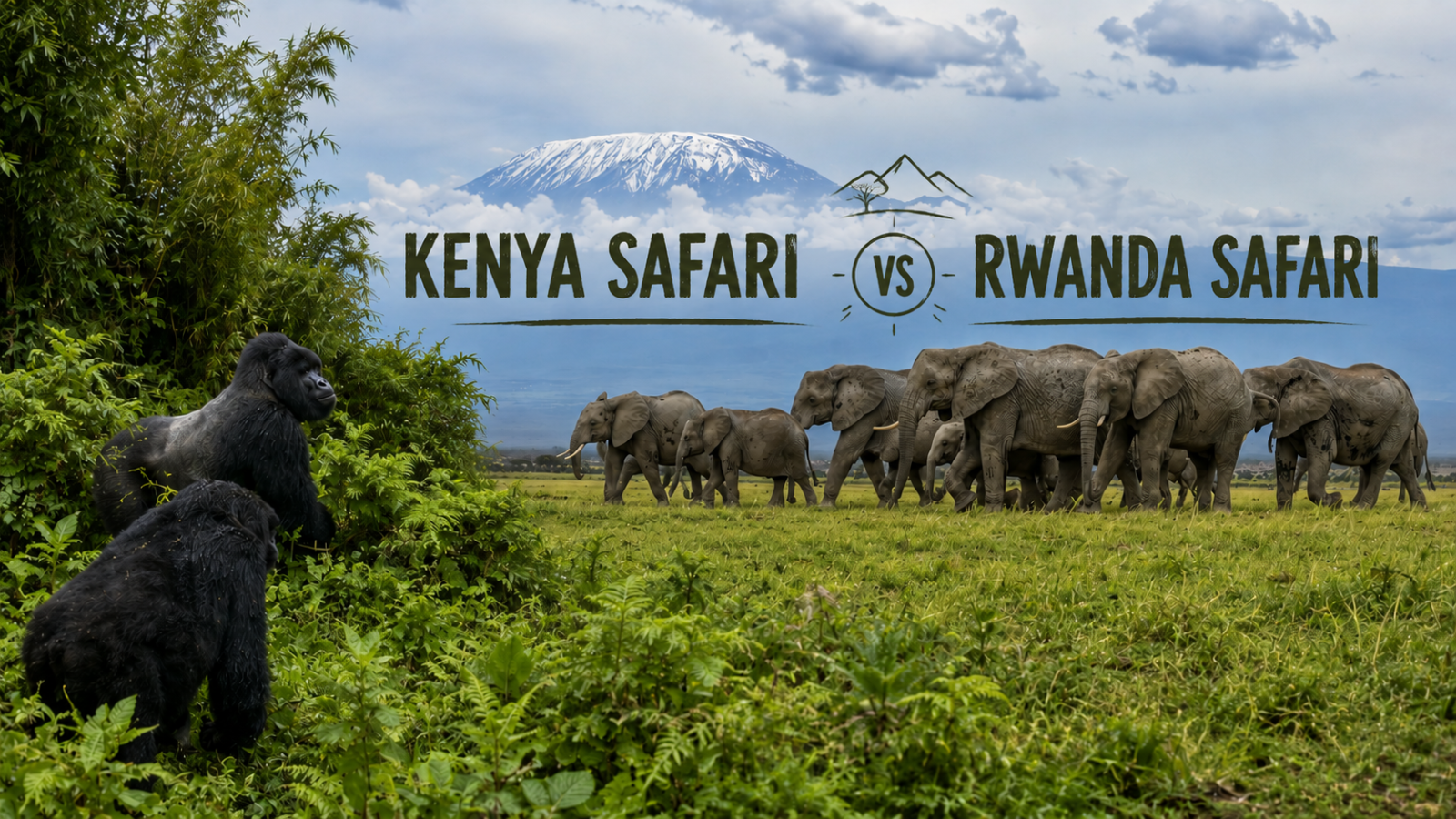

These are not two versions of the same trip. They are different products at different price points serving different priorities. The ‘or’ framing is the standard mistake; the ‘and’ framing is what most travellers should consider.
The wrong question, asked very often
Travellers planning their first East Africa trip frequently arrive at the question of Kenya Safari vs Rwanda Safari as a head-to-head choice. The marketing of both countries encourages this framing Kenya as the safari classic, Rwanda as the gorilla destination. Each is positioned as a single-destination alternative to the other.
The framing is misleading. A one-hour gorilla encounter in Volcanoes National Park and a five-day Mara conservancy stay are not comparable products. One is a single photographic and emotional event, organised around a strict permit system, in mountain forest. The other is a multi-day landscape and wildlife immersion at scale, across savanna and conservancy networks. Choosing ‘Kenya or Rwanda’ is like asking whether you want to attend an opera or take a sailing holiday – both are reasonable, both produce strong experiences, neither substitutes for the other.
The honest answer to ‘which one’ is usually ‘both, in sequence’. The honest answer to ‘I only have time and budget for one’ depends on what specifically you want. This article works through what each country actually delivers, at what cost, with what trade-offs – and then the combination framework that produces the strongest East Africa trip for most travellers.
Throughout this article: Rwanda permit prices and access information have been verified against the Rwanda Development Board (RDB) as of mid-2026. Kenya information reflects current operator practice. Permit prices change; confirm at booking.
Gorilla trekking is a single profound hour. Kenya safari is a week of accumulated wildlife encounters. The choice is not which is better — it is which structure of experience fits the trip you want. For most travellers, the answer is to do both, with Kenya first.
| RWANDA GORILLA PERMIT (2026) $1,500 per person, foreign non-resident – set by Rwanda Development Board | RWANDA PERMIT, EAC RESIDENTS $200 – the lowest pricing tier; African residents pay $500 |
| VOLCANOES NP HABITUATED FAMILIES 14 (daily permit cap raised from 96 to 112 in 2024) | KIGALI TO VOLCANOES NP 2.5–3 hour drive on well-tarmacked roads |
| KENYA MAASAI MARA FEE (2025) $100–200/day depending on season – 12-hour window | KENYA SAFARI INDICATIVE COST $300–600/person/day mid-tier; $800–1,500 premium |
| COMBINED TRIP DURATION SUGGESTION Kenya 7–9 nights + Rwanda 3–4 nights produces a strong East Africa trip | BOTH-COUNTRY VISA East Africa Tourist Visa $100 covers Kenya, Rwanda, Uganda for 90 days |
What each country actually delivers
Strip away the marketing and the products look like this:
Rwanda – the curated single-experience destination
Rwanda is a small, well-organised, intensively conservation-focused country built around mountain gorilla trekking as the centerpiece experience. Volcanoes National Park (the Rwanda end of the Virunga Massif, shared with Uganda and DRC) holds 14 habituated gorilla families, 12 of which receive 8 trekkers daily, for a daily cap of 96–112 permits. The trek itself is a one-hour observation period with a habituated gorilla family, preceded by a hike of 30 minutes to 5 hours depending on the family’s location that day.
Beyond gorillas, Rwanda offers Akagera National Park (Big Five savanna safari at much smaller scale than Kenya — roughly 1,200 km², roughly 8,000 large mammals, recently reintroduced lion and rhino populations following years of post-genocide recovery work led by African Parks since 2010), Nyungwe Forest (chimpanzee trekking, Africa’s largest remaining mountain rainforest), Lake Kivu (lakeside relaxation), and Kigali itself (one of the cleanest, safest, most navigable African capitals, with the Kigali Genocide Memorial as essential context for understanding the country).
The defining Rwanda experience is the gorilla hour. Everything else in a Rwanda trip is positioning for it or extending around it. A standard Rwanda gorilla trip is 3–4 nights with one or two gorilla treks; an extended Rwanda trip adding Akagera and Nyungwe can run 7–10 nights.
Kenya – the diversified multi-experience destination
Kenya offers a portfolio: the Mara conservancy network and Reserve (savanna safari at scale, with conservancies providing the structurally premium product), Amboseli (elephants against Kilimanjaro), Samburu and the northern conservancies (dry-country specialists including the ‘Samburu Special Five‘ – Grevy’s zebra, reticulated giraffe, gerenuk, Beisa oryx, Somali ostrich), Tsavo East and West (Big Five but at lower density than the Mara), Laikipia (private and community conservancies with rhino, wild dog, and forest-edge species), Lake Nakuru and the Rift Valley lakes (waterbirds, although the historical flamingo numbers have declined dramatically), Mount Kenya and the Aberdares (highland forest and trekking), the coast (Diani, Lamu, Watamu — beach, Swahili culture, and the Arabuko-Sokoke endemic birds).
The defining Kenya experience is the multi-night safari combination across several distinctly different ecosystems. A standard Kenya safari is 7–10 nights across 2–3 destinations; an extended Kenya trip combining safari with coast can run 14+ nights.
THE STRUCTURAL CONTRAST Rwanda delivers one outstanding experience and a country to extend around it. Kenya delivers a portfolio of strong experiences and a country to design within. These are different products. Travellers who treat them as substitutes will end up disappointed in whichever they choose.
The cost comparison, honestly
Permits and accommodation drive the cost gap. The Rwanda premium is real and substantial.
| Cost item | Rwanda (3 nights, 1 gorilla trek) | Kenya (7 nights, 2 conservancies) |
| Park / activity permits | $1,500 per person (1 trek) | $700–1,400 per person (conservancy + KWS fees) |
| Accommodation — mid-tier | $1,500–2,500 (3 nights, $500–800/night) | $2,800–4,200 (7 nights, $400–600/night) |
| Accommodation — premium | $4,500–8,000 (Bisate, Singita Kwitonda, One&Only Gorilla’s Nest) | $7,000–12,000 (Angama, Mahali Mzuri, Bateleur, Sirikoi) |
| Internal transfers (flights + transfers) | $200–600 (mostly road from Kigali) | $800–1,800 (multiple internal flights) |
| Mid-tier total per person, 7 nights vs 3 nights | Approximately $3,200–4,600 (3 nights) | Approximately $4,300–7,400 (7 nights) |
| Per-night cost (mid-tier) | $1,070–1,530 per night | $615–1,060 per night |
The per-night cost in Rwanda runs roughly 50–75 percent higher than Kenya in the mid-tier, primarily driven by the $1,500 gorilla permit which is amortised over only a few nights. At the premium tier the gap narrows because both destinations are operating at the top of their accommodation pricing. At the high-end premium tier — Singita Kwitonda or Bisate in Rwanda vs Angama Mara or Mahali Mzuri in Kenya — the per-night costs are roughly comparable.
THE BOTTOM LINE ON COST Rwanda is materially more expensive per night because the $1,500 permit drives the math. Kenya is roughly half the per-night cost in the mid-tier. For travellers cost-constrained but wanting both, the structurally correct trip is a longer Kenya stay plus the minimum Rwanda gorilla extension (3 nights, one trek).
Permit logistics that the brochures gloss over
Three things about gorilla permits that matter for trip planning.
Booking lead time and the 2026 changes
Rwanda permits sell out 3–12 months in advance for peak season (June–September and December–February). The Rwanda Development Board recommends 6–12 months ahead; 9 months is a safer baseline. The Uganda Wildlife Authority changed its permit policy in March 2026, eliminating the 7-day soft-hold that previously let operators reserve permits without immediate payment. Both countries now require full upfront payment to secure permits.
The practical implication: travellers should commit to permit dates before flights, not the other way around.
Rwanda’s residency-tiered pricing
Rwanda’s $1,500 permit applies to foreign non-residents. Foreign residents in Rwanda pay $500; East African Community citizens pay $200. The 2026 promotion that extended these reduced rates through December 2026 has a blackout for June–October when standard rates apply. For most international travellers, the $1,500 is the relevant number. For African travellers, the residency-tiered pricing is materially more accessible.
The minimum age and physical considerations
Both Rwanda and Uganda require a minimum age of 15 for gorilla trekking. The treks can last anywhere from 30 minutes to 5 hours depending on which family the rangers locate and where they are that day. Rwanda treks are generally shorter than Uganda treks (the Volcanoes terrain is more contained), but both can be physically demanding. Mobility-limited travellers can hire porters (typically $20–50) and, in Uganda, sedan-chair carriers (~$300–500). The minimum-age and fitness requirements should be considered seriously in family trip planning.
Rwanda beyond gorillas: what the other parks actually deliver
Travellers extending their Rwanda trip beyond Volcanoes face a real choice between three secondary destinations. Each delivers something genuinely different, and the marketing tends to flatten the differences.
Akagera National Park (Big Five savanna at small scale)
Akagera sits in eastern Rwanda on the Tanzania border, covering 1,122 km². The park’s recent history is unusual: by the late 1990s, post-genocide encroachment had reduced it to roughly a third of its original size and effectively destroyed its large-mammal populations. African Parks took over management in 2010 in a partnership with the Rwanda Development Board. Lions were reintroduced in 2015 (the first lions in Akagera in two decades), eastern black rhinos in 2017, and the park now holds approximately 13,500 large mammals including the Big Five.
The Akagera product is materially smaller in scale than the Kenya Mara: fewer animals across less area, less vehicle density, less established operator network. The Big Five sightings are documented but not as reliable as the Mara. The park’s strength is the genuinely impressive recovery story — a savanna ecosystem rebuilt from near-collapse, visible in 1–2 days of game drives. For travellers wanting to see Big Five in Rwanda alongside gorillas, Akagera delivers. For travellers who have already done Kenya Big Five safari, Akagera will feel small.
Nyungwe Forest National Park (chimpanzees and montane forest)
Nyungwe holds Africa’s largest remaining mountain rainforest at roughly 1,019 km², on the Burundi border. The park’s principal product is chimpanzee trekking, which produces sightings at lower reliability than Uganda’s Kibale Forest but in a fundamentally beautiful forest setting. The park also offers a famous canopy walkway (50 metres above the forest floor), strong birding for forest specialists (the Albertine Rift endemics), and golden monkey and L’Hoest’s monkey encounters.
Logistically, Nyungwe is the more demanding Rwanda extension – 5–6 hours by road from Kigali, with limited high-end lodge inventory. One&Only Nyungwe House is the polished option; Nyungwe Top View Hill Hotel and Gisakura Family Hostel offer more accessible alternatives. For travellers prioritising primate diversity beyond gorillas, Nyungwe is the destination; for chimpanzees specifically, Uganda’s Kibale Forest is the stronger option.
Lake Kivu (lakeside relaxation and the Congo border)
Lake Kivu forms most of Rwanda’s western border with Democratic Republic of Congo. The Rwandan lake towns – Rubavu (formerly Gisenyi), Karongi (Kibuye), and Rusizi (Cyangugu) – offer lakeside accommodation, boat trips, and access to the Congo Nile Trail (a 227 km hiking/cycling route along the lake’s eastern shore). Lake Kivu functions as the Rwandan equivalent of a beach extension after a wildlife-heavy trip; travellers wanting decompression after gorilla trekking and Akagera safari can add 2 nights at Karongi or Rubavu without compromising the trip’s structure.
Note: Lake Kivu is one of three African ‘exploding lakes’ (alongside Lake Nyos and Lake Monoun in Cameroon) due to dissolved CO2 and methane at depth. This is a documented but not currently dangerous condition managed through methane extraction; mentioned here only because it occasionally appears in travel writing and travellers should know it is being actively managed.
Who Rwanda is for
Rwanda specifically suits four traveller types.
First, gorilla-priority travellers. If the gorilla encounter is the experience you most want from East Africa, Rwanda is the most accessible and most polished way to get it. The Kigali airport, the road infrastructure, the lodge quality, and the conservation organisation are all geared around this one experience. Rwanda makes the gorilla product easy in a way that Uganda does not.
Second, time-constrained travellers. A complete Rwanda gorilla trip – flights from Europe or US, two gorilla treks, optional Akagera or Nyungwe – fits into 5–7 nights total. For travellers who cannot easily commit two weeks to Africa, Rwanda is the more compact East Africa product.
Third, premium-tier travellers focused on lodge experience. The Bisate-Singita Kwitonda-One&Only Gorilla’s Nest tier in Volcanoes is among the most sophisticated lodge product in Africa. For travellers who specifically value lodge quality alongside the wildlife encounter, Rwanda’s high-end product is exceptional.
Fourth, repeat African travellers who already know Kenya, Tanzania, or southern Africa. The gorilla encounter sits genuinely separate from anything those destinations offer. Travellers who have done multiple southern Africa safaris but never gorillas should weight Rwanda heavily.
Who Kenya is for
Kenya specifically suits four traveller types.
First, first-time safari travellers. Kenya is the most accessible, most diversified, and best-supported first East Africa trip. The Mara delivers the iconic experiences travellers have seen on television; the supporting cast (Amboseli, Samburu, Tsavo, Laikipia) adds depth without requiring a steep learning curve.
Second, multi-experience travellers. If you want savanna, mountain, lake, and coast in a single trip – Kenya does this within a single country in a way that Rwanda does not. The Kenya coast (Diani, Lamu, Watamu) extends a wildlife trip into beach and Swahili culture without adding a country.
Third, cost-conscious mid-tier travellers. Kenya’s per-night mid-tier accommodation runs materially lower than Rwanda’s, and the cost-per-experience math favours Kenya substantially over 7+ night trips. Budget-conscious travellers who still want a strong product should weight Kenya.
Fourth, repeat-visitor travellers. Kenya rewards return visits more than Rwanda does – different conservancies in different seasons, photography projects, conservation engagement. Rwanda is a destination most travellers will visit once and feel they have understood. Kenya supports multiple distinct trips over years.
The combination framework: Kenya first, then Rwanda
For travellers who can afford both, the strongest East Africa trip combines them. The logistics favour a specific ordering.
The standard 11–12 night combination
Days 1–8: Kenya. Two conservancies (Mara conservancy plus Laikipia or Samburu) with internal flights. The Kenya component anchors the trip as a multi-day immersion in landscape and wildlife at scale. By day 8, the traveller has accumulated enough Kenya experience that the contrast with Rwanda will land clearly.
Days 9–12: Rwanda. Fly Nairobi to Kigali (1.5 hours, Kenya Airways or RwandAir, daily). Drive Kigali to Volcanoes (2.5 hours). Two nights at a Volcanoes lodge with one gorilla trek. Optional third night for a second trek or for Kigali (the Genocide Memorial visit before departure adds essential context). Fly out from Kigali.
This ordering puts the more demanding logistics (Kenya, multi-destination) at the start when energy is highest, and the single-experience emotional peak (Rwanda gorilla trek) at the end where it serves as the trip’s culminating moment rather than its baseline.
The extended 14+ night combination
For travellers with time, the extended combination adds Akagera (1–2 nights, savanna safari at Rwanda’s scale) or Nyungwe (2 nights, chimpanzee trekking and forest birding) or Lake Kivu (2 nights, lakeside relaxation) to the Rwanda end. Some travellers extend the Kenya end with a Mount Kenya trek or a Lamu coastal extension instead. Beyond 14 nights, structural diminishing returns set in — the additional days do not produce proportionally more memorable experiences.
The minimum-viable combination
Travellers cost-constrained but determined to do both should consider: 5 nights Kenya (single conservancy, 4 days of game drives) plus 3 nights Rwanda (one gorilla trek). Total: 8 nights, approximately $5,500–8,500 per person mid-tier. This is the floor that still produces both experiences with credibility. Below 8 total nights the trip starts cutting into the experiences themselves.
THE COMBINATION LOGISTICS Kigali-Nairobi flights run multiple times daily on Kenya Airways and RwandAir, 1.5 hours direct. Visa logistics: Kenya eTA plus Rwanda visa, or the East Africa Tourist Visa ($100) covering both countries plus Uganda. The travel is straightforward — most travellers who don't combine the two are simply not aware that the combination is easy.
Uganda as the value alternative
Uganda is the third option for gorilla trekking and offers materially different economics.
The Uganda gorilla product
Bwindi Impenetrable National Park holds nearly half the world’s remaining mountain gorillas across four sectors (Buhoma, Ruhija, Nkuringo, Rushaga) with 19+ habituated families and 152 permits daily. Mgahinga Gorilla National Park adds one additional family and 8 daily permits. Uganda gorilla permits cost $800 for foreign non-residents at standard rates, with $600 low-season discounts in April, May, and November. Uganda also offers the gorilla habituation experience at $1,500 (4 hours with a semi-habituated family) – same price as a Rwanda standard trek but a fundamentally deeper experience.
Uganda chimpanzee trekking
Kibale Forest National Park holds the highest concentration of chimpanzees in East Africa. Kibale standard chimp tracking is $250 for foreign non-residents; chimp habituation (CHEX) is $300 for a longer day-long encounter. For travellers wanting both gorillas and chimpanzees in a single trip, Uganda is the structurally strongest single-country option.
Why Uganda is less popular
Uganda’s logistics are less polished than Rwanda’s. The drive from Entebbe to Bwindi is 8–10 hours; charter flights add cost. Bwindi terrain is steeper and muddier than Volcanoes. Lodge quality at the high end (Sanctuary Gorilla Forest Camp, Buhoma Lodge, Clouds Mountain Gorilla Lodge) is good but not at the level of Rwanda’s premium tier. Uganda is the right choice for travellers who specifically want the economics ($800 permit vs $1,500) and the optional chimpanzee combination, or for travellers wanting habituation rather than standard trekking.
| Dimension | Rwanda | Uganda | Kenya |
| Headline experience | Gorilla trekking | Gorilla + chimpanzee | Multi-destination safari |
| Gorilla permit cost | $1,500 standard | $800 / $600 low season | Not applicable |
| Big Five access | Akagera (small-scale) | Queen Elizabeth, Murchison Falls (moderate) | Mara, Tsavo, Amboseli (high-scale) |
| Logistical polish | Highest in region | Moderate; longer transfers | High; established operator network |
| Best minimum trip length | 3–5 nights | 5–8 nights | 7–10 nights |
| Repeat-visit potential | Low (one-and-done) | Moderate | High (multiple distinct trips) |
Honest limits on the comparison
Three things this article cannot tell you about the choice.
First, which gorilla family or which Mara conservancy you will be assigned to. Rwanda’s family allocation happens at the daily morning briefing; you cannot reliably pre-select. Kenya’s conservancy stays are camp-specific but the wildlife you encounter depends on luck and on the season. The trip quality is partly dependent on factors outside operator control.
Second, the political and security context. Rwanda is among the most stable East African countries; Kenya has occasional political tensions around elections and protests; Uganda has had visible instability around elections. The 2027 Kenya election cycle may produce travel-affecting events; travellers booking far ahead should monitor. For most travel windows in 2026, all three countries are operating normally.
Third, the question of whether gorilla trekking is the right experience for you specifically. Some travellers find the one-hour structured observation, with strict viewing-distance rules and a queue of trekkers behind them, less emotional than the marketing suggests. Others find it the singular most powerful wildlife encounter of their life. There is no way to predict which response you will have. The mid-tier $3,200–4,600 minimum-viable Rwanda trip is a meaningful sum to commit to an experience that may not land for you.
THE HONEST PICK FOR THE EAST AFRICA FIRST-TIMER Kenya 8 nights (Mara conservancy plus Laikipia or Samburu) plus Rwanda 3 nights (Volcanoes lodge plus one gorilla trek). Total cost approximately $7,500–11,000 per person mid-tier. This is the trip most travellers should book if they can. Travellers cost-constrained to a single country should default to Kenya unless gorilla trekking is the specific reason for the East Africa trip — in which case Rwanda is the better single choice.
Who this article is for, and who should look elsewhere
Travellers planning their first East Africa trip and trying to choose between countries – this article gives you the framework. The combination approach is almost always the better outcome.
Repeat African travellers who have already done both Kenya and Rwanda – you should look at Uganda for gorilla habituation, at Tanzania for the Serengeti scale, or at southern Africa for a fundamentally different safari product (Botswana, Zambia, Zimbabwe). This article will not change your trip.
Travellers focused exclusively on photography – both countries deliver, but they deliver different photography. Rwanda gorilla photography is portrait-and-detail work in low forest light. Kenya safari photography is landscape, action, and behavioural work across the full light range. Photographers should weight their portfolio gaps.
RELATED READING
- Kenya vs Uganda: which safari destination is right for you?
- Kenya food guide: the East African region context for combined trips
- Solo safari in Kenya: the operator-selection framework that also applies to combination trips
- Kenya’s community conservancy model: what your premium funds in Kenya specifically
- When is the Mara too crowded: why conservancy stays matter for the Kenya leg
Tell us what you are looking for, and we will tell you honestly whether we can deliver it — and if we cannot, we will tell you who can.