

Most coverage of Mahali Mzuri makes the same mistake. It leads with Richard Branson. It leads with the heated infinity pool, the Maasai-inspired cabanas, the freestanding copper bathtub overlooking the Ntiakitiak valley. It treats the camp as a luxury hotel that happens to have giraffes nearby. This is precisely backwards, and if you are the kind of traveller considering an over $4,100-per-night tented suite in the Maasai Mara ecosystem, you deserve to understand why.
The value of Mahali Mzuri is not in what the 12 tents contain. It is in what 12 tents, on 33,000 acres, make possible. The camp is a mechanism for accessing one of the most ecologically productive and least vehicle-dense parcels of land in the entire Mara-Serengeti ecosystem. The upholstery, the curated East African art, the solar farm- these matter, but they are secondary to the ratio. If you evaluate this property by thread count alone, you will miss the point entirely. And if you evaluate it without understanding what Olare Motorogi Conservancy restricts, permits, and protects, you will pay for a view you could have had elsewhere for less.
What 12 tents on 33,000 acres actually buys you is not a room. It is a ratio. One guest bed per roughly 350 acres. One game-viewing vehicle per 8.5 square kilometres. The freedom to follow a lion pride off-road until the light fails, to sit with a cheetah for two hours without a queue of Land Cruisers forming behind you, to hear the Ntiakitiak River at night without generator hum from a neighbouring camp.
It buys you the version of the Maasai Mara that exists because the land is leased, not grazed, and because the Maasai landowners who gave up their cattle rights receive stable payments regardless of whether you post about the experience on Instagram. This is what access means when it is enforced by contract rather than courtesy.
Key Facts: Mahali Mzuri & Olare Motorogi Conservancy
| Camp | 12 tented suites (including 1 family unit); reopened June 2025 after full interior refurbishment by Lynne Hunt London |
| Conservancy | Olare Motorogi, ~33,000 acres (140 km²), unfenced northern boundary of Maasai Mara National Reserve |
| Density | Maximum 94 beds across 5 camps in entire conservancy; 1 vehicle per 8.5 km² |
| Lion Density | Olare Motorogi recorded among highest in Africa; 16.85 lions per 100 km² across combined Mara conservancies (Oxford/Conservation Biology, 2016) |
| Sighting Limits | 3–6 vehicles maximum per wildlife sighting, contractually enforced between camps |
| Rates | From $2,400 per person/night (green season) to $5,100 (peak migration); all-inclusive |
| Local Employment | 80%+ of staff from surrounding Maasai villages |
| Permitted Activities | Off-road driving, night game drives, walking safaris with armed guides, bush meals, sundowners — all prohibited in the adjacent national reserve |
The Conservancy Is the Product
Olare Motorogi Conservancy is the reason Mahali Mzuri exists. The camp opened in 2013 specifically to protect a section of the Great Migration corridor that was coming under threat from overgrazing and subdivision. Its position on a ridge above the Ntiakitiak valley is not accidental. The land was selected because the wildlife was already there, in extraordinary density, and because a low-footprint camp could generate the lease revenue required to keep it that way.
The ecological data is striking. Research published in Conservation Biology by Nicholas B. Elliot and Arjun M. Gopalaswamy of Oxford University documented lion density across the Mara ecosystem at 16.85 lions per 100 km² — and found that the highest concentrations occurred not in the Maasai Mara National Reserve itself, but in the adjacent conservancies, with Olare Motorogi and Ol Kinyei recording the peak figures.
This is not a marginal difference. In ecological terms, the conservancies are relatively new, having been established in 2006 through the merger of the former Olare Orok and Motorogi Conservancies. That they now outperform the reserve in predator density is a direct result of the lease model: Maasai landowners receive stable monthly payments, remove livestock and permanent homesteads, and in return the land recovers.
The Tony Lapham Mara Predator Hub — operated by Kenya Wildlife Trust and located within Olare Motorogi — conducts long-term individual identification of lions and cheetahs. This means the guides at Mahali Mzuri are not working from generic species knowledge. They are working from continuous research data. When a guide identifies a lion as a member of the Olare Pride or notes that the Marsh Pride has shifted territory toward the Ntiakitiak Gorge, that information is grounded in years of individual-level monitoring.
What this means in practice is that Olare Motorogi functions as a controlled experiment in what the Mara ecosystem can produce when human pressure is capped. The conservancy permits off-road driving where vegetation allows, night drives using handheld spotlights, and walking safaris with armed guides — all activities prohibited under Kenya Wildlife Service regulations inside the national reserve.
The vehicle limit of 3–6 per sighting is not a suggestion. It is a contractual obligation between the five camps operating within the conservancy. During peak season, when the Maasai Mara National Reserve can see 20–40 vehicles clustered around a single cheetah, Olare Motorogi guests are watching the same species behave without that pressure.
What the Tents Actually Are (And What They Are Not)
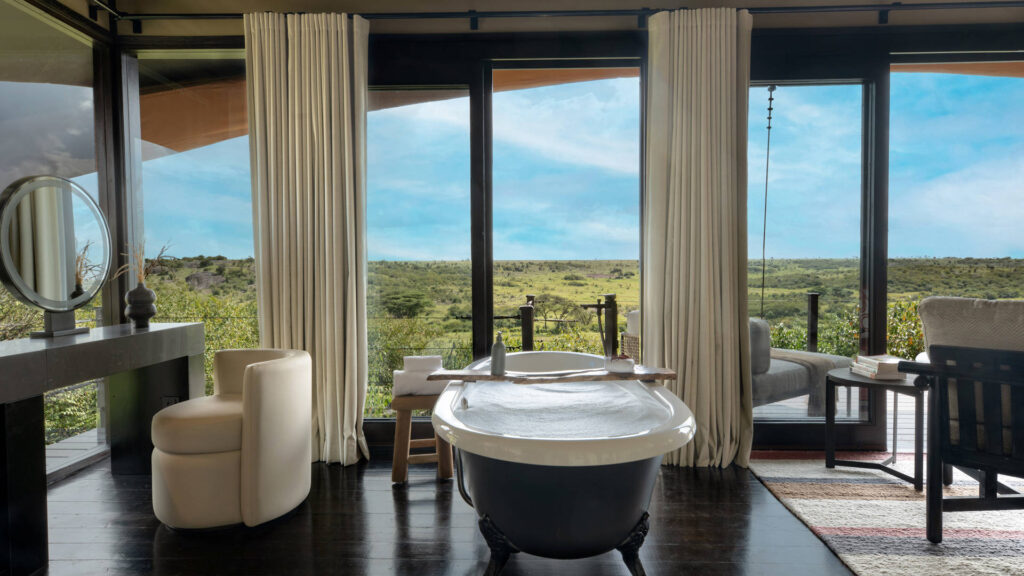
Mahali Mzuri reopened in June 2025 after its first full interior refurbishment. The 12 tented suites retain their original architectural skeleton, steel-frame structures designed by Real Studios in 2013, inspired by the shape of Maasai shields, anchored into the hillside with concrete footings and seven-metre centre poles, but the interiors have been entirely reconceived by Lynne Hunt London.
The result is a contemporary African aesthetic: earthy tones, natural materials, floor-to-ceiling windows, and private terraces with panoramic views across the conservancy plain. Each suite has a king or twin configuration, a lounge area, a separate walk-in shower, and a freestanding bathtub positioned to overlook the valley. The family tent adds a second bathroom and convertible sofa beds. Contemporary artworks by East African artists — Theresa Musoke, Dickens Otieno, and others curated by Circle Art Gallery – are installed throughout. Maasai beadwork accents, created in collaboration with The Maa Trust, appear in the soft furnishings.
The communal areas follow the same logic. The dining tent, bar, and lounge surround an open firepit. A 12-metre heated infinity pool overlooks the migration corridor, now with cabanas in red and black textiles referencing traditional Maasai dress.
Here is the honest assessment. The tents are stylish, but they are not enormous. The canvas interiors are smaller than the architectural frames suggest, and the open-plan layout means privacy between sleeping and bathing areas is limited by tent walls, not solid partitions. The camp runs on a solar farm supplemented by generator, and power is typically off for several hours during the night.
If you are expecting a safari villa with enclosed rooms and 24-hour climate control, you will be disappointed. What you get instead is a tent that functions as a viewing blind: floor-to-ceiling glass that frames the valley, a deck where elephant and giraffe move through at eye level, and a bathroom where you can watch the light change on the escarpment while soaking in a tub. The design prioritises the view over enclosure. That is the correct choice for this location, but it is a choice you should understand before booking.
The Math of Exclusivity: What 12 Tents Enable
There are five camps in Olare Motorogi. The maximum bed count across all of them is 94. Mahali Mzuri accounts for roughly 24 of those beds. This means that at full capacity- which rarely occurs outside peak migration season- there are still fewer guest beds in the entire 33,000-acre conservancy than in a single wing of a mid-sized hotel in Nairobi.
The arithmetic translates directly into behaviour. In the Maasai Mara National Reserve, vehicle numbers at a sighting are unlimited. During July and August, a single leopard in a sausage tree can attract 15–25 vehicles. In Olare Motorogi, the same sighting would have three, perhaps four, and they would be required to position without blocking each other or pressuring the animal.
This is what access actually means in a Mara conservancy: your guide can follow the cheetah through the long grass until it stops, without asking permission, without waiting for other vehicles to clear. You move when the animal moves. You stop when it stops. This is not a luxury add-on. It is the fundamental difference between a safari and a guided tour of wildlife.
The off-road permit is equally significant. In the national reserve, vehicles must stay on designated tracks. If a leopard retreats into thick bush 200 metres from the road, reserve guests watch it leave. In Olare Motorogi, your guide can drive to the edge of the thicket, reposition for light and angle, and wait. Night drives extend this access into the hours when lions hunt, leopards call, and aardvarks emerge. The reserve goes silent at dusk. The conservancy does not.
Walking safaris complete the picture. With an armed, KPSGA-certified guide, you leave the vehicle and read the landscape at ground level: dung analysis, track identification, bird alarm calls, wind direction. This is not a nature stroll. It is a different relationship with the terrain- one that the reserve regulations prohibit entirely.
The Guiding Difference
Mahali Mzuri employs a field guide team that includes silver-certified Kenya Professional Safari Guides Association (KPSGA) guides.
This matters because KPSGA certification is not decorative. Silver-level guides have passed written and practical examinations in ecology, animal behaviour, conservation, and guest safety, and have accumulated substantial field hours. In a conservancy where individual lions are research-catalogued, a guide who can identify the resident Olare Pride male by scar pattern and family history is providing a categorically different experience from one who can only name the species.
The conservancy’s relationship with the Tony Lapham Mara Predator Hub means that guide knowledge is reinforced by ongoing research. The Mara Lion Project and Mara Cheetah Project operate within Olare Motorogi, producing individual identification records that filter down to camp level.
When your guide tells you that the cheetah you are watching is part of a territorial female who raised a litter in the Motorogi plains last season, that information is not generic patter. It is field intelligence.
The Maasai guides employed by the camp bring a separate layer of knowledge. Over 80% of Mahali Mzuri’s staff come from surrounding Maasai villages, and many guides have family histories on this specific land stretching back generations.
Their ability to read subtle signs in the bush, the particular posture of a dik-dik that indicates leopard presence, the alarm call sequence that distinguishes martial eagle from crowned eagle, is not learned from a manual. It is inherited and refined.
This is what intimacy means in practice: not a scripted cultural performance, but a guide who knows the individual animals, the individual landowners, and the individual valleys well enough to adjust the day’s route based on wind direction, recent kills, and the social dynamics of four separate lion prides.
The Honest Trade-Offs
No property is the right choice for every traveller, and Mahali Mzuri has specific limitations that should determine whether it belongs in your itinerary.
You will not see the great Mara River crossings from the conservancy. The Ntiakitiak River provides secondary crossing points during high migration flow, and wildebeest columns do pass through Olare Motorogi between July and September. But the dramatic, churning, crocodile-laden spectacle that defines the migration in documentary footage happens further south, in the national reserve proper. If your primary goal is to witness a major river crossing, you will need to drive into the reserve- a day trip that incurs additional park fees (currently $100–$200 per person per day depending on season) and exposes you to the vehicle crowds you came to the conservancy to avoid.
The price is substantial. Peak-season rates run from approximately from $3,400 per person per night, all-inclusive. Green season rates drop to around $2400 per person per night.
For a five-night stay in August, you are looking at $15,000+ in accommodation alone, before international flights, internal charters, and reserve day-trip fees. This is not a value proposition. It is an exclusivity proposition. If your budget is tight, the same conservancy offers comparable wildlife access at Porini Lion Camp for significantly less – though without the pool, the spa, and the Branson association.
The camp is polished. The June 2025 refurbishment leans into contemporary African luxury: curated art, designer textiles, infinity pool cabanas. For some experienced safari travellers, this level of finish risks feeling closer to a boutique resort than to the raw bush experience they seek. The tents are beautiful, but they are unmistakably designed. If your ideal safari camp has frayed canvas, shared bucket showers, and a sense of improvisation, Mahali Mzuri will feel overproduced.
Electricity is limited overnight. The solar farm and generator configuration means power is typically off for several hours after midnight.
This is standard for remote camps, but if you require CPAP machines, continuous charging, or climate control through the night, you need to discuss this with the camp in advance.
When to Go and What It Actually Costs
Olare Motorogi performs well in every season, but the experience changes significantly.
July–September (Peak Migration): The wildebeest herds move through the conservancy, lion activity peaks, and the camp is at its most expensive — from $3,900 per person per night. This is also when the national reserve is at its most crowded, making the conservancy’s vehicle limits most valuable. The trade-off is that you are paying maximum rates for a migration spectacle you will partially have to leave the conservancy to see in its most dramatic form.
January–March (Dry Shoulder): Excellent predator sightings, fewer visitors, lower rates. The resident lion prides are active, the grass is shorter, and the conservancy feels emptier. This is the season for travellers who prioritise cat encounters over migration spectacle.
April–June (Green Season): Lowest rates, from approximately $2,400 per person per night. The landscape is lush, birdlife is exceptional, and predator sightings remain strong. Some roads become difficult after heavy rain, but the conservancy’s low vehicle density means you are not competing for position. This is the best-value window for travellers who can tolerate afternoon showers.
October–December (Short Rains): Post-migration, moderate rates, good resident wildlife. A strong secondary option for travellers who cannot manage the peak-season premium.
What the rate includes: All meals, all beverages (standard spirits, wine, beer), twice-daily game drives on the conservancy, transfers from Olare Orok airstrip, laundry service, and all taxes and conservancy levies.
What it does not include: Hot air balloon safaris, day trips into the Maasai Mara National Reserve (park fees separate), spa treatments, premium spirits, curio shop purchases, and voluntary community donations.
Access is via Wilson Airport in Nairobi to Olare Orok Airstrip (OLG) or Mara North Airstrip (HKR), followed by a short game-drive transfer to camp. Road access from Nairobi takes approximately five hours and is only advisable for travellers who view the transfer as part of the experience.

Conservation, Community, and What Your Money Supports
Mahali Mzuri’s community model is integrated, not appended. The camp operates under the Olare Motorogi lease structure, in which Maasai landowners receive stable monthly payments regardless of occupancy, retain ownership of their land, and benefit from employment priority. The camp employs over 80% of its staff from surrounding Maasai villages.
The camp’s charitable arm, Inua Jamii (“uplifting the community”), channels guest donations into specific projects. The most significant is the Enkenju–Enkoirien Primary School, located approximately 4 kilometres from camp, which has been built and funded through guest contributions and currently supports over 100 pupils.
The camp is also a member of Pack for a Purpose, allowing guests to bring school supplies and medical items directly.
Operationally, the camp runs on a solar farm that provides up to 100% of energy needs, harvests rainwater, and maintains a kitchen garden and greenhouse that supplies the kitchen with organic produce.
Staff uniforms are produced by Kenyan heritage brand Kikoromeo using biodegradable materials. The Maa Trust supplies beadwork for the interiors, creating a direct revenue stream for Maasai women artisans.
This is not greenwashing. The conservancy model itself- lease payments, employment, no fences between the conservancy and the reserve- is the conservation mechanism. The camp’s existence is the intervention. Without the revenue from those 12 tents, the land would likely revert to grazing and subdivision, and the lion density that makes Olare Motorogi exceptional would decline.
Rarely Mentioned but Highly Rated: Two Alternatives in the Same Conservancy
If Mahali Mzuri’s price point or polish does not suit you, Olare Motorogi offers two properties that deliver the same wildlife access with different trade-offs.
Porini Lion Camp operates ten tents on the banks of the Ntiakitiak River, positioned specifically to maximise proximity to the Marsh Pride territory. It is operated by Gamewatchers Safaris, which helped establish the conservancy model in the Mara, and the camp’s conservation credentials are embedded in its founding mission. It is undermarketed because it does not invest in international lifestyle media, does not carry a global brand association, and is booked primarily through specialist safari operators and word-of-mouth. There is no spa, no infinity pool, and no designer refurbishment. What you get instead is a lower nightly rate, a smaller footprint, and guides with comparable individual-level predator knowledge built over years in the same territory.
Kicheche Bush Camp is the smallest and least publicised of the five Olare Motorogi camps. It is owner-managed, not part of a hospitality group, and does not appear on most international booking platforms. Its undermarketing is structural: the owners rely on repeat guests and photographic safari specialists rather than travel magazine coverage. The guiding is photography-focused, the camp is intimate, and the rates sit between Porini and Mahali Mzuri. It is the choice for travellers who want conservancy access without either the luxury premium or the absolute simplicity of Porini.
What to Ask Before You Book
If you are considering Mahali Mzuri, the following questions will help you determine whether the property aligns with your priorities:
- Which specific guide will be assigned to my stay, and what is their KPSGA certification level and conservancy tenure? Guide quality varies more than camp quality in the Mara.
- What is the current lion pride territory distribution, and how does that affect the recommended season for my dates? The answer should be specific, not generic.
- If I want to see a Mara River crossing, what is the realistic vehicle time to the reserve, and what park fees apply on top of my all-inclusive rate?
- What is the camp’s current solar/generator schedule, and will my tent have continuous overnight power?
- Can the camp arrange a walking safari on my first full day, or only after a game drive assessment? Conservancy walking protocols vary.
THE BOTTOM LINE
Book Mahali Mzuri if you specifically want Olare Motorogi's conservancy access combined with the design-led luxury hospitality wrapper and the Virgin Limited Edition operational standard. The strongest single recommendation for travellers building a Mara trip is to combine — 3 nights at Mahali Mzuri for the conservancy plus design, 2 nights at a different Mara property or a different ecosystem entirely, produces a richer trip than 7 nights at any single property including this one.
Related Reading
Olare Motorogi Conservancy: Inside the Mara’s Highest Lion Density
The Complete Guide to Mara Conservancy Accommodation
Tell us what you are looking for, and we will tell you honestly whether we can deliver it — and if we cannot, we will tell you who can.