

Africa’s most dramatic wildlife spectacle — and the one travellers most often plan wrong. Where the crossings actually happen, when your odds are best, why no one can guarantee one, and how camp position and the reserve-versus-conservancy choice change everything.
The spectacle, and the planning mistake
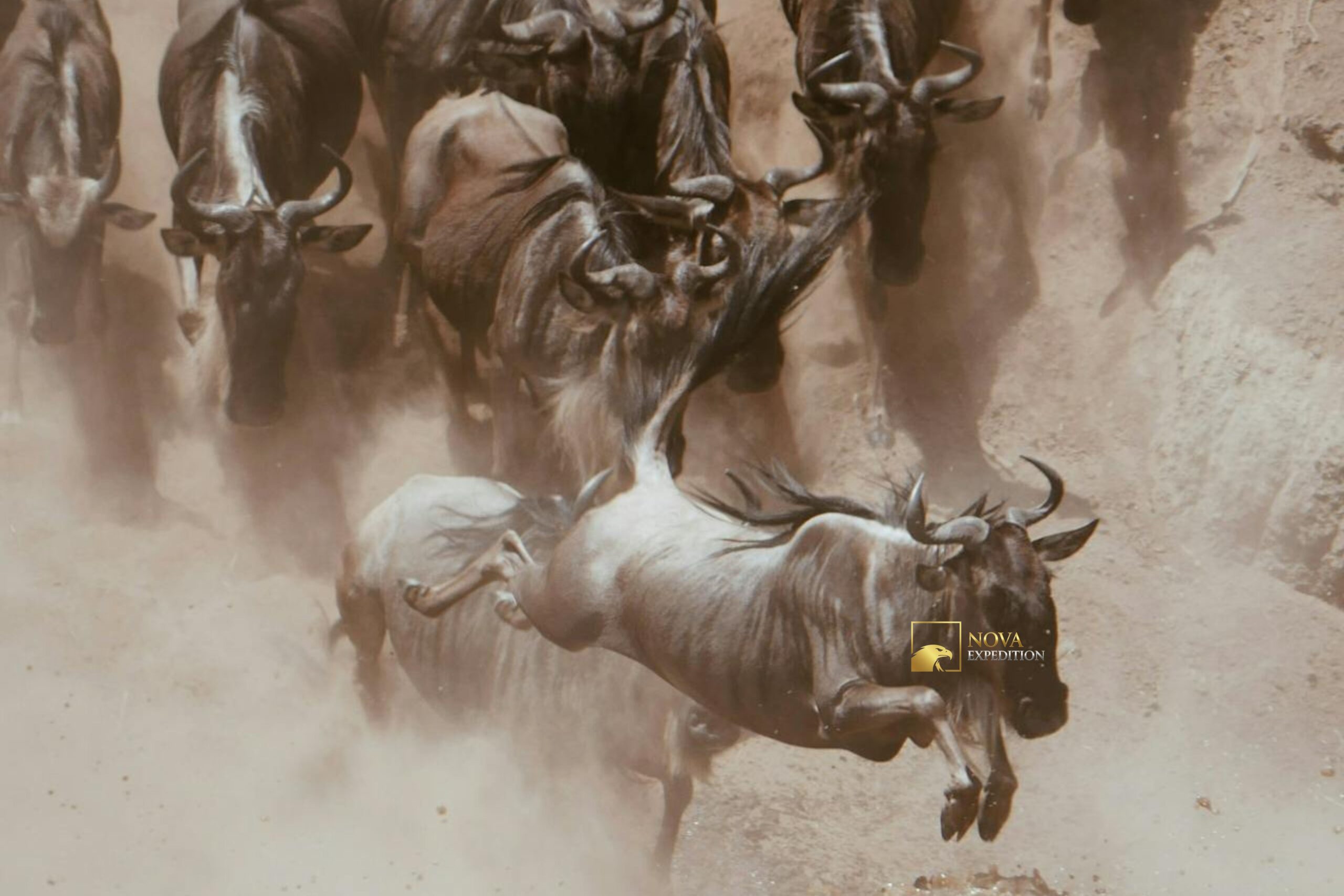
The Mara River crossing is one of Africa’s most dramatic wildlife spectacles, and the reputation is fully deserved. When large herds of wildebeest mass at the river’s edge, hesitate, surge forward, and plunge into crocodile-filled water, the scene feels almost unreal — powerful, chaotic, and unforgettable. It is the image that sells more Kenya safaris than any other, the moment every migration traveller pictures before they book.
And it is the moment travellers most often plan wrong. The single biggest mistake is believing a river crossing can be scheduled with precision — booked, like a performance, for a particular morning at a particular spot. It cannot. The wildebeest do not follow a human timetable.
Herds gather at a crossing point and then do nothing for hours; they approach repeatedly, panic, split, and turn back; they cross suddenly after long inactivity, or move overnight when no vehicle is there to see it. Understanding this is not a disappointment to manage — it is the first step to planning the trip correctly, because once you stop chasing a mythical exact date you can focus on the things that genuinely improve your odds.
This guide does both halves of the job. It tells the honest truth about timing and predictability, which is the part most marketing skips. And it gives the concrete detail most honest articles skip in turn: where the crossings actually happen (named locations, on both sides of the border), how camp position and the reserve-versus-conservancy choice change your access, what a crossing day really looks like, and how to set your expectations so the safari delivers whether or not the iconic plunge happens in front of you.
You cannot book a crossing like a ticket — but you can stack the odds heavily in your favour. Travel in the right window, choose a camp positioned for crossing access, stay enough nights, and work with a guide who reads herd pressure honestly. Then let the river do what it will. The travellers who plan this way see the most and enjoy it most.
| BEST OVERALL WINDOW July to late September; August often the standout month | NORTHBOUND CROSSINGS Serengeti → Mara, roughly July-October |
| RETURN (SOUTHBOUND) CROSSINGS Mara → Serengeti, roughly late October-November | MAIN KENYA CROSSING POINTS Lookout, Paradise, Serena (Triangle), Sand River, Talek |
| CONSERVANCY CROSSING ACCESS Kichwa Tembo crossing (Mara North) — bypasses reserve queues | MINIMUM NIGHTS FOR GOOD ODDS 3 nights; 4+ strongly preferred |
| CAN A CROSSING BE GUARANTEED? No — no ethical operator promises one on a given day | SAME RIVER, TWO COUNTRIES Crossings occur in northern Serengeti too (Kogatende/Lamai) |
What travellers misunderstand about crossings
Many travellers search for exact crossing dates, specific hours, or ‘secret’ guaranteed locations, and it is entirely understandable — the crossing is marketed as the headline event of a Great Migration safari, so it feels like something that should be bookable. But the herds respond to rainfall, grazing pressure, instinct, and the simple physics of pressure building from the animals behind them. A crossing happens when the accumulated tension at the bank tips over, and that tipping point is genuinely unpredictable on any given day.
Here is what an honest day at a crossing point can look like. Several thousand wildebeest gather on the bank from mid-morning. They mill, they call, they edge toward the water and retreat. A single animal commits, then loses nerve. The herd builds, disperses, rebuilds. By mid-afternoon they may pour across in a ten-minute torrent of dust and water and crocodiles — or they may simply drift away to graze and cross at dusk, or the next morning, or two valleys upstream where no one is watching. The most authoritative advice is therefore not the most dramatic. It is the most truthful: you can improve your odds substantially, but you cannot guarantee the moment.
This is also why the crossing should never be the sole measure of a migration safari’s success. The travellers who fixate on the river plunge as a pass-or-fail checklist item are frequently the least satisfied, because they discount everything else the season offers. The travellers who plan for strong odds and then stay open to whatever the ecosystem delivers almost always come away with more — including, often, the crossing itself, precisely because they gave it enough time and didn’t give up after one quiet afternoon.
When do Mara River crossings happen?
In broad seasonal terms, the migration herds move into the Maasai Mara from roughly July, with river-crossing activity strongest from mid-July through late September. August is frequently regarded as the single strongest month for the most reliable overall migration energy and the highest day-to-day probability of witnessing a crossing during a multi-night stay. September remains excellent and is often slightly less crowded than peak August.
Two important nuances the simple ‘go in August’ advice misses. First, the crossings are continuous and rainfall-driven, not calendar-driven — in some years the main movement arrives earlier, later, or in a more fragmented pattern, and weather across the wider Serengeti-Mara ecosystem influences everything. There is no date on which a crossing is assured. Second, there are two directions of crossing.
The famous northbound crossings (Serengeti into the Mara) run roughly July to October; the return southbound crossings (Mara back toward the Serengeti) happen roughly late October into November as the short rains begin to pull the herds south again. The return crossings are less marketed, less crowded, and can be just as dramatic — worth knowing for travellers whose dates fall outside peak season.
THE HONEST TIMING SUMMARY Aim for mid-July to late September for the best northbound-crossing odds, with August the strongest single month. Accept that no day is guaranteed. If your dates fall in late October or November, the southbound return crossings are a genuine and far less crowded alternative. And remember the same river runs through northern Serengeti — a 'Mara River crossing' can be witnessed on the Tanzania side too.
Where the crossings actually happen — the named locations
Most honest articles about crossing unpredictability never tell you where to actually go. Here are the real locations. None of them guarantees a crossing — herds choose their points by instinct and conditions, and may favour different spots in different years — but these are where crossings concentrate, and knowing them lets you have an informed conversation with your operator about camp positioning.
On the Kenya side — the Maasai Mara
Inside the national reserve, the principal crossing zones are the Lookout (or Lookout Hill) crossing, which sits on high ground giving a clear elevated view of herds gathering and plunging; Paradise Plains, the most photographed and documentary-filmed crossing, set in open terrain that makes the action easy to see and capture; the Serena crossing on the Mara Triangle side near Serena Lodge, often cited as one of the single most active crossing points and serving guests in both the central reserve and the Triangle; and the Sand River crossing in the southeast near the Tanzania border, where herds entering from the eastern Serengeti routes often cross. The Talek River area also sees crossing activity on the Mara’s tributary system.
In the conservancies, the most relevant is the Kichwa Tembo crossing area associated with Mara North Conservancy. This matters enormously for the experience, as the next section explains: conservancy camps can reach crossing points via private tracks that bypass the reserve’s vehicle queues entirely.
On the Tanzania side — northern Serengeti
This is the detail that catches travellers out: the Mara River runs through the northern Serengeti before it reaches Kenya, and dramatic crossings happen on the Tanzania side too, concentrated in the Kogatende and Lamai Wedge areas. The Serengeti’s crossing points are conventionally numbered, with several being especially active. A traveller booking a ‘Mara River crossing’ safari should be clear which country they will be in — both deliver the spectacle on the same river, but the logistics, costs, and camp options differ. Travellers weighing the two sides should see the companion article on Maasai Mara versus Serengeti for the fuller comparison.
Why camp position changes everything
One of the least discussed but most important booking factors is where your camp sits. Not all camps described as being ‘in the Maasai Mara’ are equally placed for crossing logistics. Some properties have fast access to the key crossing zones; others require long transfer drives, meaning you may arrive after the decisive moment or burn most of the day getting there and back. Knowledgeable planners talk about crossing access, not just reserve access — and if witnessing a crossing is a top priority, camp choice should reflect that from the very first decision rather than being an afterthought.
There are two layers to this.
The first is simple proximity: a camp near the Mara River and its main crossing points puts you within striking distance when herd pressure builds, which is exactly when you want to be minutes away rather than two hours.
The second layer is the structural one, and it is the single most useful thing this guide can tell you: the reserve-versus-conservancy choice fundamentally changes your crossing experience, not just your wider safari.
The reserve crossing reality — and the conservancy alternative
The famous crossing points (Lookout, Paradise, Serena, Sand River) are inside the national reserve. That is where the herds cross, and to sit at those points you are in the reserve, subject to its rules and its crowds. At peak season a single building crossing can draw dozens of vehicles to one bank — a wall of engines and lenses that is itself part of why the herds sometimes baulk. There is no vehicle cap in the reserve. This is the trade-off of the headline crossings: you are at the real thing, but rarely alone with it.
Mara North Conservancy camps offer a partial way around this. They hold private-track access to crossing points along their stretch of the river, allowing guests to reach crossing locations via routes that bypass the reserve road network and its queues. You may still cross into the reserve for the major crossing points when herd intelligence suggests it, but you have the option of quieter conservancy crossings and uncrowded approaches that reserve-only guests cannot use.
For travellers who want the crossing spectacle without the full reserve scrum, a Mara North conservancy camp is the structurally smartest base — combining private-track crossing access with the conservancy’s night drives, walking safaris, and off-road freedom. The companion articles on private conservancy versus national reserve and on the best Mara lodges cover the specific camps.
Why you need multiple nights
If a crossing is high on your wishlist, a one- or two-night stop is simply too optimistic. A herd can build pressure at a bank for days before committing, and it can cross while you happen to be in another sector of the reserve. The mathematics of probability are unforgiving here: each day in the right area is a roll of the dice, and one or two rolls is not enough when the outcome is genuinely uncertain. Staying at least three nights, and ideally four or more, gives you the repeat attempts and the flexibility that changing conditions demand.
This is where intelligent planning beats wishful thinking. The way to be there at the right moment is not to chase a mythical exact date — it is to create a time window wide enough that nature has room to happen within it. Three nights gives you perhaps four or five game-drive sessions at or near crossing points; four or five nights gives you the genuine flexibility to follow herd pressure across days, reposition when your guide reads building tension, and absorb a quiet afternoon without it costing you the whole trip. Longer stays do not just improve crossing odds arithmetically; they let you safari intelligently rather than desperately.
What a strong crossing strategy looks like
A strong strategy assembles four controllable factors and then accepts that the fifth — the crossing itself — is not controllable.
- First, the right season: mid-July to late September for northbound crossings, August strongest.
- Second, a well-positioned camp: near the river, and ideally a Mara North conservancy camp for private-track access plus the conservancy activity range.
- Third, enough nights: three minimum, four or more if the crossing is a genuine priority.
- Fourth, a guide with current local awareness — someone tracking recent herd movement who will commit time to likely crossing points when conditions suggest tension is building, rather than running a generic loop.
- The fifth factor is patience, and it is where many travellers undermine their own odds. They mistake waiting for failure and leave a crossing point an hour before the herds finally commit.
On migration safaris, waiting is not dead time — it is the activity. The herds gathering, the tension building, the false starts, the predators positioning on the banks: this is the spectacle unfolding, and the plunge is its climax rather than its entirety. A guide who knows the signs will tell you when a build looks promising enough to hold position; trusting that judgment, and bringing the patience to act on it, is what separates the travellers who see crossings from those who narrowly miss them.
The drama on the bank — crocodiles, predators, and the leap
Understanding what you are watching deepens the experience. The Mara River holds some of Africa’s largest Nile crocodiles, animals that have learned the migration’s rhythm over generations and position themselves at the established crossing points to intercept the herds. The crossings are genuinely dangerous for the wildebeest: the steep, often muddy banks, the fast current, the crush of bodies, and the crocodiles combine to make every crossing a real gamble for the animals. Drownings and crocodile predation are part of the spectacle, and it can be confronting — this is raw survival, not a choreographed show.
The danger is not only in the water. Lions and other predators learn the crossing points too, waiting in the bankside vegetation for animals that make it across exhausted and disoriented. The result is that a crossing point in full flow can deliver several layers of drama at once — the plunge, the current, the crocodiles, the predators on the far bank, the dust and noise and chaos of thousands of animals committing to the same desperate gamble.
This is why open crossing points like Paradise Plains are so prized for photography: you can sometimes capture wildebeest, crocodiles, and waiting predators in a single frame. It is also why the experience moves people in a way few wildlife sightings do; it is nature at its most elemental.
How to be ready when it happens
Practical preparation improves both your odds and your photographs when a crossing does occur. The crossing-day approach that works:
- Be out at first light. Herds often build pressure through the morning, and being positioned early means you are there when tension is rising rather than racing to catch up. Crossings can happen at any hour, but a guide reading the morning’s mood is your best early signal.
- Trust your guide’s positioning call. When a guide judges that a build looks promising, holding position — sometimes for hours — is the price of admission. Repositioning constantly to chase rumours of activity elsewhere often means missing the crossing that finally happens where you were.
- Have your camera ready before it starts. Crossings can erupt in seconds and end in minutes. Long lens on, settings dialled for fast action, plenty of memory and battery. The first commit is sudden; you will not have time to fumble with gear.
- Bring patience and provisions. A full day near a crossing point means food, water, sun protection, and the mental readiness to wait. Many camps pack breakfast and lunch boxes for exactly this. Treat the wait as the experience, not as time wasted.
- Manage your expectations daily. Some days the herds will not cross where you are, or at all. Approaching each day as a strong possibility rather than a promise keeps the experience joyful rather than anxious — and the relaxed travellers genuinely seem to have the better trips.
Frequently asked questions
When do Mara River crossings happen?
The strongest window for northbound crossings (Serengeti into the Mara) is roughly mid-July to late September, with August often considered the single best month for overall migration energy and crossing probability. Return southbound crossings happen roughly late October into November. The crossings are rainfall-driven and continuous rather than fixed to the calendar, so timing shifts year to year and no specific date is ever guaranteed.
Can you guarantee a Mara River crossing?
No. No ethical operator can guarantee a crossing on a specific day or time. The herds respond to rainfall, grazing, instinct, and pressure from behind, and they cross when accumulated tension tips over — which is genuinely unpredictable. You can substantially improve your odds with the right season, camp position, and length of stay, but anyone promising a guaranteed crossing on a given date is either misinformed or overselling.
How many nights should I stay for the best chance?
At least three nights, and preferably four or more if a crossing is a major priority. A herd can build pressure for days before crossing, and it can cross while you are in a different sector. More nights mean more game-drive sessions at crossing points and the flexibility to follow building herd pressure across days rather than gambling everything on a single afternoon.
Where are the best places to see the crossing?
On the Kenya side, the main reserve crossing points are Lookout, Paradise Plains (the most famous and photogenic), the Serena crossing on the Mara Triangle side, and Sand River in the southeast. Mara North Conservancy offers private-track access to crossing points that bypasses the reserve crowds. On the Tanzania side, the same Mara River is crossed in the northern Serengeti (Kogatende and Lamai areas). Herds choose their points by instinct, so no single location guarantees a crossing.
Is camp location important for seeing crossings?
Critically important. Some camps are far better placed than others for quick access to crossing points, and a long transfer drive can mean arriving after the decisive moment. Beyond proximity, the reserve-versus-conservancy choice matters: the famous crossing points are inside the reserve (with its crowds and no vehicle cap), while Mara North conservancy camps have private-track access that bypasses the queues. For crossing-focused trips, a well-positioned conservancy camp is usually the smartest base.
What if I do not see a crossing?
You can still have an exceptional migration safari. During crossing season the Mara holds vast columns of wildebeest, intense predator activity around the herds, dramatic dust-and-light scenes, and exceptionally high plains-game density — a richer wildlife experience than almost any other time of year, even if the iconic river plunge does not happen in front of you. The travellers who plan for strong odds but stay open to the wider spectacle are consistently the most satisfied.
Do crossings happen in Tanzania too?
Yes. The Mara River runs through the northern Serengeti before entering Kenya, and dramatic crossings occur on the Tanzania side, concentrated in the Kogatende and Lamai Wedge areas, broadly during the same July-October window. A ‘Mara River crossing’ can therefore be witnessed in either country. The choice between the Kenyan Mara and the northern Serengeti comes down to wider itinerary, cost, and crowd preferences — covered in the Maasai Mara versus Serengeti comparison.
Honest limits to this guide
Two honest caveats.
First, everything here improves odds rather than delivering certainty — the central, unavoidable truth of river-crossing travel is that the spectacle cannot be scheduled, and any guide who tells you otherwise is not being straight with you.
Second, crossing points and herd routes shift year to year with rainfall and conditions; the named locations here are where crossings concentrate based on established patterns, not a promise that the herds will use them on your dates. The most reliable approach is not a fixed plan but a flexible window built on the controllable factors — season, camp position, length of stay, and an honest, locally-aware guide — combined with the patience to let the river do what it will.
OUR HONEST VIEW To be in the right place at the right time for a Mara River crossing, focus on what you can actually control: travel mid-July to late September (August strongest), base yourself at a well-positioned camp — ideally a Mara North conservancy camp for private-track crossing access plus the full conservancy activity range — stay at least three nights and preferably four or more, and work with an operator who speaks honestly about probability rather than certainty. Then let the ecosystem do what it will. Paradoxically, the travellers who plan this way and hold their expectations lightly are the ones who see the most and enjoy it most.
Who this guide is for, and who should look elsewhere
Travellers building a migration safari around the river crossing — this guide gives you the honest timing, the named locations, the camp-positioning logic, and the realistic expectations to plan well. Pair it with the Great Migration complete guide for the full ecosystem-wide picture across the whole year.
Travellers weighing Kenya against Tanzania for the crossing — both deliver the spectacle on the same river. The Maasai Mara versus Serengeti comparison covers the wider trade-offs in cost, crowds, and itinerary.
Travellers choosing where to stay for crossing access — the reserve-versus-conservancy decision is the key one, and the best-Mara-lodges and seven-best-conservancies guides cover the specific camps with private-track crossing access.
Travellers who want a guaranteed crossing on fixed dates — no honest guide can offer that, and this article will not pretend otherwise. If certainty is non-negotiable, the migration safari may frustrate you; if you can embrace strong odds and genuine wildness, it will likely be the most extraordinary wildlife experience of your life.
Tell us what you are looking for, and we will tell you honestly whether we can deliver it — and if we cannot, we will tell you who can.
RELATED READING
- The Great Migration complete guide: the full year-round picture this crossing sits within
- Maasai Mara vs Serengeti: which side of the river is right for you
- Private conservancy vs national reserve: the crossing-access decision explained
- Best lodges in the Maasai Mara 2026: camps positioned for crossing access
- Best time to visit Kenya: how the migration window fits the wider calendar