
One of Africa’s most cited conservation success stories — examined honestly. The Mara’s lion recovery is real and important. But the headline statistics deserve more scrutiny than safari marketing usually gives them, and the truth is more interesting than the slogans.
The story you’ve heard, and the story worth telling
The version of this story that appears on safari websites runs roughly as follows: in 1961, there were only nine lions left in the Maasai Mara. Today, thanks to the community conservancy movement, lion numbers have tripled in a decade and the conservancies now hold higher lion densities than the national reserve itself. It is a stirring narrative of community-led conservation triumph, and it is repeated almost verbatim across the industry.
Most of it is true in spirit. Some of it does not survive close examination. And the honest version — the one this article tells — is actually more interesting than the slogan, because it reveals how a genuine conservation success was built, what the real mechanisms were, and where the evidence is strong versus where it has been smoothed into marketing. The Mara’s lion recovery is one of the most important conservation stories in Africa. It deserves to be told accurately rather than reduced to a set of impressive-sounding numbers whose sources few people have ever checked.
This- How Conservancies Saved the Mara’s Lions- guide works through what actually happened: why Maasai communities were killing lions and why that was rational rather than savage, how the conservancy lease model changed the economics, what the lion-recovery evidence genuinely shows (including where the most-cited statistics come from and how much weight they can bear), and what it all means for a visitor deciding where to stay. Where a number is well-evidenced, this article says so. Where a number is widely repeated but weakly sourced, this article says that too.
The conservancy model genuinely transformed lion conservation in the Mara. The mechanism — making wildlife economically valuable to the people who live alongside it — is real, documented, and replicable. But the specific headline statistics range from solidly evidenced to safari-lore, and an honest account distinguishes between them rather than repeating them all with equal confidence.
| RESERVE ESTABLISHED 1961 (as a 520 km² sanctuary, expanded the same year) | “NINE LIONS IN 1961” Widely repeated in safari accounts; no primary census on record |
| GREATER MARA LIONS TODAY ~850-900 (Mara Predator Conservation Programme, 2022) | ECOSYSTEM-WIDE DENSITY ~16.85 lions/100km² (Elliot & Gopalaswamy, Conservation Biology 2016) |
| CONSERVANCY VS RESERVE DENSITY Comparable to or higher than reserve (sources vary — see below) | MMWCA FIGURE Lion density 14% higher in conservancies (MMWCA/Equator Initiative) |
| LAND UNDER CONSERVATION Grew from 33% to 64% of ecosystem since MMWCA formed | CONSERVANCY LEASE MODEL Monthly payments to Maasai landowners create protection incentive |
Why Maasai were killing lions — version
The framing of lion conservation in Africa has historically been colonial in its structure: external conservationists designating protected areas, local people excluded from those areas, and the people who lived with lions treated as the problem to be managed. This framing fundamentally misunderstood the dynamics involved, and the misunderstanding made conservation harder rather than easier.
The Maasai did not kill lions out of cultural bloodlust, as early colonial accounts often suggested. They killed lions for a precise rational reason: lions killed cattle, and cattle were the primary store of wealth, food security, and social capital for Maasai families. When a lion killed a cow, it destroyed a piece of family capital equivalent to several months of income. When lions killed repeatedly, with no compensation and no economic benefit from their continued survival, rational households killed the lions. This was not savagery. It was basic economic logic operating in the absence of any countervailing incentive.
The traditional Maasai relationship with lions was more complex than either the bloodlust caricature or the noble-coexistence romance suggests. The olamayio — the ceremonial lion hunt through which young warriors (morans) demonstrated courage and status — was a real cultural institution, but it was bounded by rules and was never the primary driver of lion mortality. The larger driver, particularly through the 20th century, was retaliatory and preventive killing of lions that threatened livestock, frequently by poisoning, which kills indiscriminately and can wipe out entire prides plus the scavengers that feed on the carcasses.
The national reserve model, established in 1961, made the underlying tension worse in some respects. By designating land as protected, it excluded Maasai from grazing areas they had historically managed and used. The reserve generated revenue from tourism, but that revenue flowed to the Narok County Council and to tour operators, not to the Maasai communities who lived alongside the wildlife and bore the costs of its predation. The result was a community with every incentive to undermine conservation and none to support it. The wildlife inside the reserve was protected; the wildlife outside it, on community land, had no economic value to the people who controlled that land.
FROM THE FIELD “People who receive rent from the conservancy want lions in the area because this is what the tourists come to see the most. This means more money will be received through tourism.” — A Maasai guide and conservancy landowner in the Koiyaki area describing, in plain economic terms, how the lease model changed the incentive structure that had previously made lion-killing rational.
The “nine lions in 1961” claim — what the evidence actually shows
The story’s most dramatic statistic deserves direct scrutiny, because it is repeated everywhere and verified almost nowhere. The claim that only nine lions remained in the Mara in 1961 appears across safari operator websites, but it traces to industry accounts rather than to any documented scientific census. The Maasai Mara was only established as a protected area in 1961; there was no systematic lion survey at that moment that would have produced a precise figure of nine. The number should be treated as safari lore — possibly rooted in a real observation of severe local depletion, but not a citable census result.
What is better evidenced is the broader trajectory. Lion populations across the Mara ecosystem were severely depleted by the mid-20th century through hunting and retaliatory killing, recovered partially under reserve protection, and then expanded again as the conservancy model brought community land into the protected system from the mid-2000s onward. The honest framing is directional rather than precise: lions were severely depleted, conservation reversed the decline, and the conservancy movement extended the recovery onto community land. The exact starting number is not the point; the trajectory and its mechanism are.
Similarly, the claim that conservancy programmes have ‘almost tripled lion numbers in ten years’ is widely repeated but should be read as an approximate, conservancy-specific figure rather than an ecosystem-wide audited statistic. Lion populations in specific well-managed conservancies have grown substantially over the past two decades. Whether the precise multiple is ‘tripled’ or some other figure depends entirely on which areas, which baseline year, and which counting methodology — and the published peer-reviewed work is more careful about these qualifications than the marketing summaries are.
The conservancy model — how it actually works
The Mara conservancy system was built on a single foundational insight: if Maasai landowners could receive regular income from wildlife tourism on their land, they would have a financial incentive to protect rather than eliminate wildlife. The mechanism was a land lease. Tour operators would lease land from Maasai families, pay a regular fee per acre, and operate safari camps exclusively for their guests. The Maasai would receive predictable cash income without having to participate directly in the tourism industry, and the wildlife on their land would shift from being a liability to being an asset.
The first Mara conservancies were established in the mid-2000s, with Ol Kinyei (2005) often cited as the first fully community-owned example. The model spread rapidly. The Maasai Mara Wildlife Conservancies Association (MMWCA), the umbrella body that now coordinates the conservancies, reports that since its formation the share of the ecosystem under conservation has grown from 33% to 64% — effectively doubling the protected wildlife habitat beyond the reserve boundary. This is one of the most concrete and well-attributed statistics in the entire story, and it is arguably more important than any single lion-count figure: it measures the actual expansion of land available to wildlife.
The economics at the household level changed the equation completely. A lion that previously represented only a potential threat to cattle now represented part of the reason tourists would pay to visit — and therefore a share of the lease income that depended on wildlife being present. When a lion kills a cow in a conservancy today, the herder can report it and access compensation schemes rather than resorting to poisoning. The difference between a conservancy lion and a non-conservancy lion is, fundamentally, economic rather than cultural.
A note of honesty about the lease figures: the often-cited numbers — roughly $4 million annually in total lease payments across the Mara conservancies, and an average of around $350 per family per month — appear in conservation and tourism literature but vary considerably between conservancies and between years, and are difficult to verify against audited primary sources. Lease income is real and significant; the precise aggregate figures should be treated as approximate. What matters structurally is that the income is regular, predictable, and tied to wildlife presence — which is what makes it change behaviour.
The lion-density evidence — what the science genuinely shows
Here the article must be especially careful, because the most-repeated claim — that conservancies have higher lion densities than the national reserve — is partly supported, partly contested, and more nuanced than safari marketing admits. There are three relevant bodies of evidence, and they do not all say the same thing.
The 2016 Oxford/Mara Lion Project study
The most rigorous single estimate comes from Nicholas Elliot and Arjun Gopalaswamy, published in Conservation Biology in 2016. Using a Bayesian spatially-explicit capture-recapture method — identifying individual lions by their whisker-spot patterns across an 8,400-kilometre, 90-day survey — they estimated approximately 420 lions over the age of one across the Reserve and adjoining conservancies, at a density of around 16.85 lions per 100 km². They identified 203 individual lions within the 2,400 km² survey area. This is among the highest lion densities documented anywhere in Africa, and it is the strongest scientific anchor in the whole story. The study covered the Reserve, the Mara Triangle, and the Ol Kinyei, Naboisho, Olare Motorogi, Mara North, Lemek and Ol Chorro conservancies.
The MMWCA / Equator Initiative figure
The widely-cited ‘14% higher lion density in the conservancies than the National Reserve’ figure comes from MMWCA via the Equator Initiative. It is a real, attributable figure and supports the claim that conservancies are at least as good as the reserve for lions. It is the source most safari marketing draws on when it says conservancy densities are ‘higher.’
The Mara Predator Conservation Programme’s own most recent reading
Here is where honesty matters most. The Mara Predator Conservation Programme — the organisation that actually conducts the ongoing lion monitoring — stated in its Q1 2025 technical report that the conservancies surveyed support lion densities ‘comparable to those in the Maasai Mara National Reserve.’ Comparable, not necessarily higher.
The people doing the counting, in their most recent reading, frame the relationship as parity rather than clear conservancy superiority. This does not undermine the conservation case at all — densities comparable to one of Africa’s best lion reserves, achieved on community land that two decades ago held far less wildlife, is a genuine triumph. But it does mean the flat claim ‘conservancies have higher densities than the reserve’ is stronger than the most current primary source supports.
The 2025 camp-impact study — the inconvenient nuance
A 2025 study from Aarhus University’s ECONOVO centre, published in Conservation Science and Practice, analysed lion density against tourist-camp placement across the Mara from 2014 to 2022. Its finding complicates the simplest version of the conservancy story: the highest lion densities were found in areas without camps, and the expansion of permanent tourist camps was associated with locally suppressed lion density.
The authors are explicit that tourism remains essential to conservation — conservancy revenue is what prevents land conversion in the first place — but the study is a useful corrective to any narrative that treats building more camps as automatically good for lions. The relationship between tourism infrastructure and the wildlife it depends on is more complicated than the brochures suggest.
THE HONEST SYNTHESIS ON DENSITY Conservancies support lion densities comparable to, and by some measures higher than, the National Reserve — an extraordinary outcome on land that recently held far less wildlife. The conservation success is real and well-evidenced. But the flat claim that conservancies definitively beat the reserve on lion density is stronger than the most recent primary monitoring supports, and recent research suggests that camp density itself can locally suppress lions. The model works; the slogans oversimplify.
The Simba Scouts — Maasai warriors as lion monitors
One of the most important operational programmes in the conservancy system inverts the traditional relationship between Maasai warriors and lions. Young Maasai men — who in the traditional system might have demonstrated status through the olamayio lion hunt — are now employed as lion monitors, tracking, protecting, and reporting on the same animals their grandfathers might have hunted. The programme works within the cultural framework that made the original relationship meaningful, rather than against it.
These lion monitors carry radio equipment and GPS trackers, following individual lions and reporting their locations both to camp guides (enabling better guest wildlife experiences) and to the management team (enabling rapid response when lions move close to community areas and livestock). When a lion kills livestock, the monitors are often the first to investigate, assess compensation claims, and feed data into the compensation fund. Their deep local knowledge of individual lion behaviour — knowledge the traditional culture had always maintained for strategic reasons — becomes conservation knowledge of direct, daily value.
In some communities participating in the conservancy system, the traditional lion hunt has been formally suspended by elder councils, specifically because the lease income changed the underlying economics. Young men still go through warrior initiation; what they no longer routinely do is mark that status by killing a lion. This is cultural change driven by economic restructuring rather than by external moralising — which is precisely why it has held.
The Maliasili census claim — handle with care
One statistic in particular circulates widely and deserves a flag: the claim that the conservancies, covering roughly 25% of the ecosystem, contain around 83% of its large mammals, while the national reserve over the remaining area holds the rest. This is a striking inversion of expected park-versus-community dynamics, and it is attributed to a census associated with Maliasili, an organisation supporting community conservation.
The directional point is plausible and consistent with other evidence — community conservancies with low vehicle disturbance, active conflict management, and economic protection incentives can hold remarkable wildlife concentrations. But the specific 83%/25% figures are difficult to trace to a primary, peer-reviewed census, and they should be treated as illustrative rather than precise. An honest article presents them as a widely-cited claim that captures a real pattern, not as an audited measurement. The pattern — that community conservancies hold a disproportionate share of the ecosystem’s wildlife relative to their area — is well-supported even where the exact percentages are not.
What this means for your visit
For visitors, the conservancy story has direct, practical, and well-evidenced implications — and these hold regardless of whether the precise headline statistics are exact or approximate.
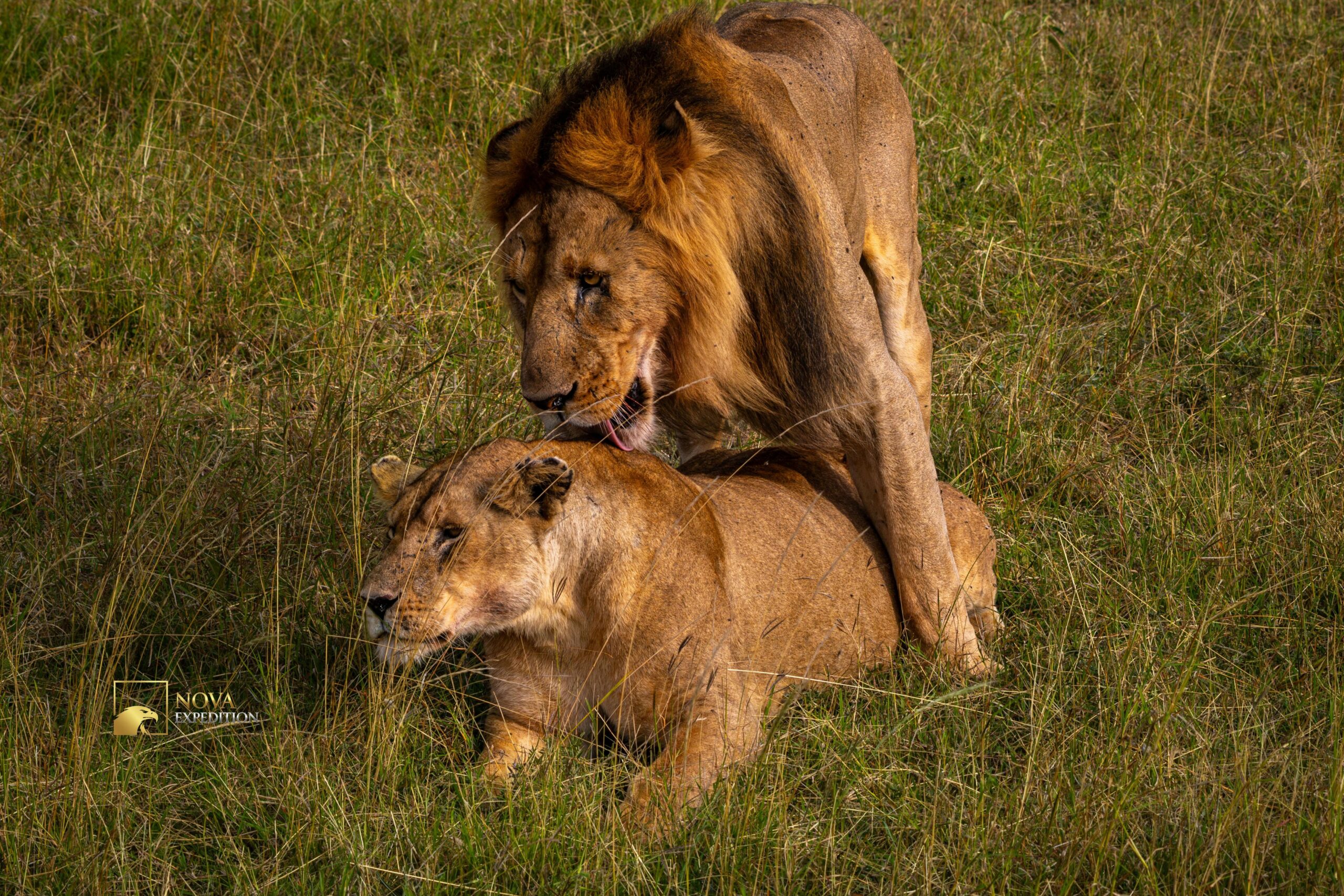
The best lion encounters happen in the conservancies. This is not primarily a marketing claim — it is a direct consequence of the lower vehicle limits (typically three to five vehicles maximum per sighting versus the reserve’s uncapped access). A lion accustomed to one or two vehicles will hunt, feed, and interact socially with behavioural naturalness. A lion repeatedly surrounded by twenty vehicles shows avoidance and stress responses. The conservancy lion experience is observably different from the reserve experience, and this difference is real whatever the exact density figures say.
Your accommodation choice is a conservation decision — with one honest caveat. When you pay the conservancy fee (typically bundled into all-inclusive lodge rates), a substantial portion flows to the Maasai landowners whose lease income is the financial foundation of the model. This is the mechanism that brought community land into the protected system. The honest caveat from the 2025 camp-impact research: the relationship between camp density and lion density is not simply ‘more camps equals more conservation.’ Staying in a well-managed conservancy with sensible camp density supports the model; the model works best when camp expansion is restrained rather than maximised.
Night drives reveal the predator world the daytime barely shows. Lions are substantially more active at night. Conservancies allow night drives; the national reserve prohibits them. The quality of lion behaviour visible on a conservancy night drive — hunting sequences, territorial calling, social interaction — is simply unavailable to reserve guests at any price. This is among the most concrete reasons to choose a conservancy camp.
The unexpected beneficiary — the giant pangolin
The conservancy model’s benefits extend to species that receive almost no public attention. The Mara conservancy landscape is among the last strongholds in Kenya for the giant ground pangolin — one of the world’s most trafficked mammals, armoured in distinctive interlocking keratin scales and targeted for the illegal Asian wildlife trade. Estimates of how many remain in Kenya are alarmingly low; figures circulating from conservation organisations suggest only a small remnant population survives, concentrated in exactly the kind of community conservancy land that lease payments maintain as wildlife habitat rather than farmland.
A note on the number: the specific figure of ‘around 30 giant pangolins left in Kenya’ that appears in some accounts should be treated cautiously — pangolins are nocturnal, solitary, and exceptionally difficult to survey, which makes any precise national count unreliable. What is well-established is that the species is critically threatened, that Kenya’s surviving population is very small, and that the community conservancy landscape northwest of the reserve is one of its last refuges. The precise count is uncertain; the precariousness is not.
Most visitors to the Mara will never see a giant pangolin. But the fact that the last handful of Kenya’s giant pangolins survive partly because Maasai families receive lease income to keep their land wild — rather than converting it to agriculture — is a striking illustration of how the conservancy model protects species that will never appear on a tourism brochure beside the lions and cheetahs that do.
Frequently asked questions
Did the Maasai Mara really have only nine lions in 1961?
This figure is widely repeated across safari accounts but is not backed by any documented scientific census. The Mara was only established as a protected area in 1961, and no systematic lion survey produced a precise count at that moment. Lion populations were genuinely severely depleted by mid-century through hunting and retaliatory killing — the directional story is true — but the specific number nine should be treated as safari lore rather than verified data. Today the Greater Mara holds approximately 850-900 lions.
Are lion densities really higher in conservancies than the reserve?
Partly supported, partly contested. MMWCA reports densities 14% higher in conservancies. But the Mara Predator Conservation Programme’s most recent (Q1 2025) reading describes conservancy densities as ‘comparable to’ the reserve rather than clearly higher. And a 2025 Aarhus University study found the highest densities in areas without tourist camps. The honest position: conservancies support densities comparable to or higher than the reserve — an excellent outcome — but the flat claim of conservancy superiority is stronger than the most current primary monitoring supports.
How does staying in a conservancy help lions?
Conservancy fees (usually bundled into lodge rates) flow to Maasai landowners as lease income, giving them an economic stake in keeping their land as wildlife habitat rather than converting it to agriculture or grazing. This is the core mechanism that brought community land into the protected system. The honest caveat from recent research is that the benefit depends on sensible camp density — the model works best when camp expansion is restrained, not maximised.
What is the olamayio?
The olamayio is the traditional Maasai ceremonial lion hunt through which young warriors (morans) historically demonstrated courage and status. It was a real cultural institution bounded by rules, but it was never the primary driver of lion mortality — retaliatory and preventive killing of livestock-threatening lions, often by poisoning, caused far more deaths. In several conservancy-participating communities, elder councils have formally suspended the olamayio because lease income changed the economics that once made it meaningful.
Is the conservancy model unique to the Mara?
No. Community-managed conservancy models that give local people economic stakes in wildlife have been developed in Namibia (the communal conservancy programme), Zimbabwe (CAMPFIRE), and elsewhere in Kenya (the Northern Rangelands Trust conservancies, Lewa, Ol Pejeta). The Mara conservancies are among the best-known and best-studied examples, but the underlying principle — align local economic incentives with wildlife survival — is a broader and increasingly influential conservation strategy across Africa.
Honest limits to this article
This article has tried to distinguish well-evidenced claims from widely-repeated but weakly-sourced ones, which is itself an admission of limits. Three in particular.
- First, lion counting is genuinely hard — even the best spatially-explicit methods produce estimates with meaningful uncertainty ranges, and different studies use different boundaries, baselines, and methods, which is why their numbers don’t always line up.
- Second, the conservancy lease economics vary substantially between conservancies and years, and audited aggregate figures are not readily available, so the financial numbers here are approximate.
- Third, the relationship between tourism and conservation is genuinely contested at the research frontier — the 2025 camp-impact study is recent and its implications are still being debated. The conservation success is real; the precise quantification of it remains a live scientific question.
THE BOTTOM LINE The Mara's lion recovery is one of Africa's genuine conservation successes, built on a real and replicable mechanism: making wildlife economically valuable to the people who live alongside it. The land-under-conservation figure (33% to 64%) and the 2016 density study are the strongest evidence. The dramatic headline statistics — nine lions, tripled in a decade, 83% in 25% — capture real patterns but should be read as approximate or illustrative rather than audited. Told accurately, the story is more credible and more interesting than the slogan version.
Who this article is for, and who should look elsewhere
Travellers who want to understand the conservation story behind their Mara safari honestly — this article gives you the real mechanism and the real evidence, including where the famous numbers are solid and where they’re soft. You’ll be a better-informed visitor and a more discerning reader of safari marketing.
Travellers choosing between reserve and conservancy accommodation — the conservation case for conservancies is real, and the article on private conservancy vs national reserve covers the practical booking decision in depth.
Conservation-minded travellers wanting to maximise positive impact — the article makes the case for conservancy bookings while honestly flagging the recent research on camp density. Travellers wanting to dig deeper should look at the primary sources cited (MMWCA, Mara Predator Conservation Programme, the 2016 Conservation Biology study) rather than relying on aggregated safari marketing.
Readers wanting an uncomplicated feel-good conservation narrative — this article will frustrate you, because it insists on distinguishing evidence from marketing. The story is genuinely positive; it is just more nuanced than the slogan version, and that nuance is the point.
Tell us what you are looking for, and we will tell you honestly whether we can deliver it — and if we cannot, we will tell you who can.
RELATED READING
- The 7 best private conservancies in the Maasai Mara: where to stay to support the model
- Private conservancy vs national reserve: the practical booking decision
- Best lodges in the Maasai Mara 2026: specific camps across every conservancy
- Maasai Mara vs Serengeti: how the conservancy advantage compares to Tanzania
- Best time to visit Kenya: when to see the Mara’s lions at their most active
- The 7 best private conservancies in the Maasai Mara — and why they matter more than the national reserve
- Private Conservancy vs National Reserve Kenya: The Complete Honest Guide (2026)
- Maasai Mara, Kenya — Destination Guide | Nova Expedition Kenya
- Maasai Mara vs Serengeti: Which African Safari is Better? (2026 Honest Guide)
- Best Lodges in the Maasai Mara 2026: From Ultra-Luxury to Best Value
- Maasai Mara Lodges and Camps — Reserve vs Conservancy