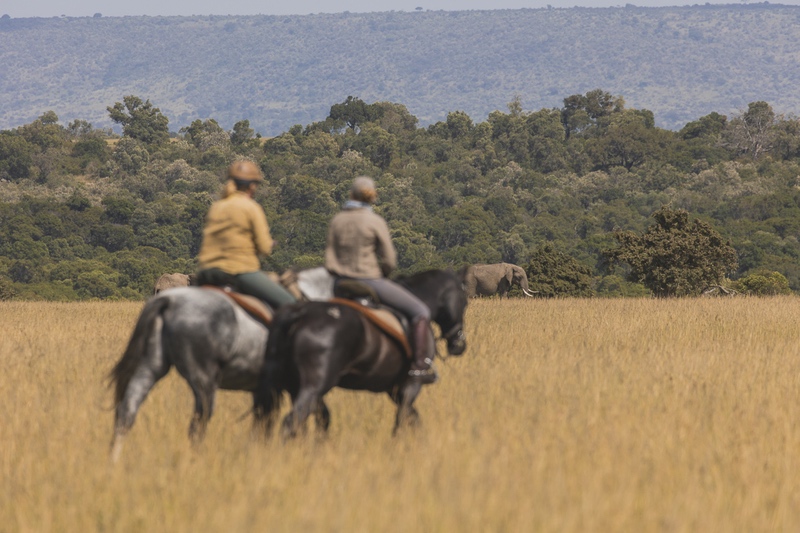

Approaching plains game on horseback at trotting pace, with elephants on the horizon and the country opening for kilometres — this is one of the strongest African experiences available. It is also a product that requires real riding ability and that the marketing consistently undersells the demand for.
The first thing to make clear
Horseback safari marketing tends to lead with the romance — galloping alongside wildebeest, sundowner from the saddle, mobile camp at dusk. The romance is real. So is the prerequisite: you need to actually be able to ride. Multi-day Horseback safari in Kenya requires competence at walk, trot, and canter on potentially unfamiliar horses, in open country, with wildlife present, sometimes at speeds and over terrain that demand more than ‘I had lessons as a child.
The reason this matters: a multi-day horseback safari is not a riding lesson and not a guided trail ride. It is a working expedition that moves real distance on horseback every day, traverses unfenced wildlife country, and depends on every rider being capable of controlling their horse in the unexpected encounters that are the whole point of the experience.
This is the article that distinguishes the two main categories of Kenya horseback product: the lodge-based ride (suitable for less-experienced riders, accessible to beginners with adaptation) versus the multi-day mobile expedition (suitable for confident intermediate-plus riders only). The price difference, the experience difference, and the rider-requirement difference are all material. Prices indicative; confirm at booking.
Horseback safari is among the most extraordinary wildlife experiences Kenya offers — and it is also the one most commonly oversold to riders who cannot do it justice. The mismatch produces both safety incidents and disappointing trips. Honest framing of the riding requirements is the most important thing in this article.
| SAFARIS UNLIMITED FOUNDED 1971 by Tony Church; now run by son Gordie Church and Felicia Church | MULTI-DAY SAFARI DISTANCE Often 200+ km on horseback over 7–10 nights through Maasai Mara |
| STABLE SIZE AT SAFARIS UNLIMITED 25–30 horses — Thoroughbred crosses, Percheron-Boerperd, Friesian crosses, Arab-French-Somali, Appaloosas, Warmbloods | RIDER REQUIREMENT (MULTI-DAY) Competent at walk, trot, and canter in open country; confident at all paces |
| MINIMUM AGE (MOST OPERATORS) 12 years for lodge-based; 14–16 years for multi-day mobile | PRICING INDICATIVE Mobile multi-day: $1,200–2,500 per person per night; lodge-based: $700–1,500 |
| ACCREDITATIONS TO LOOK FOR Kenya Association of Tour Operators (KATO), Kenya Professional Safari Guides Association (KPSGA) | BEST RIDING SEASON January–March and June–October dry seasons; April–May long rains complicate logistics |
The two product categories travellers must distinguish
Kenya horseback safari is not a single product. It is two genuinely different formats sold under the same headline.
Lodge-based horseback riding (the accessible product)
Several Kenya lodges offer horseback riding as one activity among the lodge’s broader programme. Typical structure: half-day or full-day rides departing from the lodge, returning to the lodge for nights. The rides are shorter (2–4 hours), the pace more controlled, the routes more predictable, and the rider requirements more flexible — most lodges will accommodate intermediate riders comfortably and many will work with beginners (walk-only rides, lead-line for novices, short morning hacks for new riders).
Lodge-based horseback riding is the right product for travellers who want horseback as one element of a broader safari rather than the trip’s centerpiece. Properties with established horseback programmes include: Borana Lodge (Laikipia — strong stable, suitable for intermediate riders), ol Donyo Lodge (Chyulu Hills — exceptional rides between Tsavo and Amboseli, the strongest single lodge-based product), Sosian Lodge (Laikipia — relaxed pace, good for less-confident riders), Lewa Wilderness (working family farm with horses, classic lodge-based product), Loisaba / LMW (Laikipia — strong stable, multi-day options available), Tortilis Camp (Amboseli — Kilimanjaro views from horseback), and Mara Plains (Mara conservancy — limited horse availability but premium product). Pricing $700–1,500 per person per night including the riding component.
Multi-day mobile horseback expeditions (the specialist product)
Multi-day mobile horseback safaris cover real distance — typically 200+ km over a week — riding through unfenced wildlife country with a mobile camp moving with the riders. The riders cover 25–35 km on horseback each day, the camp is set up at a new location each evening, and the experience is much closer to traditional 19th and early 20th century safari than modern lodge-based wildlife tourism.
This product requires real riding competence. Operators will ask detailed questions: how often you ride per week, how recently you have ridden at canter and gallop, whether you have ridden in open country with hazards (rocks, holes, low branches), whether you have ridden unfamiliar horses, whether you have ridden in heat. Riders who exaggerate competence will be discovered on the first day; the consequences range from inconvenient (the rider is moved to a slower horse and the pace adjusted) to serious (a fall in lion country).
The specialist operators
Multi-day mobile horseback expeditions in Kenya are run by a small number of operators. Quality is high across the category but the products differ meaningfully.
Safaris Unlimited
Founded in 1971 by Tony Church, Safaris Unlimited is the oldest continuously operating horseback safari company in Africa. Tony’s son Gordie Church took over operational leadership in 2001 and runs the company with his wife Felicia from a base in Naivasha (the stable) and field operations across Kenya. The company is a member of the Kenya Association of Tour Operators (KATO), Kenya Professional Safari Guides Association (KPSGA), and East African Wildlife Society (EAWLS).
The flagship product is the multi-day Mara horseback safari — typically 8 nights, covering 200+ km through the Maasai Mara ecosystem, using mobile tented camps that move with the riders. Wildlife encounters at trotting and cantering pace alongside herds of zebra, wildebeest, giraffe, and (during migration season July–September) the wildebeest crossings themselves. The classic Lewa-to-Mara crossing remains in the operator’s portfolio under bespoke arrangement. A 6-night Lolanasoit ride in Laikipia is the alternative product. Stable: 25–30 horses, a mixture of Percheron-Boerperd crosses, Friesian-Boerperd, Arab-French-Somali crosses, Appaloosas, Warmbloods, and Thoroughbreds, ranging from 14hh to 17hh.
Pricing indicative $1,500–2,500 per person per night depending on configuration and season; the 8-night Mara safari typically books out 12+ months in advance. Riders must be competent at all paces — Safaris Unlimited’s pre-trip questionnaire is detailed and the team will refuse to take riders who do not meet the standard.
Offbeat Safaris (Tristan Voorspuy’s legacy operation)
Offbeat Safaris was founded by the late Tristan Voorspuy, one of the iconic figures in Kenya horseback safari (Tristan was killed in 2017 during the Laikipia pastoral invasions; the operation continues under his family’s leadership). The company runs multi-day mobile rides in the Mara conservancies and Laikipia, with a particular tradition of long-distance point-to-point routes. Pricing comparable to Safaris Unlimited. Rider requirements similarly strict.
Lewa Wilderness Horseback (lodge-based)
Lewa Wilderness, operated by the Craig family, runs a strong lodge-based horseback programme from Lewa Conservancy in northern Laikipia. The stable is comprehensive, the country is exceptional (Lewa is one of the world’s strongest rhino conservancies), and the format combines rides into Lewa and onward day-rides into adjacent ranches. Less mobile than Safaris Unlimited; more accessible to riders who want comfort and short rides between long ones.
Borana Lodge Horseback
Borana, also in northern Laikipia, operates one of the strongest lodge-based programmes for intermediate-plus riders who specifically want horseback as a primary trip element. Multi-day rides between Borana and adjacent properties (Lewa, Mugie) are available by arrangement. Strong choice for riders combining horseback with rhino-tracking and standard game drives.
THE CREDIBLE-OPERATOR TEST FOR HORSEBACK A credible horseback safari operator: requires a detailed pre-trip riding questionnaire and will refuse riders who cannot meet the standard, supplies horse names and rough rider-allocations in advance (so riders can ask questions before arrival), explains the safety framework around dangerous-game encounters on horseback, names the senior ride leaders and their bushcraft credentials, and produces references from recent guests. An operator that accepts any rider regardless of stated ability should not be trusted with multi-day mobile work.
Why horseback works so well for wildlife observation
Travellers who have done both vehicle safari and horseback safari report a consistent observation: animals respond differently to horses than to vehicles. The behavioural difference is the reason horseback safari produces such strong wildlife encounters.
Most large African herbivores — zebra, wildebeest, giraffe, eland, impala, Thomson’s gazelle — do not perceive horses as predators in the way they perceive humans on foot. The animals will allow horse-and-rider to approach much more closely than they would allow foot approach, and they will continue normal behaviour (grazing, drinking, moving) rather than fleeing or freezing. The result: a horseback safari spends more time in proximity to wildlife in undisturbed behaviour than any other format. Photographs from the saddle have a quality that vehicle photographs do not.
Predators are a different question. Lions are perceived as a threat by horses and the operators avoid lion country during walking pace, take wide detours around known prides, and rely on the armed escort if a close encounter develops. Leopards are generally non-confrontational. Wild dogs and hyenas typically retreat. Elephants are the more complex case — elephants can find horses threatening if approached too closely, and operators give elephant groups generous distance. The honest position is that the wildlife protocol for horseback safari is more involved than vehicle safari, with implications for routing.
The honest physical and emotional reality
Travellers who have ridden recreationally but not done multi-day distance work tend to underestimate three things.
Day-after-day cumulative load
Riding 25–35 km a day for seven days is harder than riding 25 km once. The cumulative load on hips, knees, lower back, and core is meaningful. By day three, most riders feel it. By day five, riders without significant fitness preparation feel it substantially. Operators recommend cardiovascular and core preparation for 8–12 weeks pre-trip. Riders coming off long lay-offs should consider a lodge-based ride first to test fitness.
Variable horse temperament
Mobile safari horses are working animals, not riding-school mounts. They have personalities, preferences, and quirks. Some are fast and forward (suitable for advanced riders); some are steady and reliable (suitable for less-confident intermediate riders). Allocations are made by the senior guide based on the pre-trip questionnaire and on observation during the first day. Riders who arrive thinking the horse should match their expectations rather than the other way around will struggle; riders who arrive ready to work with whichever horse the team allocates will have a much better experience.
The safety mental load
Walking and riding in dangerous-game country requires constant low-level vigilance. The guide is reading the country continuously; competent riders are also doing this. Riders who treat the safari as a passive scenic experience will miss cues and create awkward moments for the team. The mental load is part of the experience for those who can carry it, and a real cost for those who cannot.
What a multi-day horseback safari day actually looks like
Travellers booking the multi-day mobile expedition product without prior experience often assume the day structure mirrors a riding-school programme. It does not. The structure is closer to a working expedition than to a guided tour.
Pre-dawn: tea or coffee at the camp fire. Quick breakfast. Saddle up around 6am. The horses are typically untacked and grazing overnight, retrieved by the syces (grooms) before dawn. The morning briefing covers wind direction, expected wildlife along the route, and any specific cautions about the day’s terrain.
Morning ride: 3–4 hours of riding, covering 12–18 km. The pace varies — long walks through dense game country to allow approach, trots in open ground to cover distance, occasional canters when the country opens and the wildlife situation permits. Stops for wildlife observation, photography, and to rest the horses. By 10–11am the heat begins to build and the wildlife retreats to shade; this is the natural break point.
Mid-day break: at a pre-arranged site, often at a water source where the horses can drink and rest. A picnic lunch or a hot lunch depending on operator. The break is typically 2–3 hours — the heat of the day is not the time to be moving on horseback. Riders may walk to a vantage point, swim if a river or pool is available, or rest under acacias. The team uses this period to reset and check the horses.
Afternoon ride: 2–3 hours of riding, typically covering 8–12 km. The pace is often slower than the morning — the wildlife is more active again as temperatures drop, photography opportunities increase, and the team may stop more frequently. Sundowner at a viewpoint before returning to the camp, which the support team has set up at the new location during the day.
Evening at camp: arrival around dusk. Bucket showers, dinner around the fire, debrief on the day’s wildlife. The conversation tends to be focused and engaged — the shared physical effort and the proximity to the country produce a different group dynamic than vehicle safari. Most riders are in their tents by 9pm; the next day starts pre-dawn.
Total distance and the cumulative load
A typical riding day covers 20–35 km on horseback. Over a 7-day safari, this accumulates to 150–250 km. Riders without significant fitness preparation feel the cumulative load by day 4 — hip flexors, lower back, and core stability all carry the work. Operators recommend 8–12 weeks of cardiovascular preparation pre-trip, with specific focus on core strength and hip mobility. Riders who ride regularly (2+ times per week) tend to handle the cumulative load comfortably; riders who ride occasionally and prepare specifically also handle it; riders who arrive in poor condition will struggle.
THE HONEST DAY-STRUCTURE FRAMING A multi-day horseback safari is not a riding holiday — it is a working expedition that uses horses as the primary mode of travel through wildlife country. Riders who expect a series of guided trail rides interspersed with hotel-style downtime will find the actual format more demanding. Riders who expect a working expedition will find it deeply rewarding.
The lodge-vs-mobile decision framework
| Question | Suggests lodge-based programme | Suggests multi-day mobile expedition |
| How often do you ride per week? | Once a week or less, occasional rider | Twice a week or more for the past year |
| How recent is your last canter on unfamiliar horse? | Last year or earlier | In the last 3 months on a horse you didn’t know |
| Have you ridden in open country with hazards? | No, mostly arena or controlled trail | Yes, including over varied terrain with surprises |
| Is horseback the trip’s centerpiece? | No — one element among several | Yes — the reason for the trip |
| How many days can you ride for? | 1–3 day rides over the trip total | 6+ consecutive days willing |
| Budget for the riding component | $700–1,500 per night including other activities | $1,200–2,500+ per night for the mobile product |
A rider answering ‘lodge-based’ to most of the table should not book the multi-day mobile expedition. The trip will be physically punishing, the rider will struggle with horse allocation, and the entire group will be slowed. A rider answering ‘mobile’ to most of the table will find lodge-based riding too restrained and the wildlife observation pace too short.
Hidden-gem horseback experiences
Two undermarketed horseback options worth knowing about.
ol Donyo Wuas / ol Donyo Lodge (Chyulu Hills)
ol Donyo Lodge, in the Chyulu Hills between Tsavo and Amboseli, has one of the most underrated lodge-based horseback programmes in Kenya. The riding country combines volcanic landscape, elephant range, and direct views of Kilimanjaro. The lodge accommodates riders from intermediate up, with multi-day rides available within the Mbirikani Group Ranch. Why undermarketed: ol Donyo’s marketing emphasises landscape and big-game over horseback, so the strength of the riding programme is under-promoted relative to its quality.
Mugie Conservancy horse rides
Mugie Conservancy in Laikipia operates a small but high-quality horse stable accessible to lodge guests. The conservancy’s lower tourism density and Karisia Hills setting produce strong riding country. Why undermarketed: Mugie operates with very limited tourism volume by design, the rides are typically arranged as part of a private booking rather than scheduled.
Honest limits
Three things horseback safari in Kenya cannot give you.
First, the riding-school graduated experience. Operators that genuinely run quality safari rides will refuse novice riders for the multi-day mobile expeditions. Novice riders should not seek a back-door route into these trips — they will either be turned away, refunded, and disappointed, or accepted under conditions that make the trip difficult for everyone.
Second, the cheap option. Multi-day horseback safari in Kenya runs $1,200–2,500 per person per night for quality operators. The economics of mobile camps with skilled riding staff, large horse strings, and bushcraft-trained personnel produce this floor. Travellers wanting horseback at lower price points should consider lodge-based programmes.
Third, the predictable wildlife product. Horseback safari produces extraordinary wildlife encounters but at lower predictability than vehicle safari from a permanent camp. Some days will produce exceptional crossings or close approaches; other days will be quieter scenic rides. Travellers wanting maximum wildlife volume should not book horseback as the primary safari format.
THE HONEST PICK FOR THE RIDER CONSIDERING KENYA HORSEBACK Strong intermediate-plus riders wanting the multi-day expedition product should book Safaris Unlimited's 8-night Mara safari. Less-confident riders or first-time horseback safari travellers should book a 3–5 night lodge-based stay at ol Donyo, Borana, or Lewa Wilderness with riding included alongside other activities. The middle-ground option — 'lots of riding but at a lodge' — is what most travellers should actually book. The mobile expeditions are for genuine specialists.
Who this article is for, and who should look elsewhere
Competent riders who specifically want horseback safari as a primary trip element — this article is the planning framework. The product is exceptional and the operators are credible.
Non-riders or beginning riders — Kenya horseback safari is not the trip for you. Standard safari with vehicle game drives is the better fit. If horseback genuinely interests you, start with riding lessons at home and reconsider in 18 months.
Travellers wanting maximum wildlife volume — vehicle safari from a permanent Mara conservancy camp will deliver more wildlife encounters per day than horseback safari. Choose horseback for the experience type, not for the wildlife count.
RELATED READING
- Walking safari in Kenya: the foot-based equivalent of horseback’s slower approach to country
- Ol Pejeta Conservancy: rhino-focused riding adjacent to the conservancy
- Solo safari in Kenya: the operator-selection framework applies to specialist riders too
- Fly camping in Kenya: the mobile-camp format that underpins multi-day horseback
- Kenya community conservancy model: where most quality riding takes place
Tell us what you are looking for, and we will tell you honestly whether we can deliver it — and if we cannot, we will tell you who can.