Why Samburu is the safari Kenya keeps to itself
Samburu sits roughly 320 kilometres north of Nairobi in a completely different Kenya from the one most visitors see. The Mara is lush southern savannah. Samburu is the semi-arid northern frontier — doum palms and red laterite soil, volcanic outcrops and rocky scrub, intense dry heat and a wildlife roster you genuinely cannot find anywhere south of the equator in Kenya. The light is different. The colours are different. The animals are different. For travellers who have done the Mara once and want to know where Kenya stops being the place on the postcards, Samburu is the answer.
The destination most operators sell as “Samburu” is in fact a complex of three contiguous national reserves separated by the Ewaso Ng’iro River — Samburu, Buffalo Springs, and Shaba — surrounded by a constellation of community-owned conservancies that significantly expand the protected landscape. Samburu and Buffalo Springs sit on opposite banks of the river. Shaba lies further east, on the other side of the highway through Archer’s Post. Surrounding all of them are Kalama, West Gate, Namunyak, Sera, Nakuprat-Gotu and other community conservancies that extend the wildlife range across hundreds of thousands more acres. Game moves freely between every part of this complex. The vehicle traffic at sightings is a fraction of the Mara. The wildlife is, in a meaningful sense, more original — these are species adapted to dry country that have been here for centuries and that the safari industry has not yet flattened into a circuit.
The three reserves — Samburu, Buffalo Springs and Shaba explained
The three reserves were originally a single protected area, established in 1948 as the Samburu-Isiolo Game Reserve. They were split and re-gazetted separately from the 1960s onwards and are now administered by different county councils — Samburu Reserve by Samburu County, Buffalo Springs and Shaba by Isiolo County. Wildlife treats them as one ecosystem and moves freely between them. Visitors typically don’t, and that’s the gap worth understanding. Each reserve has a different character, and the operators who know what they’re doing will route you across at least two of the three.
| Reserve | Character & landscape | What it’s best for |
|---|---|---|
| Samburu | Rugged, north of the river. Doum palms, riverine forest, the dramatic Koitogor Hill. The most-visited and best-known of the three. | Classic Samburu experience. Highest concentration of elephant along the river. Long-running predator monitoring. The Save the Elephants research camp. |
| Buffalo Springs | South of the river. Gentler terrain, springs and marshes, more open. The natural oasis at the western end gives the reserve its name. | Easier wildlife visibility in open country. Both common and Grevy’s zebra co-occur here. Slightly less crowded than Samburu. Hippo and crocodile concentrations at the springs. |
| Shaba | Further east, beyond Archer’s Post. Dramatic volcanic landscape dominated by Shaba Hill. Greener and lusher than the other two in places, with more bushland. The most remote and least visited. | Solitude — often the most empty of the three. Lion prides are notable. Walking safaris available. The Joy Adamson legacy and the Williams’s lark, endemic to this reserve. |
Shaba carries the strongest historical narrative of the three. Joy Adamson — author of Born Free, the most famous book ever written about a Kenyan lion — lived at Shaba in her final years while attempting to rehabilitate Penny, a hand-raised leopard, back to the wild. She was murdered at her tented home in the reserve on 3 January 1980. The site is now a memorial and a lodge (Joy’s Camp) operates on the location. Shaba was also the principal Kenyan filming location for the 1985 film Out of Africa, and the season-three set of the American reality series Survivor: Africa. For visitors interested in the layered history of African wildlife conservation — the Adamsons, the early arguments about whether large carnivores could be rewilded, the cultural mythology that built around Born Free — Shaba is the only place in Kenya where all of this is literally on the ground.
Practical note: each reserve has its own gate fee, but the three are administered such that lodges and operators routinely arrange cross-reserve game drives. A typical Samburu-area itinerary will include drives in at least two of the three reserves over a 3-4 night stay. The original draft of most online guides treats “Samburu” as a single destination — in fact, anyone serious about the wildlife or the photography will want to see all three.
The Samburu Special Five — wildlife you cannot see anywhere south
The defining attribute of the Samburu complex — the reason it earns a position on a Kenya safari itinerary alongside the Mara — is the Samburu Special Five: five species adapted to semi-arid conditions, endemic to Kenya’s northern region, and found nowhere in the Mara, Amboseli, Tsavo, or any other southern ecosystem. Seeing them for the first time produces a specific kind of delight: the recognition that the familiar categories of “African wildlife” contain whole sections you had not previously seen.
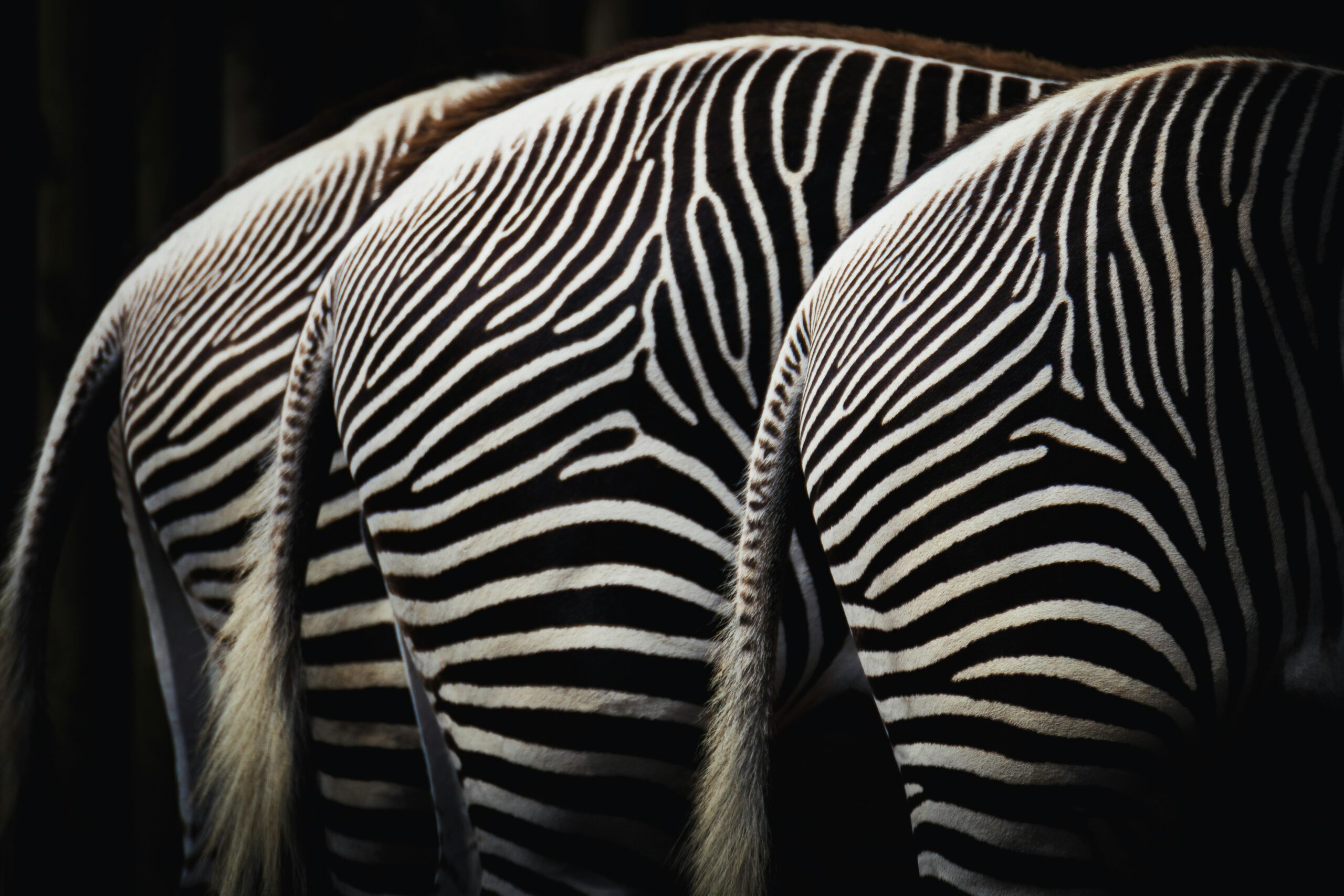
- Grevy’s Zebra — The largest of all zebra species and the most endangered. The global population is now estimated at just over 3,000 individuals, with more than 90% in northern Kenya — a roughly 80% decline since the 1970s. Distinguished from the common plains zebra by dramatically narrower, more closely spaced stripes that stop at a white belly, large rounded ears, and a more upright, mule-like stature. Grevy’s are looser-knit socially than plains zebras and can survive several days without water. The Samburu complex and the wider Greater Ewaso ecosystem hold the single largest concentration of Grevy’s on Earth.
- Reticulated Giraffe — Distinguished from the Maasai giraffe by its striking coat pattern of large, geometrically defined polygonal patches separated by narrow white lines, like stained glass. The IUCN reclassified reticulated giraffe as a full species (not a subspecies) in August 2025. The global population is around 20,900 — recovering from earlier declines, with 98% in Kenya and small remnant populations in southern Ethiopia and Somalia. Northern Kenya is the stronghold of the species.
- Beisa Oryx — A large, elegant antelope with long straight horns and bold black-and-white facial markings. Evolved for extreme aridity: capable of letting its body temperature rise several degrees above normal during the hottest hours rather than sweating to cool down, then dumping heat at night. One of the most physiologically remarkable large mammals in Africa, and a Samburu staple.
- Gerenuk — Called the “giraffe gazelle” in older literature for its ability to stand fully upright on its hind legs, using its elongated neck to browse leaves from branches up to 2.5 metres high. The behaviour is unique among gazelles and gives the gerenuk access to food sources no other ground browser can reach. Watching a gerenuk stand vertically against the red Samburu landscape is one of the most striking individual animal behaviours on the continent.
- Somali Ostrich — A separate species from the common ostrich, distinguishable by its blue-grey neck and leg skin (vivid blue in breeding males) versus the pink-red skin of the common ostrich. Blue neck and legs against the red volcanic soil of Samburu is an extraordinary visual combination — and Buffalo Springs is one of the rare places where both the Somali and common (Maasai) ostrich co-occur, allowing direct comparison.
The Special Five are not the whole story. The complex also supports the Big Five — lion, leopard, elephant, buffalo, with rhino accessible at the adjacent Sera Sanctuary — plus cheetah, wild dog (occasionally), striped hyena, aardwolf, caracal, and serval. Elephant numbers are substantial, with the wider Samburu-Laikipia ecosystem holding Kenya’s second-largest elephant population. The reserves are also a serious birding destination — over 350 species recorded across the three reserves, including the near-threatened Williams’s lark, which has been recorded nowhere else in the world.
One historical footnote that operators inevitably mention: Kamunyak, the lioness who between January 2002 and early 2003 adopted a succession of six baby oryx calves in Samburu National Reserve — protecting them, even allowing their natural mothers to nurse them, in a complete inversion of predator-prey behaviour. The first adoption lasted 15 days before the calf was killed by another lion. The behaviour was documented for the BBC by Saba Douglas-Hamilton — daughter of the elephant researcher Iain Douglas-Hamilton, who founded Save the Elephants here in Samburu — in the film Heart of a Lioness. Kamunyak was last sighted in February 2004 and has not been seen since. The story remains one of the most discussed examples of unexplained cross-species attachment behaviour in scientific literature.
The Ewaso Ng’iro River — the ecosystem’s lifeline (and its risk)
The Ewaso Ng’iro — “brown water” in the Samburu language — originates on the western slopes of Mount Kenya and the Aberdares, flows north through Laikipia, then east through the three reserves, and ultimately dissipates into the Lorian Swamp far to the east. It is the only permanent water source in the entire complex, and that permanence is the organising principle around which all wildlife behaviour is structured. In the dry season, the river is where everything happens — elephants bathing in columns, crocodiles lined up on the banks, leopards resting in the riverine acacias, herds of impala and the Special Five coming down to drink in succession. The dense riverine forest is the coolest and most wildlife-rich habitat in an otherwise dry landscape.
The Ewaso Ng’iro also produces the most consequential risk in the Samburu visitor calendar: flash flooding. Heavy rains in the Mount Kenya and Aberdares catchments — sometimes hundreds of kilometres upstream and with no rain visible in Samburu itself — can send the river over its banks within hours. The 2010 floods were the worst on record. The river burst its banks in March of that year and tourists were evacuated by helicopter from camps along the riverbank, with Intrepids Camp, Larsen’s, the Save the Elephants research camp, and others sustaining serious damage. Smaller flooding events occurred in 2012, 2018, and again in late 2019/early 2020. Reputable operators take this seriously: lodges have been rebuilt on higher ground where possible, evacuation procedures are now standard, and any trip planned for the long rains window (April-May) or short rains (November) should factor this in. The 2020 short-rains season was particularly heavy and disrupted operations across the ecosystem.
None of this means avoiding Samburu — only understanding that the river is both the gift and the hazard. Game drives logically follow it. The most productive morning routes trace the southern bank in Samburu and Buffalo Springs, checking the riverine trees for leopard, scanning the banks for elephant and crocodile, then opening out to the plains beyond. The contrast between the dense green riverine vegetation and the hot, red-soiled plains is one of the distinctive visual signatures of the destination.
The surrounding conservancies — where the experience opens up
Like the Mara, the Samburu complex now sits inside a wider network of community-owned conservancies that extend the protected landscape and unlock activities the reserves themselves do not allow. The reserves prohibit off-road driving, night drives, and walking safaris. The conservancies allow all three. Staying at a conservancy lodge with reserve access is typically the strongest configuration — you get the off-road and night activity in the conservancy and the reserve game drives during the day.
| Conservancy | Position & size | Why it matters |
|---|---|---|
| Kalama | North of Samburu Reserve · ~95,000 acres | Best-positioned conservancy for direct Samburu Reserve access plus night drives and walking safaris. Home to Saruni Samburu. |
| West Gate | West of Samburu Reserve · ~22,000 hectares | Community-owned by 6,000 Samburu landowners. Sasaab camp sits here. Drier and quieter than the reserve itself. |
| Namunyak | North in the Mathews Range · ~75,000 hectares | Larger, more dramatic landscape. Home to Reteti Elephant Sanctuary — the first community-owned elephant orphanage in Africa. |
| Sera | Northeast · 840,000 acres (largest community conservancy in the region) | Holds East Africa’s first and only community-run rhino sanctuary. On-foot rhino tracking. The conservation success story of northern Kenya. |
| Nakuprat-Gotu | East of Shaba | Conservation buffer between Shaba and the wider rangelands. Genuinely off-the-circuit. |
The Northern Rangelands Trust (NRT), founded in 2004, coordinates many of these conservancies as a federation and provides infrastructure for ranger training, anti-poaching, peace-building between historically rival communities, and benefit-sharing. The NRT model — community ownership of conservation, with safari revenue flowing back to landowners through transparent governance — is one of the more successful conservation experiments anywhere in Africa, and a significant part of why wildlife populations in the Samburu ecosystem have stabilised or recovered over the last decade despite ongoing pressures.
Sera Conservancy and the rhino-tracking sanctuary
Sera Wildlife Conservancy, approximately two hours’ drive northeast of Samburu Reserve, is one of the most remarkable conservation stories in contemporary Africa. The conservancy itself was established in 2001 as a peace and conservation project bringing together three historically rival communities — Samburu, Rendille, and Borana — across an extraordinary 840,000-acre landscape. In 2015, Sera launched the Sera Rhino Sanctuary: a fenced 26,000-acre core area within the conservancy, into which ten black rhinos were translocated from elsewhere in Kenya. It was the first and only community-owned and community-run rhino sanctuary in East Africa.
The numbers since then: from the founding 10 black rhinos, the population has grown to 26 today, with zero poaching incidents recorded in the sanctuary’s first decade. In 2024, four southern white rhinos were translocated to Sera from Lewa Wildlife Conservancy — the first time white rhinos have lived in Samburu in modern history — and the first white rhino calf was born in the same year. Sera is now the only place in northern Kenya where visitors can track both black and white rhinos on foot.
The tracking experience itself is the point. Guided by armed Samburu rangers across the semi-arid scrubland, reading tracks and dung, closing the distance slowly and deliberately — it is a fundamentally different mode of wildlife observation from watching from a vehicle. The silence, the physical engagement, the awareness of being genuinely in the bush rather than observing it from a moving platform, creates a quality of attention that changes how you see the animal when you find it. Sera can be visited as a day trip from Samburu or — strongly preferable — as an overnight stay at Saruni Rhino, the only lodge inside the conservancy. The combination of a Samburu Reserve stay with two nights at Sera is among the most distinctive itineraries available in Kenya.
Three research programmes shaping the ecosystem
The Samburu complex is, proportionally, one of the most scientifically studied wildlife areas in Africa. Three major research initiatives operate inside or adjacent to the reserves, and their presence shapes both the conservation outcomes and the visitor experience.
Save the Elephants, founded by Dr Iain Douglas-Hamilton — one of the founders of the modern field of elephant ecology — has had its research headquarters along the Ewaso Ng’iro inside Samburu National Reserve since 1993. STE pioneered the use of satellite-linked GPS collars to track individual elephant movements across vast distances, producing the data that revealed the full scope of elephant range, family structure, and the effects of poaching and habitat loss. Individual elephants in Samburu have been continuously known by name across generations of research. Understanding that the elephants drinking at the river have documented family histories — available in real time to researchers working hundreds of metres away — adds a dimension to elephant watching no other destination provides. STE’s research camp was severely damaged in the 2010 floods but rebuilt.
Ewaso Lions, founded in 2007 by Dr Shivani Bhalla, works on lion conservation and coexistence with the herding communities of northern Kenya. Lions and pastoralist communities live in genuine proximity here — conflicts over livestock predation are ongoing — and the project’s work on compensation schemes, community engagement, and the “Warrior Watch” programme that turns young Samburu morans into lion conservation ambassadors has directly reduced retaliatory lion killing. For visitors, this means the lions you see in Samburu are part of an active conservation story, not wildlife preserved behind a fence.
Grevy’s Zebra Trust, founded in 2007, runs a community-scout programme across northern Kenya to monitor and protect the remaining Grevy’s zebra population. Samburu and Rendille community members are employed as scouts, providing income while building local ownership of zebra conservation. The Trust’s work has contributed to a modest but significant stabilisation of Grevy’s numbers in the Samburu ecosystem after decades of decline.
A fourth name worth knowing: Reteti Elephant Sanctuary in Namunyak Conservancy, which opened in 2016 and was the first community-owned elephant orphanage in Africa. Reteti rescues and rehabilitates orphaned and abandoned elephant calves, eventually releasing them back into the wild. It is also notable for being staffed largely by Samburu women — the first women keepers of elephants in Kenya. Visits can be arranged through most camps in the area and are routinely cited as among the most affecting experiences of a Samburu trip.
The Samburu people — landowners, hosts, conservation partners
The Samburu are a semi-nomadic Nilotic people, closely related to but culturally distinct from the Maasai. Like the Maasai, they are pastoralists who measure wealth in cattle and maintain a complex social structure based on age sets, with each generation moving through defined roles from boyhood through warrior status to elder. The visible cultural signatures — the vivid red and orange beadwork, the men’s warrior braids and elaborate ochre body decoration, the heavy beaded jewellery and shaved heads of the women — are among the most striking material cultures in East Africa.
Unlike some cultural tourism experiences elsewhere in Kenya, Samburu community visits tend to feel less like performances and more like genuine encounters — partly because the Samburu maintain a stronger separation between traditional life and the tourist economy than the Maasai, and partly because the conservancy model in northern Kenya has developed more slowly, giving communities more direct control over how they engage with visitors. The Samburu landowners who lease land to the conservancies are partners in the conservation economy, not a backdrop. The “singing wells” of the Samburu — where herders sing in chorus while drawing water from deep wells for their livestock — are one of the most distinctive cultural experiences in the region, and only accessible through guides with genuine community relationships.
Getting there and best time to visit
By air — Scheduled flights from Nairobi Wilson Airport to the Samburu airstrips (Samburu, Buffalo Springs, Kalama, Oryx) take approximately 60–75 minutes. Safarilink and AirKenya run daily services. Most lodges arrange airstrip transfers as part of the booking. Air is the standard for any conservancy or higher-end itinerary.
By road — Approximately 5–6 hours from Nairobi via Thika, Nanyuki, and Isiolo. The road is now largely tarmacked and reasonable. The journey itself is interesting — climbing from Nairobi through the central highlands, crossing the equator at Nanyuki, then descending into the dry northern plains — and works well for travellers who want to experience the geographic transition into the northern frontier. Samburu is one of the more pleasant Kenyan safari destinations to reach by road.
Best time — June through October (peak dry season, wildlife concentrated at the river) and December through February (the secondary dry window, hot but excellent visibility). Samburu’s semi-arid climate makes it more drought-resistant than the southern parks — even during the long rains, wildlife viewing continues, unlike the Mara where some tracks become impassable. The long rains (April-May) and short rains (November) carry the genuine flooding risk discussed above, particularly for camps directly on the river. February and June are the underrated months: the heat in February is intense but Kilimanjaro and Mount Kenya views are at their clearest, and June carries the value advantage of low-season pricing.