
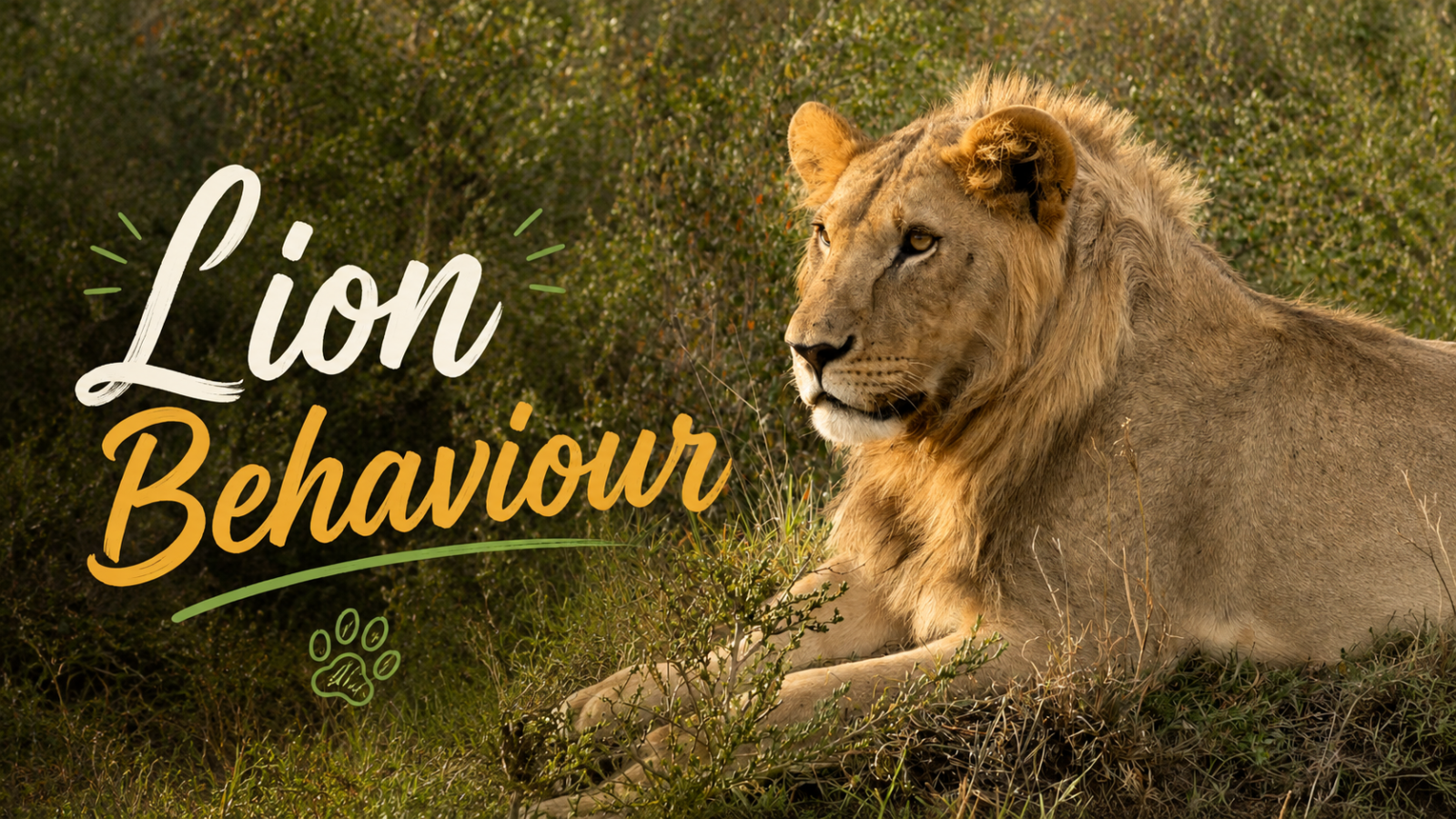

The lions you see on a typical game drive are usually resting — and the resting is more interesting than it looks once you can read it. This Lion Behaviour article is the guide to lion pride dynamics, body language, and behavioural signals that turns passive viewing into informed observation. The wildlife dimension you’re watching is denser and more readable than the typical safari briefing reveals.
Most safari guests watch lions for an hour and see five percent of what’s happening
The standard lion sighting on a Kenya game drive is structured around finding a pride, observing for 20-45 minutes, photographing, and moving on. The pride is usually resting (lions sleep or rest for 16-20 hours of a 24-hour cycle). The standard photographic content is a lion lying down, occasionally yawning or stretching, looking faintly bored.
The vehicle’s other guests typically watch for 5-10 minutes, take their photographs, and then ask the guide to drive on to the next sighting. The guide, who can read the pride and knows that the apparent boredom contains substantial behavioural content, complies because the alternative — sustaining the observation for 60-90 minutes while the pride continues to do what looks like nothing — is not the format guests usually choose.
This is the structural problem with most lion sightings: the visible behaviour is dense if you can read it, and most guests cannot. A lion’s tail twitch communicates information. The angle of an ear position changes between threat assessment, mild interest, and unconcerned awareness. The order in which pride members feed at a carcass reflects three to four different social signals. The roaring at sunset is genuinely communication, not random vocalisation. The pride relationships visible on a single hour’s observation contain weeks of mating history, dispersal economics, and territorial dispute. The pride is doing something. Most guests cannot see it.
This article works through what is actually happening when you watch lions, what to read in the visible body language and group dynamics, and how to extract more information from the same sighting time. It is not a behavioural-science textbook — those exist and are excellent — but a practical reading framework for game drive observation. The goal: shift the typical lion sighting from passive observation to informed reading, and in doing so substantially increase the experiential value of the same time.
Lions are the most-studied African mammal and one of the most behaviourally rich species on the continent. The accumulated research literature is vast. Some of that knowledge translates directly to what you can observe on a typical Mara, Samburu, or Laikipia game drive. Knowing it changes what you see. The lions are not lazier or less interesting than the cheetahs and leopards you also encountered; they are simply demanding more attention than the typical sighting structure provides.
Lion Behaviour Quick reference — the essential lion facts
| PRIDE SIZE (AVERAGE, KENYA/EAST AFRICA) 13–15 individuals | PRIDE SIZE (RANGE) 5 to 40+ depending on habitat |
| PRIDE COMPOSITION (TYPICAL) 1.7 adult males, 4.5 adult females, 3.8 sub-adults, 2.8 cubs | CUB MORTALITY RATE (FIRST YEAR) ~50% (varies by population) |
| MALE TENURE AS PRIDE MALE 2–3 years on average before displacement | SUB-ADULT MALE DISPERSAL AGE 2–3 years old; may travel 50+ km |
| TERRITORY SIZE (TYPICAL, SERENGETI/MARA) ~200 km² | ROARING RANGE5 –8 km on still nights |
Pride structure — what the group you’re watching actually is
A lion pride is structurally different from any other mammalian social group most safari travellers encounter. Understanding what you are watching requires understanding the genetic relationships and roles that define the pride.
| Category | Typical count | Notes |
| Adult males (pride males) | 1–4 individuals | Brothers or coalition partners. Rule the pride for 2-3 years on average before being displaced. |
| Adult females (lionesses) | 3–6 individuals (most prides) | Related — sisters, mothers, daughters, aunts, cousins. Form lifelong bonds. The pride’s permanent core. |
| Sub-adults (1.5–3 years) | 2–6 individuals | Daughters stay with pride; sons disperse at 2-3 years and may travel 50+ km to find a new pride. |
| Cubs (under 18 months) | 2–4 individuals (variable) | ~50% cub mortality typical. Vulnerable to other lions, hyenas, leopards, accidents, infanticide on pride takeover. |
| Total pride size | 13–15 average | Can range from 5 to 40+. Kruger and Serengeti studies show average of 13. Larger in prime habitat; smaller in arid areas. |
The female core
The single most important fact about a pride is that the females are the permanent residents. Sisters, mothers, daughters, aunts, and cousins form the genetic core that may persist across multiple generations. Lionesses born into a pride generally stay with that pride for their entire lives — often 15-18 years in wild conditions. The bonds are real and lifelong. Females cooperate in hunting (coordinated flanking and ambushing of prey), in raising cubs (communal nursing of the pride’s cub cohort, regardless of which female is the mother), in territorial defence, and in social grooming and rest. The complex group behaviours you observe — coordinated hunts, shared cub-rearing, synchronised movements across territory — emerge from these lifelong female relationships.
The male coalition
Male lions are the transient element of the pride. The 1-4 adult males currently resident — typically brothers, half-brothers, or unrelated coalition partners — assumed the pride approximately 2-3 years ago by displacing the previous male coalition. They will themselves be displaced in another 2-3 years on average, often before the cubs they have sired have fully matured. The males’ role is principally territorial defence (patrolling pride boundaries, fighting rival males, marking with scent and roaring) and mating with the resident lionesses.
They participate in some hunting (particularly buffalo and other large prey requiring force) but most hunting is done by the lionesses. The relationship between the male coalition and the female core is structural and economic rather than emotional in any sentimental sense — the females tolerate the males in exchange for protection from infanticide and territorial intrusion; the males access mating opportunities in exchange for defence services. The arrangement lasts as long as both parties find it functional.
Sub-adults and the dispersal economy
Sub-adult lions (1.5-3 years old) are at the structural transition point of the pride. Female sub-adults will integrate into the pride as adult lionesses, eventually replacing their mothers in the reproductive economy. Male sub-adults face a different future: at 2-3 years of age, they are evicted from the natal pride by the resident pride males (who recognise them as future competitors) and forced into the dispersal phase.
Sub-adult males may travel 50 kilometres or more in search of new territory, often in coalition with their brothers or half-brothers (which substantially improves their survival odds). The ‘nomad’ lions you occasionally encounter — single males or small groups of young males moving through unfamiliar territory — are the dispersing cohort, and they are the most vulnerable demographic in the lion population. A sub-adult male’s survival to age 4 is typically 30-50%; once he successfully assumes a pride, his life expectancy increases substantially.
Cubs and the cohort phenomenon
Lionesses in a pride often synchronise their breeding and produce cubs in cohorts — multiple females giving birth within a few weeks of each other. The synchronisation enables communal nursing (any nursing female will allow any pride cub to nurse, regardless of maternity) and shared protection. Cub mortality remains high (~50% by age 1 is typical in most studied populations) due to a combination of starvation when prey is scarce, predation by hyenas and other predators, accidents, and crucially infanticide by new pride males.
When a new male coalition takes over a pride, the standard behaviour is to kill all dependent cubs (under 18 months) sired by the previous males — this brings the lionesses back into oestrus more quickly and ensures the new males’ reproductive investment. The infanticide phenomenon is one of the structural drivers of the pride’s social dynamics and is the reason the female core’s relationship with any specific male coalition is provisional rather than permanent.
Body language — reading what you’re seeing
Lion body language operates on multiple channels simultaneously: facial expression (eyes, ears, mouth), body posture (head height, tail position, leg tension), vocalisations, and contextual positioning (proximity to other lions, orientation to prey or threat). Reading the channels together transforms a typical sighting from passive observation to informed interpretation.
| What you see | What it means | What might come next |
| Tail twitching, ears swept forward, low crouch | Pre-hunt stalking posture | Imminent hunting attempt within 5-30 minutes. Stay quiet and watch for coordinated movement of other pride members. |
| Heads up, ears pricked, intense focused gaze | Detecting potential prey or threat at distance | Either hunting decision in 1-5 minutes, or shift to ignore mode. Watch the direction of the gaze. |
| Yawning, stretching, rolling on back | Relaxed digestion mode | No immediate behavioural change. The pride is resting. Productive viewing window for behaviour observation. |
| Lionesses moving in coordinated flanking pattern | Active hunting coordination | Hunt sequence imminent. Move vehicle to safe observation distance; do not interpose between hunters and prey. |
| Male roaring at sunset or dawn | Territorial signal + pride communication | Other pride members will often respond from distance. The roar carries 5-8km. Strong sound recording opportunity. |
| Cub presenting head-up rubbing to adults | Begging for food or attention | Adult may regurgitate food or move toward kill site. Strong behavioural sequence to watch. |
| Two lions head-rubbing each other | Social bonding behaviour | Common between pride members; reinforces bonds. Continues 1-3 minutes typically. |
| Male approaching female with following behaviour | Mating sequence beginning | Mating sequence lasts 3-4 days with frequency every 15-20 minutes. Females in oestrus reject males with snarls and swats initially. |
| Sub-adult male moving alone or with one or two males | Recently dispersed from natal pride | These are the nomads — most vulnerable demographic. May be travelling 50+ km in search of new territory. |
| Pride at carcass — order of feeding | Pride male feeds first, then adult females, then younger animals | Aggression at carcass is normal — snarls, swats. The hierarchy enforces itself; usually no serious injury. |
The ear position channel
Ears are the most reliable single body-language indicator and the easiest to read. Ears swept forward and slightly up indicate focus and intent — usually scanning for prey or assessing a potential threat. Ears flattened back against the head indicate threat or aggression — the lion is signalling potential attack. Ears relaxed in neutral position indicate unconcerned awareness or rest. Ears twitching independently of head movement often signal mild attention to a sound the lion has registered but not committed to investigating. Watching ear positions across a pride for 5-10 minutes is one of the strongest ways to extract behavioural content from an apparently still sighting.
The tail channel
Tail position complements ear position. A relaxed tail trailing on the ground indicates rest mode. A tail with the tip twitching repeatedly indicates focused attention (the lion is processing information and may be preparing to act). A tail held high indicates confidence and territorial signal. A tail tucked low between the legs indicates submission or fear. During hunting sequences, lionesses’ tails often twitch in apparent coordination as they approach the prey — though the literature is mixed on whether this is communication or simply individual focus simultaneously expressed.
The mouth and yawning channel
Yawning in lions is communicative as well as physiological. A lion yawning while resting is often signalling ‘I am relaxed and not a threat’ to other pride members — particularly important in the periodic close-quarters social interactions that produce friction in groups. Yawning before activity (rising from rest, beginning to hunt) is partly a physiological warm-up of the jaw muscles and partly a signal of intent. The visible canines during a yawn are unmistakable — they are the prime visual signal of why lions are apex predators.
The roaring sequence
Lion roaring is one of the most identifiable mammalian sounds in Africa and one of the most readable. The roaring sequence typically involves 1-3 lions in coordinated vocalisation, building from low grunts to full roars and tapering off into ‘huh huh huh’ contact calls. The signal function is dual: territorial advertisement to other prides (‘this is our territory; stay out’) and pride cohesion (‘here we are; respond if you’re a pride member’).
The roar carries 5-8 kilometres on still nights — meaning that a pride roaring at sunset is communicating with potentially several other prides simultaneously. Listening to a roar at sunset and then hearing the response from a distant pride 30-90 seconds later is one of the most distinctive auditory experiences of an African safari.
Social dynamics — what’s happening between pride members
The greeting ritual
When lions reunite after being separated for hours or days (very common — large prides operate in scattered subgroups across the territory), they perform a specific greeting ritual. The individuals approach each other, head-rub forcefully, sometimes vocalise low contact calls, occasionally lick each other. The ritual reinforces the social bonds that define the pride. Watching a pride reunion after a separation — particularly the ‘mother greeting daughter’ or ‘sister greeting sister’ sequences — is one of the most affectionate-looking and behaviourally rich interactions to observe. The duration is typically 30-90 seconds; the warmth is obvious.
Cub-adult interactions
Cubs in a pride interact constantly with adults beyond their own mothers. Communal nursing is standard (any lactating female will allow any pride cub to nurse). Adults tolerate substantial cub harassment — being pounced on, having tails bitten, having ears nibbled — with remarkable patience. Cubs learn hunting techniques through observation and play; pride adults often capture small prey and bring it to cubs for practice killing. The ‘aunt-uncle’ role of non-mother adult lionesses with the cub cohort is one of the strongest examples of cooperative mammalian parenting outside the human species. Watching the cub-adult interactions for 30-60 minutes at a sighting often reveals more about the pride’s social texture than the most dramatic predator-prey content.
Pride disputes and reconciliation
Pride members do fight — over food at carcasses, over reproductive access, over territorial position. The disputes are usually short and rarely produce serious injury. The reconciliation that follows is part of the pride dynamic. Watching the post-dispute social grooming and head-rubbing between previously fighting lions is the structural maintenance of the pride bond — and it is one of the more behaviourally interesting moments to observe.
Hunting behaviour — what to read when the action begins
Lion hunting is the highest-value behavioural content on a typical game drive, but it is also the briefest and most easily missed. Understanding the hunting sequence allows the observer to identify the early-stage signals and to position appropriately for the action.
The pre-hunt phase
Successful lion hunts begin with deliberate pre-hunt positioning, often 20-60 minutes before the actual chase. The signals: lionesses moving from rest into focused mode (ears pricked, head up, eyes scanning), coordination between two or more lionesses (flanking patterns where they spread out to surround the prey), slow stalking approach (low crouch, deliberate slow movement), wind-direction awareness (lions hunt into the wind to avoid scent detection). Watching for these signals during an apparently routine sighting can transform observation when the hunting decision begins.
The chase and kill
Lion chases are typically very short — 50-100 metres at maximum sprint speed of approximately 60 km/h. Lions are sprinters, not endurance runners, and prey that escapes the initial 100 metres usually escapes entirely. The kill sequence involves a lioness grabbing the prey (usually by the rump or back), bringing it down with body weight and grip, and then suffocating it with a throat hold or muzzle hold.
Death typically takes 1-5 minutes depending on prey size and the specific killing technique. Vehicle observers should maintain distance during the chase and kill — the action is intense and lionesses are entirely focused on the prey. Approaching too close risks disrupting the hunt or, occasionally, finding the vehicle between hunters and prey at the moment of action.
The feeding sequence
Pride feeding follows a specific hierarchy. The pride males feed first (typically the larger and more vulnerable prey such as buffalo or zebra; on small prey like Thomson’s gazelle, the lioness who killed often eats considerable amounts before males arrive). Adult females feed next, often in order of seniority within the female pride hierarchy. Sub-adults and cubs feed last, often after the adult feeding has substantially finished. Aggression at the carcass is normal — snarls, swats, brief fights — but usually does not produce serious injury. The full feeding sequence may last 6-12 hours depending on prey size; a full-grown buffalo will support a pride for 24-48 hours.
The post-kill phase
After feeding, lions enter a digestion period that may last 18-30 hours. The behavioural pattern is highly visible: heavy resting, frequent yawning and stretching, water consumption (a lion may drink 30-40 litres of water after a major meal), and gradual return to normal activity. The post-kill phase is often the strongest viewing window for observing pride dynamics — the lions are stationary, social interactions are visible, and the typical guest who arrives 6-12 hours after a kill encounters the pride in this post-feeding state without realising what they have just missed.
Game drive guidance — what to ask your guide
Specific questions during a lion sighting transform passive observation into informed engagement. The questions that produce meaningful guide responses:
- ‘Which pride is this, and where is their territory?’ Most senior guides know specific prides by name and history.
- ‘Who is the current pride male coalition?’ Recent coalition takeovers explain visible social tension and cub vulnerability.
- ‘When was the last kill?’ Determines whether the pride is in pre-hunt or post-kill phase, and predicts behaviour over the next 12-24 hours.
- ‘Are there any cubs in this pride, and what age?’ Cubs often hidden in vegetation; knowing they exist explains adult behaviour.
- ‘How is this pride related to other prides we might see?’ Many Mara prides have genetic relationships across multiple generations and pride territories.
- ‘What individual lions in this pride are you watching?’ Senior guides often have specific monitoring relationships with individual animals through Mara Predator Conservation Programme partnerships.
- ‘What behaviour are you hoping to see develop here?’ Guides often have predictive models for specific sightings based on what they have seen earlier.
Conservation context — the broader picture
The lions you observe on a Kenya safari exist in a specific conservation context worth understanding. The Mara Predator Conservation Programme (MPCP) operates ongoing monitoring of the Greater Mara ecosystem’s lion population. As of Q1 2025, MPCP documented 459 resident lions in the Mara region, with lion density approximately 14% higher in the conservancy belt than in the National Reserve itself. The conservancy economic model — paying Maasai landowners directly through tourism-derived lease payments to maintain wildlife corridors — has produced one of the most documented African conservation recovery stories of the past 25 years.
The lions you watch are part of this story. Specific prides and individuals are monitored across multi-year periods; named lions appear in conservation publications and ranger reports; the lineages and territories are tracked with research rigour. Senior guides often have direct relationships with MPCP researchers and can share specific monitoring narratives across the sighting. Asking about the conservation context turns a sighting from wildlife observation into wildlife understanding — and contributes structurally to the engagement that makes the conservancy economic model sustainable.
The honest position
The lions on a Kenya game drive are doing more than they appear to be doing. The pride structure has multi-generational depth that is partially visible to the informed observer. The body language operates on multiple channels that combine into readable behavioural states. The hunting and feeding sequences follow patterns that experienced observers can anticipate. The social dynamics between pride members — the greeting rituals, the cub-adult interactions, the post-dispute reconciliations — are some of the richest mammalian social content available in the wild. None of this is invisible. Most of it is unread by the typical safari guest who watches lions for 15-20 minutes and moves on.
For travellers wanting to extract more from their lion sightings: stay longer (60-90 minutes at productive sightings rather than the typical 20-30), ask specific behavioural questions of the guide, watch the ear and tail channels rather than the obvious large movements, and pay attention to the relationships between pride members rather than only the individual animals. The pride is the right unit of observation, not the single lion. The reading framework above turns the typical safari sighting from passive observation into informed engagement.
THE BOTTOM LINE Lions are the most-studied African mammal and one of the most behaviourally readable species on the continent. The typical safari sighting captures a small fraction of what is happening. Reading the body language, understanding the pride structure, asking the right questions of your guide, and sustaining observation through the resting phases of the pride dynamic together transform the experience. The lions are interesting. The reading is the upgrade.
RELATED READING
- How private conservancies are saving Kenya’s lions — The broader conservation economics of the lions you observe.
- Mara North Conservancy / Olare Motorogi Conservancy — The strongest pride-density destinations.
- Night safari Kenya: what to see and where it’s allowed — The other context for lion behaviour observation (working lions).
- Walking safari Kenya: what to expect and where to go — The on-foot framework for predator awareness.
- Maasai Mara Destination Guide — The ecosystem-level context for the lion behaviours you observe.
Tell us what you are looking for, and we will tell you honestly whether we can deliver it — and if we cannot, we will tell you who can.