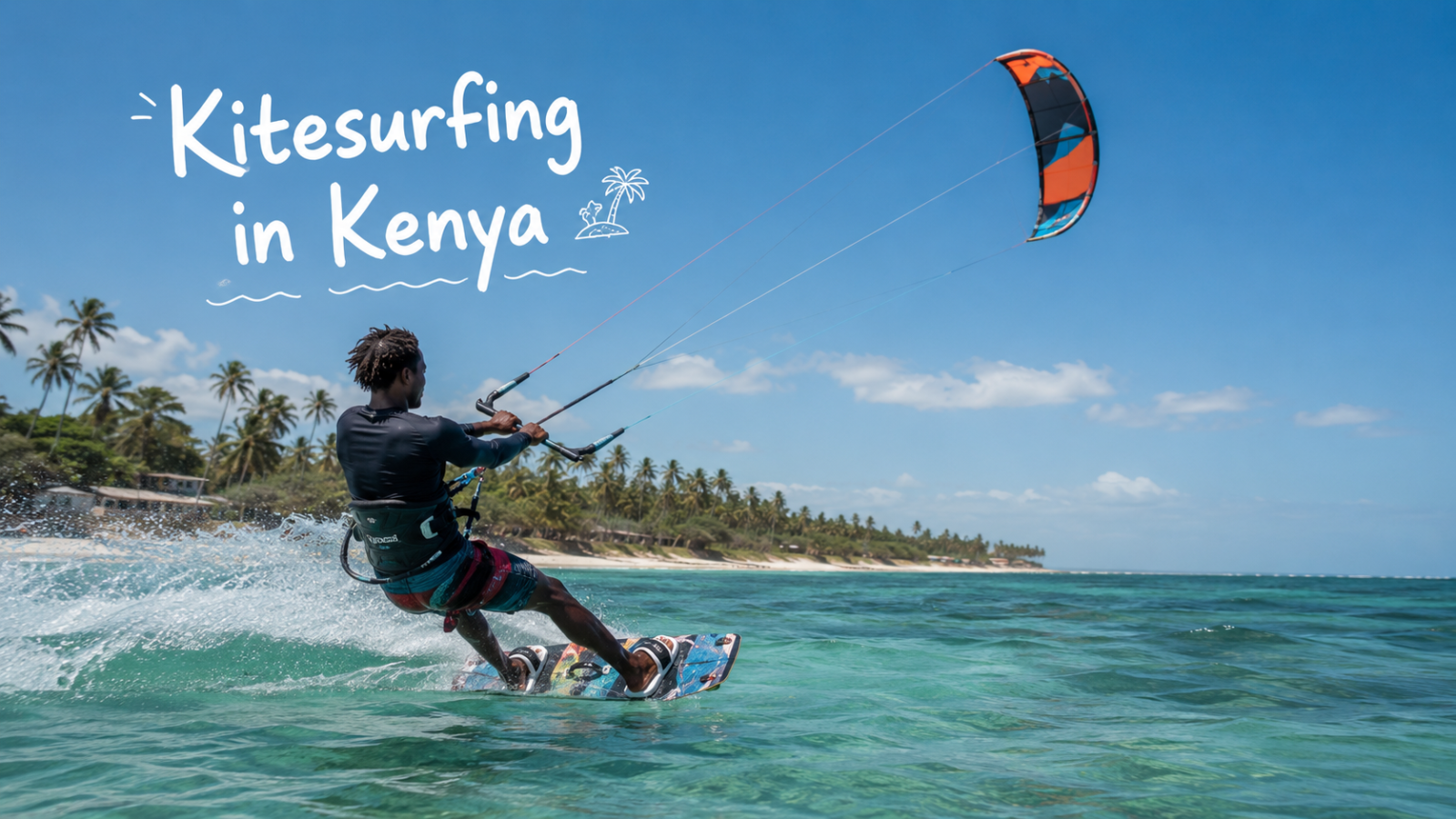

Two reliable wind seasons, two distinct coastal regions, and a small set of credible schools. Kitesurfing in Kenya is genuinely strong for travellers wanting it combined with safari — and weaker than dedicated destinations like Zanzibar’s Paje for travellers prioritising kite-only trips.
The position no one quite states clearly
Kenya is a credible kitesurfing destination. It is not the strongest single kite destination in East Africa — that title still belongs to Zanzibar’s Paje, with consistent wind, dedicated international kite tourism, and the infrastructure depth that comes from being a destination people specifically travel to. Kenya is, however, the strongest ‘kitesurfing-as-part-of-safari’ product in East Africa, and for many travellers that combination is more valuable than the pure-kite optimum.
This article works through the honest comparison: what Kenya’s kitesurfing actually delivers, where (Diani’s Galu Beach versus Watamu’s Plot 40 Sandbar), when (the Kaskazi and Kusi wind seasons), through which credible schools (Tribe Watersports, KiteMotion, H2O-Extreme), and at what cost. It also positions Kenya against the dedicated alternative (Zanzibar) for travellers choosing between them. The marketing for both destinations overstates their respective cases; the truth sits somewhere between.
Permit dependencies, school accreditation, and operator-level safety practice have been verified against IKO (International Kiteboarding Organization) and BKSA (British Kitesports Association) sources as of mid-2026. Wind data is drawn from school weather stations and the 2025 Kaskazi-Kusi season reports.
Kenya kitesurfing is the right product for safari travellers wanting active beach time on the same trip. It is the wrong product for kite-specialist travellers who would prefer a dedicated destination. The cost of being on the wrong side of this choice is high — kite-priority travellers booking Kenya will be disappointed; safari-plus-kite travellers booking Zanzibar will be over-paying for kite infrastructure they did not need.
| KASKAZI SEASON (NE TRADE WINDS) December – March; 16–22 knots; smoother conditions; beginner-friendly | KUSI SEASON (SE TRADE WINDS) Mid-June – early September; 18–25 knots; stronger conditions; advanced-rider season |
| WATER TEMPERATURE YEAR-ROUND 24–28°C — no wetsuit needed | PRIMARY KITE SPOTS Galu Beach (south of Diani) and Watamu’s Plot 40 Sandbar (north coast) |
| ESTABLISHED SCHOOLS (DIANI/GALU) Tribe Watersports, KiteMotion, H2O-Extreme — all IKO certified | INDICATIVE LESSON COST $80–120/hour for one-on-one IKO instruction; multi-hour packages discounted |
| ACCOMMODATION RANGE $70/night budget (Galu Backpackers) to $400+/night premium (Almanara, Alfajiri) | DISTANCE FROM NAIROBI Diani: ~1hr flight from Wilson to Ukunda; Watamu: ~1hr 20min flight to Malindi then 20min transfer |
The two seasons for Kitesurfing in Kenya, in technical detail
Kenya’s coast is governed by the East African monsoon system — the Kaskazi (north-east trade winds) blowing from December to March, the Kusi (south-east trade winds) from approximately mid-June to early September. The transition periods (April-May and October-November) are characterised by lighter and less reliable wind. Understanding which season suits you matters more than choosing the spot.
Kaskazi (December – March): the beginner season
The Kaskazi delivers smoother, more consistent trade winds averaging 16-22 knots. The wind is side-onshore at most Kenya spots — the safest direction for kitesurfing because it pushes riders parallel to or slightly away from the beach rather than out to sea. Water is glass-smooth in the lagoons at low tide, perfect for learning and freestyle progression. The Kaskazi is the season most kite schools market most heavily — it produces the highest student volumes and the strongest learning outcomes.
December-January is peak tourist season, which means higher accommodation prices and busier beaches. February-March produces similar wind conditions with lower tourism volume — for travellers prioritising the kite experience over the social environment, late February to mid-March is the sweet spot.
Kusi (mid-June – early September): the advanced season
The Kusi delivers stronger, slightly cooler winds averaging 18-25 knots. The wind is south-easterly, producing wave conditions on the reef offshore that Kaskazi flatwater riders rarely see. For wave riders and experienced kiters, this is the more rewarding season — the reef in front of Galu Beach produces clean swell during Kusi, and Watamu’s Plot 40 area offers reef-wave riding for advanced students.
July-August can occasionally see wind at the upper end of Kenya’s range (gusts to 30+ knots), which is too much for novice kiters. The Kusi also brings cooler air temperatures (the East African winter), and some travellers find the persistent strong wind less enjoyable as a beach experience. For pure kite-priority travellers, the Kusi is the technical peak; for kite-plus-beach-relaxation travellers, the Kaskazi suits better.
The shoulder seasons (April-May and October-November)
Wind in the shoulder periods is unreliable. April-May overlaps with Kenya’s long rains, which produce overcast skies and wind transitions. October-November sees the short rains, with similar unreliability. Schools remain open but lesson cancellations are more frequent. Travellers planning a kite-priority trip should avoid these windows. Travellers willing to accept wind uncertainty in exchange for low-season pricing and minimal crowds may still find shoulder seasons worthwhile.
THE STRUCTURAL TAKE ON SEASONS Choose Kaskazi (December-March) for learning, smooth water, and the social tourism scene. Choose Kusi (June-September) for advanced riding, waves on the reef, and the wilder energy of stronger wind. Avoid the shoulder seasons unless you have low expectations and high schedule flexibility.
Where to actually go — Diani vs Watamu
Two principal kite destinations on the Kenya coast. They are not interchangeable — each suits different traveller profiles.
Diani Beach / Galu Beach (south of Mombasa)
Diani is Kenya’s principal beach tourism destination. The 17km stretch of white sand from Diani Beach proper down to Galu Beach in the south is Africa’s leading beach destination (per the World Travel Awards, won six years in a row according to Galu-based H2O-Extreme). Kitesurfing infrastructure clusters at Galu Beach — the southern, less-developed end — where Tribe Watersports’ Pro Center, KiteMotion’s Soulbreeze Resort base, and H2O-Extreme’s Blue Marlin Hotel location operate. The kite community concentrates here for a reason: Galu’s beach is wide, the side-onshore wind hits clean (no high-rise hotels disrupting airflow as happens in central Diani), the lagoon at mid and low tide is shallow and forgiving, and the reef offshore produces wave riding during Kusi season.
Diani-Galu suits travellers wanting kitesurfing combined with mainstream beach amenities. Accommodation choice is wide — from Galu Backpackers and Eco-Lodge (budget, kite-community focused) through mid-tier hotels like Pinewood Beach Resort and Sands at Nomad, up to premium options Almanara, Alfajiri, AfroChic, and Kinondo Kwetu. Restaurants and bars are abundant. The social atmosphere is the strongest in Kenya’s kite scene. Family kite trips work here — non-kiting partners and children have plenty of amenities.
Watamu (north coast)
Watamu sits roughly 110km north of Mombasa, 1hr by road or accessible via Malindi airport (20min from Watamu). The kite location is the Plot 40 Sandbar — a unique geographic feature where the tidal sandbar produces mirror-flat water during Kaskazi season and reef-wave riding during Kusi. Tribe Watersports operates a Pro Center at Garoda and Gecko Resort on this stretch.
Watamu suits travellers wanting more boutique, less commercial beach atmosphere. Accommodation includes Hemingways Watamu (premium), Medina Palms (mid-tier with strong design aesthetic), Sun n Sand Beach Resort (family-friendly mid-tier), and a range of villas and smaller properties. Watamu Marine National Park is on the doorstep, producing world-class snorkelling and diving as kite-day-off activities. Arabuko-Sokoke Forest’s birding (Article #47) sits 20 minutes inland. The travellers who choose Watamu over Diani consistently report that the trade-off — slightly less kite scene, more beach atmosphere and natural attractions — was the right one.
Comparison
| Dimension | Galu Beach / Diani (south) | Watamu (north) |
| Distance from Nairobi | ~1hr flight to Ukunda | ~1hr 20min flight to Malindi + 20min transfer |
| Kite scene density | Highest in Kenya — clustered schools, active social scene | Moderate — single-school presence, quieter atmosphere |
| Beach quality | Wide, white-sand, side-onshore wind clean at Galu specifically | Smaller bays, Plot 40 Sandbar uniquely flat at Kaskazi low tide |
| Off-kite activities | Diani village, restaurants, bars, Shimba Hills nearby | Watamu Marine Park snorkelling/diving, Arabuko-Sokoke birding, Mida Creek |
| Family suitability | Strong — wide amenities, multiple lodge tiers | Strong but smaller scale — better for families wanting quieter setting |
| Premium lodge availability | Almanara, Alfajiri, AfroChic, Kinondo Kwetu | Hemingways Watamu, Medina Palms |
The schools and what to ask before booking
Kenya’s kitesurfing instruction is concentrated in a small number of established schools. Quality is generally high; the differences are stylistic and capacity-related.
Tribe Watersports
The longest-established kite school in Kenya, with over 20 years of operation. Awards include a TripAdvisor Travellers’ Choice Award and recognition as Kenya’s only Slingshot Pro Center.
Two principal locations: Galu Beach (at Galu Backpackers and Eco-Lodge) and Watamu (Garoda and Gecko Resort, on the Plot 40 Sandbar). IKO and BKSA certified, with rescue boat support on the water during lessons. Strong reputation for both beginner instruction and advanced coaching. Pricing $80-120 per hour for one-on-one IKO lessons; multi-hour packages reduce per-hour rates. Equipment: top-of-line gear from Slingshot, Ozone, Mystic. Tribe is the default safe choice for first-time bookers.
KiteMotion
Operating in Diani since 2015, with three Kenya bases — Flamboyant Hotel (central Diani), Soulbreeze Resort (Galu Beach), and Simba Oryx. IKO certified instructors with insurance and live meteo station at the Flamboyant location (free public access to the wind data). KiteMotion’s distinguishing features: the radio-based instruction (instructor talks to student via radio during the lesson, dramatically improving feedback speed), the multi-base setup (you can switch between locations if wind shifts), and a Sicily school for travellers wanting to continue progression in Europe. Pricing similar to Tribe. KiteMotion is the option for travellers who specifically value technological instruction quality (radios, live meteo, structured lesson plans).
H2O-Extreme
Based at Blue Marlin Hotel on Galu Beach. One of three International Kiteboarding Organization centers in Kenya, with IKO-certified instructors and radio-based coaching. Includes e-foiling and wing foiling alongside traditional kitesurfing. Equipment from Ozone, Mystic, Gong, Prolimit, and Lieuwe boards. Operating 7 days a week from 9am-6pm. H2O-Extreme is the option for travellers who specifically want broader watersports access (foiling, wing) alongside kitesurfing — the school’s facility configuration supports cross-discipline progression in a way the more kite-focused schools do not.
The credibility test for kite schools
Five questions that distinguish credible kite schools from operators marketing without substance.
- IKO or BKSA certification status? All three Kenya schools above are certified. A school without one of these certifications should not be trusted with safety-critical lessons.
- Rescue boat or safety boat support? Lessons in open water require a rescue boat or a clear shore-based rescue protocol. Schools that hedge on this should not be booked.
- Instructor-to-student ratio? One-on-one is standard for the first 6-10 hours of instruction. Two-students-per-instructor is acceptable for more advanced lessons but should be priced accordingly.
- Equipment age and brand? Top-tier brands (Ozone, Slingshot, Cabrinha, Naish, Duotone, F-One) with 2-3-year-old equipment is the expected standard. Schools using older or unbranded gear should explain why.
- Multi-day progression plan? Strong schools will sketch a learning trajectory — typically 8-12 hours to independent riding for an average student. Schools that promise faster results are either selling false expectations or risking student safety.
THE LESSON COST REALITY Kitesurfing instruction is expensive everywhere in the world because of the equipment, the safety infrastructure, and the one-on-one teaching model. Kenya at $80-120 per hour is competitive with global pricing but not cheaper. A 10-hour learning package will cost $700-1,000 plus lodging. Travellers expecting Africa-discount pricing on a global premium activity will be disappointed.
Gear, physical preparation, and what to bring
Three practical considerations that most pre-trip articles do not address adequately.
What the schools provide
Established Kenya kite schools (Tribe, KiteMotion, H2O-Extreme) supply all the technical equipment a student needs: kite (typically 7m to 12m sizes available depending on wind), board, bar, lines, harness, helmet, and impact vest. Equipment is replaced regularly and maintained between lessons. Students do not need to bring kites or boards unless they specifically want to ride their own gear. Travellers progressing to intermediate level may want to consider bringing their own harness for fit consistency, but this is optional, not essential.
What to bring yourself
Rashguard with UPF 50 protection (the tropical sun on the water is fierce — surface burns are the most common kite-trip injury), board shorts or longer swim shorts (longer protects the back of the legs from harness rub), reef-safe sunscreen (SPF 50, water-resistant), polarised sunglasses with retainer strap, a wide-brimmed hat or cap with strap (the wind takes anything not secured), Velcro-strapped sandals (Tevas, Chacos, or similar for moving between beach and water), small dry bag for phone and valuables on the beach.
Optional but useful: an action camera (GoPro) with kite-helmet mount, ear plugs (wind-driven water is the principal cause of swimmer’s ear in long kite sessions), a kite-specific buoyancy aid if you have one (the school provides one but personal fit matters).
Physical preparation
Kitesurfing is more physically demanding than beginners expect. The first 3-4 days of learning produce significant strain on the forearms (from gripping the bar), the lower back (from absorbing the kite’s pull), and the legs (from balancing on the board and absorbing chop). Travellers without recent gym work or active sport may struggle physically through the first half of a 10-hour learning programme, even at the technically appropriate pace. Suggested preparation: 8-12 weeks pre-trip of grip strength work, core conditioning, and lower-back strengthening. Travellers in good general fitness can skip this preparation but should expect to be tired in the evenings during the first 4-5 days.
The hidden cost — physiotherapy and recovery
Long kite days produce muscle strain that benefits from active recovery. Most quality Kenya kite destinations have access to massage and basic physiotherapy services within walking distance — Diani’s mid-tier hotels typically include spa services, and Watamu has independent practitioners. Budget $30-60 per session for sports massage. For travellers doing 6+ kite days in a single trip, scheduled massage on the rest days dramatically improves overall riding output.
THE 'PHYSICAL REALITY' FRAMING Kitesurfing looks effortless when the experts do it; it is genuinely demanding when beginners attempt it. Travellers should arrive prepared for muscle fatigue, sunburn risk, and the physical learning curve that comes with any new water sport. Most students need 8-12 actual riding hours to reach independent water riding; this typically takes 4-6 calendar days of lessons given weather and rest requirements.
The Zanzibar comparison, honestly
Paje on Zanzibar’s east coast is the dedicated alternative for travellers prioritising kitesurfing. The honest comparison:
Zanzibar’s Paje delivers more consistent wind (the Kaskazi blows reliably for 4+ months at 18-25 knots), broader school infrastructure (dozens of operators competing on price), a more international kite-tourism scene (which produces both a stronger social environment and the homogenisation that comes with dedicated kite destinations), and a more developed off-water amenities ecosystem (kite-specific accommodation, gear stores, after-kite venues). For travellers whose trip is fundamentally about kitesurfing, Paje is the structurally stronger choice.
Kenya delivers the same physical product (warm water, reliable seasonal wind, side-onshore conditions) with lower kite-tourism density (which suits some travellers and not others), better off-kite alternatives (the safari combination is the single biggest argument for Kenya), simpler visa logistics for travellers already in Kenya, and a more diverse Kenya coast aesthetic that suits travellers wanting variety. For travellers whose trip is fundamentally about safari with kitesurfing as one component, Kenya is the right answer.
The cost difference is smaller than is sometimes suggested. Mid-tier Paje accommodation runs $80-150 per night; mid-tier Diani-Galu accommodation runs $80-200 per night. Lesson costs are roughly comparable. The decisive factor is what the trip is actually for.
Hidden-gem aspects
Three aspects of Kenya kitesurfing that the standard marketing under-emphasises.
The Watamu sandbar quirk
Plot 40 Sandbar at Watamu produces uniquely flat water during the Kaskazi season’s mid-tide windows. The geographic feature — a low tidal sandbar inside the reef — creates a small natural lagoon that becomes glass-smooth in 16-knot winds, ideal for early-progression freestyle work (jumps, transitions, foundational tricks). Few kite spots globally offer this specific combination of conditions. Travellers progressing past beginner level should specifically seek out Plot 40 during their trip if learning at Diani-Galu, even as a 2-3 night extension.
The kite-and-safari week
The structurally strongest Kenya kitesurfing trip combines 4-5 days at Diani-Galu or Watamu with a 5-7 night Kenya safari. Internal flights connect the segments efficiently — Diani’s Ukunda airstrip and Watamu’s Malindi airport both have direct charter flights to Mara conservancies and Laikipia. Total trip cost mid-tier: $4,500-7,500 per person for a 10-day combination. This produces a trip that no other African destination quite matches — kite-priority travellers comfortable with the format will return with both portfolios.
The Tropic Air helicopter access
Tropic Air operates helicopter flights from Diani to Kenya coast and inland destinations, including bespoke routings into the Mara and Laikipia. For premium-tier travellers, this opens up multi-day routing that would otherwise involve uncomfortable road transfers or schedule constraints. The cost is real (helicopter charter pricing runs $1,500-3,000 per hour depending on aircraft), but for high-value combination trips, it removes the principal logistical friction.
Honest limits
Three things Kenya kitesurfing cannot match.
First, the dedicated kite-destination depth. Paje, Cumbuco (Brazil), Tarifa (Spain), and Mauritius are kite destinations in a way Kenya is not. Travellers committed to kitesurfing as their primary travel focus over multiple years will eventually find Kenya’s relative shallow infrastructure limiting. The school depth, the gear stores, the kite-specific accommodation, the year-round destination community — Kenya does not offer these at the level dedicated destinations do.
Second, the wind reliability at the extremes. Kenya’s Kaskazi delivers about 75 percent reliable wind days during peak season; Paje delivers about 85 percent. The difference is real for travellers booking short trips where lost days matter materially. Longer trips (10+ days) absorb the variance; shorter trips do not.
Third, the wave product. Kenya has reef-wave conditions during Kusi season but does not compete with Cape Verde, Sumbawa, or Brazil for wave-priority kite trips. Travellers prioritising wave riding should look elsewhere.
THE PICK FOR THE KENYA KITE-CURIOUS TRAVELLER For travellers wanting kitesurfing combined with safari, Kenya is the right choice. Book 4-5 nights at Galu Beach (Tribe Watersports for established quality, KiteMotion for tech-forward instruction) or at Watamu (Tribe Watersports' Plot 40 location), plus 5-7 nights of Kenya safari. For travellers wanting pure kitesurfing, book Paje on Zanzibar — Kenya is not the optimal pure-kite destination, and trying to make it serve that purpose will produce a worse trip than the dedicated alternative.
Who this article is for, and who should look elsewhere
Travellers wanting kitesurfing combined with Kenya safari — this article is the planning framework. The combination trip is one of East Africa’s strongest active-plus-wildlife products.
Travellers wanting their first kitesurfing experience — Kenya works well for learning, particularly during the Kaskazi season at Galu Beach with Tribe Watersports or KiteMotion. The instruction quality is high, the conditions are forgiving, and the social environment is welcoming.
Kite-priority specialist travellers — Zanzibar’s Paje, Mauritius’s Le Morne, or further-afield destinations (Cape Verde, Brazil) will serve you better. Kenya is the wrong primary destination for kite-specialist trips.
Travellers wanting wave-priority kitesurfing — Cape Verde, Sumbawa, or Maui are the correct destinations. Kenya’s reef waves are real but not at the level wave-specialists need.
Tell us what you are looking for, and we will tell you honestly whether we can deliver it — and if we cannot, we will tell you who can.
RELATED READING
- Kenya to Zanzibar: the Paje comparison alongside the broader coastal extension
- Kenya in December: the Kaskazi peak season alongside the festive coast
- Birdwatching in Kenya: Arabuko-Sokoke and Mida Creek for kite-day-off birding
- Kenya food guide: the Swahili coast cuisine that the kite-trip extension accesses
- When is the Mara too crowded: why a coast-and-safari split avoids peak congestion