
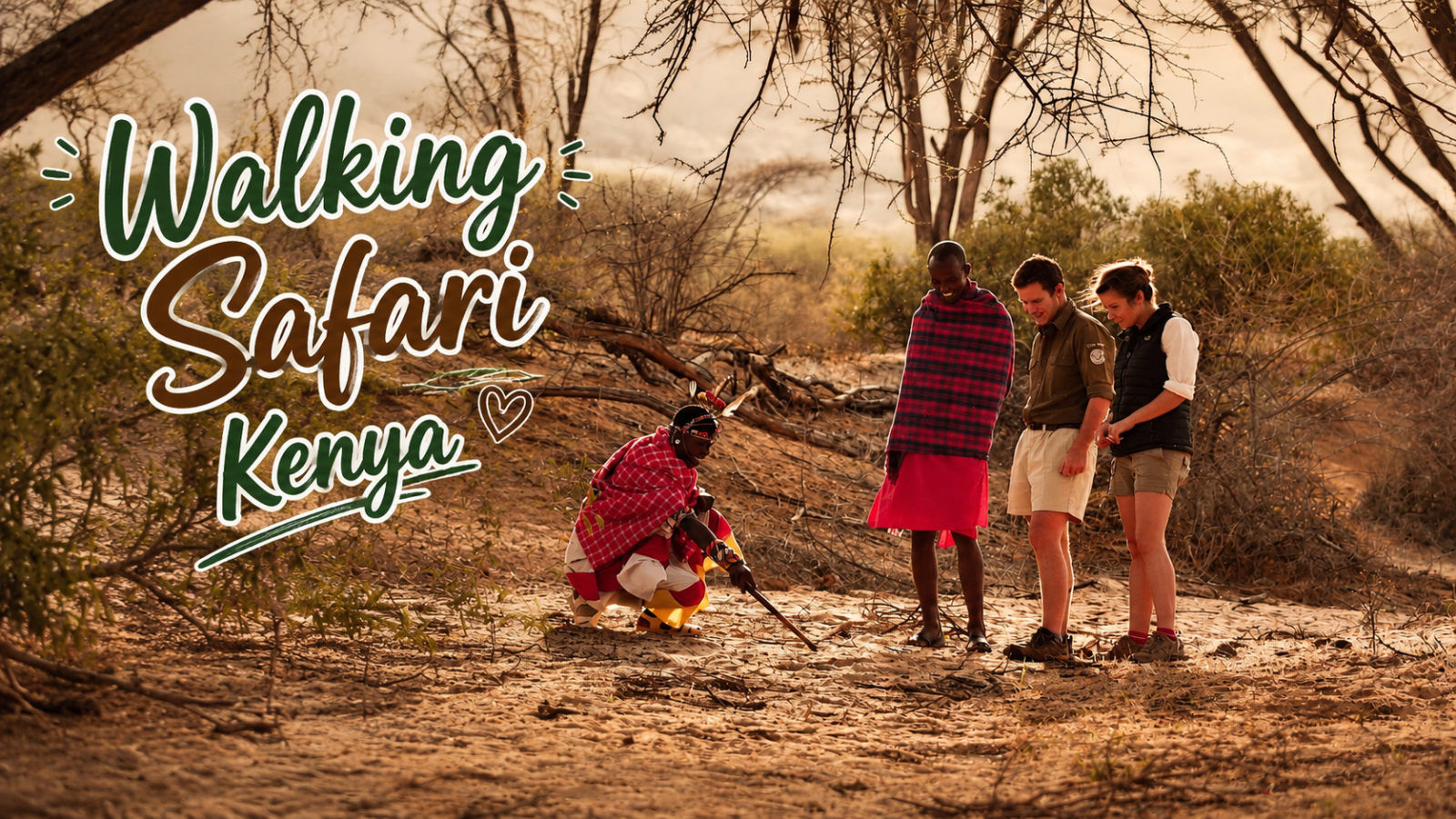

A Walking Safari Kenya is not a substitute for a game drive — it is a fundamentally different way of engaging with the wildlife landscape, and the best ones are some of the most powerful experiences available in African wildlife travel. This is the honest guide to what walking safaris actually deliver, where to do them, and how to choose well.
Walking safaris are the most underbooked premium activity in Kenya
The standard Kenya safari is a vehicle activity. Twice-daily game drives in modified Land Cruisers; mornings on the move, afternoons resting in camp, evenings on sundowner drives. The format is so universal that most travellers do not consider an alternative — and most operators do not actively recommend one. Walking safaris in Kenya remain a specialist activity for a small minority of travellers, despite being available across most conservancies and ranches in the country and despite consistently producing some of the strongest single-experience moments on a typical itinerary.
The under-recommendation has a logical cause. Walking safaris are slower, more physically demanding, and inherently smaller-scale than vehicle drives — you can put 6 guests in a Land Cruiser but you cannot reasonably take 6 guests on a walking safari with one guide. The unit economics favour the vehicle. The unit economics, however, do not measure what the walker actually experiences.
The shift from vehicle to foot changes the sensory profile of the wildlife encounter entirely: ground awareness replaces vehicle window; tracking and reading sign replaces driving to the next sighting; the body knows it is in the bush rather than observing it. For the right traveller, the walking element of a Kenya trip is the part they remember most clearly five years later.
This guide takes the position that walking safaris should be a deliberate component of most serious Kenya itineraries — not necessarily a full multi-day walking trip, but at least a half-day walking element built into the trip alongside the vehicle game drives. It also names the places where walking safari is actually allowed (almost nowhere inside KWS national parks; conservancies and ranches almost everywhere), the formats available, and the specific operators who do walking better than the rest.
Quick reference — where Walking Safari Kenya is and isn’t allowed
| WALKING PERMITTED IN MAASAI MARA RESERVE No — vehicle only | WALKING PERMITTED IN AMBOSELI, TSAVO, SAMBURU RESERVES No (some designated zones excepted) |
| WALKING PERMITTED IN MARA CONSERVANCIES Yes — all major conservancies | WALKING PERMITTED IN LAIKIPIA CONSERVANCIES Yes — all |
| WALKING PERMITTED IN HELL’S GATE NP Yes — self-guided, no large predators | ARMED RANGER REQUIRED (WHERE ALLOWED) Yes — always, in all big-game areas |
| TYPICAL WALKING SAFARI DURATION 2–4 hours (half-day); 4–7 days (multi-day) | GUIDE QUALIFICATION STANDARD KPSGA Silver or Gold for premium walking |
Why walking changes what wildlife is
The case for walking is not aesthetic. It is sensory and epistemic. Eight specific things change between a game drive and a bush walk, and understanding them is the difference between a competent first walking experience and a transformative one.
Ground awareness becomes the primary sense
In a vehicle, you watch the landscape pass at speed. On foot, you read it. Within an hour of starting to walk, you notice tracks, scat, dragged grass, broken vegetation, recent dust — the lexicon of wildlife sign that game drives generally do not surface. A senior walking guide reads this lexicon continuously, and the experience of having sign explained in real time fundamentally changes how you see subsequent vehicle game drives. The wildlife was always there; the walking developed your capacity to register it.
Wind direction matters
Vehicles are noisy and visually obvious; wildlife responds primarily to sight at vehicle range. On foot, the human is much less visible but generates scent. The guide constantly checks wind direction, repositioning the group so that scent is carried away from the wildlife rather than toward it. Watching this in action — feeling the wind on your face shift through trees, watching the guide adjust angle, recognising that the wildlife you are about to encounter has no idea you are there — is a structural element of bush awareness that vehicles cannot teach.
Distance has different meaning
A lion at 200 metres from a vehicle is a close sighting. A lion at 200 metres from a walking group is genuinely the limit of acceptable proximity. The compression of safe-distance norms changes the emotional weight of every wildlife encounter. A buffalo at 150 metres on foot has serious presence; the same buffalo at 50 metres from a vehicle is a benign observation. Walking trains a kind of distance-respect that vehicle game viewing does not.
Time slows down
A vehicle game drive covers 20-40 kilometres in a morning. A walking safari covers 4-6 kilometres in the same time. The reduced ground covered is the entire point — the walking pace gives the landscape time to register. Single sightings can absorb an hour. Bird songs that pass unnoticed from a vehicle become individually identifiable. The intricate ecological texture of the landscape — termite mounds, dung beetle activity, ant trails, oxpecker birds following buffalo — comes into focus.
The smaller scale of wildlife becomes accessible
Walking safaris are particularly strong for everything below cat size — antelope behaviour, baboon troops, mongoose families, the various civets and genets, the bird species that game drives often miss. The ‘micro-universe’ that Kicheche and other walking-focused operators reference is genuine: walking opens up entire sections of the wildlife roster that vehicle-only trips never access.
Tracking and reading become possible
On a vehicle drive, you arrive at a sighting. On a walking safari, you sometimes track to a sighting — reading fresh tracks, following dragged grass, identifying scat freshness, and arriving at the wildlife through a process of inference. The tracking does not always succeed; the wildlife may have moved on, the trail may go cold. The process itself is the experience, and it is one of the most engaging bush activities available anywhere.
The presence of risk is real
Walking with armed ranger escort is overwhelmingly safe — incidents on commercial walking safaris in Kenya are very rare — but the underlying potential for risk is real, and being on foot in big-game country induces an alertness that vehicle safaris cannot. The combination of guide skill, ranger backup, wind reading, and group discipline produces a controlled experience, but the awareness that controlled does not mean theoretical is part of what makes walking different.
The communal element changes
Vehicle game drives are inherently group activities focused outward — eight people in a vehicle all looking at the same lion. Walking safaris are smaller (usually 4-6 guests maximum) and the group becomes a working unit moving through space together. The communication style, the spatial discipline, the shared attention to the guide’s signals — all produce a stronger group cohesion than the parallel-observation format of vehicle game viewing.
Where walking is actually allowed in Kenya
The single most important practical fact about walking safaris in Kenya: walking is broadly prohibited inside Kenya Wildlife Service-managed national parks and county-managed national reserves. The Maasai Mara National Reserve, Amboseli National Park, Tsavo East and West, Samburu and Buffalo Springs Reserves, Lake Nakuru National Park — none of these permit walking activity within their boundaries. Walking happens almost entirely in private conservancies, community conservancies, and private ranches that operate under different regulatory regimes. The geographic options:
| Location | Walking format | What you actually get |
| Mara conservancies (Olare Motorogi, Naboisho, Mara North, Ol Kinyei) | Half-day bush walks; some overnight fly-camping | Big cat country on foot with KPSGA Silver/Gold guides plus armed ranger. Resident lion prides occasionally seen at safe distance. Strong predator-tracking content. |
| Ol Pejeta Conservancy (Laikipia) | Rhino tracking on foot · Lion tracking · Conservation immersion | The signature walking safari experience in Kenya. Black rhino approach on foot with armed rangers. Lion-tracking by telemetry. Conservation programme depth. |
| Lewa Wildlife Conservancy | Walking · Camel safari · Horseback | UNESCO World Heritage site. Walks focused on rhino conservation, Grevy’s zebra, and the conservation infrastructure that has made Lewa a model for the continent. |
| Sera Conservancy (Samburu) | Black and white rhino tracking on foot | The only community-run rhino sanctuary in East Africa. Walking with armed Samburu rangers across semi-arid scrub. Distinctive sensory environment. |
| Laikipia private ranches (Borana, El Karama, Ol Lentille, Sosian, Laikipia Wilderness) | Multi-day walking, fly-camping, horseback combinations | The most flexible walking safari terrain in Kenya. Multi-day fly-camp routes possible. Horseback and camel-supported walking options. Genuine wilderness immersion. |
| Karisia Hills (with camels) | Multi-day camel-supported walking safari | Karisia Walking Safaris’ speciality. 4-7 day routes through Laikipia and northern Kenya with camels carrying camp. The most authentic ‘walk into the wild’ format in East Africa. |
| Hell’s Gate National Park | Self-guided walking and cycling | Unusual KWS-managed park where walking and cycling are permitted without an armed guard. No predators present; zebra, giraffe, gazelle, dramatic geology. |
| Crescent Island (Lake Naivasha) | Self-guided walking among habituated wildlife | Private sanctuary, no large predators, allows close-range walking among zebra, giraffe, antelope. The most accessible ‘walk with wildlife’ day-trip option in Kenya. |
Hell’s Gate and Crescent Island — the unique exceptions
Two locations in Kenya allow walking without armed guard because they do not hold large predators. Hell’s Gate National Park, near Lake Naivasha, is a KWS-managed park (one of the very few that permit walking) with dramatic geology, basalt cliffs, the Olkaria geothermal features, and resident zebra, giraffe, eland, baboon, and several antelope species. No lions, leopards, or elephants in significant numbers. Self-guided walking and cycling are permitted; guided walking is available through local operators. Crescent Island on Lake Naivasha is a private sanctuary on a curved peninsula where wildlife (zebra, giraffe, hippo at the water’s edge, eland, antelope) is unusually habituated to walking visitors. Both are accessible as day trips from Naivasha-area lodges or from Nairobi.
The five walking safari experiences worth the trip
1. Rhino tracking on foot at Ol Pejeta
Ol Pejeta Conservancy in Laikipia holds Kenya’s largest black rhino population (165+ individuals) and offers the most established on-foot rhino tracking programme in East Africa. The walk typically starts before dawn with armed rangers, tracking by foot through Ol Pejeta’s open grassland and acacia woodland to approach a known rhino on foot. The encounter — closing in on a 1,500kg black rhino at walking range, reading the wind, watching the animal acknowledge your presence — is one of the most concentrated single experiences in African wildlife tourism. Available through most Ol Pejeta lodges; Kicheche Laikipia, Porini Rhino Camp, and Ol Pejeta Bush Camp all run strong programmes.
2. Sera Conservancy black and white rhino tracking
Sera, in the wider Samburu ecosystem, is the only community-run rhino sanctuary in East Africa and the only place in northern Kenya where you can track both black and white rhinos on foot. The experience is structurally different from Ol Pejeta — semi-arid scrubland rather than open grassland; Samburu rangers leading the tracking; smaller scale (Sera holds 26 black rhinos and 4 white rhinos as of 2025). Saruni Rhino is the only lodge inside the sanctuary. The community-ownership dimension adds meaningful conservation context: 100% of Saruni Rhino’s revenue contributes to the conservancy’s operations.
3. Karisia camel-supported multi-day walking
Karisia Walking Safaris, based in the Karisia Hills of Laikipia, runs 4-7 day walking expeditions with camels carrying the camp. The format is the closest thing in modern East African travel to the classic explorer-era walking expedition: each day’s walk of 10-20km through varied Laikipia terrain (forest, escarpment, plains, riverine valleys), with camp pitched in a different location each night. The camels carry tents, kitchen, bedding, and supplies, freeing walkers to carry only daypacks. Wildlife encounters include elephant, buffalo, plains game, and the Laikipia conservancy predator populations. For travellers seeking the deepest version of the walking safari, Karisia is the strongest single operator in Kenya.
4. Mara conservancy bush walks
The Mara conservancies — Olare Motorogi, Naboisho, Mara North, Ol Kinyei — all offer walking activity adjacent to standard vehicle game drives. The format is usually a half-day walk from camp with KPSGA-rated guide plus armed ranger, focused on ecological reading rather than predator approach. Resident lion prides are occasionally encountered at safe distance (300m+), which is a structurally different sighting from the vehicle version. Kicheche, Saruni, Asilia, Encounter Mara, and Offbeat properties all run strong walking programmes. The walking is rarely the primary activity at these properties but adds meaningfully to a multi-night stay.
5. Laikipia private ranch fly-camping
Several Laikipia ranches — Sosian, Borana, El Karama, Ol Lentille, Laikipia Wilderness — offer overnight fly-camp walking safaris where guests walk to a remote pre-prepared camp, sleep in basic tents, and walk again the next day. The format is somewhere between the day-walking-from-lodge model and the full Karisia expedition. Laikipia Wilderness in particular is operated by a ‘true bushman’ (Steve Carey) and offers some of the most hands-on walking guiding in the country. For travellers seeking authentic bush immersion without the multi-day commitment of Karisia, the Laikipia fly-camp model is the strongest middle ground.
How to choose a walking safari operator — five questions
The single biggest determinant of walking safari quality is the guide. Guide rating, experience, and tenure in the specific landscape matter substantially more on a walking safari than on a vehicle drive — partly because the guide is reading sign in real time, partly because the guide is making safety decisions continuously, partly because the educational content of a walking safari is delivered through the guide’s running commentary rather than through wildlife visibility alone. Five questions to ask any operator before booking:
- How long has the lead guide worked in this specific landscape? Walking guides need landscape-specific tenure. A guide with 15 years in the Mara may not be the right guide for Laikipia. Multi-year tenure in the specific area is what produces the deep ecological reading that makes walking work.
- What is the armed ranger arrangement? Armed ranger escort is mandatory for walking safaris in big-game country in Kenya. The ranger is typically separate from the guide. Operators where the same person is both guide and armed escort are corner-cutting; the dual-role compromises both functions.
- What is the maximum walking group size? Six guests is the upper limit for productive walking. Larger groups become difficult to manage safely, fail to maintain wind discipline, and lose the small-group communication that makes walking work.
- What backup arrangements exist for medical or wildlife incidents? Reputable operators have rapid-response vehicles within radio range, evacuation procedures pre-arranged with AMREF Flying Doctors or equivalent, and ranger backup beyond the immediate walking escort. Operators who treat this casually are signalling something material.
What to wear and bring for a walking safari
Walking safari gear is simpler than mountain trekking gear but specific. The list below covers a typical half-day or full-day walk; multi-day expedition gear (Karisia, Laikipia fly-camp) adds layers of complexity around camping kit that the operator usually provides.
- Neutral-coloured clothing (khaki, olive, brown, grey). Bright colours alert wildlife and bright white reflects light. Patterns are fine; saturated colours are not. Long sleeves and long trousers prevent insect bites and brush abrasions.
- Sturdy walking shoes or low hiking boots — broken in. New boots blister on the first walk. Trail runners work for shorter walks; full hiking boots for multi-day routes or rocky terrain.
- Hat with brim. Sun exposure on a 4-hour walk is substantial. Wide-brim hats work better than caps.
- Sunglasses with strap. Equatorial sun is intense; sunglasses are not a fashion accessory but a functional requirement.
- High-SPF sunscreen. UV exposure at the typical 1,500-2,000m walking altitude is dramatically higher than at sea level.
- Insect repellent. Long sleeves and trousers reduce dependence on it, but morning and dusk walks attract mosquitoes and flies.
- Daypack with 2 litres of water capacity. Walking activity at moderate temperatures dehydrates faster than vehicle activity at the same temperature; persistent hydration is essential.
- Binoculars (8×42 or 10×42 are standard). The single most useful piece of optical gear on a walking safari. The wildlife is often at a respectful distance and binoculars are how the detail registers.
- Camera with appropriate lens. The walking-safari subject mix favours wider focal lengths than vehicle game drives — 24-70mm for landscape and tracking content; 70-200mm for closer wildlife; longer lenses are useful but heavy on multi-hour walks.
- Small first aid kit (blister plasters in particular). Operators carry full kits; the personal kit handles incidental needs.
Walking safari etiquette — what your guide actually needs from you
Walking safaris work because of a specific behavioural contract between guide and group. The contract is rarely articulated explicitly but is the difference between a productive walk and a frustrating one for the guide. Eight specific behaviours matter:
- Walk single file behind the guide. The guide reads the wind and the terrain; deviating from the line undermines both.
- Stay quiet. Voice carries. Wildlife responds to voice well beyond visible range. Conversations are for breaks, not for moving.
- Move slowly and deliberately. Sudden movements register as predator behaviour to nearby wildlife. The guide’s pace is set deliberately; match it.
- Stop when the guide stops. Hand signals are common. The ‘fingers up’ stop signal means stop instantly and look at the guide for the next signal.
- Do not photograph compulsively. Camera operation produces noise and shifts focus. Photograph at deliberate breaks; do not photograph continuously while walking.
- Do not initiate movement toward wildlife. Approach distance is the guide’s decision based on wind, terrain, animal behaviour, and group composition. Decisions to advance further or to back off are not group decisions.
- Communicate physical issues immediately. Blister forming, water running low, feeling dizzy — tell the guide as soon as the issue appears. Walking safaris are time-flexible; deal with issues before they compound.
- Respect the armed ranger’s role. The ranger is your physical safety. Their instructions take precedence over anything else if a situation develops.
Safety — the honest assessment
Commercial walking safaris in Kenya have a strong safety record. The combination of professional guide, armed ranger escort requirements, conservancy management standards, group-size limits, and accumulated operational experience produces a very low incident rate. The honest framing of risk is: walking safaris with reputable operators in established locations are statistically very safe; walking safaris with budget operators, untrained guides, or in unmanaged locations carry meaningfully higher risk.
The principal risk categories worth understanding: surprise encounter with elephant or buffalo (rare but the most likely serious incident, managed by wind discipline and the armed ranger); leopard contact (extremely rare on foot — leopards almost always avoid walking groups); lion contact (managed by safe-distance protocols and the armed ranger; serious lion incidents on commercial walking safaris in Kenya are very rare); snake bite (uncommon; snakes generally avoid walking groups; reputable operators carry first aid for the local species); heatstroke and dehydration (more common than wildlife incidents, especially in the dry season). Travel insurance with high-altitude and remote-area medical evacuation cover is the standard precaution; AMREF Flying Doctors membership is the additional layer.
The honest position
Walking safaris are the most underbooked premium activity in Kenya, and the gap between their experiential value and their bookings volume is the single clearest signal of the standard safari itinerary’s limitations. The walking element of a Kenya trip is the part that develops the wildlife reading skills that subsequent vehicle drives benefit from. It is the part that produces the strongest single-experience moments for many travellers. It is the part that engages the cultural and conservation dimensions of the destination most directly. And it is the part that most operators do not actively recommend, partly for unit-economics reasons and partly for inertia.
The decision worth making is to build at least one walking element into any serious Kenya itinerary. A half-day walk from a Mara conservancy lodge adds real value to an otherwise vehicle-only Mara trip. A rhino tracking session at Ol Pejeta is the strongest add-on a Laikipia or Mara itinerary can include. A multi-day Karisia walking expedition is the strongest single experience available in northern Kenya, and worth structuring an entire trip around. The right scale depends on the rest of the itinerary; the right inclusion is non-negotiable for travellers serious about the wildlife dimension.
THE BOTTOM LINE Walking is how you turn a Kenya safari from sightseeing into engagement. Choose a KPSGA-rated guide, accept the armed ranger requirement, follow the behavioural contract, and you will produce one of the trip moments you remember most clearly. The vehicle game drives will be better afterwards too.
RELATED READING
- Ol Pejeta Conservancy: Africa’s rhino success story — Where the strongest walking safari programme runs.
- Samburu Destination Guide — Sera Conservancy rhino tracking and the northern frontier.
- Mara North Conservancy / Olare Motorogi Conservancy — Walking opportunities adjacent to the main game drives.
- Night safari Kenya: what to see and where it’s allowed — The other non-standard wildlife format.
- Responsible tourism in Kenya: how to travel ethically — Including guide and ranger considerations.
Tell us what you are looking for, and we will tell you honestly whether we can deliver it — and if we cannot, we will tell you who can.