
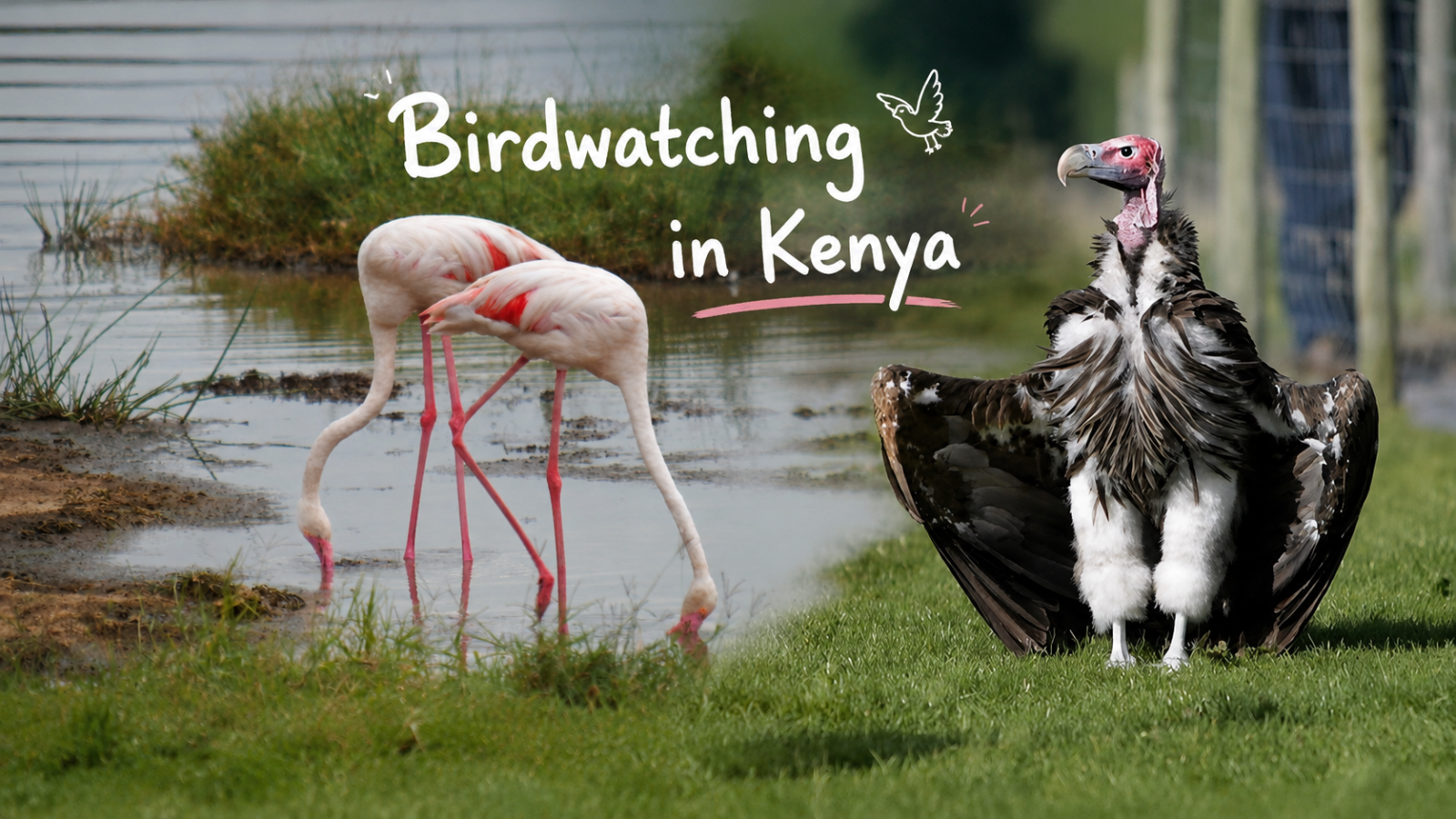

Kenya has 1,100+ recorded species across some of Africa’s most varied habitat — but the trip-planning question is not how many you can count. It is which families, in which landscapes, with which operators.
Why a species-count framing produces a bad trip
A birder optimising for total species count will end up driving long distances between habitats to bag a checklist that includes Kakamega’s central-African forest species, the coastal Arabuko-Sokoke endemics, the dry-country specialists of Samburu, the highland forest birds of the Aberdares, and the Rift Valley waterbirds — all in one fortnight. The trip will be exhausting, every site will feel hurried, and the birds that reward sustained attention (canopy mixed flocks, raptor passes, the slow-burn discoveries that come from sitting in one place for three hours) will be missed.
A better framing organises the trip around the bird families that have unusual representation in Kenya, then chooses two or three landscapes where those families are accessible, then selects operators who know those landscapes well enough to find the difficult ones. The total species count comes out about the same. The experience is structurally different.
Birdwatching in Kenya guide lays out that framing — the families that matter, the landscapes that hold them, and the operator distinctions that separate strong birding safaris from generic safaris with binoculars added on.
Kenya's birding strength is not the headline count. It is the unusual diversity of bird families clustered in habitats that lie within a single seven-hour drive of each other. That clustering — not the total species number — is what makes the country exceptional.
| RECORDED SPECIES 1,100+ (some sources cite 1,154); 11 endemic species | RESIDENT VS MIGRANT ~800 residents, ~170 Palearctic migrants, ~60 intra-African migrants |
| IMPORTANT BIRD AREAS (IBAS) 68 IBAs across all major habitat types | MARA RECORDED SPECIES 500+ recorded within Maasai Mara National Reserve alone |
| KAKAMEGA FOREST ~400 species; last East African remnant of Guineo-Congolian rainforest | ARABUKO-SOKOKE ~270 species; multiple coastal endemics — Sokoke Pipit, Clarke’s Weaver, Sokoke Scops Owl |
| LAKE BARINGO Specialist freshwater destination; ~470 species recorded | MIGRANT ARRIVAL WINDOW Palearctic migrants present September to April |
The bird families that make Kenya unusual
Twelve families and groups disproportionately drive Kenya’s birding reputation. A trip that picks two or three of these and pursues them seriously will produce more memorable birding than a trip that pursues species totals.
Raptors
Kenya holds roughly 65 diurnal raptor species — eagles, hawks, falcons, harriers, buzzards, kites, plus the seven African vulture species (all in serious decline, see –How to identify Kenya’s raptors). The Mara concentration of large raptors is exceptional: martial eagle, tawny eagle, bateleur, long-crested eagle, fish eagle, African hawk-eagle, brown snake eagle, black-chested snake eagle, augur buzzard, lizard buzzard. Laikipia adds Verreaux’s eagle (on the cliffs around the plateau edges) and a strong population of crowned eagle in the forested patches. For raptor-priority birders, the Mara plus Laikipia combination is the country’s strongest two-stop itinerary.
Turacos
Six turaco species occur in Kenya — Hartlaub’s (highlands), Schalow’s (Lake Victoria region), Ross’s (Kakamega), Great Blue (Kakamega), Fischer’s (coastal forests including Arabuko-Sokoke), and White-bellied Go-away-bird and Bare-faced Go-away-bird (their savanna cousins). The Great Blue Turaco at Kakamega is the species most birders want to see; it is large, electric-blue, and produces one of the most distinctive vocalisations in African forest birding. Hartlaub’s is reliable on a Mount Kenya or Aberdares foothills stay.
Hornbills
Ten hornbill species in Kenya, including the southern ground hornbill (Mara — listed as Vulnerable globally, in decline locally), Von der Decken’s (dry country, Tsavo and Samburu), trumpeter (forested areas including Aberdares and Kakamega), silvery-cheeked (highland forest), African crowned (forest), Hemprich’s (rocky northern Kenya), and the small red-billed and yellow-billed hornbills universal in savanna country. Hornbills are easier to find than turacos and produce some of the most satisfying mid-distance bird photography on a Kenya trip.
Bee-eaters and rollers
Ten bee-eater species are regularly recorded, including the spectacular northern carmine (December–March migrant flocks in Tsavo and the Mara), Madagascar (October–April migrant), white-throated, blue-cheeked, little, white-fronted, Somali (dry-country specialist), cinnamon-chested (highlands), and the resident African green and blue-breasted. The lilac-breasted roller is everywhere in savanna; the rufous-crowned and broad-billed rollers are forest specialists. Bee-eater colonies on river banks (the Mara River carmine roosts during migration are remarkable) are among the most photogenic bird gatherings on the continent.
Sunbirds
Forty-plus sunbird species in Kenya. Sunbirds are the African analogue to South American hummingbirds — long-billed, often metallic, often territorial around flowering plants. Highland forests (Aberdares, Mount Kenya, Kakamega) hold the highest diversity: scarlet-tufted malachite sunbird (Aberdares moorland), green-headed, eastern double-collared, tacazze, golden-winged, bronze, malachite, variable. For sunbird-priority birders, the Aberdares is the country’s strongest single site.
Larks, pipits, and longclaws
Open-country specialists. Kenya holds several restricted-range species: William’s Lark (Shaba), Masked Lark (Marsabit), Sharpe’s Longclaw (Aberdare moorlands and Kinangop — globally Endangered), Sokoke Pipit (Arabuko-Sokoke, globally Endangered). For dedicated open-country birders, the Marsabit-Shaba-Samburu northern circuit holds species that are essentially unfindable elsewhere on standard Kenya itineraries.
Coastal endemics and near-endemics
Arabuko-Sokoke Forest near Watamu holds the highest concentration of globally threatened bird species on the Kenya coast: Sokoke Scops Owl (range-restricted, requires night work), Sokoke Pipit (Endangered), Clarke’s Weaver (Endangered, rediscovered breeding only in 2013 at Dakatcha Woodland), Amani Sunbird (Near Threatened), East Coast Akalat (Vulnerable), Spotted Ground Thrush (Endangered). Birders targeting Arabuko-Sokoke should plan a minimum of three full days with a specialist guide; a single half-day visit will produce frustration.
Forest birds at Kakamega
Kakamega Forest is the only Kenya location for roughly 40 bird species that are otherwise central African (Congo Basin) specialists. Turner’s Eremomela (Endangered), Chapin’s Flycatcher (Vulnerable), Blue-headed Bee-eater, Black-billed Turaco, Black-and-white Casqued Hornbill, Toro Olive Greenbul, Ansorge’s Greenbul, Yellow-bellied Wattle-eye, Equatorial Akalat. The forest covers roughly 240 km² and holds 400+ bird species. Specialist birding lodges on the forest edge (Rondo Retreat, Kakamega Forest Lodge) give access to dawn forest birding that no Mara-Samburu-Tsavo trip can replicate.
Rift Valley lake waterbirds
Lake Nakuru, Lake Naivasha, Lake Bogoria, Lake Baringo, Lake Magadi. Each holds a different waterbird assemblage. Lake Nakuru historically held a million-plus flamingo flocks, though those numbers collapsed after 2010 (see guide on Lake Nakuru); the lake still holds great white pelicans, African fish eagles, marabous, yellow-billed storks, and a strong raptor passage. Lake Baringo is the freshwater specialist destination, with Hemprich’s hornbill, Jackson’s hornbill, northern masked weaver, and an unusual concentration of nightjar species. Lake Bogoria still holds reliable flamingo flocks when other lakes are sparse.
Cranes, storks, and ibises
Grey crowned crane (the national bird, listed as Endangered, in decline), saddle-billed stork, marabou, African openbill, woolly-necked stork, yellow-billed stork, hadada ibis (universally common), glossy ibis, sacred ibis. The Mara concentrations of crowned crane are still strong; the wider population is declining. Birders should not assume crowned crane will remain reliable on future Kenya trips at current densities.
Bustards
Kori (the world’s heaviest flying bird, reliable on Mara plains), Denham’s (rarer, occasional Mara), Heuglin’s (Marsabit), buff-crested, white-bellied, black-bellied, Hartlaub’s. The Mara and the dry north hold the strongest bustard assemblage.
Owls and nightbirds
Sokoke Scops Owl (range-restricted to coastal forest), Pel’s Fishing Owl (Tana River, occasional Lake Baringo), Verreaux’s Eagle Owl (universal), African Wood Owl, Cape Eagle Owl, Spotted Eagle Owl, Pearl-spotted Owlet, African Scops Owl, plus several nightjar species. Camps that offer night drives — most conservancy camps, almost no national park lodges — will produce far more owl and nightjar contact than camps confined to daytime drives.
Migrant warblers and waders
From September to April Kenya hosts roughly 170 Palearctic migrant species — warblers (willow, garden, marsh, sedge, river), wheatears, hirundines, raptors (steppe eagles, common buzzards), waders (curlew sandpipers, ruffs, marsh sandpipers, wood sandpipers), and waterbirds (Eurasian wigeon, garganey). Mida Creek on the coast and Sabaki Estuary are exceptional for wader-priority birding during migration. The Tana Delta is the strongest single migrant-staging site in the country.
THE HONEST VERDICT ON FAMILY SELECTION A birder who picks three families that genuinely interest them — say raptors, sunbirds, and forest birds — and then designs a trip around the two or three landscapes where those families are strongest will have a far better trip than a birder who chases the total species count. The total count comes out roughly the same. The memorable encounters do not.
The five landscape clusters and what each delivers
Most Kenya birding itineraries draw from these five clusters. A 14-day trip can comfortably include three; a 10-day trip should include two.
| Cluster | Strongest families | Standout species |
| Mara + adjacent conservancies | Raptors, bustards, savanna passerines, cranes, plovers, larks | Secretarybird, martial eagle, southern ground hornbill, kori bustard, grey crowned crane, rosy-throated longclaw |
| Samburu / Shaba / Marsabit | Dry-country specialists, larks, bee-eaters, weavers, raptors | Vulturine guineafowl, William’s lark, Somali bee-eater, golden-breasted starling, Heuglin’s bustard, Masked lark |
| Rift Valley lakes | Waterbirds, raptors, kingfishers, migrant waders, nightbirds (Baringo) | Flamingos (Bogoria), Pel’s fishing owl (Baringo), Hemprich’s hornbill, white-fronted bee-eater, Verreaux’s eagle (Lake Magadi escarpments) |
| Highland forests (Aberdares, Mt Kenya) | Sunbirds, turacos, mountain forest passerines, owls | Hartlaub’s turaco, scarlet-tufted malachite sunbird, Aberdare cisticola (endemic), Sharpe’s longclaw (Endangered), Jackson’s francolin |
| Coast (Arabuko-Sokoke, Mida, Sabaki, Tana) | Coastal forest endemics, migrant waders, estuarine specialists, raptors | Sokoke Scops Owl, Clarke’s Weaver, Sokoke Pipit, Amani Sunbird, Crab Plover (migrant), Madagascar bee-eater (migrant) |
| Kakamega (separate sixth cluster) | Central African forest specialists — birds found nowhere else in Kenya | Great blue turaco, Turner’s eremomela (Endangered), Chapin’s flycatcher (Vulnerable), blue-headed bee-eater, Equatorial akalat, Black-billed turaco |
Two practical observations from this table. First: a birder who wants the genuinely unusual Kenya species — the ones unfindable anywhere else in the country — needs to commit to Arabuko-Sokoke or Kakamega. These are the cluster trips, not the add-ons. Second: the Mara and Samburu together produce roughly 700 species over a competent 10-day trip with a strong guide, which is most of what a non-specialist birder will want.
The migrant calendar
Migrant timing matters more than most operators discuss. Palearctic migrants are present from approximately mid-September through mid-April. Intra-African migrants follow a more variable pattern, often tied to rainfall in source regions.
| Window | Migrant arrivals | Notes for birders |
| September – October | Early Palearctic arrivals (warblers, wheatears, harriers, terns) | Underrated birding window — fewer tourists, migrants building up, resident birds in pre-breeding condition |
| November – December | Migrant numbers peak; northern carmine bee-eaters in flocks; first carmine roosts on Mara River | Short rains greening the savanna; raptor passage at peak |
| January – February | Migrants present and feeding; coastal waders at full diversity at Mida and Sabaki | Dry season — best raptor visibility; good for breeding-plumage waders |
| March – April | Migrant departure; intra-African breeding birds in breeding plumage | Long rains start — habitat green, fewer tourists, weaver and bishop colonies active |
| May – August | Resident birds only; African intra-migrants present in some areas | Wildebeest migration in the Mara; high tourist numbers; birding remains strong but vehicle congestion is the dominant constraint |
The implication for trip timing: serious birders should weight September–April over the high-season May–August window, even though high-season is when most safari trips happen. The migrant overlay is worth roughly 100 species on a good itinerary.
Operator distinctions that matter for birding-priority trips
A generic safari guide will identify the obvious birds — lilac-breasted roller, fish eagle, kori bustard, hornbills. A birding-specialist guide will identify the difficult ones — cisticolas to species (notoriously hard), the migrant warblers in non-breeding plumage, the LBJ (little brown job) workers, the dawn forest mixed flocks. The price difference between the two is usually 20–40 percent. The species difference over a 10-day trip is roughly 200–300 species.
What separates a strong birding guide
A strong birding guide will: (a) know the calls — most forest birding is auditory before it is visual; (b) carry a current Kenya bird app or field guide and use it actively; (c) keep a daily species list for clients on request; (d) brief clients on target species the evening before each location; (e) understand habitat — they will know that the patch of acacia at the river edge will hold something different from the open grassland 200 metres away. A weak guide will do none of these consistently.
Operators with credible birding programmes
Specialist birding operators in Kenya include Birding Africa (a regional operator with strong Kenya itineraries), Rockjumper (international operator with Kenya tours), Ben Mugambi’s BirdRoute Kenya, and Naturetrek. Several lodges have invested in birding-specialist guides and habitat development — Sosian Lodge (Laikipia), Saruni Samburu, Borana Lodge, Loisaba (now LMW), Rondo Retreat (Kakamega), Lake Baringo Club, Lake Naivasha Sopa, Sarova Salt Lick (Taita Hills with the Taita-Apalis endemic nearby), and most Mara and conservancy camps with experienced senior guides. The Tropical Birding network has historically run strong Kenya tours.
Independent confirmation matters. Operators that claim ‘birding specialism’ should be able to name their senior birding guide, that guide’s bird tour history, and the species count their tours typically deliver. Vague claims should not be accepted.
THE STRUCTURAL TEST FOR BIRDING OPERATORS A birding-credible operator can: name the senior bird guide, point to their tour history, share recent client species lists, identify which sites they're strongest at, and tell you which sites they'd recommend you go with someone else for. An operator that claims to be 'great at birding' across every site in Kenya is overclaiming. No guide is equally strong everywhere.
Combining birding with general safari interests
Many Kenya travellers are not pure birders — they want strong birding alongside big-game safari, photography, or cultural interests. The model works. A few patterns make it work better.
The 70/30 split
Most mixed-interest birders find a 70 percent general safari / 30 percent dedicated birding split produces a stronger trip than either pure birding or pure general safari. Practically: a Mara conservancy stay with a senior guide who happens to be a strong birder produces 200+ species over four days alongside the full big-cat and migration experience. Add three days in Samburu (200+ more species) and three days at Lake Baringo or in the Aberdares (another 100–150) and the total approaches 500 species without ever pivoting to a pure birding format.
Adding Kakamega or Arabuko-Sokoke
These two sites are non-substitutable. A trip that includes one of them produces fundamentally different birding than a trip that does not. Kakamega is logistically easier — direct charter flight to Kisumu, hour transfer, two or three nights at Rondo Retreat or similar. Arabuko-Sokoke is reachable from coastal flights into Malindi or via Mombasa, with accommodation at Watamu lodges. The site choice should follow family interest: Kakamega for central-African forest birds, Arabuko-Sokoke for coastal endemics.
Independent extensions
Serious birders sometimes do a general Kenya safari with their partner or family, then send themselves alone for three to five additional nights to Lake Baringo, Kakamega, or Marsabit. This works well operationally — the specialist sites are not high-demand for general tourism and accommodate small bookings — and aligns the trip pricing with the partner’s actual interest level.
The hidden-gem cluster: Mount Elgon and Tana Delta
Two undermarketed Kenya birding destinations deserve mention because they consistently outperform expectations for travellers willing to go there.
Mount Elgon National Park (border with Uganda)
Mount Elgon is the country’s second-highest peak after Mount Kenya and the most underbirded major site in Kenya. The forest holds turacos, mountain forest birds, and the northern boundary of several central-African species’ ranges. The site receives a fraction of the visitors of Mount Kenya and produces excellent forest birding for those willing to organise a trip from Eldoret or Kitale. Why undermarketed: limited high-end lodge infrastructure on the Kenya side, although the Ugandan side has more developed lodges (Mount Elgon Hotel).
Tana Delta
The Tana River Delta is Kenya’s largest wetland system and the country’s strongest single migrant-staging site, with over 350 recorded species. It holds Pel’s Fishing Owl, the Tana River Cisticola (range-restricted), and concentrations of migrant waders and waterfowl that exceed Mida and Sabaki at peak season. Why undermarketed: very limited tourism infrastructure, security considerations have historically restricted travel (now largely resolved but still affecting operator marketing), logistics are non-trivial. For serious wader and waterbird birders, the Tana Delta is among the strongest single-site bird counts achievable in East Africa.
The birder’s operator audit: six questions worth asking before booking
The standard safari-operator pitch will rarely tell a birder what they actually need to know. These six questions, asked at the enquiry stage, will distinguish operators with genuine birding capacity from operators who are accommodating birders as a bolt-on.
- Who specifically will be my guide, and what is their personal birding background? The answer should be a name, a tour history, and ideally a species count from a recent tour. If the operator deflects to ‘we have several excellent guides’, the senior birding guide is probably not allocated to your trip.
- What is your senior guide’s call recognition for the families I care about? Most forest birding is auditory before it is visual. A guide who relies on app playback rather than ear identification will be slow in productive mixed flocks and will miss canopy birds entirely.
- Which Kenya birding sites would you not send me to with your team — and who would you recommend instead? This is the diagnostic question. An operator that names two or three sites where they’d recommend a specialist instead is being honest about their limits. An operator that claims to be uniformly strong everywhere in Kenya is overclaiming.
- Will you supply a pre-trip target species list and brief me on what is realistic at this season? Birding-specialist operators will produce a target list with probability assessments — ‘realistic’, ‘good chance’, ‘low probability but possible’. Generic operators will not.
- What is your operating policy on early starts and late returns for birding? Dawn forest birding requires a pre-dawn departure. Mid-day birding is largely unproductive. A camp that won’t depart before sunrise or won’t accommodate a late return from an evening owling session is not a birding camp regardless of marketing language.
- Can you connect me to a recent birder who has done this itinerary? Birding-specialist operators have a stable of repeat clients and willing references. Operators who claim birding strength but cannot produce a reference are claiming something they cannot back up.
THE HIDDEN-GEM OPERATOR FRAMING Birders should treat Kenya birding-tour operators the way wine importers treat producer relationships — the genuine specialists are a small group of named individuals operating through one or two preferred camps, not the marketing departments of generalist safari companies. Ask for the guide by name. The trip quality follows the guide, not the operator brand.
Honest limits and what serious birders should expect
A few things Kenya birding will not give you, despite the marketing.
Forest mega-flocks of the Amazon kind. African forest birding produces smaller mixed flocks, often quieter, with longer waits between productive encounters. Kakamega is excellent by African standards; it is not Manu, Tambopata, or the Western Ghats. Birders who have done Neotropical or Asian forest birding should calibrate expectations.
Reliable rare species. The Kenya endemics and near-endemics are findable but not guaranteed. Sharpe’s Longclaw on the Kinangop has become genuinely scarce. Sokoke Scops Owl requires night work with a specialist guide. Clarke’s Weaver was only confirmed breeding in 2013 and remains range-restricted. Pel’s Fishing Owl requires the right timing and reliable local knowledge. Birders driving up to a single site for a half-day in the hope of a specialty target will frequently miss.
Even species coverage across all habitats. Kenya’s protected-area network is excellent for savanna birding, good for highland forest, weaker for coastal forest (Arabuko-Sokoke aside), and patchy for the wetlands. The state-protected estate is not optimised for serious birders. Specialist sites are mostly outside it — Kakamega and Arabuko-Sokoke are reserves, but the Tana Delta, Mida Creek, and large parts of the Rift Valley wetlands rely on community or private arrangements.
WHO THIS ARTICLE IS FOR, WHO SHOULD LOOK ELSEWHERE If you are a birder choosing between Kenya and another African destination — Kenya is in the top three for diversity (Tanzania and DRC alongside), the most accessible of the three, and the best for combining birding with big-game safari. If you are a generalist safari traveller who wants 'good birding too' — you'll find it without effort, but you should ask your operator about senior guide birding credentials. If you are a specialist after specific endemic targets — you need a specialist birding operator, not a general safari operator, and you should plan around the migrant calendar.
The bottom line for trip-planning
Three rules that produce better Kenya birding trips than the ‘maximise the list’ approach.
First: pick three bird families that genuinely interest you. Build the trip around those, not around the country’s headline species count. The list will take care of itself.
Second: weight September through April over the high season for migrants, vehicle availability, and accommodation pricing. The big-game viewing remains excellent. The birding is materially stronger.
Third: pay for a senior guide with documented birding experience. The marginal cost is small relative to the trip; the marginal species are substantial. A generic safari with a generic guide can deliver 300 species; a competent birding-specialist itinerary can deliver 600 or more in the same nights.
Tell us what you are looking for, and we will tell you honestly whether we can deliver it — and if we cannot, we will tell you who can.
RELATED READING
- How to identify Kenya’s raptors: a guide for non-birders
- Lake Nakuru National Park: the flamingo collapse and what the lake offers now
- Lake Naivasha: the honest day-trip assessment
- Tsavo National Park: the underrated giant of Kenya safari
- Photography at sunrise and sunset in Kenya: when and where the light works