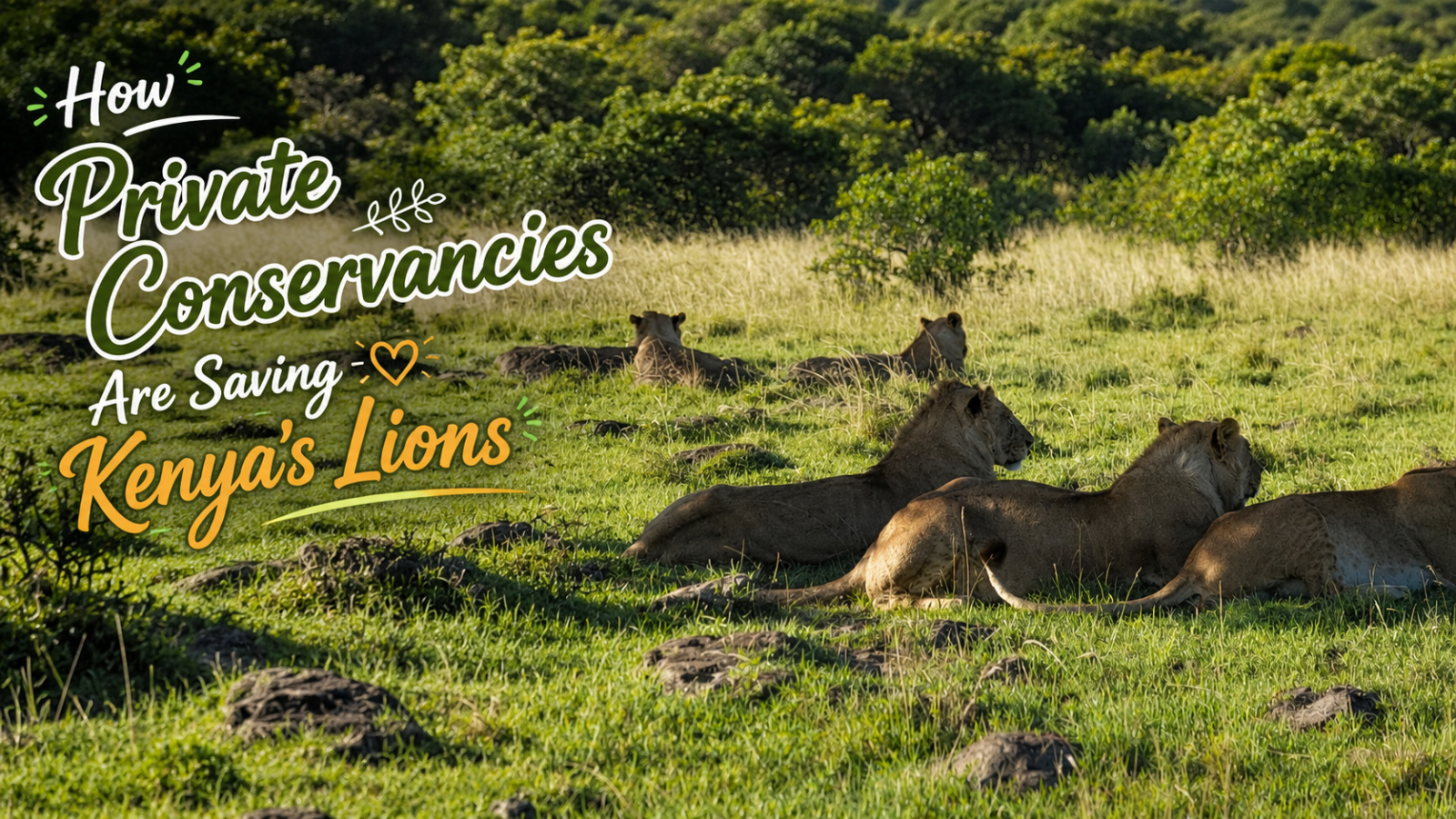

The Maasai-owned conservancies surrounding the Maasai Mara now hold 14% higher lion density than the National Reserve itself. This is the story of how a lease agreement became a conservation model — and why the people who book conservancy lodges are participating in it whether they realise it or not.
The conservancy model is doing what the parks were supposed to do
The conventional story about African lion conservation goes like this: national parks protect wildlife from human pressure, and the threat is what happens outside the fence. The conventional story is increasingly wrong. Across the Maasai Mara ecosystem, the most rigorous predator monitoring data available — collected continuously since 2013 by the Mara Predator Conservation Programme — shows that lion density inside the private community conservancies is 14% higher than inside the Maasai Mara National Reserve. The reserve is not failing. But the conservancies, structurally, are doing something the reserve cannot.
This matters because African lions are in serious trouble. Approximately 20,000 wild lions remain on the entire continent, down from an estimated 200,000 a century ago. Kenya’s national population sits at roughly 2,600. The Mara holds around 459 monitored resident lions — Kenya’s most carefully tracked predator population, and one of the few in Africa where the trend line has stabilised or grown over the past decade against a backdrop of regional decline. The conservancy model is the structural reason that stabilisation is possible. Understanding why is the difference between travelling through a conservation story and travelling alongside one.
The most important number in Kenya's lion conservation is not the headcount. It is $4.8 million — the annual lease payments flowing from conservancy lodges to more than 15,000 individual Maasai landowners. That cash flow is what keeps the land unfenced, undivided, and unconverted. Every conservancy booking is a vote, with a price tag attached, for the model that produces the higher lion density. This is what access, intimacy and time look like in conservation economics.
How Private Conservancies Are Saving Kenya’s Lions –Quick reference (the numbers behind the model)
| AFRICAN LION POPULATION (TOTAL) ~20,000 (IUCN, 2024) | KENYA NATIONAL LION POPULATION ~2,600 (KWS 2025 census) |
| MARA MONITORED RESIDENT LIONS 459 over 1 year old (MPCP 2024) | LION DENSITY VS RESERVE 14% higher in conservancies |
| MMWCA MEMBER CONSERVANCIES 24, covering ~450,000 acres | MAASAI LANDOWNERS RECEIVING LEASE INCOME More than 15,000 individuals |
| ANNUAL LEASE PAYMENTS TO COMMUNITY $4.8 million+ (most recent published) | LAND UNDER CONSERVATION, 2013 → 2025 Expanded from 33% to 64% of ecosystem |
Why the conservancies outperform the reserve on lions, in measurable terms
The same wildlife moves between the National Reserve and the surrounding conservancies — there are no fences. What differs is what happens to that wildlife in each zone. The conservancy model produces structurally different conditions for lion survival across four dimensions: density of human pressure on sightings, off-road and night access for lions to behave naturally, removal of fences that block sub-adult male dispersal, and economic incentive for landowners not to retaliate when lions take livestock.
| Metric | Maasai Mara National Reserve | Surrounding conservancies |
| Land ownership | Public — Narok County Government | Private — leased from 15,000+ Maasai landowners |
| Lion density (per 100km²) | Baseline reference | 14% higher than the Reserve (MMWCA / MPCP) |
| Vehicle limit at sightings | None enforced (20–30+ at peak) | 3–5 vehicles, rule-enforced |
| Off-road driving | Prohibited | Permitted |
| Night drives | Prohibited | Permitted (predator activity peaks at night) |
| Lease payments to community | Park fees to county government | $4.8M+ annually flowing direct to landowners |
| Wildlife habitat trajectory | Stable but bounded | Expanded from 33% to 64% of ecosystem since 2013 |
THIS IS WHAT ACCESS ACTUALLY MEANS When a vehicle in Olare Motorogi can follow a hunting cheetah off-road for an hour without sharing the sighting with anyone, the cheetah hunts. When the same sighting in the National Reserve attracts twenty vehicles in twenty minutes, the cheetah abandons the hunt. The conservancy rule is not a luxury upgrade for tourists. It is a behavioural enabler for wildlife. Lions, leopards and cheetahs simply do more of what they're supposed to do when they're not under continuous vehicle pressure. The conservancy density metric is a downstream consequence of that fact.
The four threats lions face, and what the conservancy system does about each
Conservation is not abstract. Lions die from specific causes, and the conservancy model is not a single intervention but a layered response to each of the major mortality and habitat-loss vectors operating in the Greater Mara Ecosystem.
| Threat | Why it kills lions | Conservancy intervention |
| Retaliatory killings | Maasai herders losing livestock spear or poison the lions responsible. Carbofuran (an agricultural pesticide) is the historic weapon of choice. | Predator-proof bomas built from recycled plastic posts; livestock compensation schemes; Lion Ambassadors recruited from warrior age sets. |
| Habitat fragmentation | Fences and subdivision cut migration corridors. Sub-adult males travelling 50+ kilometres to find new prides are blocked or killed at boundaries. | Lease agreements explicitly require landowners to remove fences and cap livestock numbers; two major corridors secured since 2013. |
| Prey depletion | Overgrazing by cattle and subdivision for agriculture reduces the wildebeest, zebra and Thomson’s gazelle that lions depend on. | Controlled grazing in lease terms; restoration of degraded rangeland; livestock-wildlife coexistence models that have demonstrably improved grass health. |
| Direct disturbance | Reserve vehicle crowding (20+ at a sighting) disrupts hunting, separates cubs from mothers, abandons kills, raises stress hormones. | Enforced 3–5 vehicle limit, off-road driving allowed but regulated, code of conduct binding on all lodge guides. |
Retaliatory killing — the most preventable lion death
A Maasai family that loses three cows to a lion in one night has, in straightforward economic terms, lost more than a year’s school fees. The historical response was to spear the lion responsible, or to poison the kill with carbofuran — an agricultural pesticide cheap enough to use for revenge killing and indiscriminate enough to kill the entire pride that returns to feed, plus vultures, hyenas, and any other scavengers. Carbofuran poisoning was, until very recently, the single largest source of lion mortality in the Mara ecosystem.
The Mara Predator Conservation Programme and the Kenya Wildlife Trust have built a layered response. Predator-proof bomas — livestock enclosures constructed from recycled plastic poles and chainlink — virtually eliminate nighttime predator access. Compensation schemes pay verified livestock losses, removing the financial logic of revenge. Lion Ambassadors — young men from Maasai warrior age sets, trained in conflict mitigation — work directly with their own communities. The combined effect is measurable: human-lion conflict events and verified retaliatory killings have dropped substantially across the conservancy belt since the bomas programme began.
Habitat fragmentation — the slow-motion threat
Sub-adult male lions disperse from their natal prides at around two and a half to three years old, often travelling 50 kilometres or more to find unrelated females and establish new pride territory. Without this movement, populations inbreed; with it, gene flow keeps prides viable. Every fence in a dispersal corridor blocks this movement. Every subdivision of group ranches into individually fenced plots turns the landscape into impassable mosaic.
Lease agreements in the conservancies explicitly require landowners to remove fences and accept limits on livestock numbers in exchange for the monthly lease payment. The result, documented by MMWCA over twelve years: land under conservation in the greater Mara ecosystem has expanded from 33% to 64%, and two major wildlife corridors — including the Pardamat Conservation Area — have been secured. Recent ecological research concluded that 3,500 elephants now move freely through the ecosystem, a corridor function that benefits lions, cheetahs, wild dogs, and every species needing range.
Prey depletion — the foundation problem
Lions need wildebeest, zebra, Thomson’s gazelle, topi and impala. Overgrazing by livestock, subdivision for cropland, and habitat conversion all reduce the wild ungulate biomass on which lions depend. Conservancies address this through controlled grazing — cattle are not excluded from the land, but their numbers and movement are managed under lease terms. Counter-intuitively, the science supports this. Studies in the conservancies and across Laikipia have shown that targeted, mobile livestock grazing actually improves grass health and biodiversity relative to either pure exclusion or unmanaged grazing. The wildebeest and zebra populations on which lions depend have remained stable or grown across the conservancy belt.
How the conservancy model actually came to exist
The conservancy model in the Maasai Mara did not exist 25 years ago. It was created — deliberately, gradually, and against significant initial resistance — by a coalition of Maasai community leaders, conservation NGOs, and lodge operators who recognised that the conventional protected-area model was structurally incapable of holding the line on land conversion outside the Reserve boundaries. The first conservancy in the Mara ecosystem, Ol Choro Oirouwa, was established in 1991. Olare Orok and Motorogi followed in 2006 (subsequently merging in 2014 into Olare Motorogi). Mara North was formed in 2009. Naboisho launched in 2010. The Mara Conservancies Wildlife Association (MMWCA) was formally established in 2013 to coordinate what had become a federation of more than 15 distinct conservancies.
The structural innovation was the lease agreement. Maasai landowners — whose grandparents had owned the land collectively under group ranch arrangements, and whose parents had received individual title deeds during the 1970s-90s land adjudication process — agreed to lease their plots to conservancy management companies for a fixed monthly payment per acre. In exchange, landowners agreed to remove fences, cap livestock numbers, and accept restrictions on permanent settlement within the conservancy boundary. The lodges operating within each conservancy paid the management company a daily conservation fee per guest, which combined with broader operator payments produced the cash flow that funded the lease payments. The Nature Conservancy and other international NGOs provided initial capital and technical assistance to negotiate sustainable 25-year lease agreements.
None of this was inevitable, and the early years were difficult. Some landowners refused to sign. Some who signed pulled out when neighbours offered higher rents for cropland conversion. Some conservancies lost members during the COVID-19 tourism collapse, when lease payments became financially precarious. What survived the stress test is the model that exists today: a working federation of 24 conservancies, more than 15,000 individual landowner agreements, and the largest contiguous community-owned conservation landscape in East Africa. The lion density data the rest of this article rests on is the downstream consequence of those lease agreements continuing to hold.
The conservancies that matter for lions, ranked by what the data actually shows
Not all conservancies in the Mara ecosystem produce equally strong lion outcomes. The MPCP heatmap data and member-conservancy reports identify a clear hierarchy among the larger and longer-established conservancies.
Olare Motorogi — the predator hub
Olare Motorogi covers approximately 33,386 acres and is the location of the MPCP’s Tony Lapham Predator Hub research station. The conservancy consistently records the highest lion densities of any monitored area in the ecosystem — driven by a combination of strict tourism caps (roughly one bed per 700 acres), prime topi and wildebeest habitat, and the operational continuity of long-term resident prides including the Enkoyenai and Acacia prides. For visitors prioritising lion viewing specifically, Olare Motorogi is the strongest single-conservancy choice in the Mara ecosystem.
Mara Naboisho — equal predator density with broader habitat
Naboisho spans over 52,000 acres and consistently ranks among the highest predator densities in the world according to its management company. The conservancy holds healthy lion populations alongside one of the strongest leopard densities in the ecosystem — partly because the habitat mosaic (open plains, riverine corridors, rocky kopjes) supports both species at scale. Cottar’s 1920s, Encounter Mara, and Naboisho Camp are the principal lodges. The 2010 establishment of Naboisho involved 500+ Maasai landowners; the conservancy now contributes lease income to that founding family group through MMWCA member agreements.
Mara North — the largest member conservancy
Mara North Conservancy covers approximately 74,000 acres on the northern boundary of the National Reserve. It is one of the largest single conservancies in the Greater Mara Ecosystem and was an early adopter of the lease model in 2009. Mara North holds strong lion populations including resident prides that move freely between the conservancy and the Reserve. The conservancy hosts 11 member camps and supports 783 landowners with guaranteed monthly lease payments. Member camps notably maintained those lease payments during the 2020 tourism collapse out of their own balance sheets to protect the model — a fact worth knowing when evaluating which operators are aligned with the conservation infrastructure they market.
Mara Triangle — public reserve, private management
The Mara Triangle is technically inside the National Reserve, not a conservancy in the lease sense — but it operates under a fundamentally different management structure. Since 2001, the western third of the Reserve has been managed by the Mara Conservancy, a not-for-profit organisation under contract with Narok County. The result is a tighter operational regime than the eastern Reserve: stricter vehicle limits, better-maintained tracks, cashless gate payment, and a stronger anti-poaching record. The Triangle holds some of the most reliable Mara River crossing access during the migration and is also one of the more consistent places to see black rhino. Lion populations are healthy and the management’s conservation outcomes are comparable to the conservancy belt.
The Mara Predator Conservation Programme — why the data is unusually trustworthy
The conservancy lion density figure that anchors this article is not casual. It comes from one of the longest-running predator monitoring programmes in Africa. The MPCP, the flagship initiative of the Kenya Wildlife Trust, is based at the Tony Lapham Predator Hub inside Olare Motorogi Conservancy on the border with Naboisho. It conducts two intensive 90-day monitoring surveys each year — one during the wildebeest migration (August–October), one outside it (February–April) — using Spatially Explicit Capture-Recapture (SECR) methods that produce statistically rigorous density estimates rather than impressionistic counts.
Lions and cheetahs are identified individually by unique whisker patterns, facial markings, and scars. Sub-adult males are GPS-collared to track dispersal. Geo-referenced photographs from camera traps and from camp guides (equipped with location-stamping cameras through the programme) feed a continually updated population database. The MPCP is the reason the 459-lion figure has confidence intervals. It is also the reason the 14% higher conservancy density is not a marketing claim but a peer-review-adjacent finding, available in their published quarterly and annual reports.
THE HONEST CAVEAT The most recent MPCP data, published in May 2025, shows the resident Mara cheetah population has dropped by more than 50% since 2014. The lion picture is better, but the broader carnivore story is not uniformly positive. Conservation is not a finished project. The conservancy model is the structural answer that has worked so far for lions. It is not yet working as well for cheetahs, and the next decade will test whether the same framework can hold both populations stable.
Where the money comes from, and where it actually goes
A meaningful share of every conservancy room rate flows directly to Maasai landowners through a contractual lease structure. This is not a profit-share, not a donation, not a marketing slogan — it is a fixed monthly lease payment that doesn’t depend on occupancy. During the COVID tourism collapse, some conservancy operators (notably the Mara North member camps) maintained those payments out of their own balance sheets to protect the model. The 2020 collapse triggered the creation of the Maasai Mara Rescue Fund — a $5 million bridge facility from Conservation International — specifically to keep landowner lease payments flowing while tourism revenue rebuilt.
The numbers from the most recent MMWCA published figures: 24 conservancies, approximately 450,000 acres, more than 15,000 individual Maasai landowners receiving annual lease payments totalling $4.8 million plus an estimated $46,200 in salaries for community rangers. At Mara North Conservancy alone, 11 member camps guarantee fixed monthly payments to 783 landowners. The Nature Conservancy has helped negotiate 25-year lease agreements paying 50% more than previous terms, creating multi-generational stability for landowner families who might otherwise convert grassland to wheat farms or sell plots for settlement.
The implication for travellers is concrete. The decision to book a conservancy lodge rather than a National Reserve lodge — even when the reserve option is cheaper — is, in measurable terms, a decision to fund the lease economy that prevents conversion of the underlying land. This is not soft conservation marketing. It is the structural economics of how Kenya’s best lion habitat continues to exist.
What the conservancy model has not solved — the honest limits
The conservancy model has produced measurable conservation outcomes for lions. It has not produced an unqualified success across every species, every threat vector, or every geography. Travellers paying conservancy rates partly on conservation grounds deserve to know the honest limits.
Cheetahs are not recovering at the same rate
MPCP’s most recent published data (Q1 2025 technical report) shows the resident Mara cheetah population has dropped by more than 50% since 2014. This is a serious and ongoing decline. The reasons are not fully understood — habitat shifts, vehicle disturbance during diurnal hunting periods, competition with growing lion populations, and possibly disease pressure are all candidates. The cheetah picture is significantly worse than the lion picture, and the conservancy model has not solved it. Work is ongoing, but honesty requires acknowledging the trajectory.
Retaliatory poisoning has not been eliminated
Predator-proof bomas have substantially reduced retaliatory killing across the conservancy belt, but they have not eliminated it. Lions still occasionally take livestock in poorly-fenced or temporary enclosures, in landowner plots adjacent to conservancy boundaries, and in the wider Maasai landscape outside the formal conservancy network. Carbofuran poisoning of carcasses remains a documented threat, occasionally killing entire prides plus vultures and other scavengers. The work is incremental, not finished.
Climate stress is the unsolved background variable
Rainfall variability has increased measurably across the Mara region over the past decade. The 2022-2023 drought tested the resilience of every conservation model — wildebeest birth rates dropped, grass biomass declined, and predator hunting success reportedly changed. Climate stress on the underlying prey base affects lions independently of any conservation intervention; the conservancy model can manage human-wildlife interactions but cannot manage rainfall. The next decade will test whether the lion recovery survives climate variability that the existing infrastructure was not designed for.
The model depends on tourism revenue volatility
The 2020 tourism collapse exposed the conservancy model’s structural dependence on travel revenue. Lease payments were maintained through a combination of operator balance-sheet absorption, the Maasai Mara Rescue Fund ($5 million from Conservation International), and reduced operational spending — but the experience demonstrated that the model can come under existential financial pressure faster than most participants had assumed. A future global disruption affecting international travel for an extended period would test the model again. The conservation outcomes documented here are not unconditionally secure; they depend on the tourism economy continuing to function.
Five questions to ask before booking, if conservation matters to you
If the conservation argument is part of why you’re paying conservancy rates, you can verify what you’re actually buying. Reputable operators answer these openly. The ones who deflect are telling you something.
- Which conservancy is the lodge in, and how many beds across the conservancy total? This determines the bed-to-acreage ratio. Naboisho at one bed per 700+ acres delivers different wildlife pressure than a 30-tent property would.
- What proportion of the room rate flows to landowner lease payments, and is that itemised? Operators with strong conservancy partnerships can answer this. Operators who use the conservancy as a postcode but contribute minimally cannot.
- Are guides trained as Lion Ambassadors or affiliated with the MPCP? This signals whether you are looking at a property that actively participates in the predator monitoring infrastructure, or one that benefits from it passively.
- How does the camp handle livestock predation by lions on adjacent community land? The answer should reference predator-proof boma construction, compensation schemes, or Lion Ambassador outreach — not vague phrases about “community relationships.”
- What is the vehicle limit policy at sightings, and who enforces it? In well-run conservancies, the limit is binding on all guide vehicles and self-enforced through radio coordination. If the answer is unclear, the limit may not be operational.
The honest position
Conservancies are not a perfect conservation model. They depend on tourism revenue, which is vulnerable to global shocks; they create generational obligations for Maasai families now tied to a single industry; they have not solved cheetah declines and have not stopped retaliatory poisoning in every case. But they are, on the available data, the most successful land-use model Kenya has produced for lion conservation, and the only one that delivers measurable conservation outcomes while also delivering meaningful economic benefit to the people who actually live on the land.
Every conservancy booking is a transaction with at least three parties — the lodge, the landowner consortium, and the predator population that benefits from the maintained habitat. The traveller who books understanding this is participating in conservation economics. The traveller who books a conservancy lodge because they want fewer vehicles at their cheetah sighting is also participating in conservation economics, whether or not they framed it that way. Either way, the model holds. That is the point.
THE BOTTOM LINE Conservancies are the best lion-conservation model Kenya has, the cash flow that keeps the model alive comes substantially from luxury and high-luxury tourism, and the choice between a reserve lodge and a conservancy lodge is — in real downstream terms — a choice about where the next decade of Mara lion density will sit.
RELATED READING
- Maasai Mara Destination Guide — The reserve vs. the conservancies, and what each actually delivers.
- Olare Motorogi Conservancy — What makes the highest lion density in the Mara ecosystem.
- Mara North Conservancy — Who it’s actually for, and who should look elsewhere.
- Luxury Safari Kenya: What Makes It Worth the Premium? — How conservancy economics drive luxury pricing.
- When is it too crowded in the Maasai Mara? — The honest case for the conservancies over the reserve.
Tell us what you are looking for, and we will tell you honestly whether we can deliver it — and if we cannot, we will tell you who can.