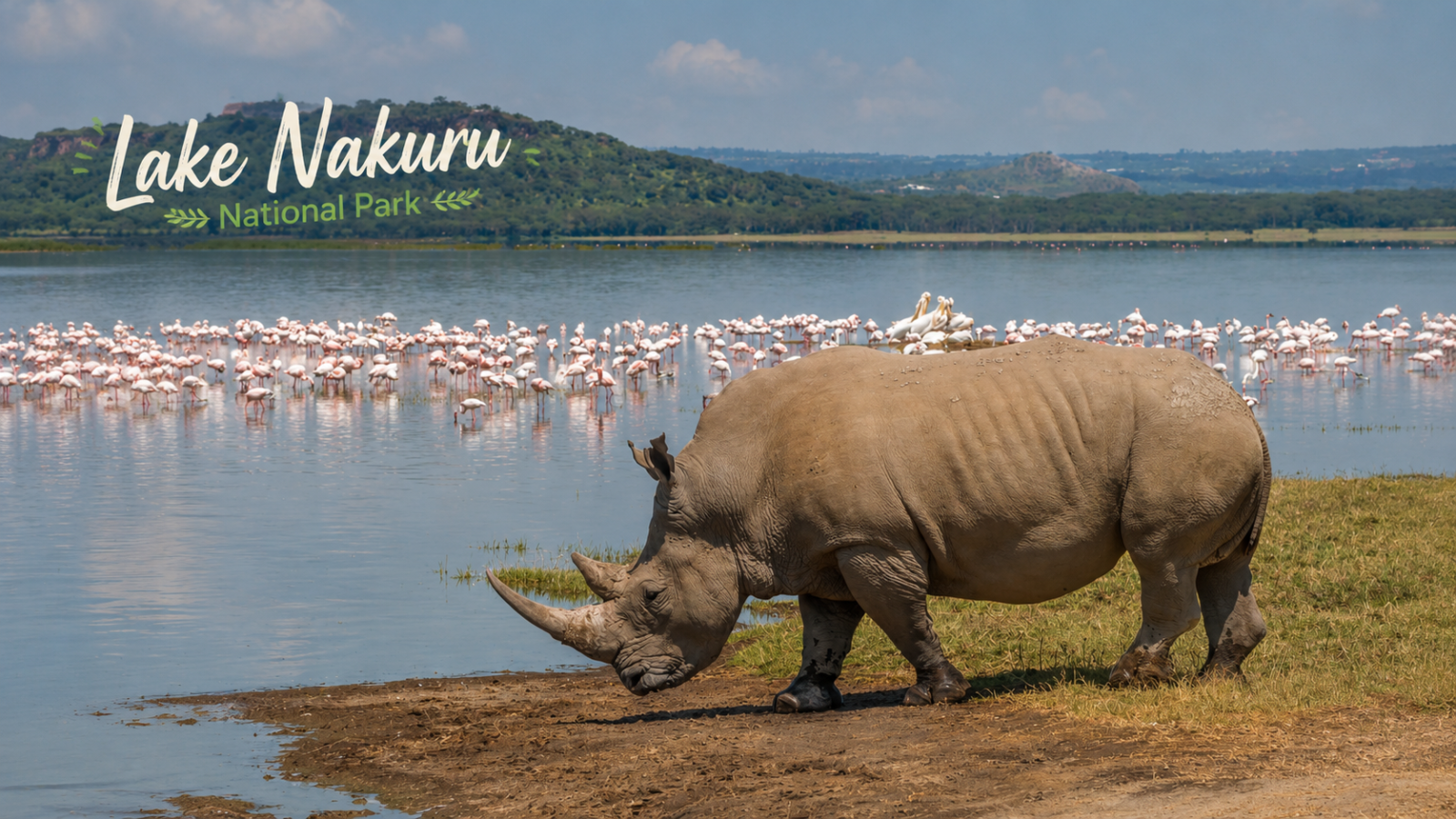
Lake Nakuru was world-famous for its million-strong flamingo blanket — and that spectacle has substantially relocated to Lakes Bogoria and Elementaita since the 2010s. The lake size has nearly doubled, the water chemistry has shifted, and the flamingos have followed the food. What remains is one of Kenya’s strongest rhino sanctuaries and a compact, time-efficient safari stop. This is the honest guide to what Lake Nakuru actually delivers in 2026.
Lake Nakuru is not the lake on the postcards — and that’s the most important fact about visiting it
For roughly three decades from the 1980s through the early 2010s, Lake Nakuru produced one of the most photographed wildlife spectacles on Earth: an alkaline soda lake whose shoreline was so densely covered in pink lesser flamingos that the water itself was hardly visible. Peak counts exceeded 1.5 million birds. The image — pink blanket, dark forest beyond, dramatic Rift Valley escarpment behind — became globally iconic, defining Lake Nakuru’s tourism identity and anchoring countless brochures, magazine covers, and travel-platform thumbnails. The image is real. The lake still exists. The spectacle, in 2026, no longer reliably appears here.
Between 2009 and 2022, Lake Nakuru’s surface area roughly doubled — from approximately 44 km² to 80-82 km². The water depth in the centre of the lake grew from approximately 4.5 metres to approximately 9 metres. The water chemistry shifted from highly alkaline (pH 10.5) toward freshwater character (pH 9), driven by sustained inflows from upstream rainfall and deforestation-related runoff.
The cyanobacteria (blue-green algae, particularly Spirulina) that flamingos depend on as their primary food source cannot reproduce at scale in the diluted water. The flamingos, mobile soda-lake specialists who function as a regional metapopulation, have largely followed the food — to Lake Bogoria, Lake Elementaita, and Tanzania’s Lake Natron. Some flamingos still visit Lake Nakuru, particularly during drier years when alkalinity briefly recovers, but the million-strong spectacle has not returned.
Lake Nakuru National Park guide takes the position that Lake Nakuru remains one of the strongest time-efficient safari stops in Kenya — particularly for rhino viewing, the Rothschild's giraffe population, the tree-climbing lions, the 400+ bird species, and the compact geography that delivers two safari experiences (rhino sanctuary + wetland) in a single fenced park. But the flamingo story has substantially relocated, and the marketing imagery that still dominates Lake Nakuru promotion does not reflect current ecological reality. Travellers who arrive expecting the pink-blanket spectacle will be disappointed; travellers who arrive understanding what the lake now is will find a strong destination that has been quietly redefined.
Quick reference — the essential Lake Nakuru numbers
| PARK AREA 188 km² (fenced national park) | LAKE SIZE (2026) ~80–82 km² (nearly 2× the 2000s baseline) |
| DISTANCE FROM NAIROBI ~160 km / 3 hours by road | EASTERN BLACK RHINOS 25+ (one of Kenya’s strongest populations) |
| SOUTHERN WHITE RHINOS ~70 individuals | BIRD SPECIES RECORDED 400+ at the lake and surrounding habitats |
| LESSER FLAMINGO PEAK (2010) 1 million+ recorded | LESSER FLAMINGO 2014 COUNT ~5,000 (the collapse year) |
The flamingo story — what actually happened
The flamingo collapse at Lake Nakuru is one of the more consequential ecological shifts in East African tourism, and it deserves to be explained accurately rather than glossed over by destination marketing. The driver is hydrological, not human-induced in the immediate sense — though deforestation in the surrounding catchment has amplified the effect.
The water-level rise
Between 2010 and 2022, Lake Nakuru’s water levels rose sharply and sustainedly. The lake essentially doubled in surface area and roughly doubled in depth at its centre. The drivers are a combination of increased rainfall in the surrounding catchment (likely climate-related), deforestation in the upper catchment causing surface runoff to flow directly into the lake rather than being absorbed by forest soils and groundwater, and the lake’s closed-basin geography (no surface outlet) trapping the additional water. Similar phenomena affected Lake Bogoria and other Rift Valley lakes during the same period, though Bogoria has remained more alkaline and continues to support strong flamingo populations.
| Year | Lake size | Lake depth (centre) | Lesser flamingo count |
| 2000–2009 (baseline) | ~44 km² | ~4.5 m | Up to 1.5 million (peak) |
| 2010 | Rising | Rising | 1 million+ recorded |
| 2014 | Significantly expanded | Increased | ~5,000 (collapse year) |
| 2022 | ~80 km² (≈2× baseline) | ~9 m | Fluctuating thousands |
| 2025–2026 | ~80–82 km² (sustained) | ~9 m | Variable; mostly thousands |
The chemistry shift and the food collapse
Lesser flamingos (Phoeniconaias minor) are extreme specialists. They feed almost exclusively on cyanobacteria — blue-green algae, principally Spirulina — that thrives only in highly alkaline soda-lake conditions (pH 10-12 typically). At Lake Nakuru’s 2000s baseline pH of 10.5, Spirulina growth was strong and continuous, supporting the million-bird population. As water levels rose and the lake diluted toward freshwater character (pH 9), Spirulina growth crashed. Without their food source, flamingos cannot remain. In 2014, the recorded lesser flamingo count at Lake Nakuru dropped to approximately 5,000 — down from over a million just four years earlier.
The flamingos have not disappeared. They have redistributed. Flamingo populations in East Africa function as a regional metapopulation — birds move between lakes (Nakuru, Bogoria, Elementaita in Kenya; Natron, Manyara, Eyasi in Tanzania) following food availability. Lake Bogoria, smaller and more thermally stable, has remained highly alkaline and continues to support flamingo concentrations in the hundreds of thousands during peak periods. Lake Elementaita, fluctuating but more chemically stable than Nakuru, holds significant populations. Tanzania’s Lake Natron remains the only major breeding site for lesser flamingos in East Africa.
Will the flamingos come back?
The honest answer is: partial recoveries do occur during drier years when Lake Nakuru’s alkalinity rises and Spirulina concentrations briefly recover. Late 2024 and parts of 2025 saw modest flamingo returns during dry-season windows. The Wildlife Research and Training Institute (WRTI) has trialled experimental Spirulina re-seeding programmes designed to accelerate algae recovery. But a permanent return to the million-bird baseline depends on a sustained reduction in lake water levels and a restored alkaline chemistry — neither of which is currently in prospect on a multi-year horizon. Travellers planning trips primarily around the flamingo spectacle should plan for Lake Bogoria or Lake Elementaita rather than Nakuru, and should accept that flamingo timing is now fundamentally unpredictable across the Rift Valley system.
THE HONEST FRAMING Lake Nakuru in 2026 is no longer principally a flamingo destination. The visitor information centres, the lodge marketing, and the travel platform imagery continue to lead with flamingos — but the ecological reality is that the lake is now best understood as a rhino sanctuary with strong birdlife (including pelicans, fish eagles, kingfishers, and yes, sometimes flamingos), rather than a flamingo destination first. This is not a marketing complaint. It is an ecological fact that buyers should be told before booking, not after arrival.
What Lake Nakuru actually delivers in 2026
Stripped of the flamingo-centric framing, Lake Nakuru is a strong destination on different grounds — and arguably better positioned for first-time Kenya visitors than it was when the spectacle dominated the visitor experience. The current case:
Kenya’s strongest single-stop rhino destination
Lake Nakuru National Park is one of Kenya’s premier rhino sanctuaries. The park holds approximately 25+ Eastern black rhinos (one of the strongest concentrations in the country) and approximately 70 Southern white rhinos. The 188 km² fenced park acts as a controlled sanctuary that protects against poaching while keeping the rhinos in viewable conditions. Black rhino sightings are nearly guaranteed; white rhino sightings are essentially guaranteed. For travellers prioritising rhino viewing within a short itinerary — particularly those who cannot make the longer trip to Ol Pejeta or Lewa — Lake Nakuru is the single most efficient rhino destination in Kenya.
The Rothschild’s giraffe sanctuary
Rothschild’s giraffe is one of the rarest giraffe subspecies — fewer than 2,000 individuals exist worldwide. Lake Nakuru hosts a stable resident population, relocated to the park starting in 1977 as part of a conservation programme to safeguard the subspecies from threats in its original western Kenya range. The giraffes are unmistakable: more strongly white-marked legs (often called ‘five-knee giraffes’ because the white extends so high they appear to have an additional knee), no patterning below the knees. Sightings are reliable across the park’s acacia woodland zones.
The tree-climbing lion phenomenon
Lake Nakuru’s resident lion population is famous for tree-climbing behaviour — adult lions resting in the upper branches of acacia trees, sometimes 5-7 metres above the ground. The behaviour is rare elsewhere in Kenya (Lake Manyara in Tanzania is the other famous site) and is variously theorised to relate to escape from biting flies, vantage-point hunting from elevated positions, or thermal regulation. The phenomenon is not guaranteed on any given drive but is reliably observed across multi-day visits. For photographers, tree-climbing lion images are among the most photographically distinctive Kenya can offer.
The 400+ bird species and the pelican surge
Even with the flamingo redistribution, Lake Nakuru remains one of Kenya’s strongest birding destinations. Over 400 species have been recorded. Great white pelicans have surged in numbers as the lake’s freshening chemistry has increased fish populations (including the Nile tilapia introduced to the lake in the 1960s, which has now flourished as alkalinity has dropped). African fish eagles, goliath herons, hamerkops, pied kingfishers, Verreaux’s eagles, and the broader waterbird and forest-bird community are all strongly represented. The Baboon Cliff viewpoint provides the strongest overview of the lake’s bird populations.
The compact geography and time efficiency
Lake Nakuru sits entirely within a 188 km² fenced national park, producing an unusually compact safari experience. A full circuit of the park — including the lake shore, the acacia woodlands, the rhino sanctuary areas, the Baboon Cliff viewpoint, and the surrounding grasslands — can be completed in a single day.
For travellers with limited time (a 1-2 night stop on a longer itinerary), Lake Nakuru delivers a complete safari experience in a way that the vast parks (Tsavo, Samburu, even the broader Mara) cannot. This time efficiency makes Lake Nakuru a particularly strong choice for: short Kenya extensions to longer East Africa trips, travellers building Mara + Nakuru + Naivasha circuits, and first-time visitors wanting maximum wildlife variety in a 5-7 day window.
| Species | Population at Lake Nakuru | Why notable |
| Eastern black rhino | 25+ (one of Kenya’s strongest concentrations) | Fenced rhino sanctuary established 1986; near-guaranteed sightings |
| Southern white rhino | ~70 individuals | Translocated from South Africa starting 1995 |
| Rothschild’s giraffe | Stable population | Relocated from western Kenya 1977 onwards; rare subspecies |
| Lion (tree-climbing) | Resident prides | Famous tree-climbing behaviour rarely seen elsewhere in Kenya |
| Leopard | Increasing sightings | The park’s high-density acacia woodland is ideal leopard habitat |
| Cape buffalo | Very strong population | One of the densest concentrations in Kenya |
| Bird species (total) | 400+ species | Great white pelicans now in surging numbers as lake becomes more fresh |
| Lesser flamingo | Variable thousands (2026) | Down from peak of 1.5 million+; redistribution to Bogoria and Elementaita |
The rhino conservation story — how Lake Nakuru became a sanctuary
Lake Nakuru’s role as a rhino destination is not accidental — it is the result of a deliberate conservation programme begun in the 1980s during the height of Kenya’s poaching crisis. The park’s 188 km² area, fenced as a controlled sanctuary, was selected specifically because the small size, controlled access, and combination of acacia woodlands and open grassland produced conditions where black rhinos (which prefer dense bush cover) and white rhinos (which prefer open grassland) could coexist with the close monitoring needed to protect them from poachers.
The Eastern black rhino population at Lake Nakuru was built from the early 1980s through a series of translocations from other Kenyan parks and protected areas during the recovery period. The Southern white rhino population was introduced separately, with translocations from South Africa beginning in 1995. The combined population grew steadily through the 1990s and 2000s.
The 2009 figures put the park at approximately 25 black rhinos and 70 white rhinos — among the strongest concentrations in Kenya. Recent figures have not been published as definitively, but the populations have remained broadly stable through the ongoing KWS conservation operations. The park has not had a significant rhino poaching incident in many years — the combination of fencing, ranger presence, and the small controlled area produces the same poaching-resistant operational model that has worked at Ol Pejeta, Lewa, and Borana.
The Lake Nakuru rhino programme is part of the broader Kenya rhino recovery story. Kenya’s total black rhino population has grown from approximately 400 in the 1990s to 2,102 as of the 2025 National Wildlife Census released in December 2025 — one of the most significant recoveries in African mammal conservation.
Lake Nakuru’s 25+ individuals represent a meaningful share of the national population, and the sanctuary continues to function as both a viewable population for visitors and a breeding source for translocations to other recovering protected areas. The Soysambu Conservancy adjacent to the park’s southeastern boundary represents a possible future expansion area for the rhino population, and an associated wildlife corridor to Lake Naivasha that has been the subject of ongoing planning.
The Rift Valley lakes circuit — how Lake Nakuru fits the broader picture
Lake Nakuru is one of seven major Rift Valley lakes that together form one of East Africa’s most ecologically diverse landscapes. For travellers wanting to understand the broader picture or planning extended Rift Valley itineraries, the comparison is useful:
- Lake Naivasha (freshwater, 90km from Nairobi): hippos, boat rides, Crescent Island walking. The accessible day-trip lake. 400+ bird species. Industrial flower-farm context around the lake.
- Lake Nakuru (soda lake, increasingly fresh, 160km from Nairobi): rhinos, Rothschild’s giraffe, tree-climbing lions. The compact safari lake. Flamingo redistribution post-2014.
- Lake Bogoria (soda lake, geothermal, 250km from Nairobi): currently the strongest flamingo destination in the Rift Valley. Hot springs and geysers along the shore. Smaller but visually dramatic.
- Lake Elementaita (soda lake, 130km from Nairobi): UNESCO World Heritage Site (part of the Kenya Lake System). Strong flamingo populations and Great White Pelican breeding colony. Less visited than Bogoria.
- Lake Magadi (extreme alkaline, 100km from Nairobi): the southernmost of Kenya’s Rift Valley lakes. Industrial soda extraction operations alongside flamingo populations. Specialist destination.
- Lake Baringo (freshwater, 280km from Nairobi): bird-watching destination, boat rides among hippos, smaller scale than Naivasha. The northern alternative.
- Lake Turkana (major remote lake, far north Kenya): the world’s largest desert lake. Requires substantial expedition logistics. Specialist destination for serious East Africa travellers.
For travellers building a Rift Valley lakes itinerary, the strongest combinations are: (1) Lake Nakuru + Lake Naivasha for the accessible 3-4 day Rift Valley introduction; (2) Lake Nakuru + Lake Bogoria + Lake Elementaita for the rhino-plus-flamingo combination if the flamingo spectacle is a priority; (3) Lake Nakuru + Lake Baringo for the rhinos-plus-northern-frontier-birding combination for serious birders.
Practical planning — how to actually visit Lake Nakuru
Getting there
Lake Nakuru is the most accessible major safari destination from Nairobi after Hell’s Gate and Mount Longonot. By road: approximately 160 kilometres / 3 hours via the A104 (Nairobi-Nakuru Highway), one of Kenya’s better-maintained highways. The drive passes the Great Rift Valley viewpoint approximately one hour out of Nairobi — a worthwhile stop. By air: short scheduled flights from Wilson Airport to Naishi airstrip inside the park are available with Safarilink, taking approximately 30-40 minutes. Most travellers drive given the short distance.
Park fees (October 2025 KWS structure)
Non-resident adults: USD 60 per 24 hours. Non-resident children: USD 35. East African residents and citizens pay reduced rates with valid ID. Vehicle fees vary by size (typically KES 300-1,030 per day). Note: the October 2025 KWS fee restructure increased rates substantially from the previous 2007-2024 structure; the regulations are subject to ongoing court challenge as of early 2026, but current rates remain in effect pending resolution.
Where to stay
Accommodation around Lake Nakuru spans the full range from budget to upper-mid-luxury. The strongest options:
- Lake Nakuru Lodge (inside the park) — mid-luxury, strong location with lake views, established operator.
- Sarova Lion Hill Game Lodge (inside the park) — mid-luxury, panoramic lake views from the hilltop position, well-rated.
- Mbweha Camp (just outside the park) — small camp with strong eco-credentials and good wildlife position.
- The Cliff (Lake Nakuru) — boutique luxury option, smaller scale, distinctive design.
- Lake Nakuru Sopa Lodge — mid-luxury inside the park boundary, family-friendly.
Note: there are no ultra-luxury properties inside Lake Nakuru National Park — the destination has not developed the conservancy-tier ultra-premium accommodation that the Mara and Laikipia offer. For ultra-luxury at this latitude, the Soysambu Conservancy adjacent to the park or properties around Lake Naivasha to the south offer stronger premium options.
When to go
Year-round destination with seasonal variations:
- January-March: Dry season. Strong general game viewing. Bird migration peak (Northern Hemisphere migrants arriving October-November remain through April). Best photography light.
- July-October: Secondary dry window. Strong wildlife viewing. Cooler temperatures than January-March. Combines well with Mara peak season trips.
- April-May (long rains): Heavy rainfall. Some access constraints. Lower visitor density. Dramatic skies for photography. Marginal flamingo recovery sometimes occurs after rains.
- November (short rains): Variable weather. Lush landscapes. Good birding (migrants present). Lower visitor density.
Combining Lake Nakuru with other destinations
Lake Nakuru sits geographically central in Kenya’s safari circuit and combines well with multiple other destinations:
- Lake Nakuru + Lake Naivasha (1-2 nights each) — Classic Rift Valley combination, both accessible from Nairobi as a 3-4 day trip.
- Mara + Lake Nakuru + Lake Naivasha — The most popular extended Kenya circuit, typically 7-9 days total.
- Lake Nakuru + Aberdares + Mount Kenya — Highland-focused itinerary combining wetland, forest, and mountain ecosystems.
- Lake Nakuru + Lake Bogoria + Lake Elementaita — The ‘Rift Valley lakes’ circuit, particularly strong for travellers prioritising flamingo viewing (Bogoria) plus rhinos (Nakuru) plus birdlife (Elementaita).
- Lake Nakuru + Soysambu Conservancy — The conservancy adjacent to the park’s southeastern boundary offers walking safaris and wildlife viewing without the park’s fee structure.
Who Lake Nakuru is actually for
Strong fit
- Travellers prioritising rhino sightings within a compact itinerary — Lake Nakuru delivers near-guaranteed Black and White rhino in a single day.
- First-time Kenya visitors wanting maximum wildlife variety in a 5-7 day window.
- Travellers with limited time wanting to combine Nairobi + Rift Valley lakes + Mara in a short trip.
- Birders (400+ species, particularly strong pelican populations and migrants October-April).
- Families with young children — compact park, manageable drive times, near-guaranteed wildlife.
- Photographers wanting Rothschild’s giraffe and tree-climbing lion compositions.
- Domestic and East African travellers — entry fees substantially lower than at the Mara or Amboseli.
Look elsewhere or adjust expectations
- Travellers specifically chasing the historic million-flamingo spectacle — book Lake Bogoria or Lake Elementaita and check current conditions before booking.
- Travellers wanting the conservancy activity portfolio (off-road, night drives, walking safaris by default) — Lake Nakuru is KWS national park, with the standard reserve rules.
- Travellers wanting the most-photographed iconic safari aesthetic (open plains with herds) — Lake Nakuru’s acacia woodlands and lake shore are different visual content.
- Ultra-luxury seekers — the highest-tier properties are not inside the park.
- Travellers wanting predator-focused itineraries (big cat hunts, large lion prides) — the Mara is materially stronger on big cat density.
The honest position
Lake Nakuru National Park is a strong destination that has been quietly redefined by the flamingo redistribution since the 2010s. The marketing imagery still emphasises the million-bird spectacle that no longer reliably appears; the actual product is a compact, time-efficient rhino-and-birdlife destination with strong supporting wildlife including Rothschild’s giraffe, tree-climbing lions, and one of Kenya’s densest buffalo populations. For travellers who arrive understanding what the lake now is — rather than what the brochures still depict — Lake Nakuru delivers a substantive and rewarding stop on a Kenya itinerary.
The honest position for trip planning: include Lake Nakuru on most standard Kenya itineraries for the rhino sanctuary and the time-efficiency. Plan for Lake Bogoria or Lake Elementaita if the flamingo spectacle is the priority. Combine Nakuru with Naivasha and the Mara for the classic seven-to-nine-day Kenya circuit. And calibrate expectations against the 2026 ecological reality rather than the 1990s postcards — the lake is genuinely different from what the marketing still shows, and the discerning traveller benefits from knowing this before arrival rather than after.
THE BOTTOM LINE Lake Nakuru in 2026 is a rhino sanctuary with strong birdlife, not a flamingo destination. Book it for the rhinos, the Rothschild's giraffes, the tree-climbing lions, and the time-efficient safari experience. Book Lake Bogoria or Lake Elementaita if the flamingos are why you came. And accept that the iconic pink-blanket imagery on the postcards is ecological history, not present reality.
RELATED READING
- Ol Pejeta Conservancy: Africa’s rhino success story — The largest rhino population in East Africa, deeper than Nakuru’s compact sanctuary.
- Maasai Mara Destination Guide — The Mara to combine with Lake Nakuru on the classic Kenya circuit.
- Lake Naivasha day trip from Nairobi: the honest guide — The closest Rift Valley lake destination.
- Best time to visit Kenya — Including the seasonal flamingo windows across the Rift Valley lakes.
- Responsible tourism in Kenya: how to travel ethically — Including the conservation framework around the Rift Valley lakes.
Tell us what you are looking for, and we will tell you honestly whether we can deliver it — and if we cannot, we will tell you who can.