
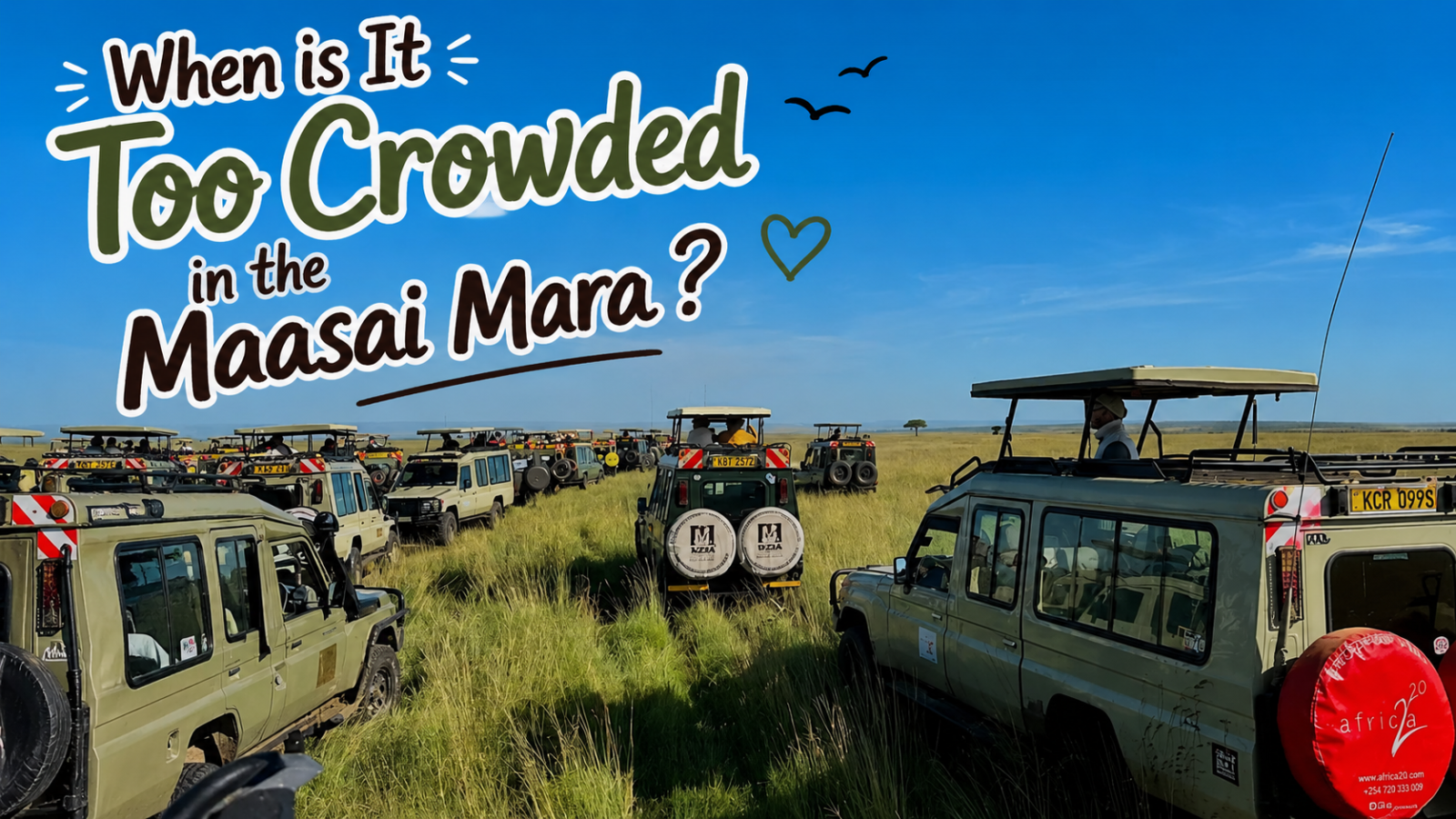

Mara visitor numbers fell by nearly half between 2023 and 2025 after Narok County doubled the entry fee — and the crowding question now has a different answer than it did two years ago. This is the honest, fact-based picture of what crowding actually looks like, when it’s worst, and how to avoid it.
The Mara crowding picture has changed faster than the guidebooks have
Until 2023, the answer to “When is It Too Crowded in the Maasai Mara?” was simple. July through October was the peak crowding window — the migration months, when up to 50 vehicles could surround a single Mara River crossing and lion sightings routinely drew 15-20 vehicles even mid-week. The reserve was on a steady upward trajectory of 5-8% visitor growth per year. The conservancies were the recommended alternative for everyone who could afford them. This was conventional wisdom across the travel industry.
That picture is now substantially outdated. In January 2024, Narok County doubled the non-resident entry fee from $80 to $200 in peak season, and from $80 to $100 in low season. The county also moved from a flat-rate ticket to a per-day basis.
The result, documented in the Kenya National Bureau of Statistics’ Economic Survey 2026: Maasai Mara visitor numbers fell from 419,829 in 2023 to 343,000 in 2024 — and then again to 213,300 in 2025. The Mara has lost roughly half its visitor base in two years. Meanwhile, Amboseli — which kept its fees substantially lower — saw visitor numbers rise from approximately 245,000 to 295,000 over the same period. For the first time in years, Amboseli outdrew the Mara in 2025.
This matters for trip planning because the conventional advice — "avoid the migration peak," "book a conservancy if you can," "go in February for fewer crowds" — was developed for the pre-2024 visitor reality. The advice is still directionally correct, but the magnitudes have shifted. The Mara in August 2025 was less crowded than the Mara in August 2023, by roughly 40%. The conservancies remain the strongest answer to crowding, but the gap has narrowed at the Reserve. The choice has become more interesting, not less.
Quick reference — the numbers behind the shift
| MARA VISITORS, 2023 419,829 (pre-fee-increase peak) | MARA VISITORS, 2025 213,300 (Economic Survey 2026) |
| TWO-YEAR CHANGE −49.2% (the steepest drop of any major Kenya park) | RESERVE FEE, BEFORE JAN 2024 $80 per person, flat rate |
| RESERVE FEE, PEAK SEASON 2026 $200 per person per day | AMBOSELI VISITOR CHANGE 2023–25 +20% (now outdraws Mara) |
| CONSERVANCY VEHICLE CAP RULE 3–5 vehicles per sighting, enforced | NATIONAL PARKS TOTAL VISITORS 2025 3.95 million (+5.7% YoY) |
Why the crowding picture shifted — the 2024 fee doubling, in honest terms
In January 2024, the Narok County Government announced an immediate, substantial increase in Maasai Mara entry fees. The non-resident daily rate went from $80 to $100 during the green and low season (January-June) and to $200 during the migration and high season (July-December). The ticket validity also changed from a flexible single-day rate to a strict 12-hour window — the source of the now-notorious “$200 trap” where departing guests on day three find themselves unexpectedly billed another full day’s fee because their original ticket has expired.
Narok County’s stated objective was a “high-value, low-volume tourism model” — explicitly modelled on Botswana’s safari pricing strategy, which has long used high fees to limit visitor numbers while maintaining tourism revenue. The county tourism executive committee member, Robert Simotwo, told Business Daily that the changes were strategic. By 2025, the strategy was producing the predicted result: dramatic visitor decline, particularly among price-sensitive market segments including families and budget-conscious non-resident tourists. Critically for the Mara’s competitive position, a significant portion of those displaced travellers shifted to Tanzania’s Serengeti (entry fee $83 per day) and to Kenya’s other parks — particularly Amboseli, which retained its $90 daily rate.
Did revenue actually rise?
Yes. Despite the visitor collapse, Narok County’s reserve revenue continued to grow — from approximately KES 1.43 billion (~USD 11.1 million) in FY2015/16 to approximately KES 5.6 billion (~USD 43.4 million) in FY2024/25. The 150% fee increase, combined with even a halved visitor base, produced significant revenue growth. From the county government’s narrow financial perspective, the policy worked. The question of whether the model is sustainable for the broader Mara ecosystem — the lodges, the operators, the community conservancies whose own economics depend on the Mara’s drawing power — is a separate question that the 2025 numbers do not yet settle.
What crowding actually looks like now — by zone and by time
The honest answer to “when is it too crowded” requires breaking the question into specific zones and specific months. Crowding in the National Reserve during August 2025 is a different phenomenon from crowding in a conservancy during the same week, or in the same Reserve during February.
| Zone / time | Typical vehicle density | Honest assessment |
| Reserve, Aug river crossing | 20–50+ vehicles | The most crowded wildlife sighting in Africa during peak crossing days. Genuine traffic jam scenarios. The 2024-25 fee doubling has reduced this somewhat but not eliminated it. |
| Reserve, Aug general game drive | 8–15 vehicles | Lion sightings still produce 10+ vehicles routinely. Improved from pre-2024 baseline but not transformed. |
| Reserve, Jan/Feb game drive | 3–6 vehicles | Substantially better. Wildlife is the same; the visitor pressure is gone. Underrated value window. |
| Conservancy, peak season | 2–5 vehicles (rule-capped) | The conservancy structure delivers exactly what its rules promise. Even at peak demand, sightings stay capped. |
| Conservancy, low season | 1–3 vehicles | Often the most exclusive wildlife viewing in Kenya. Frequently entire sightings to yourself. |
| Mara Triangle, any season | 4–10 vehicles | The Conservancy-managed western third of the Reserve consistently runs lower densities than the eastern Reserve, even during peak migration. |
HOW TO READ THE TABLE The genuinely crowded experience — 20+ vehicles at a single sighting — is now confined almost entirely to specific high-stakes events in the Reserve during peak migration weeks. The general game drive crowding has improved. The conservancy crowding has always been managed; that has not changed. The Mara Triangle, under separate management by the Mara Conservancy not-for-profit since 2001, runs structurally lower vehicle densities than the eastern Reserve.
The four drivers of Mara crowding — what they actually are
Crowding in the Mara is not a single phenomenon. It is the result of four distinct dynamics that combine differently across the year and across the ecosystem. Understanding them is the difference between booking a trip you will enjoy and booking one you will resent.
1. The migration concentration effect
From early July through mid-October, roughly 1.5 million wildebeest, 200,000 zebra and 500,000 Thomson’s gazelle move from the Serengeti into the Mara ecosystem and then back south. The Mara River crossings — the dramatic predator-and-water gauntlet that wildlife documentary footage has made globally iconic — happen primarily on a roughly 25-kilometre stretch of the river inside the National Reserve. Every safari operator in East Africa knows when and approximately where the crossings will occur.
Every guest who specifically came to Kenya for the crossings wants to be at the river when one happens. The result is that during peak August-September weeks, 30-50 vehicles converge on the most likely crossing points by mid-morning. Vehicles often wait at the river for two to three hours for crossings that may or may not happen. This is the genuine traffic-jam scenario the Mara has historically been criticised for. It still exists in 2025, though at materially lower density than 2023.
2. The big-cat sighting effect
Even outside the migration window, lion and cheetah sightings in the National Reserve routinely draw 8-15 vehicles. The mechanism is straightforward: guides communicate sightings via radio, and within fifteen to twenty minutes of a notable sighting being called in, every vehicle within range converges. The conservancy rule of 3-5 vehicles per sighting does not apply in the Reserve. The wildlife experience is materially degraded — predators abandon hunts, cubs are separated from mothers, the natural behaviour that visitors paid to see is partly cancelled by the visitor pressure itself. This is the structural problem the conservancy model was designed to solve.
3. The accommodation density effect
The National Reserve hosts approximately 35-40 lodges and tented camps inside its boundaries, several of them with bed counts in the 100-200 range. The conservancy belt around the Reserve hosts considerably more camps in aggregate, but with strict per-camp size caps and per-acre density limits. The result is that on any given morning, a substantial number of vehicles depart Reserve lodges within the same one-hour window heading for the same morning game-viewing circuits. The conservancy stagger is less pronounced because the smaller camps with capped beds simply do not produce the same vehicle concentration.
4. The day-tripper effect
A non-trivial portion of National Reserve visitor numbers comes from day-trippers — guests staying in Kenya’s central highlands, Naivasha, or sometimes even Nairobi who drive into the Reserve for a single morning game drive. The 12-hour ticket model since 2024 has somewhat reduced this segment, but day-tripping is still active particularly during peak season. Conservancies have always been closed to day visitors and accessible only to guests staying at member camps; this rule alone substantially limits conservancy crowding.
When to go — the honest month-by-month verdict
The conventional advice was “avoid July-October.” The updated advice is more nuanced because the fee-driven visitor decline has materially changed which weeks are actually crowded.
January–February: the underrated window
Dry season, hot but manageable, $100 Reserve fee (low season). Resident wildlife is excellent — the lion prides are present, leopards are reliably found, cheetah hunting is active. Calving season for the resident wildebeest produces predator action that experienced guides rate as equal to or better than the migration spectacle. Vehicle densities are low. This is the strongest value window in the Mara calendar.
March–May: the green season
Long rains. Some Reserve tracks become impassable. Lush landscapes, dramatic skies, lowest prices of the year. Predator photography is excellent (the green grass produces remarkable colour contrast for big cat images). Camp rates can drop 30-50% from peak. Visitor numbers are at their annual minimum. The honest caveat: some game drives may be cut short by sudden storms, and certain roads close intermittently. Acceptable trade-off for travellers who prioritise price and authenticity.
June: the underrated peak entrant
Last month of the low fee window ($100). Migration herds arrive in the southern part of the ecosystem from mid-to-late June. Pricing remains at low-season levels through June 30. Camps that maintain low-season rates through this window deliver exceptional value. The most price-conscious migration access in the Kenya safari calendar.
July–October: peak migration, peak fee, peak crowding
$200 Reserve fee. Camp rates at peak. River crossings primarily in late July through September. Genuinely crowded conditions at crossing events and at popular sightings. The conservancies provide effective shelter from the crowding but at full peak rates. Worth paying only if the migration spectacle is the specific reason for your trip; otherwise consider June or November.
November–December: rehabilitation and value
Short rains in early November. Migration herds depart by late October. Visitor numbers drop sharply. Camps offer shoulder-season pricing while maintaining full operations. Excellent value, with strong resident wildlife and the start of the bird-migration spectacle. December — particularly the second half — is a strong shoulder window with festive bookings creating modest demand but nothing approaching peak crowding.
The conservancy solution — what it actually delivers
Across every crowding scenario, the same answer holds: the community conservancies surrounding the National Reserve operate under structurally different rules that produce structurally different crowding outcomes. The 3-5 vehicle cap at sightings is enforced by member camps coordinating via radio. The bed-to-acreage ratio (one bed per 350-700+ acres depending on conservancy) is fixed by lease agreements. Day visitors are excluded entirely. Off-road driving and night drives are permitted, which allow guides to position vehicles away from sighting concentrations. The combined effect is that a Mara conservancy stay during peak August is comparable to a Mara National Reserve stay during February, in vehicle density terms — with identical wildlife.
Which conservancy for crowding avoidance
Not all conservancies are equally crowding-resistant. The hierarchy roughly:
- Olare Motorogi (one bed per ~650 acres, ~5 camps total) — the lowest-density option.
- Naboisho (one bed per ~700+ acres, ~9 camps) — comparable density at slightly larger scale.
- Mara North (~336 acres per bed) — strong but less restrictive than Olare Motorogi.
- Mara Triangle (Reserve under not-for-profit management) — meaningfully lower density than the eastern Reserve, plus migration access.
- Avoid: smaller conservancies that have grown bed counts without proportional acreage expansion, or properties that market a conservancy address but operate beyond the lease’s intended bed density.
Five practical rules to avoid Mara crowding
- Stay in a conservancy if your budget allows. The single highest-impact decision. Even at high-luxury tier, the experience differential is categorical.
- If staying in the Reserve, choose June or November. Low fee, low visitor density, strong wildlife. The trade-off is no peak migration crossings — but the resident wildlife is the same.
- Avoid the Sekenani and Talek gates for entry/exit. These are the highest-traffic Reserve gates. Use Oloololo or Musiara gates if possible — particularly via the Mara Triangle.
- Do not commit to seeing a river crossing. If the migration crossings are the priority, plan to spend at least three full days in the right area during the peak window. Crossings are not scheduled. Travellers who arrive expecting a specific sighting on a specific day report the highest disappointment rates of any safari demographic.
- Confirm the 12-hour rule with your operator in writing. The most common Reserve crowding-related complaint is now the unexpected $200 fee on departure day. Reputable operators schedule the morning drive to reach the gate by 10am. Confirm this is the plan.
Where the displaced Mara visitors went — the 2024-25 reallocation
The 200,000+ visitors who would have come to the Mara in 2024-25 under previous pricing have not stopped travelling. They have reallocated, and the destinations they went to tell a useful story about the broader Kenya safari economy.
Amboseli — the main beneficiary
Amboseli received the largest share of displaced Mara demand. Visitor numbers grew from approximately 245,000 in 2023 to 295,000 in 2025 — a 20% increase that made Amboseli the most-visited single wildlife park in Kenya for the first time in years. The Amboseli daily fee held at $90 (versus the Mara’s $200 peak), creating a 55% price discount. The trade-off for the diverted traveller is that Amboseli’s wildlife profile is different — it is elephant country first and foremost, with Mount Kilimanjaro as the iconic backdrop, and lacks the migration spectacle that the Mara delivers from July through October. For travellers whose primary interest was elephants, big cats, and dramatic landscape rather than the migration specifically, the substitution was straightforward.
Tanzania’s Serengeti — the international substitution
A meaningful portion of displaced Mara demand went south to Tanzania. The Serengeti’s daily fee — $83 for non-residents — represents a 58% discount versus the Mara’s peak rate. Tanzania also offers the full migration experience (since the herds are in the Serengeti for most of the year and only in the Mara during July-October), plus the Ngorongoro Crater, Tarangire, and the Selous/Nyerere. Tour operators report increased Tanzania bookings particularly from price-sensitive segments. The structural risk to Kenya is that travellers who book Tanzania for their first East Africa trip may not return to Kenya at all on subsequent visits — and the Serengeti experience can substitute for the Mara experience in ways that other Kenyan parks cannot.
Tsavo and Laikipia — the lateral shifts
Tsavo East and Tsavo West saw modest visitor growth as travellers who wanted to stay in Kenya but reduce park-fee exposure shifted their itineraries. Tsavo’s elephant populations are the largest in Kenya and the landscape is the most genuinely wild and undeveloped of Kenya’s major parks. Laikipia — Ol Pejeta, Lewa, Borana — has always been a secondary destination for first-time visitors but has gained ground as second-trip and conservation-focused travellers re-allocate. Both regions remain at lower volume than their carrying capacity and absorbed the redirected demand comfortably.
The Mara conservancy market — substantially insulated
One important nuance: the Mara conservancy market did not experience the same visitor collapse as the National Reserve. Conservancy bookings remained relatively stable because they have always operated on closed access (only camp guests), at higher price points, and with the conservancy fees structurally separate from the National Reserve fee. The conservancy clientele is also predominantly the high-luxury and ultra-luxury segment that is less price-sensitive than the day-tripper and lower-mid-range visitors who drove the National Reserve numbers. The structural consequence is that the conservancy crowding picture remained substantially unchanged through the 2024-25 shift, while the National Reserve crowding picture improved noticeably.
The economic implications — what the next 24 months will test
The 2024 fee policy is essentially a multi-billion-shilling bet by Narok County that the Mara can sustain its tourism economy on roughly half the visitors at double the per-visitor revenue. So far, the bet is paying off financially for the county government. The longer question — whether the policy is sustainable for the broader Mara ecosystem — is unresolved.
The lodge and operator picture
Mara National Reserve lodges have seen variable occupancy through 2024-25. Higher-end properties have held up better than mid-range, because the segments most affected by the fee increase were the price-sensitive market segments that did not predominantly book luxury anyway. Some mid-range Reserve lodges have moved to discount their headline rates to compensate for the fee burden, which raises medium-term questions about operational sustainability at properties dependent on high-volume mid-range tourism. The conservancy lodges are largely insulated because their pricing model was already at the high-luxury tier and their guest base was less price-sensitive.
The community impact
The Maasai community in Narok County receives revenue from three distinct streams: National Reserve gate fees (a percentage of which flows to local development), conservancy lease payments (paid by lodges directly to landowners), and direct employment income (lodge and operator staff). The fee doubling has substantially increased gross gate fee revenue while reducing visitor volume — the net distributional impact on community development is positive in the short term, but the secondary effect on conservancy lease economics depends on whether conservancy bookings remain stable. So far they have. If the broader Mara reputation suffers from sustained visitor decline, conservancy bookings could follow.
The international travel agent picture
International operators booking Mara safaris have reported guest pushback against the new pricing model — particularly the 12-hour ticket rule that frequently produces unexpected fees on departure days. Several large international operators have begun directing first-time East Africa travellers to Tanzania over Kenya, on the basis that the Tanzania safari experience now offers better value for the migration spectacle that draws first-time visitors. Whether this becomes a sustained reputational shift will depend on Narok County’s response to the visitor decline over the next two seasons — and on whether the conservancy operators continue to compensate for the Reserve’s positioning problems with strong international marketing of the conservancy alternative.
THE HONEST POSITION Narok County's high-value-low-volume policy is a defensible strategy in principle but a high-stakes experiment in practice. The wildlife is the same. The conservancy model continues to work. The Reserve will either rebuild its visitor numbers gradually as travellers adjust to the new pricing reality, or it will continue to lose volume to Tanzania and Amboseli. The discerning traveller can plan a strong Mara trip in either scenario — the question is which set of trade-offs you are willing to accept, and whether the conservancy stay is built into your itinerary as the structural protection against whatever the Reserve does next.
The honest summary
The Mara is less crowded in 2026 than it was in 2023, by roughly half. The Narok County fee doubling has worked from a visitor-reduction standpoint, but it has also displaced significant volume to other parks and to Tanzania. Whether the model is sustainable for the wider Mara economy — the conservancies, the lodge operators, the Maasai landowners whose lease income depends on continued tourism demand — is a question the next several years will answer.
For travellers planning a Mara trip today, the practical answer is simpler than the policy debate. The conservancies remain the strongest answer to crowding, and their value proposition has not changed. The Reserve has become a more interesting option than it was in 2023, particularly in the green-season and shoulder months. The migration crossings remain the most genuinely crowded wildlife event in Africa. The Mara Triangle remains the best-managed portion of the Reserve. The discerning traveller who understands all four of these dynamics can build a trip that captures the Mara’s strengths while avoiding its remaining crowding problem.
THE BOTTOM LINE If you are visiting the Mara for the migration river crossings, accept the crowding and book early. If you are visiting for the wildlife generally, the conservancies in any season, or the Reserve in low season, deliver materially uncrowded experiences. The 2024 fee policy has not eliminated crowding but it has compressed it to a smaller set of specific high-stakes events. Plan around those, and the Mara delivers what its reputation promised.
RELATED READING
- Maasai Mara Destination Guide — The Reserve vs. the conservancies, in full.
- Mara North Conservancy — The largest community conservancy.
- Olare Motorogi Conservancy — The smallest, densest-predator alternative.
- Best Time to Visit Kenya — Month-by-month, with honest trade-offs.
- Luxury Safari Kenya: What Makes It Worth the Premium? — Conservancy access pricing in detail.
Tell us what you are looking for, and we will tell you honestly whether we can deliver it — and if we cannot, we will tell you who can.