

Everything about How to See the Great Migration in Kenya — the annual route, Mara River crossing timing, where to position yourself, the structural Reserve-vs-conservancy decision, and practical booking advice for 2025–2026.
What is the Great Migration?
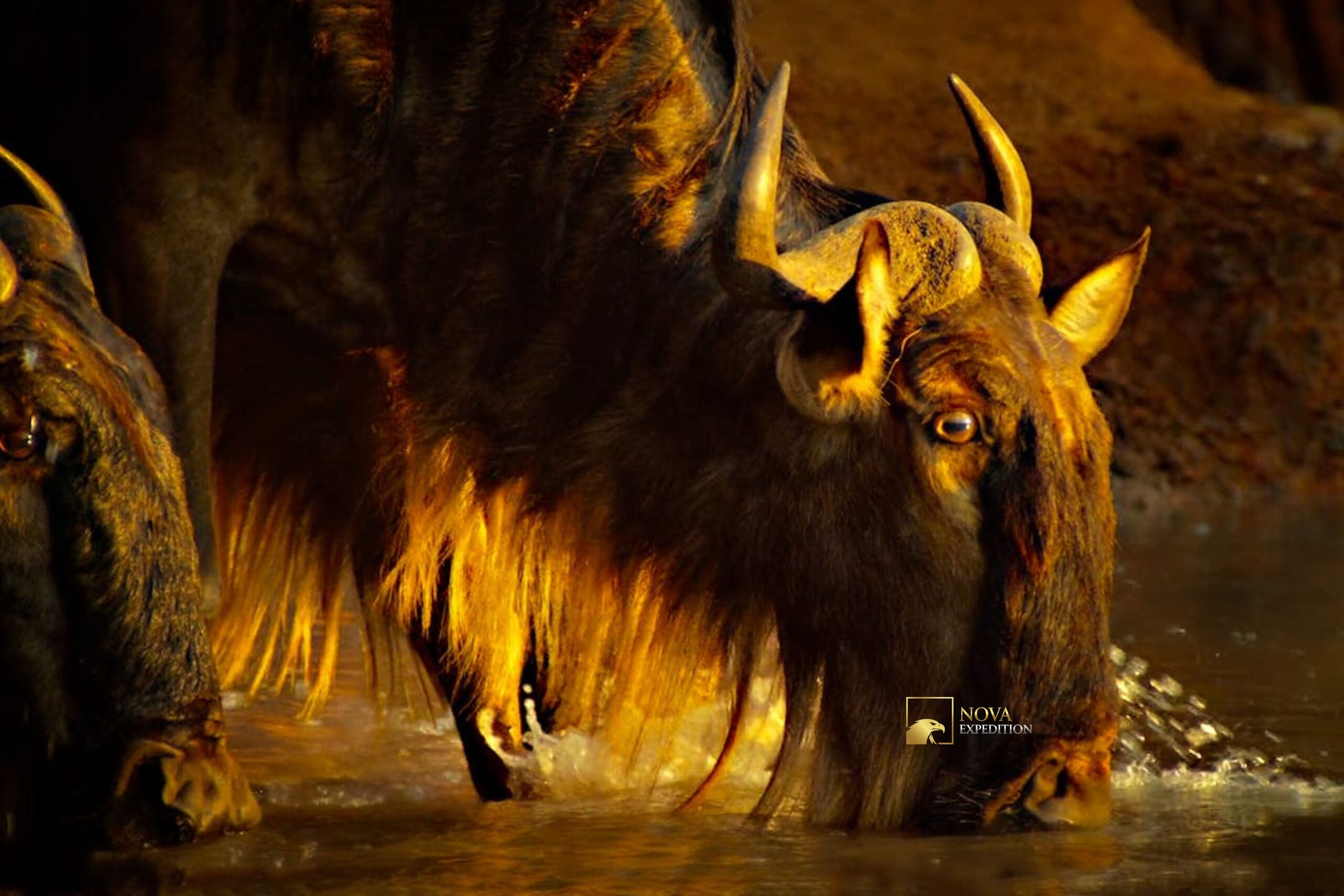
The Great Migration is the largest remaining terrestrial wildlife movement on Earth — a continuous, year-round circular journey of approximately 1.5 million wildebeest, 300,000 zebra, and 500,000 Thomson’s gazelle across the Mara-Serengeti ecosystem in Kenya and Tanzania. The animals cover roughly 1,800 miles annually in a clockwise loop, driven entirely by rainfall and the growth of fresh grazing grass.
The migration is not an event — there is no scheduled departure. The herds are always moving somewhere in the ecosystem. What changes throughout the year is where the action is: calving in January–February, the Grumeti River crossings in June–July, or the Mara River crossings in July–October that have become the defining images of East African safari.
Understanding why the migration happens at all matters for understanding when and where to position. The wildebeest follow a precise ecological logic: short-grass plains in the southern Serengeti are mineral-rich and ideal for calving but cannot sustain 1.5 million animals year-round. As the dry season advances, the herd moves north and west through progressively taller grass country, eventually crossing into Kenya’s Mara ecosystem where rainfall arrives earlier from the Indian Ocean weather system.
The Mara River crossings are not the migration — they are a forced consequence of geography, a river inconveniently positioned between the herds and the fresh grass on the far bank. The crossings are dramatic precisely because the wildebeest do not want to cross. They cross because the alternative is starvation.
The Great Migration is an ecological event, not a tourism event. The dramatic crossings exist because hundreds of thousands of animals are forced to swim a crocodile-filled river to reach grass they need to survive. Understanding this changes how you book the trip — and what you should reasonably expect to see.
How to See the Great Migration and migration facts
| ANIMALS 1.5M wildebeest + 300K zebra + 500K gazelle | ANNUAL DISTANCE ~1,800 miles in a clockwise circuit |
| RIVER CROSSINGS (MARA) July–October; peak August–September | CALVING SEASON January–February, southern Serengeti (Ndutu) |
| DRIVEN BY Rainfall and fresh grass — not calendar season | 2026 PEAK ESTIMATE Late August – early September (weather-dependent) |
| MARA RESERVE FEE 2026 $100/day Jan-Jun; $200/day Jul-Dec (12-hour ticket) | CONSERVANCY FEES Additional $80-150/day depending on conservancy |
The annual route — month by month
The migration’s annual circuit covers roughly 1,800 miles and passes through every major habitat of the Mara-Serengeti ecosystem. Each phase produces a different wildlife experience, a different price point, and a different probability of the spectacle most travellers come to see.
- January–February. Southern Serengeti (Ndutu area). Calving season: up to 8,000 calves born daily over a roughly 3-week peak. Extraordinary predator concentration — lions, cheetahs, hyenas, and wild dogs all converge on the calving grounds. The plains are short-grass and densely populated; from a single vantage point you can see tens of thousands of wildebeest with newborns. One of the most underrated migration experiences and consistently cheaper than August-September. The Tanzania side; access via Kilimanjaro International to Ndutu airstrip.
- March–May. Herds move north and west through the Serengeti’s central and western corridors. Long rains period — green plains, dramatic skies, frequent afternoon storms. Wildlife disperses across a wider area. Less concentrated than calving or crossing season but still present in large numbers. Many camps drop rates significantly; this is value season for travellers who want migration without crowds. Mating season for the wildebeest typically falls in this window.
- June. Western corridor and northern Serengeti. The Grumeti River crossings begin — a smaller-scale preview of the Mara crossings, with very large crocodiles waiting at specific points. Fewer than the Mara crossings but often more intimate, with smaller herds and less vehicle pressure. Tanzania-side accommodation in the Western Corridor (Singita Faru Faru, Grumeti Serengeti Tented Camp, Sayari) provides access.
- July. First herds cross into Kenya’s Maasai Mara, typically through the southern Sand River area. Initial Mara River crossings happen, though frequency is lower than August-September because not all herds have yet arrived. The Mara season begins in earnest — camps go to peak rates, vehicle traffic builds, and the booking competition intensifies. Travellers willing to accept lower crossing probability in exchange for fewer crowds and lower rates should consider mid-to-late July specifically.
- August–September. Peak migration season in the Maasai Mara. Mara River crossings reach peak frequency and scale. Hundreds of thousands of wildebeest in Kenya simultaneously. The most dramatic wildlife spectacle on Earth, concentrated in a relatively small area between the Mara River and the Tanzania border. Camps fully booked 6-12 months ahead. Reserve roads carry serious vehicle traffic at known crossing points (Lookout Hill, Paradise Plains) — 30+ vehicles at a single sighting is common. Conservancy access becomes the structural premium.
- October. Short rains trigger southward movement. Crossings continue early in the month, often with smaller groups attempting to recross south after grazing the north. By late October most herds are heading back to Tanzania. Pricing drops; vehicle pressure eases; conservancy access remains strong. For travellers willing to trade peak-probability crossings for better value, October has emerged as one of the strongest windows.
- November–December. Herds return through the Serengeti’s eastern plains heading south. Short rains green up the plains. Some early calving begins by late December. The cycle begins again. Low season for the Mara — limited migration content, but excellent resident-wildlife viewing including the highest big-cat density of the year as predators follow what game remains.
Mara River crossings explained
The Mara River crossings are the signature event of the entire migration — and the most misunderstood. The Mara River runs east-west across the northern Maasai Mara, forming a boundary between the main reserve and conservancy network to the south and the Mara Triangle to the north. Wildebeest must cross this river to access fresh grazing on the other side — and the river is deep, fast-moving, and filled with enormous Nile crocodiles up to 5 metres long.
Crossings are completely unpredictable. Herds may gather on the bank for hours — sometimes days — before the first animal commits. Then, suddenly, thousands of animals surge into the water simultaneously in a chaos of splashing, crocodile attacks, panicking wildebeest, and the deafening sound of thousands of hooves. A crossing can last 20 minutes or three hours. Some involve 50 animals; others involve 50,000.
The named crossing points
Mara River crossings happen at specific locations along the river — not randomly. Guides who know the river know the points, and positioning between them is the single most important game-drive decision during peak season.
- Lookout Hill / Paradise Plains. Mid-river, accessible from main Reserve roads. The most famous crossing point — and the most crowded. Vehicle counts at peak season can exceed 50 at a single crossing. Good crossings happen here, but the experience is heavily compromised by congestion.
- Main Crossing (Cul-de-Sac). Slightly east of Lookout Hill, with a tighter approach that produces more dramatic crossings when they happen. Access from Reserve or from Mara North conservancy depending on the day’s permissions.
- Serena Pump House. West of Lookout Hill, less crowded. Access typically from Mara Triangle side via Oloololo Gate.
- Mara Triangle crossings. Several smaller, less-named points along the Triangle side of the river. Access only via Oloololo Gate; vehicle pressure is dramatically lower than the main Reserve side. The Mara Conservancy that manages the Triangle has stricter enforcement of off-road and vehicle-density rules.
- Sand River crossings (south Mara). Where the herds first enter Kenya from Tanzania. The Sand River is smaller and less crocodile-rich than the Mara, so crossings here are less dramatic — but they signal the migration’s arrival and are often the first crossings of the season.
FROM THE FIELD "I can get you to the river. I cannot make the wildebeest cross. What I can do is read the signs that a crossing is coming and position you to be there when it does." — KPSGA-licensed guide, 14 years in the Mara ecosystem
The structural booking decision: Reserve vs Conservancy
This is the single most important decision in planning a migration safari, and the one most travel marketing avoids addressing directly. The Maasai Mara ecosystem is not one place — it is three distinct management zones with substantially different access rules, pricing, and visitor experiences.
The Maasai Mara National Reserve
The state-managed reserve, run by Narok County. Covers approximately 1,510 km². Holds the highest absolute density of wildlife in the ecosystem and includes most of the famous Mara River crossing points. Entry fees are now $100/day (low season) and $200/day (high season) on a 12-hour ticket system — the 2024 restructure that has reshaped trip economics. No off-road driving, no night drives, no walking. No vehicle-density cap, which during peak season produces the famous crowding around major sightings. Roughly 49 camps operate inside Reserve boundaries; quality varies enormously.
The Mara Triangle
The western section of the Reserve, managed separately by the Mara Conservancy (a non-profit) under agreement with Narok County. Same fees as the main Reserve but stricter enforcement of rules: vehicle counts at sightings are actively limited, off-road driving is prohibited and enforced (fines on the spot), litter and rule violations are pursued. Access only via Oloololo Gate. The Triangle is the structurally cleaner Reserve product — same crossing access on the far side of the river, dramatically less vehicle pressure. Operators serving the Triangle (Little Governors’, Mara Serena, Angama Mara) offer a different experience from main-Reserve camps.
The community conservancies
Twenty-four community conservancies wrap around the Reserve — Mara North, Olare Motorogi, Naboisho, Ol Kinyei, Lemek, and others — covering roughly 450,000 acres total. These are owned by individual Maasai landowners (17,000+) who lease their land to tour operators, with strict vehicle-density caps (often one vehicle per sighting maximum), off-road driving permitted, night drives permitted, walking safaris permitted, and meaningfully different game-drive economics. Conservancy fees of $80-150/day per guest are typically included in camp rates. Mara North borders the Mara River along significant length; Olare Motorogi and Naboisho are further south and offer different landscape character.
| Dimension | Main Reserve | Mara Triangle | Conservancies |
| Entry fee 2026 | $200/day peak | $200/day peak | $80–150/day |
| Vehicle density at sightings | Uncapped — 30–50+ vehicles common at peak crossings | Actively managed; lower density | Hard caps; often single vehicle at sightings |
| Off-road driving | Prohibited | Prohibited and enforced | Permitted with guide discretion |
| Night drives / walking | Prohibited | Prohibited | Permitted |
| Mara River crossing access | Strong — most famous points | Strong — north bank access | Mara North only (river-adjacent) |
The structural verdict: travellers prioritising crossing access at lowest absolute cost should book main Reserve camps and accept the vehicle congestion. Travellers prioritising the conservancy experience with reasonable crossing access should book Mara North (the only conservancy with substantial river frontage). Travellers wanting the cleanest combination of crossings and managed access should book Mara Triangle camps. The wrong call is booking a conservancy further south (Olare Motorogi, Naboisho) and assuming Mara River crossing access will be straightforward — it requires day-trips to the river and the conservancy’s vehicle quota at the river point will constrain what your camp can deliver.
Best time to see it
| Window | What’s happening | Notes for travellers |
| August – September | PEAK — river crossings | Crossings most frequent. In 2025, peak crossings hit around late August. For 2026, highest-probability window is late August to early September — though exact dates cannot be guaranteed as herds follow rain. Book 12 months ahead for the best camps. |
| July | Early season — crossings beginning | First herds arrive. Early crossings happen. Less crowded than August–September. Lower rates at some properties. Conservancy camps still fill months ahead for any July date. |
| October | Late season — herds still present | Main crossing season winding down but herds still present and crossings occurring early in the month. Fewer vehicles at sightings. Good for combining with northern Tanzania. |
| January – February | Calving season — Ndutu | 8,000 calves born daily. Extraordinary predator density. Completely different from river crossings — equally dramatic in its own way. Consistently underrated by most travellers. Lower rates than August–September. |
Kenya vs Tanzania for the migration
Most travellers ask whether to see the migration from the Kenya side or the Tanzania side. The honest answer depends on what window the trip falls in and what specific phase the traveller most wants to see.
Kenya delivers the famous Mara River crossings from July to October — these are the iconic images, the visual peak of the migration. Logistics are easier (Wilson Airport, established lodge network, more direct flights from international hubs). Conservancy access produces the strongest premium experience for travellers willing to pay it. The window is narrower: outside July-October, Kenya delivers excellent resident wildlife but the migration itself has moved south to Tanzania.
Tanzania delivers a much longer migration window — calving in January-February (Ndutu), western corridor and Grumeti crossings May-July, southern Serengeti at multiple points across the year. The Serengeti is dramatically larger than the Mara (14,750 km² versus the Mara’s ~1,510 km²), with correspondingly different vehicle density and feel. Tanzania logistics are more complex (Arusha or Kilimanjaro arrival, internal flights to multiple airstrips), and accommodation tends to be heavier on lodge-style stays versus the Mara’s intimate-camp tradition.
The combination trip — Kenya for the Mara crossings, Tanzania for either the southern Serengeti or the calving season — solves both. A typical premium itinerary runs 4 nights Mara conservancy in August-September plus 4 nights northern Serengeti for the same window, producing both sides of the same crossings (the wildebeest leaving Tanzania and arriving in Kenya). For migration-specific combination trips, the Kenya leg is the structurally more valuable booking and should be locked first.
Where to position yourself
Your camp location relative to the Mara River is the most important logistical decision after the Reserve-vs-conservancy choice. For the highest-quality crossing experience, a Mara North Conservancy camp is optimal among conservancy options because Mara North borders the river along much of its length, giving guests access to conservancy tracks that bypass the main Reserve road queues. Camps with the best crossing access:
- Sala’s Camp. Southern Mara near the Sand River — first to see herds arrive from Tanzania. Best for July arrivals and for travellers wanting the migration’s beginning rather than peak chaos.
- Governors’ Camp (main). On the river at Musiara Marsh. Inside the main Reserve, so subject to vehicle congestion, but the location itself is genuinely on the riverbank.
- Mara River Camp. Direct river access from camp; conservancy-side location.
- Karen Blixen Camp / Kicheche Mara Camp / Elephant Pepper Camp. Mara North conservancy camps with strong river access and the conservancy access rules.
- Angama Mara. Premium Mara Triangle property perched on the Oloololo Escarpment — exceptional crossings access on the Triangle side with the structurally cleaner vehicle-density experience.
- Little Governors’ / Mara Serena. Mid-tier and higher Mara Triangle options with strong crossing access.
The honest 2026 cost picture
Migration-season pricing has shifted substantially under the 2024-2026 Mara fee restructure. Travellers comparing 2026 prices against older trip-report budgets will find the numbers materially higher.
| Tier | Per person per night | 4-night peak total | What it gets you |
| Budget | $250–400 | $1,000–1,600 | Mid-tier Reserve camp (Fig Tree, Mara Sopa); shared game drives |
| Mid-tier | $500–800 | $2,000–3,200 | Strong Reserve or entry conservancy camp; better guides |
| Premium | $900–1,500 | $3,600–6,000 | Established conservancy camp (Kicheche, Karen Blixen, Mara Plains) |
| Ultra-premium | $1,800–3,500+ | $7,200–14,000+ | Angama Mara, Mahali Mzuri, Bateleur, Mara Plains private |
Park fees and conservancy fees are typically additional to camp rate at budget and mid-tier; built-in at premium and above. Add 30-50% to budget rates for park and conservancy fees over a 4-night peak-season stay. Internal flights from Nairobi to Mara airstrips run $250-450 round-trip per person depending on operator and season. International flights and Nairobi transit nights are additional.
THE HONEST PREMIUM-TIER FRAMING The pricing gap between mid-tier Reserve and premium conservancy is real and reflects genuine experiential difference. Travellers spending $3,000+ on a Mara trip should weight the conservancy upgrade hard — the vehicle-density and access difference is the part of the experience most often regretted by mid-tier travellers in retrospect.
Practical planning guide
- Book 9–12 months ahead for August–September. Top conservancy camps fill this far in advance. Waiting until 3 months before departure means taking whatever remains at inflated prices.
- Stay at least 4 nights. Three nights gives you a reasonable chance of witnessing a crossing. Four nights or more dramatically improves your odds. The migration does not perform to your timetable.
- Stay at the river through midday. Most crossings happen between 9am and 3pm. Guests who return to camp for lunch miss significant crossing activity.
- Bring binoculars. The river is wide; the far bank is 60–80 metres away. Binoculars allow you to see crocodile movement and predator positioning invisible to the naked eye.
- Apply for your Kenya eTA. At etakenya.go.ke at least 72 hours before departure. Cost: $30.
- Understand the 12-hour ticket rule. The 2024 fee restructure changed Reserve tickets from 24-hour to 12-hour validity. Plan exit timing accordingly — exit by 10am on departure day to avoid a fresh $200 charge.
- Confirm what camp rates include. Conservancy fees, park fees, internal flights, drinks, and laundry vary by camp. Mid-tier camps quoting attractive rates often exclude these; premium camps usually bundle them. A $600 mid-tier night plus $200 park plus $100 conservancy fees plus $40 drinks reaches $940 — closer to a premium quote that includes everything.
What nobody tells you
The smell. Thousands of wildebeest packed along a riverbank produce a heavy, musky scent mixed with churned mud and dust. More powerful than any documentary prepares you for.
The sound. The grunting of thousands of wildebeest amplified by the valley, the sound of hooves on compacted earth as the herd masses at the bank — it vibrates through the vehicle. When thousands of animals hit the water simultaneously, the sound is genuinely physical.
The waiting. You may sit at a crossing point for three hours with nothing happening. Then the animal at the front takes a step toward the water — and suddenly 5,000 surge in at once. The guests who complain about the waiting are the ones who don’t understand what they came to see.
The crocodiles are not always obvious. Nile crocodiles remain almost completely submerged for extended periods. Without your guide pointing them out, you would often not know they were there until the wildebeest are already in the water.
The failed crossing. Many crossings start and stop. A herd of 2,000 may gather, send 50 animals across, then panic when a crocodile takes one — the rest retreat to the bank and the crossing is over. Half the river-bank vigils end without a substantial crossing. This is normal and expected; treating each gathered herd as a guaranteed crossing produces consistent disappointment.
The vehicle congestion. At peak season at named crossing points in the main Reserve, 30 to 50 vehicles around a single crossing is the norm. The famous documentary shots are filmed from positions that produce dramatic angles; what guests actually see often includes a wall of other vehicles. This is the structural argument for conservancy or Triangle access — the experience is fundamentally different.
If you miss the crossings — the consolation product
Roughly one-third of travellers who book specifically for crossings do not witness a full river crossing during their stay. This is not a failure of the trip or the operator; it is the nature of the migration. What every Mara safari delivers, regardless of crossings, is genuinely strong: the highest big-cat density in Africa, the resident wildlife of one of the richest savannah ecosystems on the continent, elephants, giraffe, hippo, full Big Five access, and landscape and light quality that produce strong photography even without the migration’s dramatic moments.
Travellers approaching the Mara as ‘crossings or nothing’ set themselves up for disappointment. Travellers approaching it as ‘world-class safari, with crossings as the potential bonus’ come home happy regardless of what the wildebeest do.
Who this article is for, and who should look elsewhere
Travellers planning a 2026 Mara migration trip — this article is the structural framework. The combination of Reserve-vs-conservancy decision, named crossing points, cost tier framing, and seasonal timing covers the substantive booking decisions.
Travellers wanting the migration without the Mara peak-season cost — book January-February in Ndutu (Tanzania). Calving season is materially cheaper, equally dramatic in different ways, and substantially less crowded.
Travellers who specifically want guaranteed crossings — book longer stays (5-6 nights minimum), peak window (late August or early September), and camps with proven crossing-access track records. Even then, no guarantee is genuine. The biology does not work that way.
Travellers indifferent to crossings who simply want excellent Mara safari — book a conservancy in May-June or November (genuine value windows), enjoy the resident wildlife at premium quality without peak-season pricing, and treat any migration content as bonus rather than centrepiece.
RELATED READING
- Kenya’s community conservancy model: the structural argument behind the conservancy premium
- When is the Mara too crowded: navigating peak August-September vehicle congestion
- Kenya vs Rwanda (and the East Africa cross-border framework that applies to Tanzania too)
- Photography at sunrise and sunset in Kenya: timing the migration light
- Kenya’s raptors: vultures, eagles, and the predator-prey ecology at crossings
FREE · NO OBLIGATION Planning a migration safari? Ask us which dates and camps to book.
Tell us what you are looking for, and we will tell you honestly whether we can deliver it — and if we cannot, we will tell you who can.