
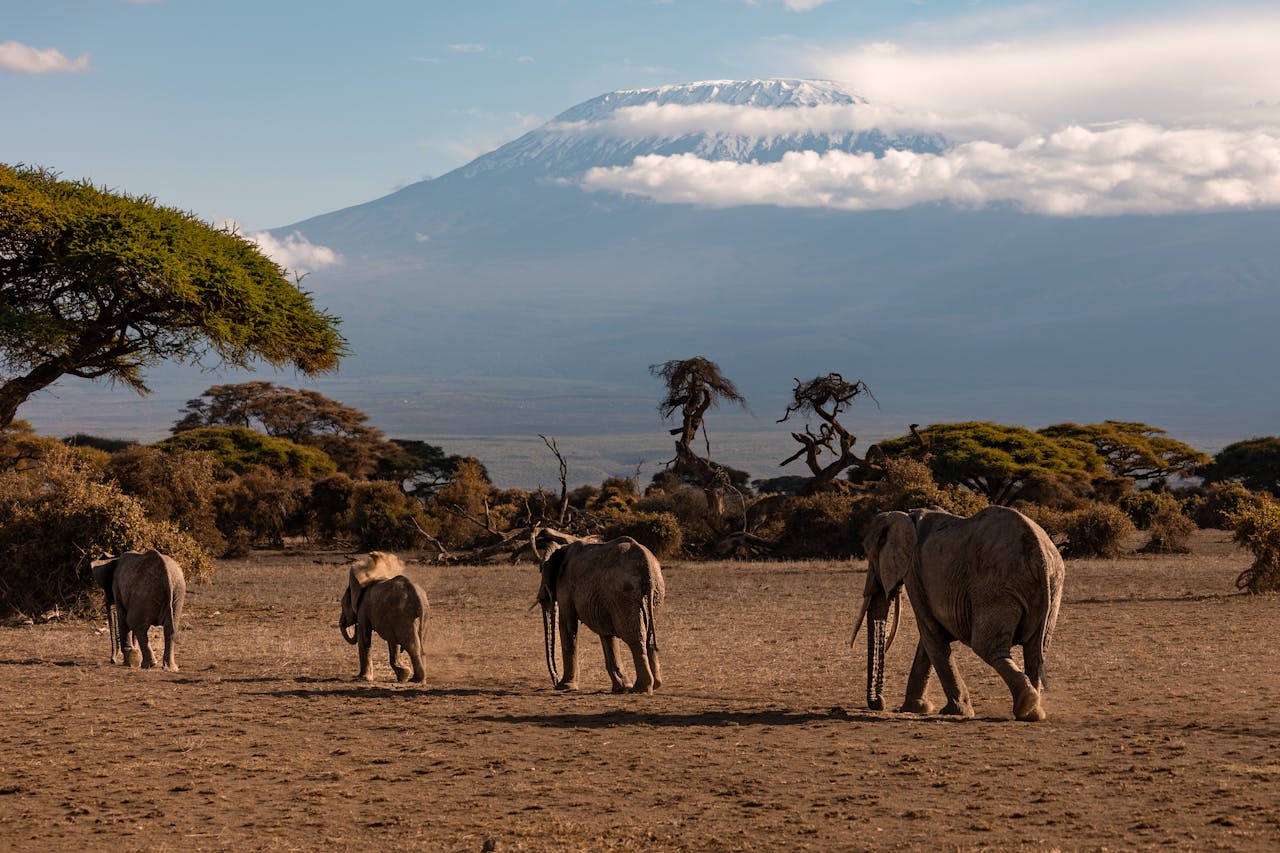

Elephants beneath Kilimanjaro, the world’s longest-running elephant study, and the most reproduced photograph in African travel. Everything you need to plan an Amboseli safari — including how to actually get the iconic shot, and the park-fee situation that most guides get wrong.
Why Amboseli is extraordinary
You have almost certainly seen Amboseli without knowing it. The image — enormous elephants moving slowly across a dusty plain with the snow-capped peak of Mount Kilimanjaro blazing behind them — is the most reproduced photograph in East African travel and one of the defining images of Africa itself. What surprises most visitors is discovering that Amboseli is far more than one iconic photograph. It is a 392-square-kilometre ecosystem of genuine ecological complexity: permanent swamps fed by underground springs from Kilimanjaro’s melting glaciers, alkaline dust plains, acacia woodlands, and dry lake beds, supporting over 1,500 elephants, four of the Big Five, more than 420 bird species, and the longest-running wild elephant study in the world.
Amboseli is also one of Kenya’s most accessible destinations: roughly 240 kilometres southeast of Nairobi, reachable in four to five hours by road or about 45 minutes by charter flight, and entirely manageable on a short two-night itinerary. For first-time Kenya safari visitors, it often makes the perfect introduction — or the perfect second destination after the Maasai Mara, delivering an elephant-and-mountain experience that contrasts completely with the Mara’s predator-and-plains character.
Amboseli National Park guide covers the park honestly: why the elephants behave the way they do (and the science behind it), how to actually get the Kilimanjaro photograph rather than just hoping for it, the wildlife beyond the headline elephants, the verified 2026 fee situation (which is more complicated than most guides admit), how to get there, where to stay across every tier, and the key experiences that justify the visit. Where the standard guides repeat outdated figures, this one corrects them.
Amboseli delivers two things no other Kenyan park matches: elephant encounters of extraordinary intimacy, backed by fifty years of individual-animal research, and the Kilimanjaro backdrop that has defined African travel imagery. Get the timing right and the iconic photograph is genuinely achievable. Get it wrong and the mountain hides behind cloud all week.
| SIZE 392 km² national park within a larger ecosystem | ELEPHANT POPULATION 1,500+ individuals across 50+ studied family groups |
| LOCATION ~240 km southeast of Nairobi, near the Tanzania border | KILIMANJARO 5,895m — Africa’s highest peak, ~40 km away in Tanzania |
| BIRD SPECIES 420+ recorded; flamingo, pelican, African fish eagle | PARK FEE 2026 (NON-RESIDENT) $90/adult/24hr (see fee note — court case ongoing) |
| BEST FOR PHOTOGRAPHY January-February (clearest Kilimanjaro atmosphere) | GATES Kimana, Meshanani, Iremito · cashless (eCitizen/M-Pesa/card) |
The elephants of Amboseli
Amboseli is home to the world’s most studied elephant population. Since 1972, Dr Cynthia Moss and Harvey Croze established the Amboseli Elephant Research Project (AERP) — the longest continuously running study of wild elephants anywhere on Earth, now operated by the Amboseli Trust for Elephants. Across more than five decades, researchers have documented the lives of over 3,500 individual elephants, naming matriarchs, recording births and deaths, mapping family structures, and decoding the acoustic and social communication that has fundamentally changed how science understands elephant intelligence and society.
The most famous of these elephants was Echo, a matriarch studied for over thirty years, whose family’s story appeared in books and documentaries that brought the Amboseli elephants to global attention. The research demonstrated that elephant society is organised around female-led family units in which the matriarch — typically the oldest female — holds extensive social and ecological knowledge accumulated over decades, knowledge that directly benefits her family’s survival. This is not abstract science; it is the kind of insight that transforms a game drive, because your guide can often identify individual animals and explain their documented family histories.
The practical consequence for visitors is extraordinary. Amboseli’s elephants are among the most vehicle-habituated in Africa. Because researchers have moved respectfully among them for generations, the elephants have learned that safari vehicles are not threats. It is entirely normal to find yourself within ten metres of a sixty-strong elephant family, the matriarch entirely unfazed, young calves playing close by. This level of proximity and natural behaviour is not reliably available anywhere else in East Africa.
The elephants are also famous for their size and tusks. The underground springs flowing from Kilimanjaro produce year-round fresh water and rich swamp vegetation, supporting some of the largest-tusked elephants remaining in the region. Amboseli’s surviving ‘big tuskers’ — bulls whose tusks sweep almost to the ground — are among the last of their kind in Africa, and the park’s protection of them is a quiet conservation achievement in an era when such genetics have been hunted out of most ecosystems.
FROM THE FIELD “The matriarch walked directly alongside our vehicle. She had been named by researchers in the 1970s, and our guide had known her for fifteen years. That depth of relationship between guide and individual animal is what makes Amboseli unlike anywhere else in Kenya.” — A guest describing the experience that the AERP’s five decades of work make possible.
How to get the Kilimanjaro shot
Kilimanjaro is notoriously shy. At 5,895 metres, the peak generates its own weather system — by mid-morning, clouds typically gather around the summit and obscure the snowcap, and by midday the mountain is often invisible entirely. Visitors who assume the mountain will simply be there all day are frequently disappointed. The window for the classic shot is specific and narrow: shortly after dawn, before heat haze and cloud cover build. Getting the photograph is a matter of planning plus a measure of luck, and the planning is what most visitors neglect.
The method that works, developed by photographers who shoot Amboseli regularly:
- Leave camp at gate opening (6am). Be positioned on the plains by 6:15-6:30am. The mountain is clearest in the first hour after sunrise, before convection currents stir up haze and cloud.
- Head toward Enkongo Narok swamp. This is where elephant herds congregate in the morning, providing the classic foreground of elephants moving across the plain with the mountain behind.
- Work the 30-minute golden window. The soft pink light on the snow is available for roughly 30 minutes after dawn. This is the shot — elephants in warm light with the snowcap catching the sunrise. After that, the light flattens and the cloud builds.
- Choose your season. Dry season (June-October) gives clear views; January-February is the single best window, with the driest atmosphere and clearest mountain. The green season (April-May) frequently obscures the mountain entirely for days at a time.
- Use Observation Hill. One of the only places inside the park where you can leave your vehicle. The short climb gives a panoramic view with Kilimanjaro in the distance — arrive early for both the view and the photography, and for the quietest experience.
The honest caveat: the perfect shot — elephants in golden light with Kilimanjaro blazing pink behind them — requires luck alongside planning. Not every morning produces it, even in peak dry season. But it is genuinely achievable in three to four days at Amboseli during the dry season, particularly January-February, and the failure mode (no clear mountain) still leaves you with extraordinary elephant encounters. Plan for the shot; don’t stake the whole trip’s satisfaction on it.
Wildlife beyond elephants
Amboseli is defined by its elephants, but the broader wildlife is stronger than its reputation suggests. The park reliably delivers four of the Big Five — elephant, lion, buffalo, and leopard (rarer here than in the Mara). Rhino are essentially absent from the main park. Beyond the headline species, the park rewards attention.
Cheetah hunt across the open lake bed, where the flat terrain and good visibility make for consistent sightings and dramatic hunting opportunities. Hippo populate the Enkongo Narok and Longinye swamps. Maasai giraffe — the distinctive dark-patched variety — are stunning silhouetted against the mountain. Large resident populations of zebra, wildebeest, and impala graze the plains. Baboons have been studied here since 1971 by the Amboseli Baboon Research Project, a companion long-term study to the elephant work. And the 420-plus bird species — including pelicans, flamingos, African fish eagle, and an extraordinary diversity of waterbirds drawn to the swamps — make Amboseli one of Kenya’s most important birding destinations and a designated Important Bird Area.
The 2026 park fee situation — what you actually pay
This is where most Amboseli guides are out of date, so it is worth getting right. The current charged rate for non-resident adults is $90 per 24-hour period, with children at $45. But the situation behind that number is genuinely complicated, and travellers budgeting for 2026 should understand it.
On 1 October 2025, the Kenya Wildlife Service implemented a new nationwide fee schedule that classified Amboseli as a ‘premium park’ and raised the non-resident adult fee from the previous ~$60 to $90 — roughly a 50% increase. Just one day later, on 2 October 2025, the Milimani High Court (Environment and Land Court) issued temporary orders suspending the new rates, following a challenge by the Kenya Tourism Federation and industry partners who argued the increase lacked adequate stakeholder consultation.
The legal position has remained unsettled since, with the new fees displayed on the eCitizen platform while the court process continues. In practice, most operators and the eCitizen system are charging the $90 rate for 2026. Confirm the exact figure with your operator at the time of booking, because this is a live legal matter that could shift.
A second 2026 change worth knowing: Amboseli is transitioning from national (KWS) management to the County Government of Kajiado under a Deed of Transfer gazetted in October 2025, with revenue-sharing beginning July 2026 and full management transition targeted for 2028/29. This is unlikely to affect a visitor’s day-to-day experience in 2026, but it explains some of the administrative flux around fees and management.
| Category | Adult (per 24hr) | Notes |
| Non-resident | $90 (child $45) | Subject to ongoing court case; confirm at booking |
| African citizen | $50 (child $25) | Nationals of African countries outside East Africa |
| Kenya resident | KES 2,025 | Valid resident permit required |
| East African citizen | KES 1,500 | Kenya, Uganda, Tanzania, Rwanda, Burundi |
Payment is fully cashless: pre-pay via the KWS eCitizen portal (recommended for smooth entry), or pay at the gate by M-Pesa, Visa, or Mastercard. If you are on a packaged safari through an operator, the park fee is almost always included in your total — you will not see it as a line item, but it is a significant chunk of the cost. Fly-in visitors typically pay on landing. Only 4WD safari-modified vehicles are permitted inside the park, and gates operate 6am to 6pm.
Best time to visit Amboseli
Amboseli’s seasons divide cleanly, and the choice matters more here than at most parks because of the Kilimanjaro factor.
| Window | Rating | What to expect |
| January – February | PEAK (photography) | Clearest Kilimanjaro of the year. Dry, elephants concentrated at swamps, excellent predators, lower crowds than July-Oct. The single best window for the iconic shot. |
| June – October | PEAK (overall) | Driest conditions, best wildlife concentration at permanent swamps, good dawn mountain views. Coincides with Mara migration — ideal for combining both parks. |
| November – December | Good value | Brief afternoon showers (short rains). Park greens up, birdlife intensifies, lower rates. Mountain views more variable. Wildlife still excellent. |
| March – May | Avoid if possible | Long rains. Some tracks impassable, Kilimanjaro rarely visible, wildlife disperses. Lowest rates. Only for serious birders or extreme-budget travellers. |
Getting there
By air (recommended). Scheduled and charter flights from Nairobi’s Wilson Airport to Amboseli’s Kimana airstrip take approximately 45 minutes. Most lodges include airstrip transfers in their rates. The flight itself is a highlight, with views across the Rift Valley and toward Kilimanjaro on clear mornings. Flying is strongly recommended for most visitors with limited time — it turns a punishing road day into a 45-minute hop.
By road. Approximately four to five hours from Nairobi via the Namanga road (A104) toward the Tanzania border, or via Emali. Road conditions vary and the final section to Kimana Gate is unpaved. A safari vehicle with a driver-guide is recommended for first-time visitors; self-drive is possible but requires a 4WD and confidence with rough roads and limited signage. The road route works well for travellers combining Amboseli with Tsavo or with an overland Kenya-Tanzania itinerary, where the drive is part of the journey rather than a wasted day.
Where to stay
Amboseli accommodation spans inside-park lodges (best for the dawn Kilimanjaro positioning) and private conservancies bordering the park (which add night drives and walking safaris the national park itself prohibits). Three properties span the range.
Tortilis Camp
In its own private conservancy bordering the park to the south. Founded in 1990 and named after the umbrella-shaped tortilis acacia trees that shade it, Tortilis is often described as Kenya’s original eco-camp. Sixteen tents positioned for Kilimanjaro views, with elephants frequently wandering through camp at night. Three decades of conservation work, solar power, and Maasai community partnerships make it the most ethically rooted camp in the Amboseli ecosystem. Its conservancy location means it can offer night drives and walking safaris unavailable to lodges inside the national park. From ~$780 per person per night, all-inclusive. Best for travellers who want the premium Amboseli experience plus conservancy activities and strong conservation credentials.
Ol Tukai Lodge
Inside the national park, in the Ol Tukai woodland among yellow fever trees. The most celebrated Kilimanjaro-view position in Amboseli — unobstructed mountain views from the restaurant and most rooms, and the iconic elephant-under-Kilimanjaro photograph is most commonly made from Ol Tukai’s grounds or the adjacent access road. Being inside the park means no night drives (park rules), but superb dawn Kilimanjaro positioning and immediate access to the swamp elephant-viewing areas. From ~$380 per person per night, all-inclusive. Best for photography-focused visitors who prioritise mountain positioning over conservancy activities.
Amboseli Serena Safari Lodge
Inside the national park, on a hill overlooking both the swamps and Kilimanjaro. The most established large lodge in Amboseli, with consistent service and strong value for groups and families. Pool with mountain views, close to Observation Hill and the main elephant-viewing swamps. From ~$280 per person per night (breakfast or half-board basis — confirm meal plan). Best for groups, families, and value-focused travellers who want a reliable, comfortable base inside the park.
Key experiences
- Observation Hill. The only place inside the park where you can leave your vehicle. A short climb to a panoramic viewpoint overlooking the park, swamps, and Kilimanjaro. Go at sunrise or sunset for the best light and the quietest experience.
- Enkongo Narok Swamp. The main elephant gathering point and the location where the classic elephant-in-the-swamp images are made. Best in the morning when herds come to drink and bathe, churning through the water with the mountain behind.
- Amboseli Elephant Research Project context. Ask your guide about the AERP’s work and the individual elephants it has documented. Understanding that the elephants in front of you have names and fifty-year histories transforms every sighting from seeing animals to recognising individuals with stories. The Trust does not run general public tours, but guides steeped in the research bring its insights to every drive.
- Maasai community visit. The Maasai surrounding Amboseli have coexisted with these elephants for centuries. A guided visit to a Maasai manyatta explains the community conservation model and the long history of human-wildlife coexistence that has helped keep Amboseli’s elephants relatively safe from poaching.
Frequently asked questions
What is the Amboseli National Park entry fee in 2026?
Non-resident adults currently pay $90 per 24-hour period ($45 for children), up from the previous ~$60 under the October 2025 KWS premium-park reclassification. However, the new rates are subject to an ongoing court challenge (the Milimani High Court suspended them in October 2025), so the situation is legally unsettled. In practice the $90 rate is being charged via eCitizen for 2026. Confirm the exact figure with your operator at booking. Payment is cashless only.
When is the best time to see Kilimanjaro from Amboseli?
Shortly after dawn, in the dry season — particularly January-February, which has the clearest atmosphere of the year. The mountain generates its own cloud cover by mid-morning and is often invisible by midday. June-October is also good. April-May (long rains) frequently hides the mountain for days. Plan your photography drives for the first hour after sunrise regardless of season.
How many days do you need in Amboseli?
Two nights (giving three to four game drives) is sufficient to experience the park’s elephants and have a reasonable chance at the Kilimanjaro shot. Amboseli is compact, so two nights covers it well — more than three nights is usually unnecessary unless you’re a dedicated photographer waiting for the perfect mountain morning. Amboseli combines naturally with the Maasai Mara (predators and plains) or Tsavo (wilderness scale) for a fuller Kenya itinerary.
Can you see the Big Five in Amboseli?
Four of the five reliably — elephant, lion, buffalo, and leopard (leopard is present but harder to find than in the Mara). Rhino are essentially absent from the main park. Amboseli’s strength is not Big Five completeness but the quality and intimacy of its elephant encounters, which are unmatched in East Africa, plus the Kilimanjaro setting. Travellers wanting reliable rhino should add the Mara Triangle, Lake Nakuru, or a Laikipia conservancy.
Is Amboseli good for a first safari?
Yes — particularly as part of a two-park itinerary with the Maasai Mara. Amboseli’s accessibility (45-minute flight from Nairobi), compact size, intimate elephant encounters, and iconic scenery make it an excellent introduction. It works well as either the first or second destination on a 7-night first Kenya safari. As a single-destination trip it is somewhat one-dimensional (elephant-focused); pairing it with the Mara gives the full range of Kenya’s wildlife.
Honest limits to this guide
Two things this guide cannot resolve.
First, the park-fee situation is genuinely unsettled as of mid-2026 — the court case challenging the October 2025 fee increase has not delivered a final ruling, and the management transition to Kajiado County adds further administrative flux. The $90 figure reflects what is being charged, but confirm at booking.
Second, the Kilimanjaro shot cannot be guaranteed by any amount of planning. The mountain’s weather is its own system; even a perfectly timed dry-season dawn drive can meet cloud. Plan for the shot, but treat a clear-mountain morning as a gift rather than an entitlement, and let the elephants carry the experience regardless.
THE HONEST PICK FOR AMBOSELI Two nights, ideally in January-February for the clearest Kilimanjaro, at Tortilis (for conservancy activities and conservation credentials) or Ol Tukai (for the best in-park mountain positioning). Dawn drives every morning toward Enkongo Narok swamp for the elephant-and-mountain shot. Combine with 3-4 nights in the Maasai Mara for a complete first Kenya safari. Budget the $90 park fee per day, confirmed at booking given the ongoing court case.
Who this guide is for, and who should look elsewhere
Travellers planning an Amboseli visit or adding it to a Kenya itinerary — this guide gives you the verified fees, the photography method, the accommodation options, and the realistic expectations. Pair it with the best-time-to-visit and cost guides for full trip planning.
Photographers specifically chasing the elephant-and-Kilimanjaro shot — January-February is your window, dawn is your hour, Enkongo Narok is your location, and Tortilis or Ol Tukai is your base. Accept that the mountain may still hide; build in enough mornings to improve your odds.
Travellers wanting a single-destination Kenya safari — Amboseli alone is somewhat one-dimensional. The Maasai Mara is the stronger single-destination choice for first-timers wanting the full range of wildlife. Amboseli shines as part of a multi-park itinerary rather than as a standalone trip.
Travellers prioritising rhino or big-cat density — Amboseli is not the strongest choice. The Mara conservancies deliver far higher predator density; the Mara Triangle and Laikipia conservancies deliver reliable rhino. Amboseli’s distinct value is elephants and scenery, not Big Five completeness.
Tell us what you are looking for, and we will tell you honestly whether we can deliver it — and if we cannot, we will tell you who can.
RELATED READING
- Best time to visit Kenya: timing the Amboseli Kilimanjaro window
- Kenya safari cost 2026: how Amboseli fees fit the total budget
- Kenya safari for beginners: building Amboseli into a first itinerary
- Maasai Mara vs Serengeti: the predator destination to pair with Amboseli
- Lamu Island travel guide: the coastal extension after the bush
- Amboseli National Park, Kenya — Destination Guide
- Private Conservancy vs National Reserve Kenya: The Complete Honest Guide (2026)
- Amboseli Hotels and Lodges- Where to Stay in Amboseli — Every Lodge, Camp, and Conservancy Rated 2026
- Where to Stay in Nairobi — Every Hotel and Suburb Rated 2026