
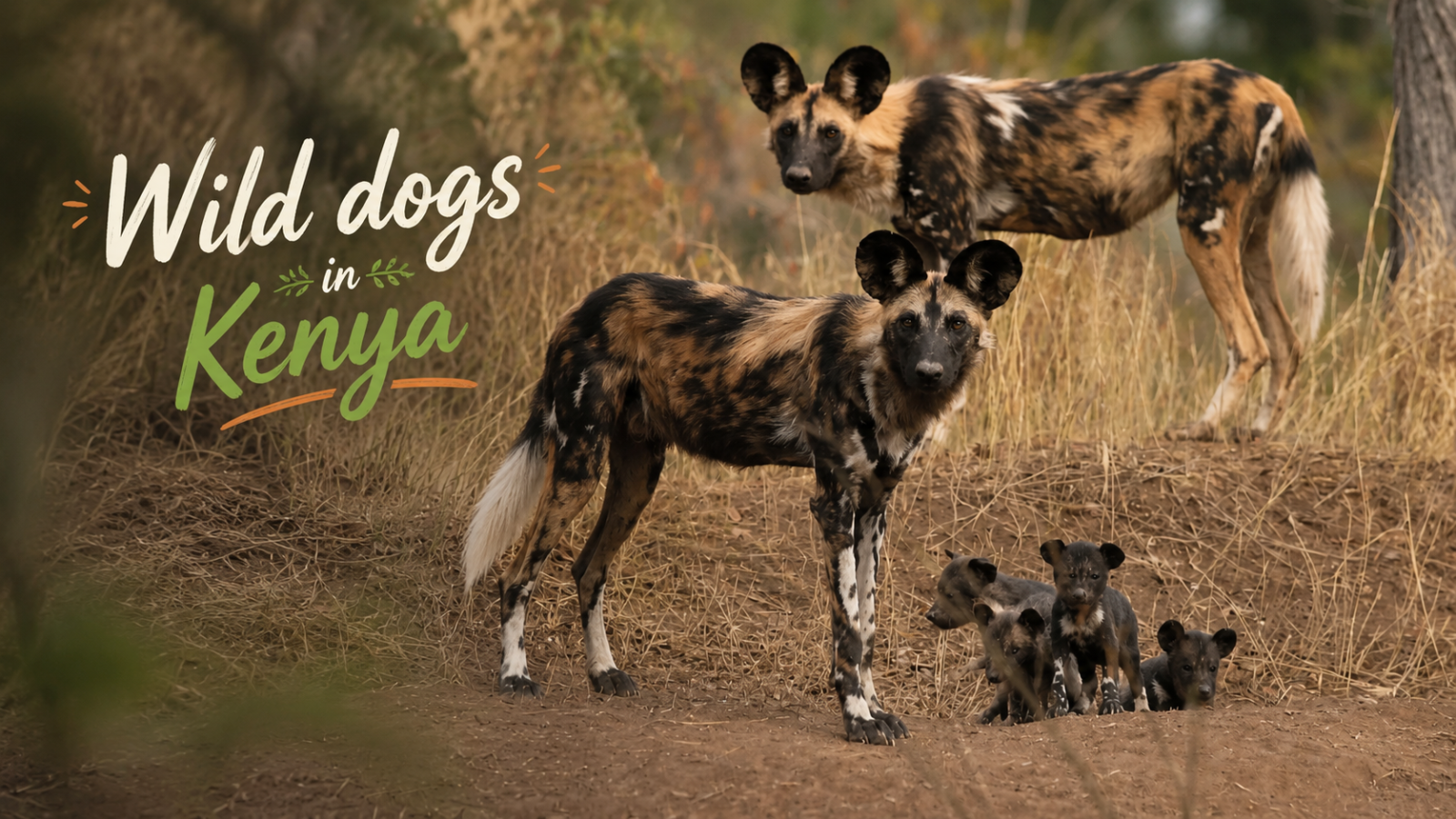

Painted wolves are Africa’s most endangered large carnivore and one of its most extraordinary social mammals. Kenya holds 10 percent of the global population. Sightings are real, sometimes spectacular — and they cannot be promised, no matter what the brochure says.
Why the ‘rarest’ framing is correct
African wild dogs — also called painted wolves, painted dogs, or by their scientific name Lycaon pictus — are the second most endangered large carnivore on the African continent after the Ethiopian wolf. The global population is approximately 6,600 individuals across 700-plus packs, fragmented across roughly a dozen range states. Kenya holds about 10 percent of that population, concentrated in Laikipia, Samburu, and northern conservancies, with smaller occurrences in Tsavo and Mara periphery.
Compare those numbers to lion (~25,000 globally, ~2,600 in Kenya), leopard (~50,000-plus globally), cheetah (~7,000 globally — comparably rare), or elephant (~415,000 in Africa, ~41,952 in Kenya per the December 2025 census). Wild dogs are not just less common than lions and leopards; they are roughly an order of magnitude rarer, and their decline curve is steeper. The Kenya population, while currently stable in Laikipia, has experienced repeated crashes — most recently the 2017 canine distemper outbreak that effectively wiped out the Laikipia population in a few months.
This guide is for travellers seriously interested in seeing wild dogs in Kenya. It covers where the population concentrates, what conservation work supports it, what a competent itinerary looks like, and — critically — what no honest operator should promise. Wild dogs are nomadic, range over hundreds of square kilometres per pack, and follow prey movements rather than tourism schedules. A four-day wild-dog-priority trip to Laikipia in the right season has perhaps a 40 to 60 percent chance of producing sightings with a strong operator. A two-night stay with a generalist operator has substantially worse odds.
The honest position is this: wild dog sightings are among the most memorable wildlife encounters available in Kenya — pack hunts at full pace are unforgettable — and they are also the least predictable of the major species. The trip should be designed around that asymmetry rather than against it.
Wild dogs are the species where the honest answer to 'will we see them' is 'we cannot guarantee it, but here is how we maximise the odds, and here is what happens if we do not.' Operators that promise sightings are misrepresenting the biology.
| GLOBAL WILD DOG POPULATION Approximately 6,600 individuals (IUCN, ZSL Range-Wide Conservation Programme) | KENYA POPULATION SHARE ~10% of global — concentrated in Laikipia and Samburu region |
| LAIKIPIA PLATEAU POPULATION 300–400 individuals across approximately 15 packs | HUNT SUCCESS RATE Approximately 80% — the highest of any African predator |
| PACK RANGE PER GROUP 100–500 km² depending on prey density | PACK SIZE IN KENYA Typically 6–25 individuals, with alpha pair as primary breeders |
| IUCN RED LIST STATUS Endangered (population trend declining) | 2017 LAIKIPIA DISTEMPER OUTBREAK Wiped out the documented Laikipia population; recovery via natural recolonisation from Samburu after 2018 |
The species and why it is unusual
Lycaon pictus is its own monotypic genus. The species is not closely related to wolves, jackals, or domestic dogs — its lineage diverged from other canids approximately 1.7 million years ago. The four-toed forepaw alone distinguishes it from every other canid (others have five). The pelage pattern is individually unique, like a fingerprint, which means researchers can identify every dog in a monitored pack from photographs.
The social biology is what makes the species extraordinary. Packs operate as cooperative units in a way that lions and hyenas approach but do not match. The alpha pair is typically the only breeding pair; all other adults are non-breeding helpers, usually siblings of the alpha pair. Pups are fed by every adult in the pack via regurgitation. Sick or injured dogs are tolerated and fed by the pack — there is documented behaviour of injured adults surviving for weeks on pack-delivered food. Decisions about movement and hunting are made via a ‘sneeze vote’ — a documented behaviour in which adults audibly sneeze, and the pack moves when a threshold of sneezes is reached.
Hunts are coordinated long-distance pursuits, often two to five kilometres at speeds approaching 60 km/h, with role-switching between leaders. Hunt success rates of around 80 percent compare to roughly 25 percent for lions and 50 percent for cheetahs. The pack consumes a medium antelope kill within 15 minutes, which is part of why hyenas and lions struggle to kleptoparasitise them — the dogs eat fast enough that interlopers arrive at bones.
Where wild dogs are in Kenya
The Kenya population is geographically concentrated. A wild-dog-priority itinerary should plan around the strongest sites and accept the realistic frequencies at each.
Laikipia Plateau — the core of Kenyan wild dog conservation
Laikipia holds approximately 300–400 individuals across 15-plus monitored packs. The plateau’s mix of private conservancies (Ol Pejeta, Lewa, Borana, Loisaba, Mpala, Mugie, Sosian, ADC Mutara), community conservancies, and pastoral lands has produced a landscape-scale conservation outcome that is the strongest in East Africa for wild dogs. The Samburu-Laikipia Wild Dog Project (now the Kenya Rangelands Wild Dog and Cheetah Project, run from Mpala Research Centre with ZSL support) has monitored the population continuously since 2001.
Specific properties with documented wild dog presence include Ol Pejeta (resident pack monitored for over a decade, although sightings are not guaranteed), Loisaba (now LMW — multiple packs use the area, but ranges are large), Borana (occasional sightings, packs move through), Lewa (occasional, less reliable than Ol Pejeta or Loisaba), and Mpala (research site, sightings tied to research operations not tourism). Mugie and Sosian have packs in their landscapes but tourism access is more constrained.
Samburu / Buffalo Springs / Shaba and northern conservancies
The Samburu ecosystem held wild dogs continuously through the period when Laikipia lost them. Sightings frequency in Samburu National Reserve is lower than in Laikipia conservancies, but the dogs do move through. Saruni Samburu and Sasaab have reported sightings periodically. The Westgate and Kalama conservancies (NRT-affiliated) have packs that range across them. The 2017 Laikipia distemper crash was followed by natural recolonisation from this northern source population — the dogs reappearing in Laikipia in late 2018 had likely walked in from Samburu and adjacent areas.
Tsavo ecosystem
Wild dogs persist in Tsavo at low densities. The Tsavo Trust collaborates with the Painted Wolf Foundation and Makueni County on rabies vaccination programmes in 12 villages bordering Kamungi Conservancy (July 2025 programme). Tsavo sightings are unpredictable; the parks are large enough that the dogs can be present in the ecosystem without being findable. For wild-dog-priority travellers, Tsavo is not the recommended destination — Laikipia and Samburu are.
Mara periphery
Wild dogs are absent as a resident population in the Maasai Mara core. Occasional pack incursions are documented from northern conservancy areas, but the Mara is not a wild dog destination. Travellers booking a Mara safari should not expect wild dog sightings as part of the trip.
THE GEOGRAPHIC VERDICT If you want to see wild dogs in Kenya, you go to Laikipia first and Samburu second. Everything else is a bonus or a probability rounding error. A traveller building a wild-dog itinerary around Tsavo or the Mara is building it around the wrong landscapes.
How sightings actually happen
Wild dog encounters fall into three patterns, and understanding the difference helps travellers calibrate expectations and select operators.
The denning season — the high-probability window
From approximately June through September each year, wild dog packs in Kenya typically den. The alpha female gives birth to a litter of 6 to 14 pups in a den (often an aardvark or hyena burrow) and remains close to the den site for the first three months. The pack as a whole stays within a much-reduced range — typically 3 to 10 km² rather than the full pack range — and returns to the den daily. For tourism purposes, this is the period when wild dogs are most findable. Camps with experienced trackers and conservation-project relationships will know the active den locations and can deliver high-probability sightings during this window.
Operators in Laikipia conservancies typically restrict den-site access and viewing distances to avoid disturbance. Strong operators will limit den visits to one short morning session and prioritise non-den encounters (the pack returning to the den, the pack on hunts) over direct den-side observation. Travellers should expect to be told ‘we cannot guarantee a den visit even if we know where the den is’ — this is appropriate conservation practice.
Pack hunts — the unpredictable spectacular
Wild dog hunts at full pace are among the most extraordinary wildlife encounters in Africa. Packs typically hunt in the cooler hours — dawn, late afternoon, early evening. The pursuit is long-distance and fast; vehicles following dogs on a hunt require skilled driving and a guide willing to leave the formal track network. Conservancies that permit off-road driving (most Laikipia conservancies) materially outperform national parks for hunt-following access. Hunt encounters are unpredictable in timing — you cannot schedule them — but a four- to six-day stay in a strong location during a hunt-active period (the cooler dry-season window) has reasonable odds of one full hunt encounter.
Pack movement — the more common encounter
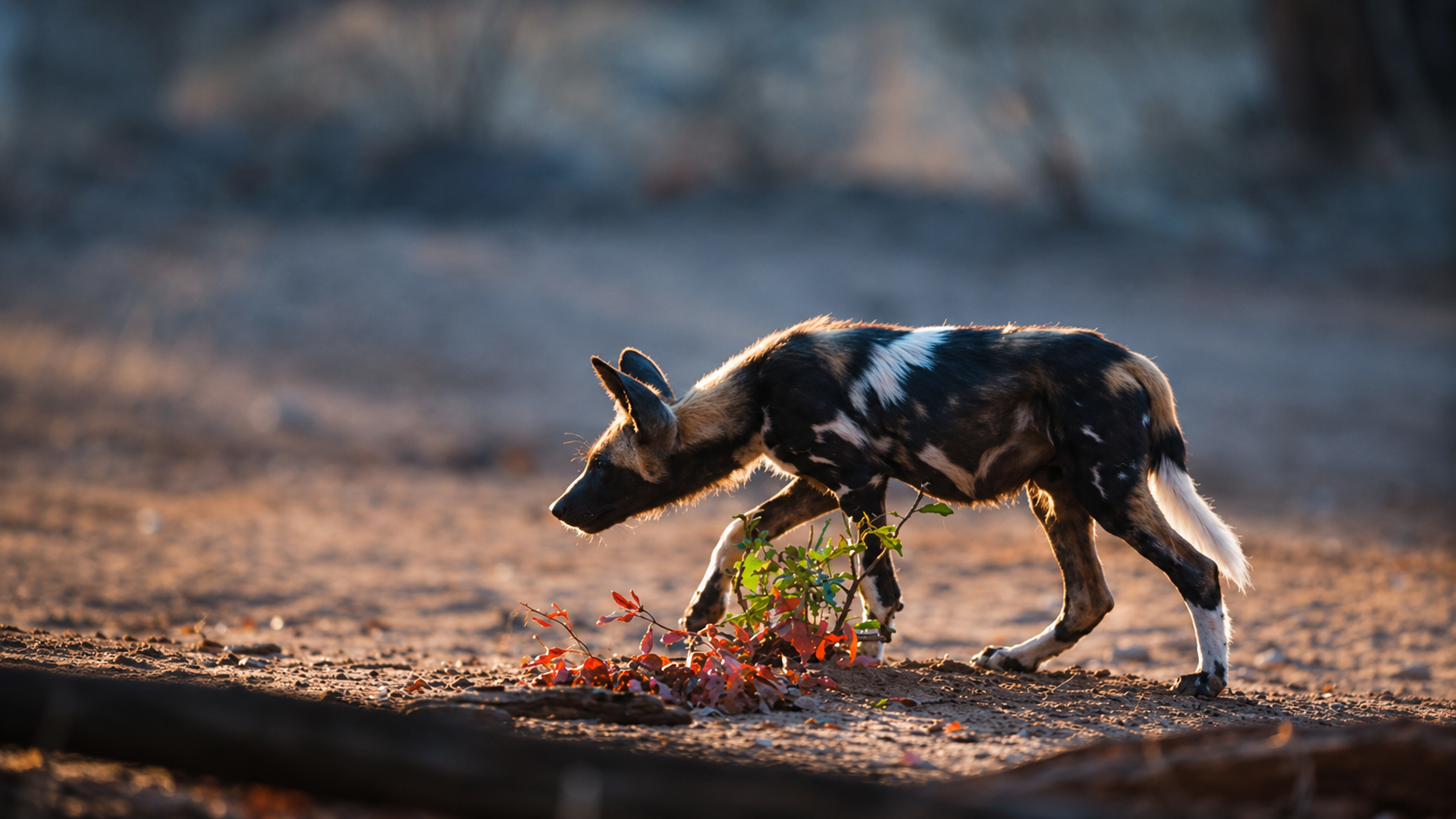
More common than den access or full hunts is pack-on-the-move encounters: the pack travelling at trotting pace through grassland, or resting at midday in shade. These are the routine wild dog encounters that good operators deliver consistently during peak season. Less spectacular than a hunt, but still extraordinary — a pack of 20 dogs in resting formation, alert, communicating, is unlike any other large-carnivore encounter you can have on safari.
The probability of wild dog Sightings
Wild dog sightings cannot be guaranteed. What can be assessed honestly is probability per night, per location, per season. The numbers below are approximate but reflect the realistic ranges.
| Location and pattern | Denning season (June–September) | Other dry season (Jan–March, late Sept) | Wet season (April–May, November–Dec) |
| Laikipia, 4-night stay, strong operator with pack relationship | 70–85% chance of sighting | 40–60% chance of sighting | 25–40% chance of sighting |
| Laikipia, 2-night stay, generalist operator | 30–50% | 15–25% | 10–20% |
| Samburu, 3-night stay, strong operator | 30–50% | 15–30% | 10–20% |
| Combined Laikipia + Samburu, 6 nights, strong operator | 80–90% | 55–70% | 35–50% |
| Tsavo or Mara, any duration | Below 10% | Below 5% | Below 5% |
These numbers come from operator reporting, the Kenya Rangelands Wild Dog and Cheetah Project’s monitoring records, and informal aggregated guest reporting from camp guides — not a single peer-reviewed study. They should be treated as informed estimates. The headline implication is that a serious wild-dog-priority trip needs to be at least six nights, split between Laikipia and Samburu, ideally in the denning season, with a strong operator who has direct relationships with the conservation monitoring teams.
THE CONTRARIAN FRAMING Most wild-dog-priority travellers underestimate how much the operator matters and overestimate how much the destination alone matters. Two travellers visiting Ol Pejeta on the same dates with different camps can have completely different sighting outcomes — one delivered by a camp with a senior guide who has hourly contact with the research team, one delivered by a camp where the guide is using the standard guest information channel. The price difference between these camps is often 20 to 30 percent. The wild-dog encounter difference is much larger.
The conservation context and what your money funds
Wild dog conservation in Kenya is one of the most operationally sophisticated wildlife-recovery programmes on the continent. Travellers paying premiums to stay in Laikipia conservancies are funding it directly. Understanding what the programme does helps a traveller distinguish camps that participate from camps that market participation.
The Kenya Rangelands Wild Dog and Cheetah Project
Run from Mpala Research Centre with Zoological Society of London support. Continuously monitored Kenya wild dog populations since 2001. Project leader Dedan Ngatia coordinates GPS-collaring of pack members across Laikipia and Samburu, disease surveillance, and the rabies vaccination programme that targets domestic dogs in pastoralist communities adjacent to wild dog ranges. The 2017 Laikipia population crash was attributed to canine distemper transmitted from domestic dogs, and the response programme has prioritised vaccination since then. This is the project that the strongest Laikipia camps support directly via funding and operational cooperation.
The Tsavo Trust / Painted Wolf Foundation partnership
Operating in the Tsavo ecosystem since 2018, focused on the smaller and more dispersed Tsavo wild dog population. The 2025 vaccination programme covered 12 villages bordering Kamungi Conservancy. Travellers staying in Tsavo properties (Galdessa, Severin Safari Camp, Finch Hattons, Satao Camp) should ask their camp whether and how it supports this work.
Northern Rangelands Trust and community conservancies
NRT-affiliated conservancies in the Samburu-Isiolo region (Westgate, Kalama, Sera, Namunyak) host the northern wild dog population that recolonised Laikipia after 2018. NRT’s ranger network monitors wildlife including wild dogs across these conservancies. Lodges in NRT-affiliated conservancies (Saruni Samburu, Saruni Rhino at Sera, Sarara, Reteti’s tented camp) contribute conservancy fees that flow directly into this monitoring work.
A wild-dog-credible operator: can name the resident packs, has direct communication with monitoring teams, can drive off-road to follow encounters, has documented sighting frequencies they will share, and will discuss what happens if the sighting does not occur. An operator that cannot or will not do these five things should not be booked for a wild-dog-priority trip regardless of headline marketing.
The honest itinerary that maximises odds
Here is the structure that produces the best statistical chance of wild dog encounters in Kenya, with honest probability framing.
The strong six-night itinerary
Three nights at a strong Laikipia conservancy camp (Ol Pejeta or Loisaba/LMW, with Borana or Lewa as alternatives) plus three nights at a strong Samburu camp (Saruni Samburu or Sasaab) in the June–September denning season. This itinerary should produce 80–90 percent sighting probability with a strong operator and 50–60 percent with a generalist.
Total cost varies by camp tier, but realistic budgets for this itinerary in 2026 are: budget tier $4,000–6,000 per person, mid-tier $6,000–9,000, premium tier $10,000–16,000. The premium tier here is genuinely buying the wild dog probability — the camp tier correlates strongly with senior-guide quality and conservation-project relationships.
The strong nine-night itinerary
Four nights Laikipia plus three nights Samburu plus two nights additional flexibility for following packs that move. The sighting probability approaches 90 percent in the denning season. The extra time is what allows for follow-up if a sighting attempt fails on day one or two.
The case against the short trip
Two-night Laikipia stays for wild dogs are not recommended. The probability mathematics is unfavourable — even at the best season with the best operator, a two-night stay is 40-some-odd percent likely to miss sightings entirely. Travellers willing to invest in a wild-dog-priority trip should invest in enough time.
Honest limits — what no operator should promise
Three things the strongest operators in Kenya will not promise.
First, sightings as a guarantee. The biology does not allow it. Packs range over hundreds of square kilometres, and even an active monitored pack can be 50 km from your camp at dawn for reasons unconnected to anything an operator can control.
Second, den access. Strong conservation practice limits den visits. Camps that promise den access as a marketing feature are either operating outside conservation-best-practice guidelines or are overselling. A traveller insisting on den access should ask whether the den site is being managed by a research team, what the viewing distance protocols are, and what the conservancy’s policy is on tourism vehicle access. Operators that cannot answer should not be trusted with the encounter.
Third, pack composition. Wild dog packs change constantly — pups die or survive, adults disperse, alpha pairs split. A camp that markets specific identifiable individuals (named alpha pair, etc.) should be able to confirm the pack is currently intact. Travellers should ask the camp to confirm the resident pack status in the week before arrival.
Who this Guide is for, and who should look elsewhere
- Travellers who are willing to design at least six nights of a Kenya trip around wild dogs and accept that even strong planning carries a 15–25 percent miss probability — this guide is aligned with what you are looking for. The trip will be one of the strongest Kenya safaris available.
- Travellers who want wild dogs as a ‘bonus’ on a generalist Kenya trip — recognise that the bonus is genuinely low-probability outside Laikipia. A Mara-Samburu-Tsavo trip with no Laikipia component has perhaps a 20 percent chance of wild dog sightings total. If that probability is acceptable, the trip is straightforward. If not, restructure around Laikipia.
- Travellers who want a guaranteed wild dog experience — Kenya is not the destination. Even Botswana’s Selinda or Linyanti, which arguably have the strongest wild dog programmes in southern Africa, do not guarantee. The species does not work that way.
The hidden-gem framing
Two destinations within Kenya are underrated for wild-dog priority travellers.
Mugie Conservancy (Laikipia)
Less-visited than Ol Pejeta and Lewa, Mugie holds resident wild dogs and operates with low tourism density. Mugie Lodge is the principal accommodation. Sighting frequency is competitive with the better-known Laikipia camps and the experience is less commercial. Why undermarketed: limited international marketing presence, smaller operator network, the conservancy chooses to limit tourism volume.
Loisaba (LMW) for active pack tracking
Loisaba has invested heavily in conservation infrastructure and currently operates active GPS collaring on the resident packs. The senior guides have real-time pack location data and the conservancy permits flexible off-road movement. Loisaba’s wild dog programme produces some of the strongest sighting frequencies in Laikipia for travellers willing to book the camp. Why undermarketed: the camp’s marketing emphasises landscape and lion programmes over wild dogs, so general-tourist marketing does not flag the strength.
The bottom line
Wild dog sightings in Kenya are achievable, occasionally spectacular, and never guaranteed. A traveller serious about wild dogs should: design a minimum six-night itinerary, split between Laikipia and Samburu, in the June-September denning season, with operators that have documented relationships with the monitoring programmes. With that structure, the trip will deliver sightings most of the time and outstanding sightings some of the time. Without that structure, the trip will deliver sightings occasionally and not at all the rest of the time. The biology of the species is not negotiable. The trip design can either work with it or against it.
THE HONEST PICK FOR THE WILD-DOG-PRIORITY TRAVELLER Loisaba (LMW) or Ol Pejeta in Laikipia for four nights, plus Saruni Samburu for three nights, in late July or August, with senior guides confirmed by name. That structure produces the best statistical case for wild dogs in Kenya — and it doubles as one of the strongest general-wildlife itineraries available in the country.
RELATED READING
- Ol Pejeta Conservancy: the rhino-success story that also delivers wild dogs
- Walking safari in Kenya: how the deeper natural history layer changes wildlife encounters
- Lion behaviour on a game drive: what to actually watch for
- Solo safari in Kenya: the considerations and the operator-selection framework
- Cheetah supplement — Cheetah in Kenya: the parallel rarity story, with different odds and different conservation challenges
Tell us what you are looking for, and we will tell you honestly whether we can deliver it — and if we cannot, we will tell you who can.