
Angama Mara opened in 2015 and has appeared on virtually every ‘world’s best new hotel’ list since. The 10-metre glass-walled tents on the Oloololo Escarpment produce one of Africa’s most photographed views. The honest question is whether the view, the location and the design justify the premium — and which other Mara property each kind of guest should consider instead.
Angama Mara delivers exactly what it sells
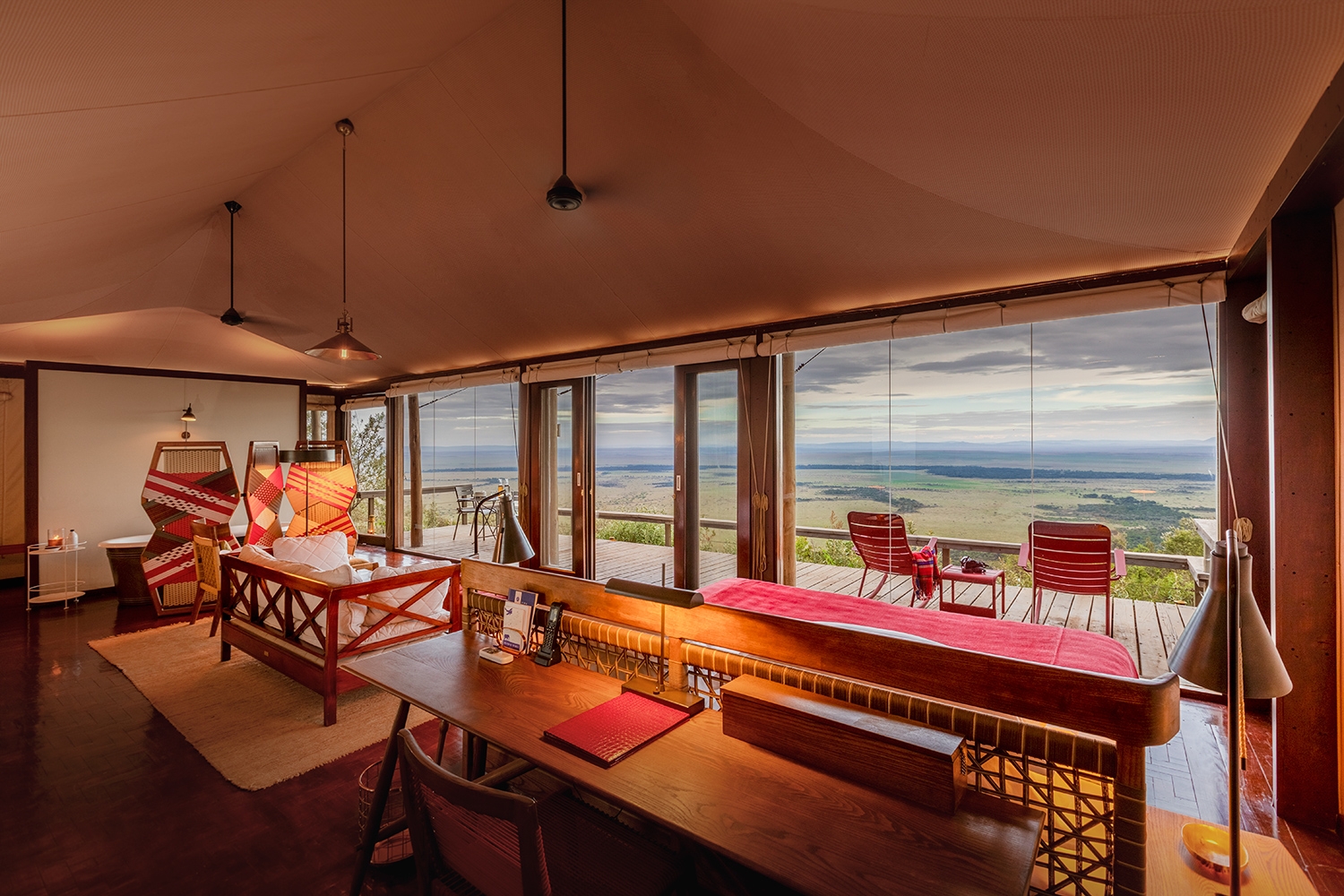
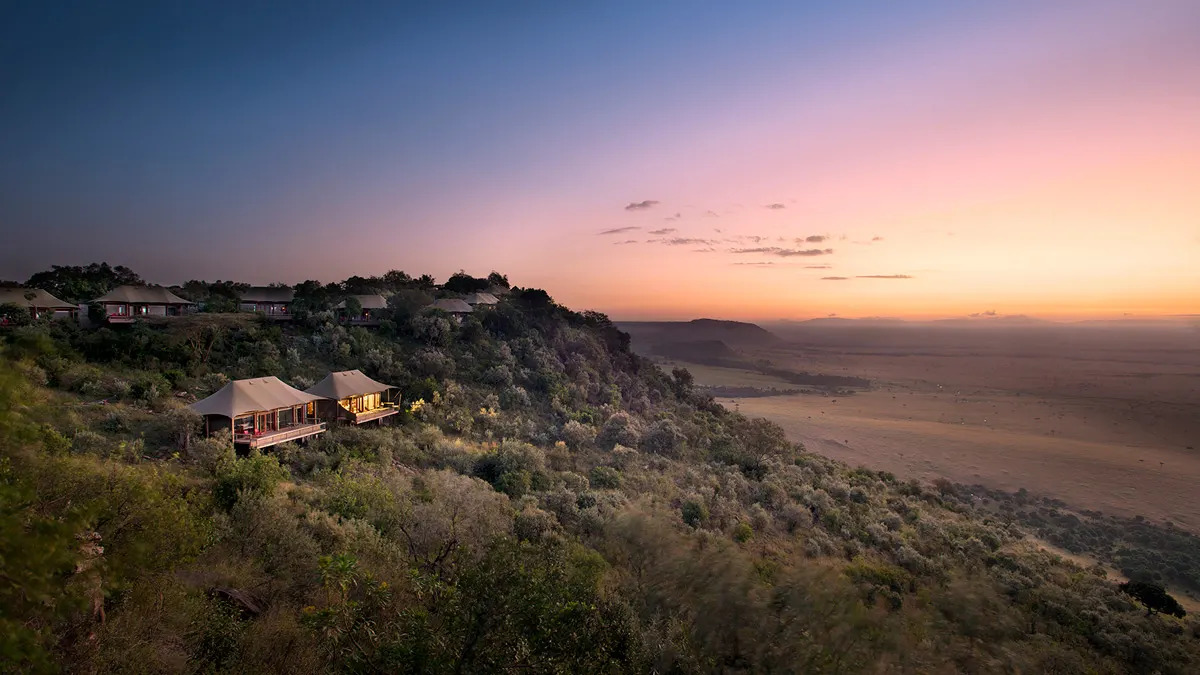
Angama Mara has been positioned, since opening day in 2015, as a property defined by a single overwhelming asset: its position on the rim of the Oloololo Escarpment at 1,900 metres above the Maasai Mara plain, with each of its 30 tented suites built around a 10-metre wall of glass facing the Mara Triangle below. The view is genuinely extraordinary, there is no equivalent property in East Africa, and the bay-window-facing-the-savannah experience has been replicated by photographers, magazines, and luxury travel platforms thousands of times. The brand-level recognition of Angama is, structurally, the recognition of this view.
The position of this review: Angama Mara is the strongest single-asset luxury safari property in Kenya for travellers whose priority is the combination of the most-photographed safari view, premium design and food, and adjacent access to the Mara River crossings during the migration window.
It is not the strongest property for travellers whose priority is the conservancy experience (low vehicle density, off-road driving, night drives, walking safaris); it is not the strongest property for travellers whose priority is the deepest guide quality or the most intimate camp scale; and it is not the strongest property for travellers whose priority is value. Each of those buyer profiles has a stronger pick elsewhere in the Mara ecosystem, and this article identifies them explicitly.
If you can articulate clearly what you want from your Mara trip — the view, the migration access, the design, the address — Angama is likely the correct booking, and the premium is what it is. If your priorities are less view-centric and more wildlife-centric, the conservancy properties at $1,500-2,000 per person deliver more of the experience that matters at the wildlife dimension while sacrificing the view. The decision is structural, not aspirational. Knowing which trip you are taking is the entire question.
Quick reference- the essential Angama Mara facts
Angama Mara: The Most-Photographed View in the Maasai Mara
A suspended dream between earth and sky, where geography becomes the primary product
The Paradox of Luxury at the Edge
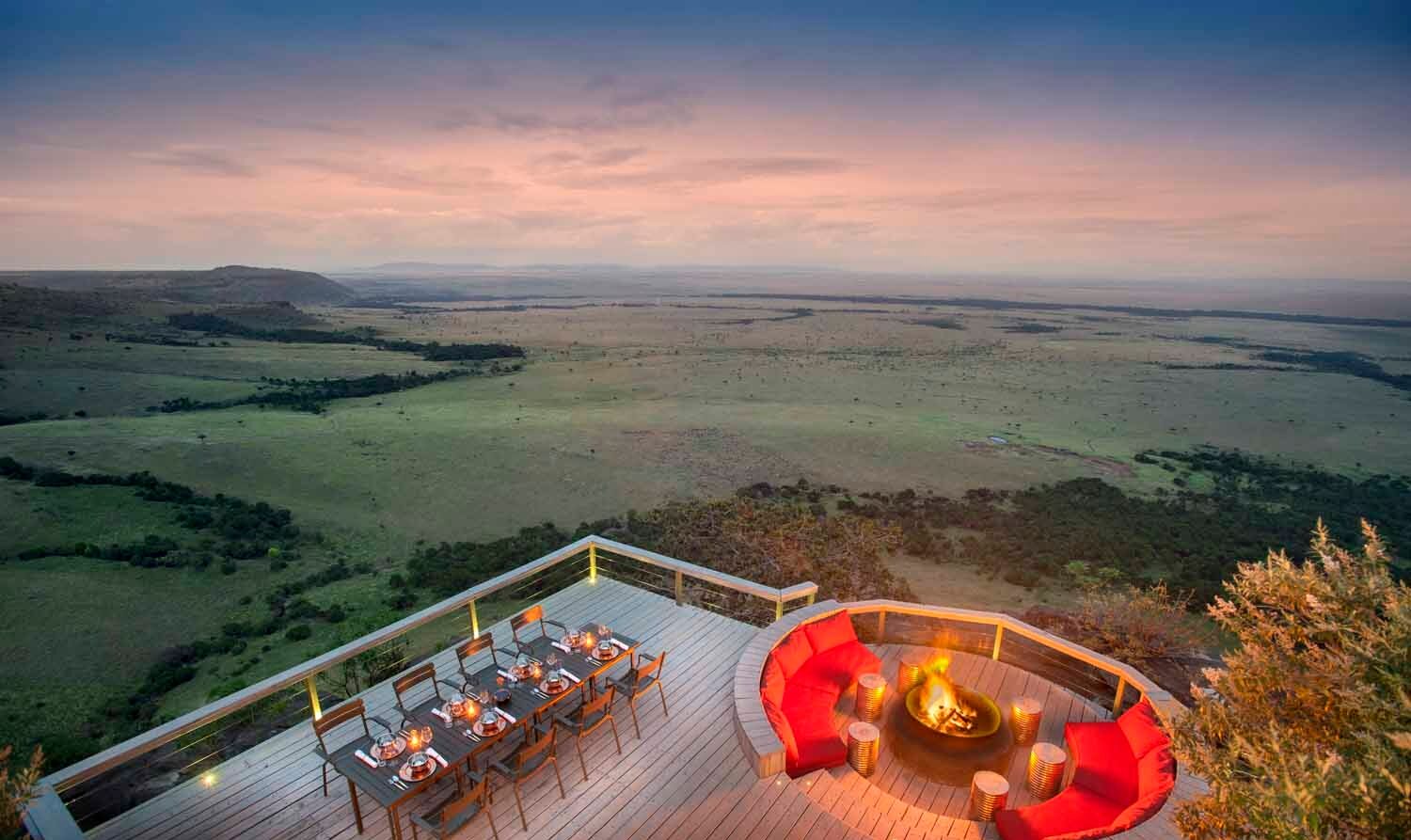
Most luxury safari lodges in the Maasai Mara operate on a simple formula: comfortable beds, good food, reliable guides, and proximity to wildlife. Angama Mara inverts this formula. Yes, it has all of those things. But the primary product is not the wildlife viewing—it is the view itself. The lodge was deliberately positioned to maximize what you see when you step onto the terrace with your morning coffee. Every design decision, from the glass-fronted suites to the infinity pool to the placement of the main gathering area, serves this single purpose: to make the view unavoidable and inescapable.

The Geography of the Oloololo Escarpment
The Oloololo Escarpment (also called the Siria Escarpment) is a geological formation that dates back millions of years. The escarpment is part of the Great Rift Valley system—a massive tectonic feature that runs from the Red Sea in the north through East Africa and down to Mozambique in the south. The Rift Valley was created by the slow separation of the African tectonic plate, a process that began approximately 25 million years ago and continues today. Standing on the edge of Angama Mara, you are standing on the edge of a massive fault line, looking at the boundary between two geological epochs rendered visible in stone and earth.
Key Facts About Angama Mara
Why This View Became the Most-Photographed
Angama Mara opened in 2015, built on the site of the former Olkurruk Mara Lodge—which was constructed specifically to house the crew and stars of Sydney Pollack’s 1985 film Out of Africa. The lodge was designed by Steve and Nicky Fitzgerald, who have a track record of creating some of Africa’s most visually distinctive safari properties. The lodge’s design philosophy is explicitly photographic. There is an on-site photographic studio staffed by professional photographers. The main gathering area—called the “baraza” (Swahili for “meeting place”)—is an open-air terrace that overhangs the escarpment. This design choice has created a feedback loop: as more people photograph the view and share it on social media, the view becomes more famous, which attracts more photographers, which generates more images, which increases the fame further.
The Mara Triangle: A Specific Ecosystem
The Mara Triangle is bounded by the Oloololo Escarpment to the west and the Mara River to the east. It covers approximately 500 square kilometers. The landscape is diverse: red oat grasslands (the primary vegetation type), volcanic hills, riverine forest along the Mara River, and scattered acacia woodlands. The Mara Triangle is home to all of Africa’s major predators: lions, leopards, cheetahs, and African wild dogs. The area is particularly known for its lion prides and is excellent for elephant viewing, as the area has one of the highest elephant concentrations in the Mara. The diversity of habitats is what makes the Mara Triangle so rich in wildlife, despite its relatively small size.
The Honest Assessment
Angama Mara is an extraordinary property. The view is genuinely stunning. The lodge is beautifully designed. The staff is professional and attentive. The food is excellent. The guides are knowledgeable. The photographic opportunities are exceptional.
The location — what Oloololo Escarpment actually delivers
Angama’s defining feature is geographic. The property occupies a section of the Oloololo Escarpment — the western rim of the Great Rift Valley that runs north-south along the western boundary of the Maasai Mara National Reserve. At 1,900 metres elevation, the camps look east and south over the Mara Triangle (the western third of the Reserve, managed by the not-for-profit Mara Conservancy since 2001) and the broader Greater Mara Ecosystem beyond. On a clear day, the view extends approximately 80 kilometres south into Tanzania’s Serengeti.
The Out of Africa connection is documented and real. The 1985 film used multiple Kenyan locations; one of the most iconic scenes — Karen Blixen’s romantic picnic with Denys Finch Hatton, looking out over the plains — was filmed on the third kopje of what is now the Angama property. The site is preserved as the ‘Out of Africa Picnic Site’ and Angama offers a recreated picnic experience there, complete with the period props the film used. For travellers with an affection for the film, this is one of the only locations in Kenya where the visual continuity to the cinematography is direct.
Mara Triangle vs. eastern Reserve access
The Mara Triangle, where Angama operates its game drives, is managed by the Mara Conservancy under contract with Narok County since 2001. It operates under tighter management standards than the eastern Reserve: fewer vehicles at sightings, better-maintained tracks, cashless gate payment, and a stronger anti-poaching record. The Mara Triangle is also one of the most reliable places in the broader Mara to see black rhino, and offers some of the strongest river-crossing access during the migration window (significant portions of the Mara River’s western bank are inside the Triangle).
From the guest’s perspective, this means that Angama’s wildlife access is materially better than a standard eastern-Reserve property at the same price point. The Triangle is less crowded than the eastern Reserve, the tracks are better, and the rhino populations are stronger. It is still, however, a National Reserve — meaning off-road driving is prohibited, night drives are prohibited, walking safaris are restricted, and vehicle limits at sightings are not enforced at the 3-5 maximum that conservancies operate under. During peak season, popular sightings in the Triangle can still draw 8-12 vehicles. The Triangle is structurally better than the eastern Reserve, but it is not structurally equivalent to a private conservancy.
The 20-minute Mara River access
Angama’s tents are approximately 20 minutes drive from the Mara River crossing points used during the wildebeest migration. This is a meaningful advantage during the August-September peak — guests staying at conservancy lodges (Olare Motorogi, Naboisho, Mara North) typically need 60-90 minutes to reach the crossing zones, often departing camp at 4:30am to be in position by 7:00am. Angama’s proximity allows later departures, more flexible scheduling, and the option to wait at a crossing for several hours without losing the day. For travellers whose specific priority is witnessing a river crossing, Angama is among the strongest positioned properties in the Mara ecosystem.
The property — design, scale and what the architecture actually delivers
Angama is structured as two separate camps of 15 tents each, built on adjacent kopjes (rocky hilltops) along the escarpment. The two-camp structure is itself a design choice with implications worth understanding: each camp operates with its own dining, lounge, and pool area, and the camps share a central Pavilion that includes a fitness centre, gallery, beadwork studio (where local Maasai women work on bespoke commissions), and a 12-metre swimming pool. The result is a property that totals 30 tents across the ridge but never feels like a 30-tent property because guests interact primarily within their assigned camp of 15.
Each tent is approximately 110 square metres including the deck and offers a 10-metre wide glass front facing the plains below. The interior design is by Annemarie Meintjes (Visi magazine), with polished hardwood floors, king-size beds positioned to face the view, freestanding baths positioned to face the view, and curated touches of contemporary Kenyan and East African design including Maasai-influenced patterns and beadwork accents. Each tent has a ‘butler’s lobby’ — a small antechamber at the entrance that allows morning coffee to be delivered without entering the main tent space. The view from the bed at sunrise, with hot air balloons drifting across the plains below, is genuinely one of the most photographed scenes in luxury safari hospitality.
The design choice that divides reviewers
Some reviewers have noted that Angama’s design — heavy on contemporary design references, polished hardwood, glass walls — feels more like a luxury hotel suspended on an escarpment than a traditional safari camp. Whether this is positive or negative depends on the guest’s expectations.
For travellers wanting the classic ‘canvas and lamps’ bush atmosphere of traditional safari camps (Cottar’s 1920s, Kicheche, Sala’s), Angama can feel architecturally cool relative to its surroundings. For travellers who want a contemporary luxury hotel experience with an extraordinary view, Angama delivers exactly that. The honest position is that Angama is closer to a design hotel with safari elements than a safari camp with luxury elements; both descriptions are accurate depending on the angle, and the buyer should know which version they want before committing.
Food and dining
Angama’s food programme has received consistent praise across multiple years of reviews and is among the strongest at the Mara’s premium tier. The kitchen produces a contemporary international menu with strong East African accents, an emphasis on sourcing from the property’s own organic garden (‘Shamba’), and a separate Shamba lunch experience where guests dine in the garden surrounded by the produce. The wine list is South African-focused with strong selections at the high-luxury price point. Service is white-glove without being stiff — a balance that requires consistent staff training and which Angama maintains better than most properties at the price point. The dining experience is genuinely an asset rather than a tolerated baseline.
The Angama Foundation and conservation alignment
Angama operates an associated non-profit, the Angama Foundation, which channels guest contributions and operator-side funding into community projects in the surrounding area — primarily through the Oloololo Wildlife Community Trust and education initiatives at local schools. The model is donation-driven rather than structurally embedded in the room rate; conservancy-based properties (Mahali Mzuri, Kicheche, Saruni) have stronger structural conservation alignment because their economic model contractually channels lease payments to community landowners. For travellers prioritising structural conservation impact, the conservancies hold a meaningful advantage; for travellers comfortable with foundation-based community contribution, Angama’s framework is credible but more discretionary.
Guiding — what Angama actually delivers in the vehicle
Angama’s guiding programme is strong but not the strongest in the Mara ecosystem. Many guides hold Kenya Professional Safari Guides Association (KPSGA) Silver or Gold certification, and several have multi-year tenure at the property. Reviews routinely name specific guides positively (Sophie, Alfred, Ekai, Johnnie among the often-mentioned), and the guide-to-guest ratio is generally favourable at the premium tier. Vehicle quality is excellent — open-sided 4×4s, well-maintained, with photography mounts and bean bags available.
Where Angama is structurally limited compared to the conservancy properties: off-road driving (prohibited in the Reserve), night drives (prohibited in the Reserve), walking safaris with armed ranger (limited within the Reserve, the property does offer escarpment walking which is its own experience but not the bush walking that conservancies allow), and vehicle limits at sightings (not enforced at conservancy 3-5 caps within the Reserve). The guiding itself is competent and often excellent; the activity scope is constrained by the Reserve’s regulatory framework rather than by the property’s choices.
Rates and the honest value question
Angama’s rate structure reflects standard Mara seasonality with specific premium-tier pricing. The current public pricing across the four major season bands:
| Season | Dates | Rate (per person sharing) | Practical note |
| Migration peak | Jul 1 – Oct 31 | ~$2,750/pp | Sells out 6–12 months ahead |
| Festive peak | Dec 23 – Jan 5 | ~$2,750/pp | Book 6+ months ahead |
| High season | Jan 6 – Mar 14, Nov | ~$1,975/pp | Strong availability |
| Green / shoulder | Mar 15 – Jun 30 | ~$1,775/pp | ‘Pay 3, stay 4’ often available |
Included in the rate: accommodation, all meals, house wines and beverages (excluding French champagne and reserve wines), twice-daily game drives, escarpment walks, return airstrip transfers, laundry, emergency medical evacuation insurance through AMREF Flying Doctors. Not included: park fees ($200/pp/day during July-December peak season, $100/pp/day January-June), hot air balloon safari (typically $495-550 per person), spa treatments, premium wines and champagnes, optional private vehicle upgrade where applicable, and gratuities (typical guide tip $20-30/day, camp staff tip $10-20/day per guest).
All-in cost honest reality check
A 4-night Angama stay during peak season for a couple, with one hot air balloon flight, modest premium wine consumption, standard gratuities, and the included park fees, comes to approximately $25,000-30,000 for two people before international flights. Add Nairobi nights, internal flights between camps if combining with other destinations, eTA visas and travel insurance, and a typical luxury Angama-centric trip lands in the $30,000-40,000 range for two for a 6-8 night itinerary. The headline $2,750 per person nightly rate is therefore approximately 60-65% of the actual trip cost, with the remaining 35-40% in fees, flights, extras and add-ons. This is standard for luxury East Africa travel but worth being explicit about for budget planning.
The Mara conservancy alternative
The strongest direct comparison for travellers considering Angama is the Mara conservancy market — properties operating inside Olare Motorogi, Naboisho, Mara North, and the broader conservancy belt. The comparison illuminates Angama’s specific value position:
| Comparison | Angama Mara | Mahali Mzuri | Kicheche Bush Camp |
| Location | Mara Triangle escarpment (Reserve-adjacent) | Inside Olare Motorogi Conservancy | Inside Olare Motorogi Conservancy |
| Tent count | 30 (two 15-tent camps) | 12 | 6 |
| Peak rate (pp sharing) | ~$2,750 | ~$3,750 (Preferred Hotels) | ~$1,400–1,800 |
| Off-road, night drives, walking | Limited (Reserve rules) | Yes (conservancy) | Yes (conservancy) |
| Mara River crossing access | Excellent (20 min) | Available with longer drive | Available with longer drive |
| Strongest claim | The view + Reserve access | Conservancy access + design | Guiding quality + value |
THE HONEST PRICING COMPARISON
Mahali Mzuri (Olare Motorogi, 12 tents) charges meaningfully more than Angama on the public Preferred Hotels listing at $3,750 per person — though its all-in cost is typically lower because the conservancy structure includes more activities and the park-fee burden is reduced. Kicheche Bush Camp delivers stronger guiding consistency at significantly lower nightly rates but without the view. The most strategically interesting comparison is therefore between Angama at $2,750 and a hybrid itinerary — say, 2 nights Angama for the view and Mara Triangle access plus 3 nights Olare Motorogi for the conservancy experience, which produces a more balanced and arguably stronger overall trip at comparable total cost.
Where Angama genuinely excels — the unambiguous case
Angama is a genuinely outstanding property in specific dimensions. The case for booking Angama, made honestly:
1. The view is irreplicable in East Africa
There is no other safari property in East Africa with an equivalent location. The combination of escarpment elevation, glass-walled tents, and the panorama over the Mara Triangle is structurally unique. Travellers for whom the view is the central asset — photographers shooting from camp, couples wanting the iconic Mara backdrop for honeymoon images, repeat African travellers who have stayed at multiple conservancy properties and want something visually different — are paying for something that genuinely cannot be replicated elsewhere at any price.
2. Mara Triangle access is structurally strong
The Triangle’s tighter management, lower vehicle pressure than the eastern Reserve, strong rhino populations, and proximity to the Mara River crossing zones produces a wildlife experience meaningfully better than the eastern Reserve at the same Reserve-fee price. Angama’s location 20 minutes from the river is among the strongest river-crossing-access positions in the Mara during the August-September migration peak.
3. Food and service operate at international luxury hotel standard
The kitchen, the wine programme, the bar, the room service, and the front-of-house staff training are all calibrated to international five-star luxury standard rather than the looser standards common to safari properties. For travellers used to luxury hotel hospitality in major cities, Angama is a property where the safari-camp limitations of food and beverage do not appear. This is genuinely rare in the safari category.
4. The Out of Africa narrative depth is real
For travellers with cultural attachment to the film or the Karen Blixen story, the location’s continuity to the cinematography is direct. The recreated picnic on the kopje is genuinely the site where the scene was filmed. This is one of a small number of safari properties with a substantive cultural-historical narrative anchor that goes beyond marketing copy.
5. Logistical simplicity
Angama’s private airfield, established airstrip protocols, and operational maturity (10 years of operation by 2025) produce a logistically polished experience. The transition from Nairobi to camp is smooth; the in-camp operations rarely surface friction; the departure flow is professional. For travellers who value low-friction luxury operation, this is a real asset.
Where Angama is structurally constrained
Five specific dimensions where Angama is not the strongest Mara property at its price point, and where alternative bookings deserve consideration:
1. The wildlife activity scope is narrower than conservancy properties
Inside the Reserve, off-road driving is prohibited, night drives are prohibited, walking safaris are restricted, and vehicle limits at sightings are not the conservancy 3-5 maximum. This is not Angama’s fault — it is the regulatory framework of the Reserve. But the practical consequence is that Angama guests have a narrower experiential portfolio than guests at Mahali Mzuri, Kicheche, Saruni, Cottar’s, and other conservancy properties at the same or lower price points. For travellers prioritising the full wildlife activity range, the conservancies hold a structural advantage.
2. The 30-tent scale is large for the price tier
Angama’s two-camp structure of 15 tents each totals 30 — substantially larger than the 12-tent Mahali Mzuri, the 6-tent Kicheche Bush Camp, the 9-tent Saruni Mara, and most other premium-tier Mara properties. While the design separates the two camps and the experience feels more intimate than the raw bed count suggests, the property is operationally larger than its competitors. For travellers prioritising the smallest possible bed-to-acreage ratio and the most exclusive feel, conservancy properties at 6-12 tents deliver a categorically different experience scale.
3. The conservation alignment is weaker than structural conservancy participation
Angama operates a foundation that channels guest and operator funds into community projects. This is positive but discretionary. Conservancy-based properties have structurally embedded conservation alignment — every room rate contributes contractually to community lease payments that secure wildlife corridors and prevent land conversion. For travellers prioritising conservation as part of why they pay the premium, the conservancy properties hold the stronger position. Angama’s contribution model is credible but is not the same as the conservancy lease economics.
4. The architecture-versus-bush tension is real
Angama’s design polish — glass walls, polished floors, contemporary luxury aesthetic — is divisive among experienced safari travellers. The ‘design hotel with view’ versus ‘safari camp in bush’ debate is genuine and has not been resolved across the reviewer community. Travellers who want a clearly bush-atmosphere safari property will find Angama architecturally cool relative to its surroundings; travellers who want a luxury hotel with the view will love it. The honest position is that Angama is closer to the former than the latter, regardless of how the marketing positions it.
5. Guide tenure and the small-camp specialist alternative
Angama’s guiding is strong but not the strongest in the ecosystem. The properties that consistently rank above Angama on guide quality — Kicheche Bush Camp, Cottar’s 1920s, Saruni Mara, certain Cottar’s Group properties — operate at smaller scale with longer-tenured senior guides and more direct guide-guest matching. Angama’s larger scale produces good guiding but rarely the extraordinary guiding that the smallest conservancy properties deliver. For travellers prioritising guide quality as the central asset (serious photographers, repeat visitors, conservation-immersed travellers), the smaller specialist camps are stronger picks.
Who Angama is actually for
The strongest match for Angama is a specific traveller profile. Pretending Angama is for everyone in the premium tier undermines the case for the travellers it actually fits well. The honest segmentation:
Strong fit
- Photographers whose central interest includes the iconic Mara escarpment view as photographic subject.
- Couples on honeymoon or milestone trips who specifically want the view as the centrepiece of the experience.
- Travellers prioritising design-led hospitality at international five-star standard alongside the safari experience.
- Repeat African safari travellers who have done multiple conservancy stays and want something visually and architecturally different.
- Out of Africa devotees for whom the cultural-historical connection is meaningful.
- Travellers prioritising migration river crossing access during the August-September peak and willing to pay the premium for proximity.
- Multi-generational families where the two-camp structure allows different generations to operate semi-independently while sharing the property.
Look elsewhere
- Travellers prioritising the full conservancy activity portfolio (off-road, night drives, walking safaris) — book Mahali Mzuri, Kicheche, Saruni Mara instead.
- Travellers prioritising the smallest possible camp scale — book 6-tent or 9-tent conservancy properties instead.
- Travellers prioritising the strongest possible guide quality at smaller scale — book Kicheche or Cottar’s 1920s instead.
- Travellers prioritising structural conservation economics — book any conservancy property with verifiable lease alignment instead.
- Value-conscious luxury travellers — the conservancy market delivers more wildlife per dollar at comparable luxury standards.
- Travellers seeking the traditional canvas-and-lamps safari atmosphere — book Cottar’s, Sala’s, Kicheche, or similar instead.
Booking strategy — how to book Angama well
Lead time
Peak season (July-October, festive 23 Dec-5 Jan) sells out 6-12 months ahead — sometimes longer at the most-demanded suites and dates. High season (January-March, November) typically books 3-4 months ahead. Green season (mid-March to June) is the most flexible window with significant late availability and frequent stay-4-pay-3 promotions. The strongest single booking strategy at premium properties is early commitment to the dates that matter most, particularly if combining with Nairobi or coastal extensions that also peak.
Combine, don’t camp
The strongest Angama itineraries are not 5-7 nights at Angama alone. They are 2-3 nights at Angama combined with 2-3 nights at a conservancy property (Olare Motorogi or Naboisho for the wildlife activity range) and optionally a Laikipia or Samburu component. This produces both the view experience that Angama uniquely delivers and the conservancy experience that completes the wildlife dimension. The combination is consistently rated higher by experienced travellers than a single-property Angama stay.
Request specific guides if you have priorities
Angama’s senior guides — Sophie, Alfred, Ekai, Johnnie among those frequently named in reviews — can be requested at booking time, subject to availability. Properties at this tier accommodate guide-matching requests for guests with specific priorities (photography, birding, photography-with-children, etc.). The request is best made through your operator at booking rather than at arrival, and is more likely to be honoured at lower-demand windows.
Verify what is and isn’t included
Angama’s published ‘all-inclusive’ coverage excludes park fees, balloon flights, spa, premium beverages, and gratuities. Confirm in writing exactly what is included before committing — particularly during peak season when the $200/pp/day park fee multiplied across a 4-5 night stay is a substantial line item. The gap between the headline rate and the actual final cost can be 30-40% at peak.
Consider the green season as a strategic alternative
Mid-March to June operates at approximately 35% discount to peak rates. The wildlife is excellent (resident populations unaffected), the view from the tent is unchanged, and the Mara Triangle’s all-weather access means the property operates fully. The trade-off is the migration herds are not in Kenya (they are in the Serengeti) and some afternoon rain is possible. For travellers who specifically do not need the migration, the green season at Angama is a structurally favourable booking.
The guest experience day by day — what your trip actually looks like
The marketing photography and the brand-tier reviews capture the property’s headline assets — the view, the design, the food — but rarely the actual day-by-day texture of a guest stay. The honest version, working through a typical four-night Angama itinerary:
Arrival day
Most guests fly from Nairobi Wilson Airport on Safarilink or AirKenya scheduled flights — 45-50 minutes to Angama’s private airstrip. The strip is short and only certain aircraft types operate it; flights are typically morning departures. On arrival you are met by an Angama guide at the strip and driven 10-15 minutes to the main camp. Welcome lunch is served on the deck overlooking the plains — the first encounter with the signature view. A property orientation walk-through follows. Afternoon game drive into the Mara Triangle departs 4:00pm, returning around 7:00pm for sundowner drinks and dinner. The arrival day operates at slower pace than subsequent days, accommodating jet lag and the first compression of the location.
Day two — the standard rhythm
5:30am wake-up call (some guests prefer 6:00am — both work). Coffee and light pastries in the tent’s butler’s lobby, delivered without entering the main space. 6:00am departure for morning game drive in the Mara Triangle. The early drive captures predator activity, dawn light, and the migration herds (during August-September) at their most active. Return to camp around 10:00am for full breakfast — typically the strongest meal of the day, with extensive cooked-to-order options. The mid-day window (11:00am to 3:30pm) is unscheduled — most guests use it for the pool, the spa, the gallery, or a Shamba lunch experience in the property’s organic garden. Afternoon game drive 4:00pm to 7:00pm, returning for sundowner cocktails at the property’s bar and dinner around 8:00pm.
Day three — the Out of Africa picnic
Many guests book the recreated Out of Africa picnic on day three or four. The experience involves a morning game drive that concludes at the third kopje — the actual filming site — where staff have set up the period picnic (checked blanket, Stanley flask, period crockery, cucumber sandwiches, champagne) referenced in the film’s most romantic scene. The picnic typically runs 90 minutes. Reactions vary: travellers attached to the film find it genuinely moving; travellers without the cultural attachment find it pleasant but less central than the surrounding wildlife dimension. Either way, the location’s continuity to the cinematography is direct, and the experience is unique to Angama. The afternoon then operates at the standard rhythm.
Day four — the river crossing or the balloon
Guests visiting in August-September who specifically want a river crossing typically dedicate day three or four to a full-day Mara River drive. The drive departs around 6:00am with packed breakfast and lunch, positions at a likely crossing zone, and waits. Crossings are not scheduled — they may happen at 9:00am, at noon, in the late afternoon, or not at all on a given day. The all-day commitment is meaningful, and travellers who arrive expecting the crossing to happen on schedule are often disappointed. The honest framing is that the all-day commitment maximises the probability of witnessing a crossing, but the probability is never 100%.
Travellers not specifically chasing the migration crossing typically book the hot air balloon flight on day three or four. The balloon departs at dawn from a launch site about 30 minutes from camp, flies for approximately 60-75 minutes over the Triangle, and concludes with a champagne bush breakfast in the savannah. The balloon experience is exceptional and structurally different from vehicle-based wildlife viewing — the aerial perspective on landscape and herd movement is among the most photographed experiences in safari travel. Cost is approximately $495-550 per person, an additional line item not included in the property rate. The flight is weather-dependent; cancellations are rare in the dry season but possible.
Departure day
Final morning game drive typically departs around 6:00am and returns to camp by 9:00am for a final breakfast. Airstrip transfers depart between 10:00am and 12:30pm for the return flight to Wilson Airport. The morning of departure operates at a slightly slower pace than the full-rhythm middle days, allowing guests to absorb the last impressions of the location.
Tent selection — the differences between Angama’s 30 tents
Not all 30 Angama tents are identical. The property’s two-camp structure (South Camp and North Camp), the orientation of individual tents along the escarpment, and the elevation differences across the property produce meaningful variation in what each tent delivers. For travellers booking at the premium tier, understanding the differences allows better matching of tent to priority.
South Camp vs. North Camp
Angama’s two camps share the same essential design and operational structure but differ in orientation and atmosphere. South Camp sits slightly higher on the escarpment ridge and faces predominantly southeast — meaning sunrise on the deck is direct and the morning view captures the south-eastern plains. North Camp sits slightly lower and faces east — also strong for sunrise but with a slightly different view angle that captures more of the central Triangle. Both camps share the central Pavilion (pool, gym, gallery, beadwork studio). Most guests do not specifically request one camp over the other at booking, and Angama’s reservations team assigns based on availability. For travellers with specific preferences, the request can be made at booking.
Tent positioning within each camp
The tents in each camp are spread along the escarpment ridge. The end tents — typically tent 1 and tent 15 in each camp — sit further from the central facilities (10-15 minutes walk to the dining room and pool) and produce the most private and view-dominated experience. The middle tents (tents 7-9) are closest to the central facilities and convenient for guests with mobility considerations. The difference between an end tent and a middle tent is meaningful for travellers prioritising privacy and immersion in the view; for travellers prioritising convenience and accessibility, the middle tents are stronger picks. Mention specific preferences at booking; the property typically accommodates within available range.
The two-bedroom family suite option
Angama operates a small number of two-bedroom family suite configurations — adjacent or connected tents that allow families with children to occupy a single configuration. The family-suite product is meaningfully better for travellers with kids age 6-16 than booking two separate tents, and the family-friendly policy (including a ‘family of four’ rate at certain periods) is among the more accommodating in the premium Mara market. For travellers with children, this should be confirmed at booking — the family-suite inventory is limited and books early.
The competing properties at the same price point — five honest comparisons
Mahali Mzuri (Olare Motorogi)
Sir Richard Branson’s Virgin Limited Edition property, 12 tents, inside Olare Motorogi Conservancy. Rate from $3,750 per person (Preferred Hotels listing) but typically lower at direct booking. Stronger conservancy access (off-road, night drives, walking), comparable design polish, ranked #4 Best Resort in Central & Eastern Africa in Condé Nast Traveler 2025 Readers’ Choice Awards. Trade-off: no escarpment view, smaller scale, less Out of Africa narrative. The strongest direct competitor for travellers whose conservancy access matters more than the view.
Kicheche Bush Camp (Olare Motorogi)
Six-tent specialist photographer’s camp inside Olare Motorogi. Rate approximately $1,400-1,800 per person. Strongest single guide team in the Mara. Eco Tourism Kenya Gold-rated. Significantly lower price than Angama but without the design polish or view. For travellers prioritising guide quality and value at the high-luxury tier, the strongest direct alternative.
Cottar’s 1920s Camp (Olderkesi Conservancy)
Classic safari camp with explicit Out of Africa atmosphere — vintage cars, period decor, traditional canvas tents. Inside Olderkesi Conservancy at the southern edge of the Mara ecosystem. Rate approximately $1,800-2,500 per person. Strong for travellers wanting the traditional safari aesthetic that Angama deliberately moves away from. Different proposition rather than direct competitor; complement rather than alternative.
Saruni Mara (Mara North Conservancy)
Six villas in a forested valley inside Mara North Conservancy. Italian-influenced design, strong wellness offering. Distinctive aesthetic that is its own version of the design-hotel-in-the-bush positioning. Rate approximately $1,400-1,800 per person. Smaller scale, different visual signature, comparable design ambition at meaningfully lower price.
Mara Plains Camp (Olare Motorogi)
Great Plains Conservation property, 7 tents in Olare Motorogi. Ultra-luxury price tier, photographer-focused, private vehicle and guide combinations available. Rate from $1,800-2,500 per person. Strong direct competitor for travellers wanting the smallest possible camp scale at the premium tier, particularly for photographic priority guests.
The honest position
Angama Mara is the strongest single-asset luxury safari property in Kenya for travellers whose priority profile matches what Angama specifically delivers — the escarpment view as central experience, premium design hospitality at international luxury hotel standard, Mara Triangle access with strong river-crossing proximity, the Out of Africa cultural connection, and the operational maturity of a 10-year-old top-tier property. For travellers in this profile, the premium is what it is, the booking is correct, and the experience consistently delivers what was promised.
For travellers whose priority profile is different — conservancy activity range, smaller intimate scale, deepest guide quality, structural conservation economics, classic safari atmosphere, or value — Angama is not the strongest pick. Mahali Mzuri delivers stronger conservancy access at higher base price. Kicheche delivers superior guiding at half the rate. Cottar’s delivers the traditional safari atmosphere. Saruni delivers comparable design ambition at lower price. Each of these is a stronger pick for the specific traveller they fit. The question is not ‘is Angama good’ (it is) but ‘is Angama right for the specific trip you are trying to take’ (sometimes).
THE BOTTOM LINE
Book Angama if the view, the design, the food, and the Mara River proximity are central to what you want from the trip — and accept the trade-offs in activity scope and conservation structure that come with the Reserve-adjacent location. Book a conservancy alternative if your priority profile is different. The strongest single recommendation is the hybrid itinerary: 2-3 nights at Angama plus 2-3 nights in Olare Motorogi or Naboisho. The combination produces the strongest overall trip and explicitly avoids the false choice between view and wildlife range.
RELATED READING
- Mahali Mzuri: what 12 tents on 33,000 acres of Olare Motorogi actually buys you — The strongest direct competitor.
- Maasai Mara Destination Guide — The Reserve vs. the conservancies in honest terms.
- Olare Motorogi Conservancy: what makes it special — The conservancy alternative to Reserve-adjacent properties.
- Mara North Conservancy: who it’s actually for — The other principal conservancy alternative.
- Luxury Safari Kenya: What Makes It Worth the Premium? — The structural framework for premium pricing decisions.
Tell us what you are looking for, and we will tell you honestly whether we can deliver it — and if we cannot, we will tell you who can.