
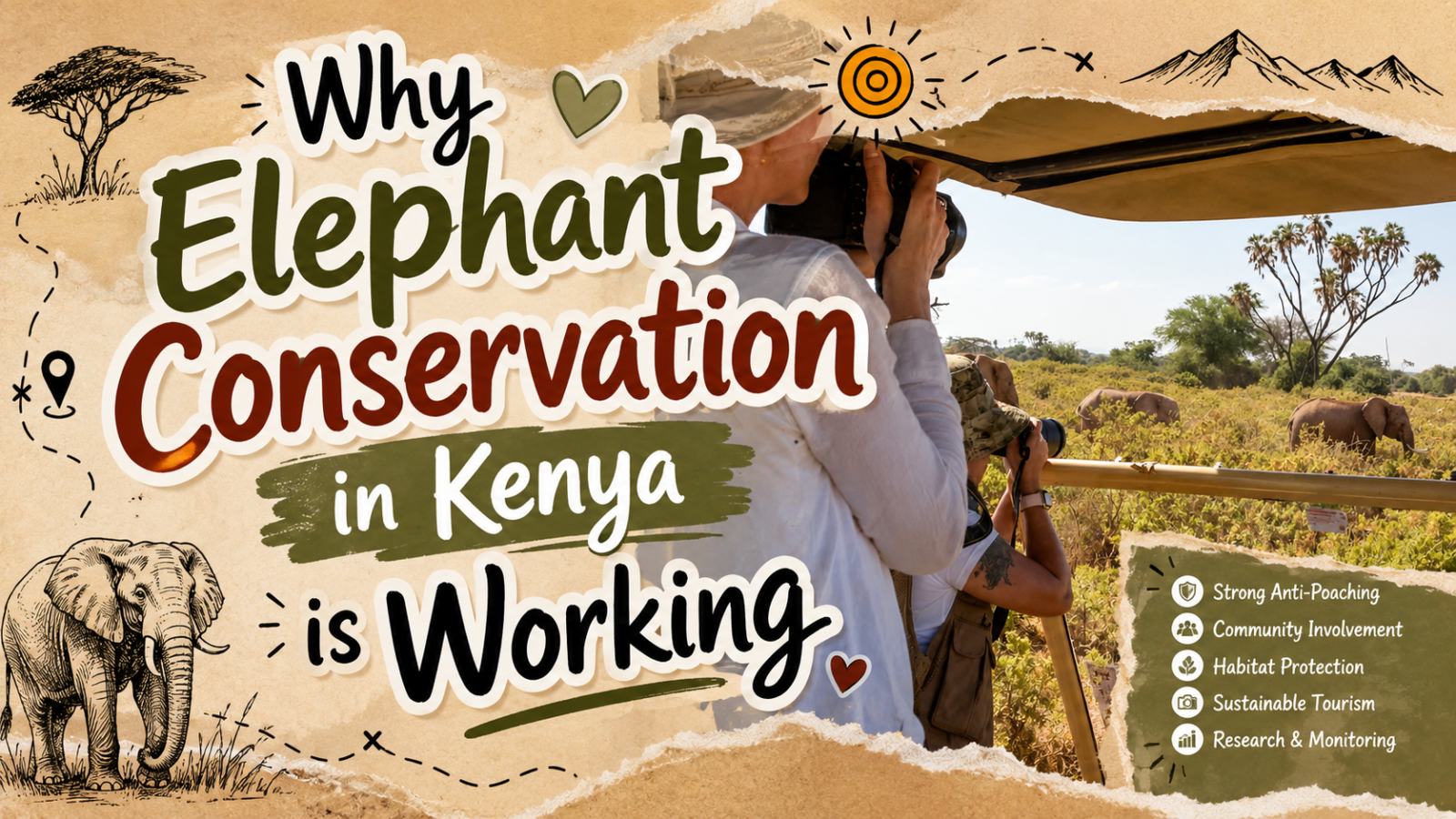

From a low of 16,000 elephants in 1989 to 41,952 today, Kenya’s elephant story is one of the few unambiguous conservation recoveries in African wildlife. This is how it happened — and why the next chapter is harder than the last.
Kenya has 26,000 more elephants than it did 35 years ago
African elephant conservation is not a story that usually ends well. The continental savannah elephant population has declined by approximately 60% since 1970. The forest elephant population has dropped by 80% in just the past three decades. Across most of the species’ range, the headline indicators — population trend, anti-poaching success, habitat trajectory — point downwards or sideways. Against this backdrop, Kenya’s elephant trajectory is an outlier.
From a poaching-crisis low of approximately 16,000 elephants in 1989, the national population has more than doubled. The 2021 National Wildlife Census put the figure at 36,280. The 2025 census, released by President Ruto in December 2025, confirmed continued growth to 41,952 elephants — a recovery measured in tens of thousands of additional animals over a single generation.
This article explains how that recovery happened, who made it happen, and what the next decade requires. The honest answer to the headline question — Why Elephant Conservation in Kenya is Working — is that it is working because several specific things came together: a CITES ivory trade ban, a political decision in 1989 to publicly burn 12 tonnes of ivory, the build-out of Kenya Wildlife Service ranger capacity, decades of pioneering research that taught the world what an elephant is, and a community conservancy economic model that gave 15,000-plus Maasai and Samburu landowners a direct financial stake in keeping the elephants alive. None of these factors alone would have been sufficient. Their combination produced the recovery.
The elephants visitors photograph in Amboseli, Samburu, Mara and Tsavo are not abstract conservation symbols. They are individual animals — many with documented life histories spanning five decades — surviving inside a working political, economic and scientific infrastructure that Kenya has built deliberately. Access, intimacy and time as conservation outcomes look exactly like a 60-year-old Amboseli matriarch leading her family across the Kilimanjaro flats with three generations behind her. That is what 26,000 additional elephants looks like, individually.
Why Elephant Conservation in Kenya is Working — the numbers behind the recovery
| 1989 KENYA ELEPHANT POPULATION ~16,000 (poaching-crisis nadir) | 2021 CENSUS 36,280 (first national census) |
| 2025 CENSUS 41,952 (released December 2025) | RECOVERY OVER 35 YEARS More than 2.5× growth |
| TSAVO POPULATION (1988 → 2025) ~6,000 → ~16,000 | AMBOSELI ECOSYSTEM ~1,870 elephants, all individually known by ATE |
| MARA ECOSYSTEM ~2,595 elephants (2021 census) | ANNUAL GROWTH RATE (CURRENT) ~5% per year (AWF estimate) |
The recovery arc — 1970 to 2025
Understanding why the recovery is working requires understanding what nearly didn’t recover. The Kenyan elephant population in 1970 was estimated at roughly 167,000 animals. Within twenty years, it had collapsed to less than 10% of that figure. The crisis was driven by a single commodity: ivory.
| Year | National population | Tsavo population | Context |
| 1970 | ~167,000 | ~40,000 | Pre-poaching baseline. Kenya holds one of Africa’s largest populations. |
| 1989 | ~16,000 | ~6,000 | Crisis nadir. Richard Leakey’s ivory burn at Nairobi National Park. CITES Appendix I listing. |
| 2007 | ~25,000 | ~13,000 | Initial recovery. Second poaching wave begins as Asian markets re-emerge. |
| 2021 | 36,280 | 14,879 | First national wildlife census. Confirms recovery is real and measurable. |
| 2025 | 41,952 | ~16,000 | Second national census released December 2025. Confirms continued growth. |
The 1970s–80s collapse
Between 1970 and 1989, an estimated 700,000 elephants were killed across Africa for ivory. Kenya lost more than 85% of its national population. The Tsavo ecosystem alone — at one point one of the largest elephant populations on the continent — dropped from approximately 40,000 elephants in 1970 to roughly 6,000 in 1988. The drivers were a combination of unregulated international ivory trade (Japan was the largest end market), well-armed poaching syndicates operating across porous borders, and an under-resourced Kenya Wildlife Service that had limited capacity to respond. Iconic individual elephants — including the legendary Tsavo super-tusker Ahmed, who lived under presidential decree of protection in Marsabit — became symbols, but the collective scale of loss was staggering.
The 1989 turning point
Three events in 1989 changed the trajectory. First, Richard Leakey was appointed director of the Kenya Wildlife Service, and within months he had restructured the organisation, dismissed corrupt personnel, and authorised shoot-on-sight orders for armed poachers — a policy that drew international criticism but produced measurable results.
Second, on 18 July 1989, President Daniel arap Moi set fire to 12 tonnes of confiscated ivory at Nairobi National Park, an event broadcast globally and timed deliberately to pressure CITES delegates meeting weeks later. Third, in October 1989, the Convention on International Trade in Endangered Species (CITES) voted to list the African elephant on Appendix I, banning all international commercial trade in ivory. Demand collapsed quickly. Ivory prices fell from $300+ per kilo to under $5. Poaching pressure eased dramatically within two years.
The slow rebuild — 1990s and 2000s
Population recovery from a poaching collapse is slow because elephants are slow. Females reach reproductive maturity at around 11 years, calving once every 4-5 years, with a gestation period of 22 months. A population reduced by 85% cannot recover quickly even under the best conditions. The 1990s and 2000s were a period of slow rebuilding — Tsavo grew from 6,000 in 1988 to roughly 13,000 by 2007. Amboseli, less hit by poaching due to its open visibility and tourist presence, grew steadily through the entire period. Samburu’s recovery was supported from 1993 onwards by Save the Elephants, founded by Iain Douglas-Hamilton specifically to apply GPS collaring and ecological research to the recovering population.
The second poaching wave — 2007 to 2014
Recovery was not linear. Beginning around 2007 — driven by rising affluence in China and Vietnam, and the parallel growth of organised wildlife trafficking syndicates operating through East African ports — a second major poaching wave hit Kenya. The peak was 2013, when 59 rhinos and several hundred elephants were poached in a single year. The response from KWS, Tsavo Trust, the Mara Elephant Project and others was sharper and faster than the 1980s response had been, partly because the infrastructure built during the recovery had created professional anti-poaching capacity. The wave was contained within five years, though not without significant losses including the deaths of several iconic Tsavo super-tuskers.
The 2020s — recovery confirmed
The first comprehensive Kenya National Wildlife Census, conducted in 2021, was the first time the country had produced a methodologically rigorous count of all major species across the entire national protected-area network. The headline finding — 36,280 elephants — confirmed what regional monitoring had been suggesting for a decade: the recovery was real and continuing. The 2025 census, released December 2025, took the figure to 41,952. That is the highest verified Kenya elephant population since at least the early 1980s, and it represents a roughly 5% annual growth rate continuing into the present.
Six research and rescue programmes that produced the recovery
The recovery did not happen as a single intervention. It happened because Kenya hosts more sustained, deeply-resourced elephant research than any other country on the continent. The institutional architecture matters — these are the programmes that produced the data, the rescue capacity, and the political pressure that the recovery required.
| Programme | Founded / based | What it does and why it matters |
| Amboseli Trust for Elephants | 1972 / Amboseli | Founded by Cynthia Moss. The longest continuous study of wild elephants in the world. Every individual elephant in Amboseli has been known by name, family, and full life history for over 50 years. Foundation of modern elephant behavioural science. |
| Save the Elephants | 1993 / Samburu | Founded by Iain Douglas-Hamilton. Pioneered GPS satellite collaring. Data underpins anti-poaching response and corridor identification across northern Kenya. Real-time tracking informs everything from MEP helicopter operations to government policy. |
| Mara Elephant Project (MEP) | 2011 / Mara ecosystem | Collaborative founding with Save the Elephants. 90+ flagship elephants collared. Helicopter and ranger network supports anti-poaching, corridor work, human-elephant conflict mitigation, and broader wildlife operations across the Greater Mara. |
| Tsavo Trust | 2013 / Tsavo Conservation Area | Big Tusker Project monitors Kenya’s last genuinely large-tusked elephants (“Super Tuskers”) in Tsavo. Aerial and ground anti-poaching coverage across the 42,000 km² Tsavo Conservation Area, including support for KWS and adjacent community lands. |
| Reteti Elephant Sanctuary | 2016 / Namunyak (Samburu) | First community-owned elephant orphanage in Africa. Staffed by Samburu women — Kenya’s first female elephant keepers. Rescues and rehabilitates abandoned calves for return to the wild. A working alternative to Nairobi’s better-known Sheldrick Trust model. |
| Sheldrick Wildlife Trust | 1977 / Nairobi | Founded by Daphne Sheldrick. Largest elephant orphan rescue and rehabilitation operation in Africa. Nursery in Nairobi, reintegration units in Tsavo. Over 320 orphans successfully rehabilitated to the wild since founding. |
WHY THIS MATTERS FOR VISITORS Every elephant a traveller photographs in Amboseli is part of an individually documented family with a life history spanning multiple generations. Every elephant in Samburu has likely been mapped by Save the Elephants for years. The Mara matriarch crossing the river at sunset is known to MEP. The orphan calves at Reteti or in the Sheldrick nursery were rescued by specific people from specific situations. This is not anonymous wildlife — it is wildlife with a documented existence inside a research-driven conservation infrastructure that almost no other country has built at this scale.
Amboseli Trust for Elephants — the foundational study
Cynthia Moss began her Amboseli Elephant Research Project in 1972. More than fifty years later, the work continues — making it the longest continuous study of wild elephants in the world. Every elephant in the Amboseli ecosystem (approximately 1,870 individuals as of early 2025) is known by name, family group, and complete life history. ATE has documented elephant intelligence, social structure, vocalisation, mourning behaviour, multi-generational matriarchal leadership, and intra-family relationship dynamics in ways that have fundamentally rewritten the species’ scientific profile. The research has direct policy weight: ATE’s data on elephant movement across the Tsavo-Amboseli ecosystem has driven the wildlife corridor advocacy that now shapes Kenya’s national policy.
Save the Elephants — the satellite collar revolution
Iain Douglas-Hamilton founded Save the Elephants in 1993 with the explicit goal of applying satellite tracking technology to wild elephants. The early collars cost five-figure sums per unit and weighed enough to require careful application. Today, STE collars dozens of individual elephants across the Greater Ewaso Ecosystem, with the data feeding real-time anti-poaching response, corridor identification, drought-response logistics, and long-term ecological research. The organisation’s research headquarters remain inside Samburu National Reserve along the Ewaso Ng’iro River. STE pioneered the collaboration model now replicated across multiple ecosystems — most notably with the Mara Elephant Project, founded jointly in 2011.
Mara Elephant Project — the operational arm
MEP holds an unusual position in the Kenya elephant landscape. It is research-driven (90+ flagship elephants currently GPS-collared), but it also operates as a working anti-poaching and conflict-mitigation organisation. The MEP helicopter and ranger network responds to elephant emergencies across the Greater Mara — baby elephant rescues, snare removals, vulture poisoning incidents, human-elephant conflict events on farmland. Marc Goss, the founding CEO, has built the organisation into one of the most operationally capable conservation NGOs in East Africa. For travellers in the Mara, MEP-collared elephants are part of the wildlife the guides will identify by name.
Tsavo Trust — protecting the giants
Tsavo is Kenya’s largest protected area (the Tsavo East / Tsavo West / Chyulu Hills complex covers roughly 42,000 square kilometres) and now holds approximately 16,000 elephants — the country’s single largest population. It is also home to Kenya’s remaining “Super Tuskers” — male elephants whose tusks reach the ground, the genetic giants that decades of selective poaching nearly eliminated. The Tsavo Trust’s Big Tusker Project monitors individual Super Tuskers, deploys aerial anti-poaching coverage across Tsavo, and supports KWS operations in adjacent areas. The work is, in conservation terms, the protection of a specific evolutionary lineage.
Reteti and Sheldrick — the rescue infrastructure
Two organisations dominate elephant orphan rescue in Kenya, and they operate on different models. The Sheldrick Wildlife Trust, founded by Daphne Sheldrick in 1977, runs the world’s most established elephant orphan rehabilitation programme — a nursery in Nairobi where milk-dependent calves receive 24-hour care, followed by graduated reintegration units in Tsavo. Over 320 orphans have been successfully rehabilitated to the wild. Reteti Elephant Sanctuary, founded in 2016 in Namunyak Conservancy, is the first community-owned elephant orphanage in Africa, staffed largely by Samburu women — Kenya’s first female elephant keepers. The two organisations are complementary rather than competing; together they form the largest elephant rescue capacity on the continent.
Where Kenya’s elephants are concentrated, and what each population represents
Not all of Kenya’s 41,952 elephants are evenly distributed. The population is concentrated in four major ecosystems, each with a distinct conservation profile and a distinct visitor experience.
Tsavo — the largest single population
Approximately 16,000 elephants — the largest contiguous elephant population in Kenya. Tsavo’s red-dust-coated elephants (the soil staining their hide a distinctive ochre-rust colour) are visually iconic. The ecosystem also holds Kenya’s last meaningful Super Tusker population. Tsavo East is the more accessible and visitor-friendly half; Tsavo West is wilder, less developed, and home to the Shetani lava flows and Mzima Springs. Both halves operate at a fraction of Mara visitor density.
Amboseli — the most-studied population
Approximately 1,870 elephants, all individually documented across multi-generational lifespans. Amboseli’s elephants are habituated to vehicles through 50+ years of research presence, making it the single best place in Kenya for prolonged, close-range elephant observation. The Kilimanjaro backdrop adds the world’s most photographed elephant landscape. The population was hit hard by the 2022-2023 droughts (elevated mortality among calves and aged adults) but remains demographically robust, and continues to receive immigration from Tsavo, Chyulu and Tanzania.
Samburu and the northern frontier
The Greater Ewaso Ecosystem — Samburu, Buffalo Springs, Shaba, Laikipia and the surrounding conservancies — holds Kenya’s second-largest elephant population. Save the Elephants has monitored these animals since 1993, generating multi-decade individual life histories comparable in depth to Amboseli’s. The conservancies (Lewa, Borana, Ol Pejeta, and the NRT federation) have created continuous habitat across hundreds of thousands of acres, allowing elephants to range freely between protected zones.
Mara ecosystem
Approximately 2,595 elephants according to the 2021 census, monitored by the Mara Elephant Project. The Mara’s elephants share their landscape with the migration herds during the July-October season but maintain a year-round presence. The conservancy model has secured key corridors — most notably the Pardamat Conservation Area, which links the Mara ecosystem to the Loita Hills.
The next decade is harder than the last
The recovery story is real, but the next chapter is not a continuation of the same dynamics. Three forces are reshaping the elephant conservation challenge in ways that the 1990s-2000s recovery framework was not designed to address.
Human population pressure
Kenya’s human population has grown from approximately 22 million in 1989 to over 55 million in 2025 — roughly the same period across which the elephant recovery happened. Human settlement has expanded into former wildlife range, agricultural land has fragmented historical migration corridors, and the carrying capacity of the landscape for both humans and elephants is approaching difficult ratios. Tsavo-Amboseli, in particular, is now classified by Kenya Wildlife Service as “increasingly under pressure due to human activities affecting the free movement of wildlife.”
Climate change and drought mortality
The 2022-2023 droughts killed elephants directly across Kenya. Tsavo lost over 100 individuals to drought-related mortality in a single year. Amboseli’s population dropped notably from its 2018 peak before partial recovery. As rainfall variability increases, the question shifts from poaching to whether the landscape can hydrologically support the elephant numbers it now holds. The answer depends partly on water infrastructure investment by KWS and conservancies, partly on corridor connectivity that allows elephants to move between water sources, and partly on broader regional climate trajectories.
Human-elephant conflict
As elephant numbers recover and human settlement expands, encounters between the two have grown. Crop-raiding incidents, particularly around Tsavo, the Aberdares and adjacent farmland, are increasingly reported. The conservation response — chilli fences, beehive fences, real-time elephant tracking to alert farmers, compensation schemes — is real but uneven across regions. Some conflict deaths are now occurring on both sides of the equation: elephants killed in retaliation, and humans killed by elephants. Resolving this without unwinding the recovery is the hardest single challenge facing Kenya’s elephant conservation infrastructure over the next 10 years.
THE HONEST PIVOT The next decade of Kenya elephant conservation is not about saving the population from extinction. That fight, against the specific threats of the 1980s-90s, has been substantially won. The next decade is about whether the recovered population can coexist with the human population around it — without either being forced into the kind of conflict that produces retaliatory killings on a scale that would reverse the recovery. The corridor work, the compensation infrastructure, and the community engagement are now where the action is.
What travellers actually contribute
The economic case for wildlife tourism in Kenya rests on a specific causal chain: tourism revenue funds KWS operational budget, conservancy lease payments to landowners, NGO conservation work, ranger salaries, and the political constituency that makes elephant-friendly policy electorally viable. The chain is verifiable. Tourism accounts for approximately 25% of Kenya’s GDP. Wildlife tourism is the largest single segment of that. Without it, the economic logic of keeping land under conservation collapses — and elephants need land more than they need anything else.
The conservancy model in particular channels tourism revenue directly to the people most likely to encounter elephants on a daily basis. A Maasai landowner receiving lease income from an elephant-friendly conservancy is, in economic terms, on the same side as the elephant. A Maasai landowner without that income, watching a 5-tonne bull walk through their maize crop, is in a more difficult position. The choice of where to spend tourism dollars matters specifically for elephants: conservancy-based itineraries channel money into the lease system that protects the corridors elephants need to survive the next thirty years.
The honest summary
Kenya’s elephant population has grown from approximately 16,000 in 1989 to 41,952 in 2025. That is a measurable conservation success on a scale rarely achieved with any large mammal anywhere. It happened because of a CITES ivory ban that worked, a Kenya Wildlife Service that became operationally serious, fifty years of cumulative research that produced the political case for elephant protection, NGO partnerships that built rescue and anti-poaching infrastructure at industrial scale, and a community conservancy model that gave more than 15,000 landowners economic skin in the game.
It is not finished. The next decade requires solving human-elephant conflict, securing corridors that climate-stressed elephants will increasingly need, and maintaining the tourism revenue flow that funds the operational backbone. The recovery has demonstrated that elephant populations can come back. The next chapter will demonstrate whether they can be kept back.
THE BOTTOM LINE If you visit Kenya for elephants, you are participating in the most successful large-mammal conservation recovery in Africa. The individuals you photograph are not anonymous — they are part of a documented population maintained by institutions built deliberately over 35 years. The destination choice you make, and the operator you book through, materially affects whether the next 35 years repeats the success or unwinds it.
RELATED READING
- Amboseli National Park Guide — Where to find the most-studied elephant population in the world.
- Samburu Destination Guide — Save the Elephants HQ and the northern frontier elephants.
- Tsavo National Park Guide — Kenya’s largest elephant population and the Super Tuskers.
- Sheldrick Elephant Orphanage: is it ethical to visit? — Honest take on the rescue infrastructure.
- How private conservancies are saving Kenya’s lions — The conservancy economic model that also protects elephant corridors.
Tell us what you are looking for, and we will tell you honestly whether we can deliver it — and if we cannot, we will tell you who can.