
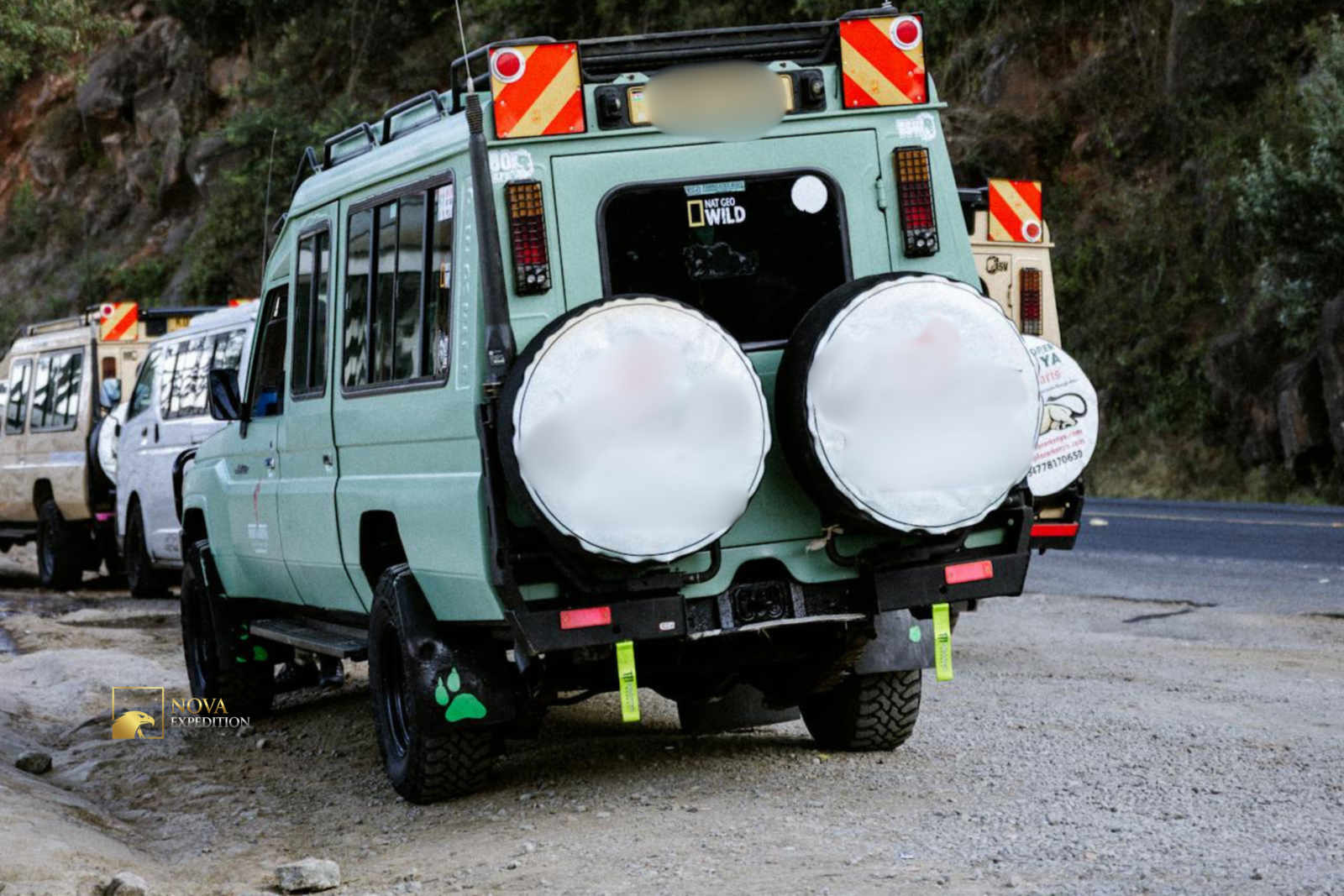

The distance from Nairobi to Maasai Mara is 270 kilometres. Depending on how you travel, this journey takes 45 minutes or eight hours. The difference is not just about comfort — it determines whether you arrive with a full afternoon of game-drive time ahead of you, or whether you lose the entire first day of a short safari to road transit. On a five-night itinerary that choice consumes or preserves 20% of your available wildlife hours. This is a wildlife decision, not merely a logistics question.
The one question to answer before comparing options
Before comparing any transport options, answer one question: how many nights is your Mara safari? If the answer is three nights or fewer, road transfer almost never makes practical sense regardless of the cost difference. The journey takes five to six hours each way in normal dry-season conditions. You lose the entire arrival day to road transit and arrive at camp too late for the afternoon game drive. On a three-night safari, two transit days out of approximately five total days in Kenya means 40% of your Kenya time spent on a road rather than in the bush. A charter flight adds approximately $150–180 per person each way.
At this trip length that cost buys back two full game-drive days — one from arriving in time for the afternoon drive, another from having the morning drive available before your departure flight rather than spending it on the road. When you measure the flight cost against the total trip investment of a multi-thousand-dollar safari, the calculation almost always favours flying when trip length is short.
For itineraries of six nights or more, road transfer becomes genuinely viable and adds real value to the experience. The drive from Nairobi to the Mara passes through the Great Rift Valley — the descent from the highland plateau to the valley floor is one of Kenya’s most dramatic landscape moments, where the escarpment drops several hundred metres in a few kilometres and the full expanse of one of Earth’s great geological features becomes suddenly visible. The transition from Nairobi’s highland suburbs through Maasai cattle country to the open savannah of the Mara ecosystem takes approximately four hours and builds the kind of contextual understanding of where you are that the 45-minute flight cannot provide.
Many experienced travellers specifically choose to drive in one direction for this reason. The standard recommendation for most 7–10 night itineraries is the combination approach: fly one way to protect the first game drive day, drive the other way to experience the landscape at a pace that allows appreciation and stops. This combination captures the speed advantage where it matters most — arrival — while providing the scenic interest on the return.
One critical planning clarification that avoids a common mistake: the Maasai Mara National Reserve banned private vehicle self-drive inside the reserve boundaries in 2025. This does not affect the road journey from Nairobi to the reserve gate — you can still drive your own vehicle to the gate. But once inside the reserve or any private conservancy, all game drives must be conducted in a licensed operator vehicle with a qualified naturalist guide.
The ban applies without exception to all in-reserve wildlife driving. If a self-drive game drive element was part of your original plan, that option is no longer available in the Mara. All operators building Mara itineraries incorporate the licensed guide vehicle requirement as standard, so this changes the planning for self-organised trips but has no practical impact on operator-run safaris.
| NAIROBI TO MAASAI MARA — ALL OPTIONS AT A GLANCE | |
| Charter flight (private) | 45 min · $90–180/person one-way · Wilson Airport — not JKIA |
| Scheduled flight | 50 min · $75–140/person · Safarilink and AirKenya · Multiple daily departures |
| Private 4×4 road transfer | 5–6 hrs · $180–320 per vehicle total, not per person |
| Shared shuttle or bus | 6–8 hrs · $20–50/person · Fixed schedules, shared with others |
| Wilson Airport | Langata area SW Nairobi — completely separate from JKIA · 15 min from Karen |
| Baggage allowance | 15kg per person soft bags only — no hard-sided suitcases on light aircraft |
| Main Mara airstrips | Keekorok · Ol Kiombo · Musiara · Mara North · Ol Seki · Olare · Talek |
| Self-drive inside reserve | Banned 2025 — licensed operator vehicle required for all game drives |
Option 1: Charter flight — the recommended default
A private charter from Wilson Airport is the most efficient, most comfortable, and for many travellers the most genuinely enjoyable way to make the journey. A twin-prop aircraft — typically a Cessna Caravan or Pilatus PC-12 carrying 8–12 passengers — departs Nairobi’s domestic terminal and lands 45 minutes later on a grass airstrip in the middle of the ecosystem. Your guide and vehicle meet you at the strip. You are on a game drive within 30 minutes of landing, in prime time for the late morning or early afternoon wildlife activity period.
There is no delay between arriving in Kenya and beginning the experience you came for. The transition from city to wilderness is almost instantaneous, and the spatial shock of suddenly being in the middle of the Mara — visible horizon in every direction, the river somewhere below you on the flight in — is itself a compelling part of the experience that the road approach builds toward more gradually.
Charter flights carry between 4 and 12 passengers and are frequently shared between independent travellers heading to the same airstrip, making the per-person cost comparable to scheduled services when the aircraft fills. Solo travellers and couples pay the full aircraft rate regardless of fill — typically $600–900 one way — which becomes $300–450 per person for a couple, or $150–225 per person for a group of four. For groups of five or more, a private charter almost always costs less per person than individual scheduled tickets.
Your operator can advise on whether a shared charter departure is available for your specific dates and airstrip, which is typically the most cost-effective option for individuals and small groups booking independently. In peak season, operators often facilitate shared charters between clients heading to adjacent conservancies on the same morning, reducing the per-person cost to close to scheduled flight levels.
The flight itself provides something that no road journey can: an immediate spatial comprehension of the ecosystem’s scale and geography. The route from Wilson Airport southwest to the Mara passes over the Great Rift Valley escarpment — the same dramatic geography that forms the backdrop of every Angama Mara photograph — before descending to the rolling plains below. From 1,500–2,000 feet over the Mara, the Mara River is visible as a dark ribbon through the pale savannah, the conservancy boundaries faintly discernible as variations in land management, and the horizon extending 50–60 kilometres in every direction.
This aerial view of the ecosystem gives you an instinctive sense of where everything is relative to everything else — where the river runs in relation to your camp, how the conservancies relate to the national reserve, how the landscape transitions from the escarpment to the plains — that a week of ground-level game driving would take days to develop organically. Guests who arrive by charter consistently describe a specific quality of arrival that the road approach cannot replicate.
Wilson Airport — the most important detail in this guide
Wilson Airport is a completely separate facility from Jomo Kenyatta International Airport. This is the single most operationally important fact in this entire guide and the most commonly confused logistical detail in Kenya safari planning. JKIA, located southeast of the city near Syokimau, handles all international arrivals and departures. Wilson Airport, located southwest of the city in the Langata area, handles all domestic safari flights including every Mara charter and scheduled service.
The two airports are approximately 20–30 minutes apart by Uber in normal traffic conditions. Confusing them — arriving at JKIA for a Wilson Airport departure, or assuming they are the same facility — has derailed morning safari connections for many visitors. Confirm your departure airport explicitly with your operator in writing, and note it separately from your international flight documentation so that it cannot be confused on a tired early morning.
Wilson is straightforward once you know what to expect. The terminal is small and domestic check-in takes fewer than 15 minutes from arrival to gate. Arrive 45 minutes before your scheduled departure. Bring your passport or national ID. The 15-kilogram soft bag limit is strictly enforced — hard-sided suitcases do not fit in light aircraft baggage holds regardless of their weight.
Leave your main suitcase in storage at your Nairobi hotel before the safari (most Karen and Langata hotels provide this service at no charge) and pack only what you need for the safari days in a soft duffel bag. Your camera bag or small daypack travels in the cabin with you. Uber and Bolt both service Wilson Airport reliably — these are the appropriate transport for all Nairobi airport transfers.
Option 2: Scheduled flights — Safarilink and AirKenya
Safarilink and AirKenya both operate daily scheduled services from Wilson Airport to the main Mara airstrips, with multiple morning departures during peak season. The aircraft are the same Cessna Caravans used for private charters, carrying up to 12 passengers on published timetables shared with independently booked travellers. Per-person costs are slightly lower than private charter at $75–140 one way depending on the route and season. The experience is essentially identical to a shared charter — same aircraft, same journey time, same views — except that the departure time is fixed by the published schedule rather than your preferences, and you share the cabin with other travellers who have booked independently.
Book scheduled flights immediately once your safari dates are confirmed. Peak season morning departures — particularly the 7am and 8am flights that allow guests to reach their camp in time for a late morning game drive — fill several weeks in advance. In July and August, the most popular departures can be fully booked more than a month ahead.
Your safari operator can book these flights as part of the overall itinerary, often at rates identical to direct booking. The logistical integration of the flight with the camp vehicle transfer — knowing that a vehicle from your specific camp will meet you at the specific airstrip on the specific date — is worth handling through your operator rather than managing as a separate booking.
Option 3: Private road transfer — when it makes sense
The road from Nairobi to the Maasai Mara runs southwest on the A104 highway through the Rift Valley to Narok, then continues on progressively smaller and less-maintained roads to the reserve gates. Total journey time from central Nairobi to the main gates — Sekenani, Talek, Musiara, Sand River — is five to six hours in normal dry-season conditions. This can extend to seven or more hours in the rainy season, during heavy traffic near Nairobi, or when specific gate roads are in poor condition. The A104 to Narok is sealed and generally well-maintained. Beyond Narok, road quality varies from adequate to rough depending on season and recent rainfall, requiring a capable 4×4 throughout. All operators provide appropriate vehicles for road transfers.
The financial case for road transfer is strongest when group size is large. The vehicle cost of $180–320 total is the same whether the vehicle carries two people or six. For a family of four, the per-person cost drops to $45–80 — significantly below charter flight pricing and comparable to or below scheduled flight costs. For groups of five or more, road transfer is almost always the most cost-effective option for the journey itself, with the only real cost being the time involved.
The drive adds genuine experiential value too: the Rift Valley viewpoint near Mai Mahiu, the Naivasha flamingos visible from the road, the Maasai cattle markets in the Narok district, and the gradual landscape transition from highland scrub to open savannah all provide a geographic and cultural context for the ecosystem you are approaching that the 45-minute flight cannot replicate.
The combination approach — the most practical recommendation
The most consistently recommended arrangement for 7–10 night Mara itineraries is the combination approach: charter or scheduled flight from Wilson on arrival day to protect the first game drive, and a private road transfer on the departure day for the scenic return journey. This captures the speed advantage where it matters most — arrival, when preserving the first full game drive day is the priority — while providing the Rift Valley road experience on the return when timing pressure is reduced and the landscape can be appreciated at a pace that a 45-minute flight over it does not allow.
The return road journey, with knowledge of the ecosystem you have just spent days in and the escarpment and valley views ahead, is a satisfying conclusion to a safari in a way that a return flight often is not. The cost saving of one charter flight leg makes this combination financially practical for most itinerary lengths.
Matching your airstrip to your camp
The Mara has multiple airstrips serving different areas of the ecosystem, and landing at the wrong one adds 45–90 minutes of vehicle transfer time that should be spent on game drives. The distance between Mara North airstrip and Keekorok airstrip, for example, is approximately 40 kilometres — meaningful when the vehicle driving to the wrong one has to turn around and cover that distance again. Confirm with your operator specifically which airstrip serves your camp and ensure the flight is booked to that airstrip. This detail is sometimes assumed rather than confirmed in booking processes, and the assumption is not always correct.
| Airstrip | Area served | Primary camps / conservancies |
| Mara North | North of Mara River | Serian, Saruni Mara, Karen Blixen, Mahali Mzuri |
| Ol Seki / Naboisho | Eastern conservancy belt | Encounter Mara, Kicheche, Naboisho Camp |
| Olare | NE conservancy | andBeyond Bateleur, Porini Lion, Mara Plains |
| Musiara | Triangle edge / NW reserve | Governors’ Camp, Rekero, andBeyond Kichwa Tembo |
| Keekorok | Central national reserve | Keekorok Lodge area properties |
| Ol Kiombo | Central/eastern reserve | Multiple central reserve camps |
| Sand River | SE reserve / Olderkesi | Cottar’s 1920s Camp, Entim Camp |
RELATED READING
- Maasai Mara — Destination Guide
- Maasai Mara Lodges and Camps — Complete 2026 Guide
- One Week in Kenya — How to Make the Most of 7 Days
- Kenya Safari Cost 2026 — The Honest Breakdown
Safarilink and AirKenya — the specific services
Safarilink Aviation (safarilink.co.ke) and AirKenya Express (airkenya.com) are the two primary scheduled domestic aviation operators in Kenya. Both are regulated by the Kenya Civil Aviation Authority (KCAA) and operate Cessna Grand Caravan EX aircraft — the 12-seat turboprop that has become the standard for Kenya domestic safari routes since the 1990s. Safarilink was founded in 1983 and has the most extensive route network. AirKenya operates fewer routes but often has competitive pricing on the Wilson-Mara corridor.
Both services are booked directly through their respective websites or through any licensed Kenya safari operator. The Kenya Airports Authority (KAA) manages Wilson Airport and publishes flight information through their platform. When booking, confirm with your operator that the airstrip designation on your charter or scheduled ticket matches the specific airstrip that serves your accommodation — this detail is confirmed by each individual camp with their transfer logistics.
The honest trade-off of road versus air in both directions
The combination approach — fly in one direction, drive the other — deserves one specific honest caveat that operators do not always mention. If you road-transfer on the departure day and have an international flight connecting from JKIA the same evening, the 5-6 hour road transfer plus the 45-60 minute JKIA transfer plus check-in time creates a compressed schedule that leaves almost no buffer for the road delays, traffic, and mechanical issues that inevitably occur on some proportion of long road transfers.
The guests who experience the most stressful Kenya departure days are those who road-transferred from the Mara on the same day as an international evening flight without building a Nairobi buffer overnight. If combining road transfer with a same-day international departure, either build a Nairobi overnight between the two or fly out of the Mara instead.