
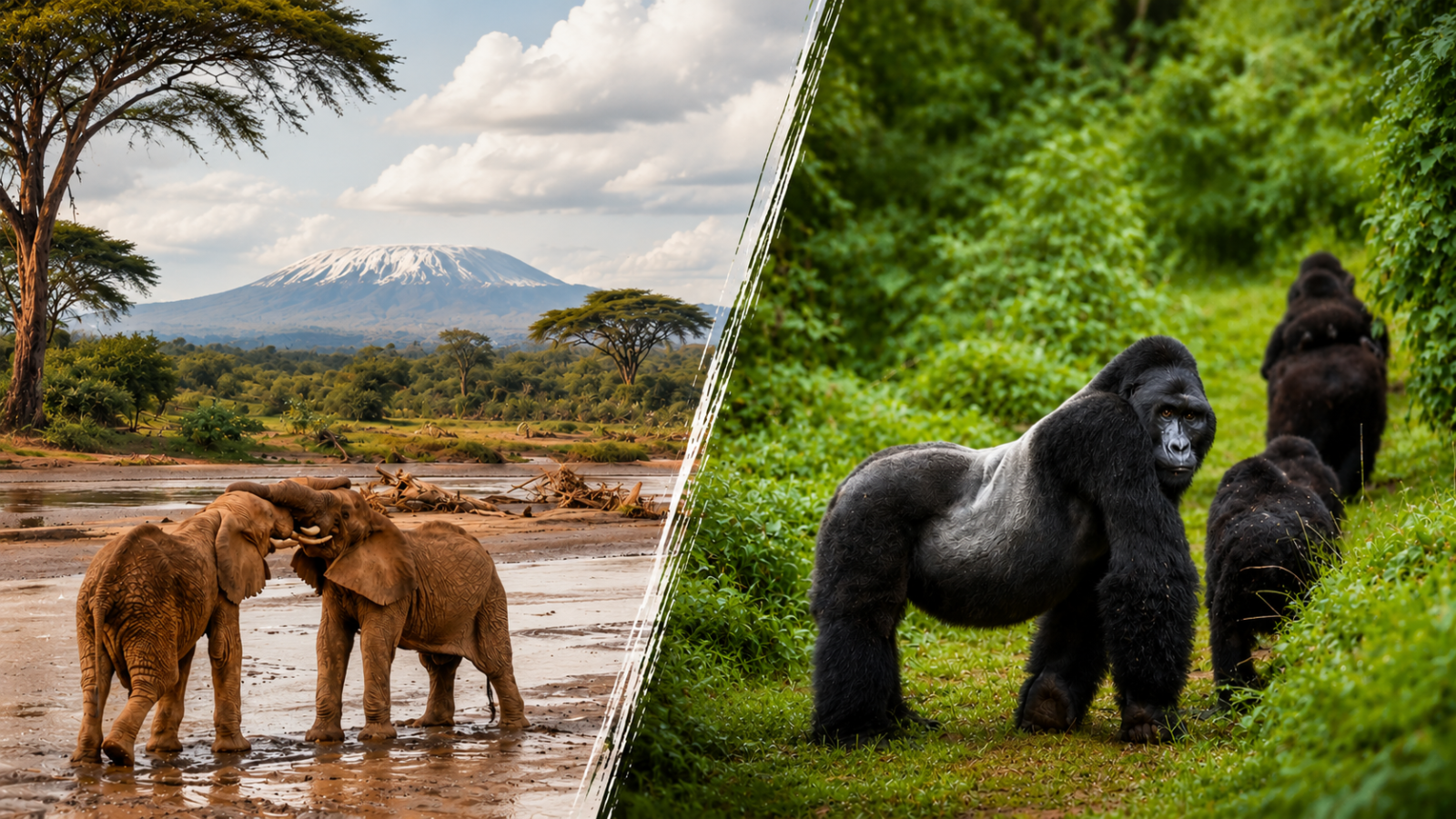

Uganda is materially undersold to first-time East Africa travellers – and Kenya is materially over-recommended. Here is the honest comparison, including the cases where Uganda is the better single-country answer.
The framing most travellers do not encounter
Search ‘Kenya Safari vs Uganda Safari’ and the results almost universally settle the question by genre: Kenya is the classic safari destination, Uganda is the gorilla and chimpanzee destination, and travellers should choose accordingly. The framing is not wrong. It is incomplete in a way that costs Uganda real bookings.
Uganda has Big Five savanna safari that most international travellers do not know it has. Queen Elizabeth National Park’s tree-climbing lions, Murchison Falls’ Nile elephant herds, and Kidepo Valley’s remote wilderness produce wildlife encounters that compete competently with mid-tier Kenya safari destinations – at materially lower cost. Add the primates (gorilla and chimpanzee trekking), the source of the Nile, and the Rwenzori Mountains, and Uganda is a more diversified single-country product than the marketing suggests.
Kenya, conversely, is heavily over-marketed for first East Africa trips. The country’s safari product is genuinely strong, but the assumption that ‘East Africa = Kenya for safari’ obscures legitimate alternatives that may better fit specific traveller priorities. Uganda is the principal one of those alternatives.
This article works through the honest comparison: what each country actually delivers, at what cost, and in which specific cases Uganda is the better answer. Permit prices and access information have been verified against Uganda Wildlife Authority (UWA) and Kenya Wildlife Service (KWS) sources as of mid-2026.
Uganda is not a smaller Kenya. It is a different country with a different wildlife portfolio, different logistics, and different economics. The right comparison is product-to-product, not country-to-country — and the product-to-product comparison favours Uganda more often than the marketing acknowledges.
| UGANDA GORILLA PERMIT (2026) $800 foreign non-resident standard; $600 in April, May, November low season | UGANDA GORILLA HABITUATION PERMIT $1,500 – 4 hours with semi-habituated family (compared to 1 hour standard trek) |
| UGANDA CHIMPANZEE PERMIT (KIBALE) $250 standard tracking; $300 habituation experience | UGANDA SAVANNA PARKS Queen Elizabeth ($45/day FNR), Murchison Falls ($40/day FNR), Kidepo Valley ($40/day FNR) |
| KENYA KWS PARK FEES $60–80/day for non-residents at most parks; Mara $100–200/day | BWINDI HABITUATED FAMILIES 19+ across 4 sectors (Buhoma, Ruhija, Nkuringo, Rushaga) — 152 permits daily |
| UGANDA TOTAL DAILY COST COMPARISON Mid-tier trip ~$350–550/person/day vs Kenya $400–700 | INDICATIVE COST SAVING UGANDA VS KENYA 20–35% over a comparable trip duration |
What each country actually delivers
Strip away the headline framing and the products look like this:
Uganda – the primate-and-savanna combination
Uganda holds approximately half the world’s remaining mountain gorillas, the highest concentration of chimpanzees in East Africa, and a savanna safari portfolio that includes lion, elephant, buffalo, and leopard (Big Five minus rhino in most parks; rhino reintroduction at Ziwa Rhino Sanctuary).
The principal destinations: Bwindi Impenetrable National Park (gorillas, 4 sectors with 19+ habituated families), Mgahinga Gorilla National Park (one additional gorilla family, plus golden monkeys), Kibale Forest National Park (the highest concentration of chimpanzees in East Africa, plus 13 other primate species), Queen Elizabeth National Park (Big Five savanna at moderate scale, famed tree-climbing lions in Ishasha sector, Kazinga Channel boat safari).
Murchison Falls National Park (Uganda’s largest park, Nile elephant herds, the Murchison Falls themselves where the Nile compresses through a 7-metre gorge), Kidepo Valley National Park (remote northern wilderness, exceptional landscape, Karamojong cultural context), Lake Mburo (small but accessible park with zebra, eland, and impala), Rwenzori Mountains (Africa’s third-highest peak, technical alpine trekking), and Ssese Islands plus the source of the Nile at Jinja (water and adventure activities).
The defining Uganda product is the gorilla-plus-savanna combination – a 10–14 night trip combining Bwindi with Queen Elizabeth or Murchison Falls produces an East Africa experience that no single Kenya itinerary can match. Uganda is also the strongest single country for combining gorilla and chimpanzee trekking, which Rwanda’s smaller Nyungwe Forest cannot quite deliver at the same scale.
Kenya – the multi-destination savanna depth
Kenya’s portfolio has been covered in detail in Article #55 and elsewhere on this site. In summary: the Maasai Mara conservancy system, Amboseli, Samburu, Laikipia, Tsavo, the Rift Valley lakes, Mount Kenya, the Aberdares, and the coast. The Kenya product is materially deeper than Uganda’s in pure savanna safari – the Mara wildlife density, the conservancy model, the operator infrastructure, the variety of distinct ecosystems within manageable internal-flight distance. Kenya’s marine, mountain, and cultural extensions add depth that Uganda’s portfolio does not match (Uganda has Lake Victoria and the source of the Nile but no Indian Ocean coast).
The defining Kenya product is the multi-conservancy savanna trip – 7–10 nights across 2–3 destinations producing wildlife at scale and conservancy economics that Uganda cannot replicate.
THE STRUCTURAL CONTRAST
Uganda offers primates plus competent savanna at lower cost. Kenya offers exceptional savanna at scale plus the conservancy premium product. Travellers who want primates need Uganda or Rwanda; travellers who want savanna depth alone should default to Kenya; travellers who want a balanced primate-plus-savanna single-country trip should weight Uganda more heavily than the current marketing suggests.
The cost comparison, honestly
This is where Uganda’s underselling becomes clearest. The per-day mid-tier cost difference is substantial, and the gorilla permit alone produces a structural cost advantage.
| Cost item (10-night trip, 2 travellers, mid-tier) | Uganda (Bwindi + QENP + Kibale) | Kenya (Mara + Samburu + Amboseli) |
| Park / activity permits per person | $800 (gorilla) + $250 (chimp) + $135 (QENP 3 days) = $1,185 | $600 (Mara 3 days) + $240 (Samburu 3 days) + $80 (Amboseli 1 day) = $920 |
| Accommodation per person, mid-tier | $2,500–3,800 (10 nights, $250–380/night) | $3,500–5,500 (10 nights, $350–550/night) |
| Internal transfers (flights + road) | $800–1,400 (longer road components) | $1,200–2,000 (more internal flights) |
| Mid-tier total per person, 10 nights | $4,485–6,385 | $5,620–8,420 |
| Per-night cost (mid-tier) | $449–639 | $562–842 |
The per-night cost in Uganda runs roughly 20–35 percent below Kenya in the mid-tier, driven by lower accommodation pricing, lower park fees, and the absence of multiple short internal flights. At the premium tier the gap narrows but remains real – Uganda’s top-tier lodges (Sanctuary Gorilla Forest Camp, Volcanoes Bwindi Lodge, Clouds Mountain Gorilla Lodge, Mihingo at Lake Mburo) charge $700–1,200 per night versus Kenya’s premium tier at $1,000–2,500.
THE BOTTOM LINE ON COST
Uganda is materially cheaper than Kenya for a comparable 10-night East Africa safari, particularly in the mid-tier where most travellers actually book. The Uganda permit costs (even with the $800 gorilla permit) work out lower than Kenya's accumulating KWS plus conservancy fees over a multi-destination trip. For cost-conscious travellers who would otherwise compromise on Kenya, Uganda delivers more for less.
Where Uganda specifically beats Kenya
Four specific cases where Uganda is the structurally better single-country East Africa choice.
For travellers who want gorillas plus chimpanzees in one country
Kibale Forest holds the highest concentration of chimpanzees in East Africa – over 1,500 individuals, multiple habituated communities, two daily trekking sessions and one habituation (CHEX) experience daily. The trekking success rate is consistently above 90 percent. Combined with Bwindi gorilla trekking, Uganda produces a ‘great apes’ safari that Rwanda’s Nyungwe chimps (lower density, less reliable) and Kenya (no wild chimpanzees at all) cannot match. For travellers prioritising primate diversity, Uganda is the strongest single-country choice in East Africa.
For travellers wanting the gorilla habituation experience
Uganda’s gorilla habituation permit ($1,500) gives 4 hours with a semi-habituated gorilla family in the Rushaga sector of Bwindi. The experience is substantively deeper than the 1-hour standard trek – researchers and trackers are actively habituating the family during your visit, and you observe the full range of family interaction (feeding, grooming, infant play, occasional confrontation). For travellers willing to pay $1,500 for either a Rwanda 1-hour trek or a Uganda 4-hour habituation, the habituation produces materially more content. Travellers should be physically prepared – habituation experiences are typically longer hikes and involve more bushwhacking.
For cost-conscious savanna safari travellers
Queen Elizabeth National Park (1,978 km²) holds Big Four (no rhino) at moderate density, plus the famed tree-climbing lions in the Ishasha sector and the Kazinga Channel boat safari (one of Africa’s strongest single-boat-trip wildlife experiences). Murchison Falls (3,840 km², Uganda’s largest park) holds Big Four plus the iconic Murchison Falls themselves and a strong elephant population. Both parks deliver competent Big Five savanna safari at park fees of $40–45/day for non-residents – a third of Kenya’s Mara fees. For travellers willing to trade off the Mara’s wildlife density and conservancy infrastructure for substantial savings, Uganda’s parks deliver.
For travellers wanting remote wilderness
Kidepo Valley National Park in Uganda’s far north-east is among the most genuinely remote wildlife destinations in East Africa. The park sits in the Karamoja region, near the borders with South Sudan and Kenya. Wildlife includes lion (including the famous tree-climbing populations), cheetah (one of East Africa’s few cheetah strongholds outside the Mara-Serengeti), elephant, leopard, buffalo, and over 470 bird species. The Karamojong pastoral culture is one of East Africa’s most distinct. The park is hard to reach (charter flight from Entebbe required for time-efficient access; road journey is 12+ hours), which is precisely why it remains uncrowded. For travellers wanting genuine remote wilderness with full Big Four wildlife, Kidepo is unmatched in East Africa.
The Uganda chimpanzee experience – why it matters more than the marketing suggests
Kenya has no wild chimpanzee population. This is a fact that the East Africa marketing rarely surfaces because it sits awkwardly against the ‘Kenya as the safari destination’ framing. For travellers who care about great apes — and most travellers who care about gorillas also care about chimpanzees – the comparison is asymmetric: Uganda holds approximately 5,000 wild chimpanzees, Kenya holds none.
Kibale Forest National Park (795 km²) is the principal chimpanzee destination. The park holds approximately 1,500 chimpanzees in 13 communities, with three communities habituated for tourism – Kanyanchu (the main tourism community), Sebitole, and the CHEX community for habituation experiences. Trekking success rates are documented at 90 percent or higher; the forest is dense but manageable, the chimps are accustomed to human presence at the habituated communities, and the typical encounter time is around 60 minutes of close observation.
Beyond Kibale, Uganda offers chimpanzee tracking at Kyambura Gorge in Queen Elizabeth National Park ($100 per person, lower success rate around 50-70 percent but spectacular setting in a forested gorge), Budongo Forest near Murchison Falls (lower-volume tourism, strong birding combination), and Ngamba Island in Lake Victoria (a chimpanzee sanctuary rather than wild encounter, but valuable for understanding the species’ conservation status). For travellers wanting maximum chimpanzee diversity, the Kibale-plus-Kyambura combination produces two distinct chimpanzee experiences in a single trip.
The Uganda chimpanzee habituation experience (CHEX) at Kibale is worth specific mention. For $300 (same as standard tracking would be in many comparison contexts, but $50 more than Kibale’s basic tracking), travellers join the researchers conducting active habituation work with a semi-habituated community. The day can run 6+ hours in direct chimp proximity, observing morning nest departure, foraging, grooming, and social behaviour. Maximum 4 visitors per session. For wildlife photographers and dedicated naturalists, the CHEX is one of the strongest single-experience products in East Africa at a price point well below gorilla permits.
THE HONEST FRAMING ON CHIMPANZEES
Travellers who would value a chimpanzee encounter as a meaningful part of their East Africa trip should book Uganda. Kenya has no answer to this — it is not a question of Kenya being weaker than Uganda on chimps; Kenya simply does not have wild chimpanzees. For travellers indifferent to chimps, this consideration does not apply. For travellers who care, it is decisive.
Where Kenya specifically beats Uganda
Four specific cases where Kenya is the structurally better choice.
For travellers wanting the Mara migration
The Great Migration’s Mara phase (July–October) is the headline East Africa wildlife event. Kenya delivers this; Uganda does not. Travellers prioritising the migration should book Kenya. Travellers who can accept that the migration is not on their itinerary have more flexibility.
For travellers wanting the conservancy model
Kenya’s community conservancy system produces a tourism product that no other African country, including Uganda, has at comparable scale. Travellers who specifically want the conservancy economics, the off-road and walking access, and the community partnership model should choose Kenya. Uganda’s protected area system is closer to traditional national-park model.
For travellers combining safari with coast or island
Kenya has Indian Ocean coast (Diani, Watamu, Lamu, Malindi) with strong beach extensions readily accessible from Nairobi. Uganda is landlocked and offers Lake Victoria as the principal water extension, which is a different product. Travellers wanting a beach extension after their safari should weight Kenya.
For first-time East Africa travellers with logistics constraints
Kenya’s tourism infrastructure is more developed than Uganda’s. Internal flights are more frequent, road quality is generally better, lodge density is higher, and the operator network is larger. Travellers who specifically value logistical smoothness – first-time visitors, families with young children, travellers on tight schedules – should weight Kenya. Uganda is more demanding logistically and rewards travellers who can roll with the friction.
The combination framework: Uganda plus Kenya
For travellers with time and budget, a combined Uganda-Kenya trip produces a stronger East Africa experience than either country alone.
The standard 14-night combination
Days 1–8: Uganda. Bwindi for gorilla trekking (2 nights including one trek), Queen Elizabeth or Murchison Falls (3 nights savanna safari), Kibale for chimpanzees (2 nights). Day 9: Fly Entebbe to Nairobi (1.5 hours, Kenya Airways or Uganda Airlines daily). Days 9–14: Kenya. One Mara conservancy plus one other destination (Samburu or Amboseli) over 5–6 nights. Total: 14 nights, comprehensive East Africa coverage.
The minimum-viable combination
For travellers cost-constrained but determined to combine: 4 nights Uganda (Bwindi + Kibale, gorillas + chimps) plus 5 nights Kenya (single Mara conservancy + Amboseli or Samburu). Total: 9 nights, approximately $5,500–8,000 per person mid-tier. This is the structural floor for the combination.
The extended 18+ night combination
Adding the savanna parks of Uganda (QENP plus Murchison Falls or Kidepo) extends the Uganda portion to 10–12 nights. Adding Kenya coast (Lamu, Diani) extends the Kenya portion to 8–10 nights. Total: 18–22 nights. This produces a comprehensive East Africa trip that few travellers commit to but that those who do report as the strongest African experience available. Indicative cost: $10,000–18,000 per person mid-tier.
Visa logistics for the combined trip
Three visa options for travellers visiting both countries.
Single-country visas
Kenya eTA ($34.09) plus Uganda eVisa ($50) plus exit and re-entry where applicable. Kenya eTA can be used for re-entry into Kenya after travel to other EAC countries (including Uganda), so the Kenya component does not require a new eTA on the second entry. This option is the most straightforward for travellers who know their itinerary and timing precisely.
East Africa Tourist Visa ($100)
The East Africa Tourist Visa covers Kenya, Uganda, and Rwanda for 90 days, multiple entries. At $100 per person, this is cheaper than two separate single-entry visas plus the Kenya eTA. The visa is valid only for tourism, must be obtained in advance (no on-arrival option), and the first country of entry must be the country that issued the visa. For travellers committed to the combined Uganda-Kenya trip (and possibly Rwanda), the EATV is the most cost-efficient option.
Multiple-entry visa traps to avoid
Travellers entering Uganda first should not assume that the Uganda visa allows automatic re-entry to Kenya – it does not (Kenya has its own eTA requirement). Travellers entering Kenya first need to confirm that the Kenya eTA application accounts for any subsequent re-entry. The eTA is single-entry by default but can be used for re-entry after EAC country travel – this exception is real but should be confirmed at booking.
The honest comparison table
| Dimension | Uganda | Kenya |
| Headline product | Gorillas + chimps + competent savanna | Multi-destination savanna at scale + coast extension |
| Gorilla access | $800 permit, $600 low season; habituation $1,500 | Not applicable |
| Big Five completeness | Big Four reliably; rhino at Ziwa Sanctuary only | Full Big Five across multiple destinations |
| Migration | Not applicable | Mara July–October |
| Logistics smoothness | Moderate – longer road transfers, fewer internal flights | High – established operator network, frequent internal flights |
| Cost vs comparable Kenya trip | 20–35% lower mid-tier | Baseline |
| Best minimum trip length | 8–10 nights | 7–10 nights |
| Beach or coast extension | Lake Victoria / source of Nile only | Diani, Lamu, Watamu, Malindi |
Honest limits
Three things this comparison cannot resolve.
First, the operator quality variance. Uganda’s operator network is smaller and less standardised than Kenya’s. The strongest Ugandan operators (Volcanoes Safaris, Wild Frontiers Uganda, Classic Africa Safaris) produce excellent products; the weaker operators produce trips that meaningfully under-deliver. Operator selection in Uganda matters more than in Kenya. Travellers booking Uganda should work through established intermediary agents or vetted specialists rather than through booking-engine aggregators.
Second, the changing permit and access rules. The Uganda Wildlife Authority’s February 2026 changes (low-season permits, immediate-payment requirement, no more 7-day soft holds) reflect the pace of change in East African wildlife tourism policy. Travellers booking trips 12+ months ahead should expect that some current information will change. The principal commitment – gorilla permit dates – should be made first, with the rest of the trip designed around them.
Third, the security context in northern Uganda. Kidepo Valley is in Karamoja, a region with historical security concerns related to cattle raiding and inter-ethnic tensions. The park itself is well-protected and tourism operations have not reported incidents in recent years, but the surrounding region carries a higher security baseline than the rest of Uganda. Travellers booking Kidepo should confirm current security advice and use operators with current local relationships.
THE HONEST PICK FOR THE EAST AFRICA TRAVELLER DECIDING BETWEEN COUNTRIES
For travellers wanting primates plus savanna in a single country at the strongest value: Uganda. For travellers wanting savanna depth at scale, conservancy infrastructure, and the option of beach extension: Kenya. For travellers who can do both: 10–14 nights split across both countries, starting in Uganda for the primates and ending in Kenya for the savanna-and-coast finish. The default 'East Africa = Kenya' is the most common booking mistake; the structural answer depends on what you specifically want.
Who this article is for, and who should look elsewhere
Travellers planning their first East Africa trip and considering only Kenya – read this article and reconsider Uganda. The cost saving alone may shift the decision; the primates and Kidepo Valley add genuine differentiation.
Travellers committed to Kenya for specific reasons (the Mara migration, the conservancy model, the coast extension).
Travellers considering Uganda alone – book Uganda. The 10-night Bwindi-plus-Kibale-plus-QENP itinerary is a strong East Africa experience that does not require a Kenya component. Adding Kenya is upside; not adding Kenya is not a failure.
Repeat African travellers who have done Kenya – strongly consider Uganda. The product is genuinely different from Kenya and will not feel like a repeat trip.
RELATED READING
- Kenya vs Rwanda: gorillas or Big Five — the complementary comparison to this one
- Kenya’s community conservancy model: the structural strength that Uganda does not match
- Solo safari in Kenya: the operator-selection framework that applies in Uganda equally
- When is the Mara too crowded: why Kenya’s strongest single product is also its busiest
- Birdwatching in Kenya: the family-based framework also applies to Uganda’s strong birding
Tell us what you are looking for, and we will tell you honestly whether we can deliver it — and if we cannot, we will tell you who can.