
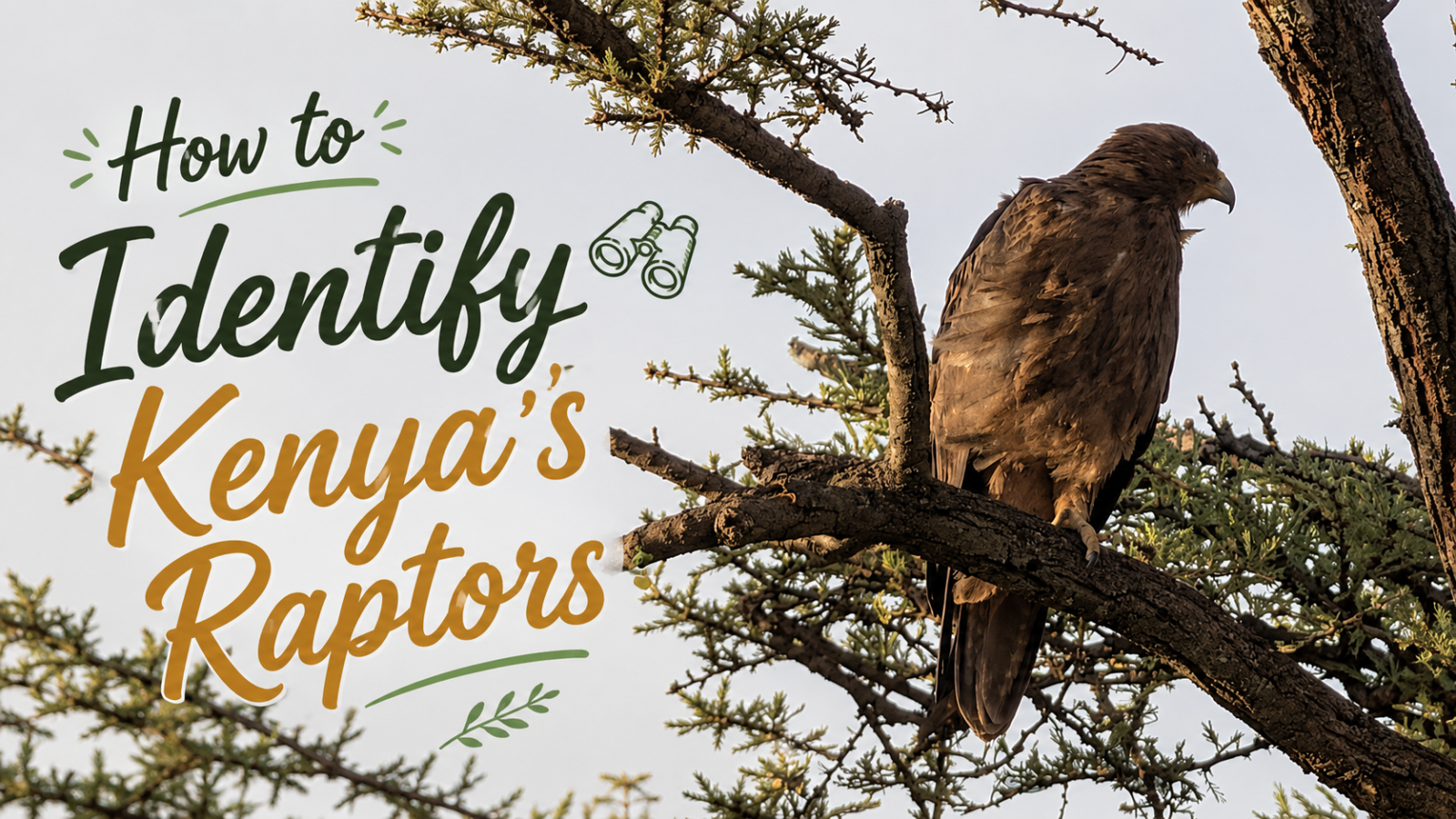

Twenty species will cover most of what you see from a vehicle. Knowing them changes the safari from a mammal-watching trip to something denser. It also lets you witness, in real time, the most catastrophic bird-population collapse on the continent.
Why raptors are the safari skill worth learning
Most safari travellers arrive ready for the mammals. Lions, elephants, leopards, giraffes, the cats they have read about and the herds they have seen on documentaries. Birds are the background — pretty, often noisy, occasionally pointed out by the guide. Within that background, raptors are usually overlooked. They are at distance, they are often perched, they require sustained looking. A non-birder will end a ten-day Kenya safari having seen perhaps thirty raptors and identified four of them.
Learning twenty raptor species before the trip and twenty more during it changes the structure of the safari. Each sighting becomes denser — a martial eagle on a kill is not just ‘a big eagle’, it is the largest African eagle taking apart a serval, and that’s something perhaps a dozen safari travellers see in a year. The bateleur flying low across the plain is not a hawk, it is a member of its own monotypic genus and one of the most distinctive flight silhouettes in any field of birding. The vultures circling over a recent lion kill are not ‘vultures’ but six or seven different species, identifiable to species in flight, three of them Critically Endangered, all of them declining.
This article is for safari travellers, not birders. It assumes no previous bird identification experience and no expensive optics. The species selection is what you will actually encounter from a vehicle in the Mara, Samburu, Tsavo, Laikipia, and the Rift Valley — not every Kenya raptor, but the practical core.
It also takes the vulture crisis seriously, because anyone learning Kenya raptors should know that they are watching a population collapse in progress. Seven of eleven African vulture species are now threatened with extinction. The numbers are extraordinary. The collapse is happening on a timescale that means most travellers reading this will outlive several of these species in the wild.
The raptors above your game-drive vehicle are not background. They are the upper trophic layer of the same ecosystem you came to see — and several of those species are vanishing fast enough that learning their names this season is worth doing this season.
| KENYA DIURNAL RAPTOR SPECIES Approximately 65 species (eagles, hawks, falcons, kites, harriers, buzzards, vultures) | VULTURE SPECIES IN KENYA 8 species: 4 Critically Endangered, 3 Endangered, 1 Vulnerable |
| WHITE-BACKED VULTURE POPULATION DECLINE 86% reduction documented in 2024 study (was 270,000; now estimated below 40,000) | RÜPPELL’S VULTURE GLOBAL POPULATION ~22,000 individuals — Critically Endangered |
| CAUSE OF VULTURE DEATHS 60%+ attributable to poisoning (carbofuran, lion-bait poisoning, retaliatory killing) | MARA VULTURE DECLINE 60%+ over two decades (BirdLife State of Africa’s Birds) |
| LARGEST AFRICAN EAGLE Martial eagle (wingspan up to 2.6m, weight up to 6.2kg) | MOST UNMISTAKABLE SILHOUETTE Bateleur — short tail, long wings, glides without flapping at moderate height |
How to identify Kenya’s raptors without a field guide
Birders develop an unconscious checklist over years of looking. Travellers can learn the abbreviated version in an evening and apply it on the first morning of safari.
The four-question framework
For any raptor in flight or perched, work through these four questions in order. They will resolve most identifications to family within seconds and to species within a minute or two.
1. What is the silhouette in flight? Long pointed wings (falcon), broad fingered wings (large eagle or vulture), narrow wings held in a V (harrier), short rounded wings (accipiter — though uncommonly seen from vehicles). The silhouette is the most reliable single ID feature in raptors. Memorise three or four silhouettes and you will know within seconds whether you are looking at a vulture, an eagle, or a falcon.
2. How does it fly? Vultures soar with wings held flat or in a slight V, rarely flapping, often circling at altitude. Eagles soar with wings flat, occasionally with deep, slow wingbeats. Falcons fly with rapid, deliberate wingbeats and rare gliding. The bateleur glides without flapping at moderate height, distinctively. Buzzards soar in tight circles. Harriers float over the grass with their wings in a shallow V, slow and wavering.
3. What habitat is it using? Bateleur, martial eagle, secretarybird, ground hornbill — savanna and open plains. Crowned eagle, African hawk-eagle, Ayres’s hawk-eagle — forest edge. Verreaux’s eagle — cliffs and rocky outcrops, specialising on hyrax. Lappet-faced vulture — open scrub and dry country. Augur buzzard — highland. African fish eagle — water. Habitat alone resolves perhaps half of all identifications.
4. What size relative to a known reference? The vehicle reference works well: a tawny eagle perched on the side of the track is dog-sized; a martial eagle in the same setting is noticeably larger. The bateleur is medium — between a buzzard and a smaller eagle. The pygmy falcon is small enough that travellers regularly confuse it with a passerine. Size relative to companions on a kill is also useful — vulture body size order at a carcass is reasonably stable.
What guides should be telling you
A competent safari guide will identify the obvious raptors — fish eagle, bateleur, secretarybird, the larger vultures. A strong birding guide will identify the difficult ones — tawny eagle versus steppe eagle (a Palearctic migrant present from October to April), the augur buzzard versus the common buzzard (same period), the differences between Wahlberg’s eagle, lesser spotted eagle, and steppe eagle in flight. If your guide is identifying these consistently, you are with a strong guide. If not, you may need to brief them that you’d like more bird identification effort — most guides will raise their game noticeably when asked.
The twenty raptor species you will see
These are the species safari travellers actually encounter. Knowing these twenty handles probably 85 percent of what you see from a vehicle in the Mara, Samburu, Tsavo, and Laikipia.
Eagles — the large soaring raptors
| Species | Field marks | Where and how often |
| Martial eagle | Largest African eagle. Dark hood, white underparts with dark spots, very large head, broad wings, long tail. Often perched on tall acacias. Will take young antelope. | Mara, Samburu, Tsavo — reasonably reliable. Listed Endangered. Look for the perched silhouette at distance. |
| Tawny eagle | Variable, tawny to almost dark brown. Stocky, medium-large. Yellow gape extends to behind the eye (key distinction from migrant steppe eagle). | Universal in savanna. The default brown eagle perched roadside. |
| Bateleur | Almost unmistakable in adult plumage: very short tail, long wings, glides low and steady. Adult has bright red cere, black body, chestnut back. Genus monotype — its own evolutionary line. | Mara universal; Samburu, Tsavo, Laikipia very common. Listed Endangered — population declining. |
| African fish eagle | White head and chest, chestnut belly, dark wings. Distinctive call — the ‘sound of Africa’. Always near water. | Lake Naivasha, Lake Baringo, Mara River, Tana River — universal where there is water. |
| Verreaux’s eagle | Mostly black with white V on back, very long wings, soars effortlessly over cliffs. Specialises on rock hyrax. | Mount Kenya, Aberdares foothills, Lake Magadi escarpment, Laikipia rocky outcrops. Less reliable; cliff-edge stops increase odds. |
| Crowned eagle | Powerful forest eagle, very broad rounded wings, distinctive double-banded tail. Loud ‘ee-aaah’ call. Takes monkeys. | Aberdares, Mount Kenya forest, Kakamega. Often heard before seen. |
| Long-crested eagle | Black with a long unmistakable crest. Often perched on dead trees and telephone poles. | Highland edge — Mau, Aberdares foothills, road verges around Nairobi-Naivasha-Nakuru. |
| Brown snake eagle | All dark brown with very large yellow eyes set high on the head. Hunts snakes — often perched motionless. | Mara, Tsavo, Samburu — common but easily missed because of long perching periods. |
Vultures — the species in crisis
This is where the crisis is most visible. All eight Kenya vulture species are now threatened. Travellers who care to count vultures on safari should treat each sighting as data — at this rate, several of these species will be functionally extinct within a couple of decades, and the personal record of what you saw will become historical record.
| Species + status | Field marks | Decline data |
| White-backed vulture (Critically Endangered) | Most common Kenya vulture. Medium-large, dark with white back patch (visible in flight). Pale juveniles cause ID confusion. | Population down 86% in 2024 study. Continent-wide decline 90%+ over three generations. |
| Rüppell’s vulture (Critically Endangered) | Larger than white-backed, mottled appearance from white feather tips, pale collar visible at distance. Flies at extraordinary altitude. | Global population estimated 22,000. Decline 97% over three generations on conservative estimates. |
| Lappet-faced vulture (Endangered) | Largest African vulture. Massive head, exposed pink skin, dark body, white thighs. Dominant at carcasses — other vultures back off. | Decline 80% over three generations. |
| White-headed vulture (Critically Endangered) | Distinctive white head, pink cere, dark body with white belly. Active hunter as well as scavenger — sometimes takes live prey. | Decline 96% over three generations. Now genuinely rare; sightings should be reported to the Mara MPCP or KWS. |
| Hooded vulture (Critically Endangered) | Smallest of the regular vultures. Long thin bill, dark plumage, pinkish hood. Often the first to arrive at carcasses. | Decline 83% over three generations. |
| Egyptian vulture (Endangered) | Small for a vulture, white with black wing tips, bare yellow face. Uses stones as tools to crack eggs. | Decline 92% over three generations. Increasingly scarce in Kenya. |
| Lammergeier / Bearded vulture (Vulnerable in Africa, Endangered globally) | Spectacular cliff-dwelling vulture. Diamond-shaped tail, rust-coloured chest, dark eye stripe. Drops bones to crack them. | Decline 70% over three generations. Kenya population restricted to Mount Kenya, Aberdares, occasional Mount Elgon. |
| Palm-nut vulture (Least Concern) | Unusual vulture — feeds significantly on palm fruits. Black-and-white, bare red face. Coastal palms. | The only Kenya vulture not in serious decline. |
THE HONEST VERDICT ON VULTURES Travellers who saw Kenya's vultures in significant numbers thirty years ago witnessed a baseline that no longer exists. Travellers in 2026 are looking at perhaps 15 percent of the vulture population that the Mara held in 1990. By 2040, on current trajectories, several of these species will require focused conservation programmes to remain in the wild. Anyone interested in raptors should make a point of looking at vultures carefully on this trip — and the next.
Buzzards, harriers, kites — the medium soaring raptors
| Species | Field marks | Where and how often |
| Augur buzzard | Stocky, broad-winged. Variable colour morph: light morph has bright rust tail and white underwing; dark morph almost entirely black. Hover-hunts. | Highland Kenya: Aberdares, Mount Kenya, Mau. Reliable. |
| Steppe buzzard (Palearctic migrant) | Medium, variable brown. Often confused with tawny eagle but smaller and shorter-tailed. Soars in tight circles. | Present October–April. Common in highland and Rift Valley. |
| Black-shouldered kite | Small, white with grey wings and black shoulder patch. Hovers like a kestrel. Often on telephone wires. | Universal in cultivated and open country. |
| Yellow-billed kite | Medium-large, dark brown with conspicuous yellow bill and forked tail. Highly opportunistic — often around camps and rubbish. | Universal. The kite most safari travellers actually see. |
| Pallid harrier (Palearctic migrant) | Slim, long-winged. Floats low over grassland with wings held in a shallow V. Adult male nearly white. | Present October–April. Mara and Amboseli reliable. |
Falcons and small raptors
| Species | Field marks | Where and how often |
| Lanner falcon | Medium falcon, rust-coloured cap, dark moustachial stripe, pale underparts. Hunts open country. | Mara, Samburu, Tsavo. Reliable but easily overlooked. |
| Pygmy falcon | Tiny — sparrow-sized. Striking white underparts, grey-blue back (male) or chestnut (female). Often nests in social weaver colonies. | Samburu and Tsavo dry country. Watch the weaver nests. |
| Secretarybird | Not strictly a falcon but is a raptor. Striding on long legs through grassland, distinctive crest, hunts snakes by stamping. | Mara, Amboseli, Laikipia plains. Endangered globally; declining in Kenya. Spectacular to watch hunting. |
The vulture crisis: what travellers should know
Most safari travellers leave Kenya without knowing they have just witnessed the early stages of a vulture extinction. The basic facts are worth carrying:
First, the population scale. Africa held an estimated 10 million vultures across the continent in the 1960s. By 2015, when the IUCN comprehensively reassessed the African vulture group, six of eleven species were uplisted to either Critically Endangered or Endangered. The most recent 2024 study put white-backed vulture decline at 86 percent. These are functionally extinction-level numbers on existing trajectories.
Second, the cause. Approximately 60 percent of recorded African vulture deaths come from poisoning. The two principal poison sources are carbofuran — a pesticide widely available in Kenya despite restrictions — used by herders in retaliation against lions and hyenas at livestock kills (the vultures arrive at the poisoned carcass and die collectively, sometimes hundreds at a time), and traditional medicine trade in vulture body parts (less significant in East Africa than West Africa, but present). The remaining 40 percent comes from power-line collisions, hunting for bushmeat, and habitat loss.
Third, the ecological consequence. Vultures are the principal cleanup species for large mammal mortality. A wildebeest carcass that vultures would historically reduce to bones in 24–48 hours now takes days, attracting feral dogs, hyenas, and disease vectors — including rabies and anthrax. The cascade effect of vulture collapse on disease ecology, livestock health, and human health is documented and severe.
Fourth, the conservation response. The Peregrine Fund, BirdLife International, Endangered Wildlife Trust, the Hawk Conservancy Trust, and the Convention on Migratory Species’ Multi-species Action Plan are coordinating across Africa. Kenya-specific responses include vulture monitoring through National Museums of Kenya, poison-response training led by Darcy Ogada’s team, and field intervention through the Kenya Bird of Prey Trust. Travellers who want to support vulture conservation directly should look to these organisations rather than generic ‘wildlife’ charities.
THE BOTTOM LINE ON VULTURE CONSERVATION FUNDING Donor selection matters. The Peregrine Fund, BirdLife International's African Vulture Programme, and the Kenya Bird of Prey Trust have specific, field-implemented anti-poisoning programmes with documented outcomes. Generic 'wildlife conservation' donations may or may not reach vulture-specific work. Travellers who care should ask about specific programmes by name and look for verifiable outputs — number of anti-poisoning teams trained, number of poisoning incidents responded to, number of vulture mortalities prevented.
What to look for from the vehicle
Three practical habits make raptor identification meaningful from a typical game drive.
Watch the perched silhouettes
Most raptor identification on safari happens from perched birds, not flying ones. The acacia trees at the edge of the track, the dead snags in the middle of the plain, the prominent rocks on a kopje — these are the perches that experienced raptor-watchers scan first. Train yourself to glance at every tall acacia and every dead branch for a perched silhouette. The pay-off is dramatic — a martial eagle perched at 200 metres looks just like ‘a dark blob in a tree’ to the untrained, and like ‘martial eagle, two o’clock, third acacia’ to the trained.
Watch the wind line at altitude
Vultures and large eagles soar on thermals at altitude. Looking up — particularly in the late morning when thermals develop — will reveal the soaring birds your guide may not point out. The bateleur is recognisable at extraordinary distances by silhouette alone. Vultures circling in the distance often signal a kill — guides will move towards them, sometimes finding lions, leopards, or cheetahs at the carcass.
Watch behaviour, not just birds
A raptor doing something interesting is worth waiting on. A martial eagle on a kill, a fish eagle stooping to take a tilapia, a brown snake eagle holding a green mamba, a bateleur taking lapwing chicks, a secretarybird stamping at a puff adder. These are the moments that produce the strongest safari memories. They happen when travellers and guides choose to stay with a raptor sighting for fifteen minutes rather than moving immediately to the next mammal.
The hidden-gem raptor experiences
Two undermarketed Kenya raptor experiences worth knowing about.
Kwenia Cliffs — Rüppell’s vulture breeding colony
Kwenia, in the Magadi area south-west of Nairobi, holds one of the few remaining Rüppell’s vulture breeding colonies in Kenya. The cliffs are accessible with local arrangement, and visits are coordinated through the Kenya Bird of Prey Trust and Nature Kenya. For raptor-priority travellers, a Kwenia visit produces a rare close-quarters view of a Critically Endangered species at a breeding site. Why undermarketed: no tourism infrastructure, requires local guide arrangement, the conservation organisations protect the site by not promoting it broadly.
Lake Bogoria Lammergeier
Lake Bogoria’s surrounding cliffs hold reliable lammergeier (bearded vulture) sightings, alongside Verreaux’s eagle. The lake itself is the flamingo destination, but the cliff system is the raptor destination, and most general-tourist itineraries miss both the cliff time and the local naturalist guides who can place travellers within range. Why undermarketed: the flamingo marketing dominates, the cliff naturalists are not centrally booked, and most international itineraries treat Bogoria as a half-day stop.
Which destinations are strongest for raptor watching
Kenya’s raptor diversity is not evenly distributed. A traveller designing a trip around raptor observation will want to weight time accordingly.
| Destination | Raptor strength | What to prioritise |
| Maasai Mara + conservancies | Strongest single Kenya destination for large raptors. Martial eagle, bateleur, secretarybird, all eight vulture species at carcasses, harriers in migration window. | Sit at active carcasses for 30+ minutes. Watch the wind line for soaring vultures. Migration season (Sept–April) doubles the count with Palearctic species. |
| Samburu / Shaba / Buffalo Springs | Dry-country raptors and the pygmy falcon in social weaver colonies. Tawny eagle and brown snake eagle universal. Less vulture density than Mara. | Watch social weaver nests for pygmy falcon. Scan rocky outcrops for Verreaux’s eagle. Lanner falcon hunts open country. |
| Laikipia (Ol Pejeta, Lewa, Borana, Loisaba) | Excellent for forest-edge and cliff raptors. Verreaux’s eagle reliable on plateau-edge cliffs. Crowned eagle in the forest patches. | Day-time cliff watching produces Verreaux’s. Listen for crowned eagle ‘ee-aaah’ calls in forest. Augur buzzard on highland edge. |
| Tsavo East and West | Open-country raptors plus martial eagle. Lower vulture density than Mara but visible. Bateleur reliable. Tawny eagle common. | Tsavo’s open landscape is excellent for soaring-raptor scanning. Less vehicle congestion than the Mara at sightings. |
| Mount Kenya / Aberdares | Cliff and forest specialists. Lammergeier, Verreaux’s eagle, crowned eagle, augur buzzard, long-crested eagle. Very different assemblage from savanna parks. | Treetop and Outspan hide stays produce night-bird and roost observations. Forest walks add crowned eagle. |
| Rift Valley lakes (Naivasha, Nakuru, Bogoria, Baringo) | Fish eagles universal. Lake Bogoria adds lammergeier and Verreaux’s. Lake Baringo holds Pel’s fishing owl alongside diurnal raptors. | Boat trips on Naivasha and Baringo give close fish-eagle observations. Cliff-edge stays at Bogoria add the rocky-country specialists. |
Two combinations produce particularly strong raptor counts: the Mara plus Laikipia (the savanna and the cliff specialists together), and the Mara plus a Rift Valley lake stop (the savanna plus the waterbird and cliff raptors). Either delivers roughly 35–40 raptor species over a competent ten-day trip.
Reading raptor evidence — pellets, kills, and feeding signs
Raptor identification does not end with the bird itself. Walking safari and slow vehicle work in Kenya regularly produces feeding evidence that experienced guides can read. The skill is worth learning because it deepens every encounter.
Pellets
Raptors regurgitate indigestible parts of their prey — fur, bones, feathers, insect exoskeletons — as compact pellets, usually deposited beneath roosts. The pellet’s content identifies the prey class; the pellet’s location identifies the roosting raptor. An eagle pellet under an acacia containing rodent skulls and fur signals a tawny or steppe eagle roost. A larger pellet with feather remains signals a martial or African hawk-eagle. A small pellet with insect exoskeletons could be a kestrel or scops owl.
On a walking safari with a strong guide, pellets are routinely collected, dissected, and identified. This is the part of the natural history that vehicle-only safaris cannot access. Camps offering walking activities — Karisia, Laikipia walking safaris, the Mara walking conservancies (Naboisho, Mara North) — give travellers regular pellet-reading exposure.
Kill sites
Raptor kills are identifiable by what is left. A small mammal taken by a martial eagle will be eaten in place with the larger bones and skull characteristically scattered. A bird taken by an accipiter will be plucked at the kill — a circular ring of feathers marks an accipiter plucking post. A fish eagle kill leaves a partial fish on a perched branch. A bateleur kill on the plain is typically a snake or lizard, often leaving the skull and partial spine.
Plucking posts
Accipiters and falcons typically take prey to a regular plucking post — a particular branch, rock, or stump where the feathers accumulate. Walking guides in forest regions can usually identify the resident accipiter from the plucking post location and the feathers present. This is dense natural history that rewards slow, attentive walking.
WHY PELLETS ARE THE DEEPER LAYER OF RAPTOR WATCHING The standard safari watches the raptor. The deeper layer reads what the raptor has been eating, where it has been roosting, and what its territorial range looks like — all of it visible in the evidence left behind. Walking guides who do this regularly will transform an ordinary safari morning. Vehicle-only safaris cannot access this layer at all.
Who this article is for, and who should look elsewhere
Safari travellers who want to deepen the experience without converting to full birding — this article is the entry point. Adding twenty species over the course of a trip will materially change how the days feel.
Travellers focused exclusively on big mammals — the raptor identification will not be a priority, and ignoring this article costs nothing. Mammals remain the primary draw of Kenya safari for most travellers, and that is a reasonable choice.
Birders with established raptor identification skills — this article is below your level. Article #47 covers the broader birding framework; specialist Kenya raptor outings are best arranged through the Kenya Bird of Prey Trust or specialist operators like Birding Africa.
Honest limits
Two things this article cannot do.
First, it cannot substitute for a real field guide. The standard Kenya bird reference is Stevenson and Fanshawe’s ‘Birds of East Africa’, which is the field guide travellers serious about identification should carry. The Merlin Bird ID app (free, eBird) is the best digital alternative for travellers who do not want to carry a book. This article is a primer; the field guide is the working tool.
Second, it cannot make a difficult identification easy. Several of the raptors in the tables above — particularly the brown eagles (tawny vs steppe vs lesser spotted vs Wahlberg’s), the vultures at distance, and the juveniles of most species — are genuinely hard to identify even for experienced birders. A traveller should not expect to identify every raptor they see. Identifying half is a significant achievement and worth the effort.
THE HONEST PICK FOR A ONE-EVENING PRE-TRIP PREPARATION If you have one evening to prepare for raptor watching on a Kenya safari: spend thirty minutes with the silhouettes of bateleur, martial eagle, fish eagle, secretarybird, and the four largest vultures (white-backed, Rüppell's, lappet-faced, hooded). Those eight species cover most of what a non-birder will actually identify successfully. The rest will arrive with practice during the trip.
RELATED READING
- Birdwatching in Kenya: a guide built around families, not lists
- Walking safari in Kenya: where pellet-and-feather natural history is at its strongest
- Tsavo National Park: the underrated giant where the open-country raptors are reliable
- When is the Mara too crowded? — and how raptor watching benefits from off-peak timing
- Responsible tourism in Kenya: how to make conservation donations land where they matter
Tell us what you are looking for, and we will tell you honestly whether we can deliver it — and if we cannot, we will tell you who can.