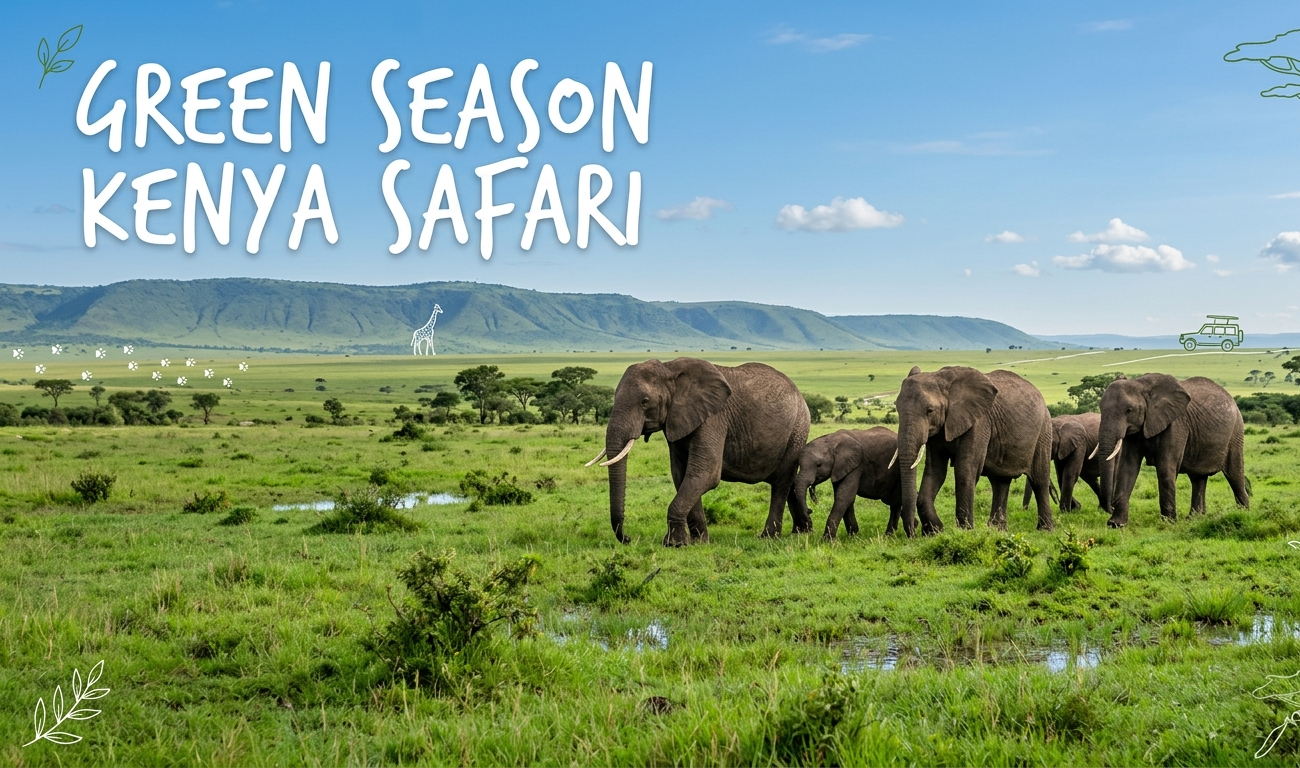

Green Season Kenya Safari runs March-May and again in November. Camp rates drop 30-40%, vehicle densities collapse, and the photography is arguably better than peak. This is the honest case for travelling Kenya when most operators would rather sell you the peak — and the honest list of trade-offs.
The conventional advice on Kenya safari timing is built around the wrong question
The standard advice on Kenya safari timing — visit between July and October for the migration, or January and February for the secondary dry season — is correct as far as it goes, but it is also strategically incomplete. It optimises for one specific outcome (witnessing the wildebeest migration’s river crossings) and treats all other months as inferior versions of the same trip. For travellers whose actual priority is some combination of wildlife, photography, value, low vehicle density, and travel experience, the green season — March to May and again in November — is frequently the better answer, and almost no one is told this in time to act on it.
The green season’s reputation as the rainy season is technically accurate but practically misleading. The ‘long rains’ (March to May) and ‘short rains’ (November) are real, but in most of Kenya’s main safari regions they fall as concentrated afternoon downpours rather than all-day rain, leaving mornings and most of the daylight hours dry and clear. Park infrastructure has improved dramatically over the past decade — many tracks that were impassable in 2010 are all-weather now. Conservancy management has further reduced rain-related access problems by maintaining road networks year-round. The result is that green-season Kenya safaris in 2026 are a fundamentally different proposition from green-season safaris a decade ago, and the conventional advice has not caught up.
This article takes the position that for many serious Kenya travellers — particularly photographers, repeat visitors, birders, families seeking value, and anyone resistant to the peak-season vehicle crowding — the green season is the strategically correct choice. It also names the destinations where the green season works less well, the activities that suffer, and the operational details (track conditions, camp closures, weather patterns) that buyers should verify before committing. The honest answer is that the green season is the strongest case-against-the-default in Kenya travel planning, and the default needs the case-against more than it needs another article repeating the peak-season prescription.
Quick reference — the green season at a glance
| LONG RAINS March–May (April typically wettest) | SHORT RAINS Late October–November (sometimes into early December) |
| TYPICAL RAIN PATTERN Afternoon downpours; mornings usually clear | CAMP RATE DISCOUNT VS PEAK 30–40% across most luxury tiers |
| MARA RESERVE FEE IN GREEN SEASON $100/pp/day (vs $200/pp/day Jul–Dec) | CONSERVANCY ACCESS Year-round; all-weather tracks |
| NATIONAL RESERVE TRACK CLOSURES Possible Apr–May; rarely Nov | MIGRATION HERDS Not present (in Serengeti); resident wildlife unaffected |
Why the green season works — six structural advantages
The case for the green season is not aesthetic or contrarian. It is a list of specific structural advantages that, when stacked, materially change the safari experience. Understanding these advantages separates buyers who choose green season deliberately from buyers who default to peak season by accident.
1. Vehicle densities collapse
The single largest experiential improvement in the green season is the reduction in vehicle pressure at sightings. The Mara National Reserve, which can host 20-30+ vehicles at a single lion sighting in August, routinely operates at 3-6 vehicles per sighting in April. Conservancies, which cap vehicles at 3-5 by rule, often operate at 1-2 vehicles per sighting during the green season. The wildlife behaves more naturally, sightings extend longer, photography improves dramatically, and the underlying safari experience becomes the one the operators were originally trying to sell — wildlife observed in its own context, not in a circle of Land Cruisers.
2. Photography conditions improve materially
Green-season photography is, by most experienced wildlife photographers’ assessment, better than peak season — not equivalent.
The reasons compound: dust drops dramatically after rain, increasing visibility and reducing the haze that softens peak-season images; dramatic skies (towering cumulonimbus clouds, storm fronts, double rainbows after afternoon showers) provide compositional opportunities that the cloudless peak-season sky cannot match; the green grass replaces the bleached straw colour of the dry season, producing the saturated colour palette that dominates the most-celebrated wildlife photography; and the lower vehicle density means longer single-vehicle sightings where the photographer can wait for the moment rather than working under the time pressure of a 15-vehicle queue.
The peak-season trade-off — higher wildlife concentration at predictable water points — is real, but for photographic outcomes the green-season trade is almost always favourable.
3. Pricing drops 30-40% across the luxury tiers
Camp rates in the green season run 30-40% below peak rates across most luxury tiers. The Mara National Reserve fee drops from $200 per person per day in peak to $100 per person per day in green season — a 50% reduction on this single line item that adds up to hundreds of dollars for any multi-day stay. Total trip cost reductions of 25-35% are realistic for green-season Kenya itineraries versus peak-season equivalents at the same property tier.
| Property tier | Peak (Jul-Oct, Dec-Jan) | Green season (Mar-May, Nov) | Effective discount |
| Entry luxury | $500–$850/pp/night | $340–$580/pp/night | 30–35% |
| High luxury | $900–$1,600/pp/night | $580–$1,050/pp/night | 35–40% |
| Ultra-luxury | $1,800–$3,500/pp/night | $1,200–$2,300/pp/night | 30–35% |
| Mara Reserve fee (non-resident) | $200/pp/day (Jul-Dec) | $100/pp/day (Jan-Jun) | 50% |
| Internal flights | Standard rate | Standard rate (no discount) | 0% |
The pricing is not a marker of inferior experience — it is a marker of supply-demand imbalance. The same wildlife, same camps, same guides, same conservation operations are available at green-season prices. The discount exists because most travellers default to peak season; it does not exist because the green season delivers a worse safari.
4. Birding peaks during the green season
Kenya’s birding peak runs October to April — when migrant species from Europe, Asia and the Middle East arrive in addition to the year-round resident population. The full bird roster is in the country only during these months. November is particularly strong (migrants arriving + nesting activity peaks for many resident species). The green season is unambiguously the strongest birding window of the Kenya calendar, and for travellers with serious birding interest the seasonal trade-off is the wrong question — the green season is simply when the birds are there.
5. The calving season produces predator action
Late January through February brings calving season for resident wildebeest, zebra, and many of the smaller antelope species. The predator response is intense: lion prides with high cub survival, cheetah hunting peaks, and serengeti-style predator action that conventional Mara migration coverage often misses. February in particular falls outside the technical green season (it is part of the secondary dry window) but the surrounding calving period extends into the early green season weeks and produces wildlife encounters that experienced photographers and repeat visitors often rate as equal to the migration spectacle.
6. The conservancies handle rain better than the Reserves
Conservancy management actively maintains all-weather tracks year-round because their economic model depends on year-round access. National Reserves rely on county or KWS infrastructure that is variable in maintenance quality and seasonally affected. The result is that in the green season, the conservancies often offer better access than the National Reserves they border — even though the Reserve fee structure incentivises Reserve stays during peak. The green-season case is therefore particularly strong for conservancy-based itineraries: rates drop, vehicle densities drop, access remains strong, and the conservancy economic model continues to function.
Where the green season works, and where it doesn’t
The green season is not uniformly favourable across Kenya. Some destinations handle rain better than others; some specific activities suffer. The honest geographic verdict:
| Destination | Green-season verdict | Why |
| Maasai Mara conservancies | Excellent | All-weather tracks, drained quickly. Calving season Feb produces strong predator action. Resident wildlife unchanged. November short rains generally afternoon-only. |
| Mara National Reserve | Mixed | Some tracks become impassable during long rains (April-May). November mostly fine. Resident wildlife excellent. Lower visitor density adds value. |
| Amboseli | Strong | Kilimanjaro views often clearest after rains have washed away dust. Elephants gather at fewer water points. April-May can flood swamps temporarily. |
| Samburu / Buffalo Springs / Shaba | Mixed (flood risk) | Semi-arid environment recovers fast from rain. But Ewaso Ng’iro can flood, threatening river-side camps. Game viewing strong throughout. |
| Tsavo East / West | Strong | Vast park, rain disperses wildlife but coverage is so extensive that wildlife concentration remains visible. Lush landscape transforms photography. |
| Laikipia conservancies | Strong | Elevated terrain drains well. Vegetation flourishes. Wildlife disperses but conservancy bed density means low vehicle pressure throughout. |
| Lake Nakuru / Naivasha | Variable | Heavy rain can cause flooding. Bird life peaks during migrant season (Oct-Apr). November and Nov-Dec especially strong for birding. |
| Indian Ocean coast | Avoid for diving Apr-May; otherwise good | Long rains reduce visibility for diving. November short rains usually brief. Beach experience generally available year-round. |
The flood-risk caveat for Samburu and the river-side camps
Samburu, Buffalo Springs and Shaba sit in a flood-vulnerable position because the Ewaso Ng’iro River drains the eastern slopes of Mount Kenya and the Aberdares — meaning heavy rains far upstream can produce sudden river-level rises in the reserves even when local weather is clear. The 2010 floods were severe; 2018-2020 also saw multiple flood events.
Riverside camps including Elephant Bedroom, Intrepids, Larsen’s, and the Save the Elephants research camp have all sustained flood damage in past years. Reputable operators now factor this into green-season operations (raised platforms, evacuation procedures, alternative camp locations), but green-season bookings in Samburu should explicitly confirm flood-preparedness with the operator before committing. April-May carries higher flood risk than November.
The honest trade-offs — what you lose
The case for the green season is strong but not absolute. Five specific things the green season delivers less well than peak season, and which travellers should weigh honestly:
1. The migration is not in Kenya
The wildebeest herds are in Tanzania’s Serengeti during the green season — the river crossings, the dramatic herd numbers, the wildebeest-and-crocodile spectacles that define the peak-season Kenya brand are entirely absent. If the migration is your primary reason for travelling to Kenya, the green season is the wrong window. Period. Travellers should either accept this and travel July-October at peak pricing, or pivot the trip’s primary purpose to align with what the green season actually delivers.
2. Some tracks become impassable
April and May are the wettest months. Even with the conservancies’ all-weather maintenance, certain tracks in the Mara National Reserve, Tsavo, and some areas of Samburu can close temporarily after heavy rain. Reputable operators reroute around closures; less reputable ones produce frustrating drives that hit muddy dead-ends repeatedly. Confirming the operator’s wet-season experience and backup-route capability is essential before booking April or May.
3. Some camps close
A small number of camps — particularly small operations on the Laikipia Plateau and some tented camps in the more remote Mara conservancies — close during the wettest weeks of April-May. The properties that close are not the strongest operations; reputable luxury camps largely stay open year-round. But families and groups booking specific properties should verify closure dates before booking the rest of the itinerary around them.
4. Coastal diving and snorkelling are degraded
April-May rains reduce Indian Ocean water clarity dramatically as river run-off flows into the coastal waters. Diving, snorkelling, and underwater photography all suffer. Travellers planning bush-and-beach combination trips should not book the beach portion in April-May. November short rains are briefer and less disruptive to coastal activities, but November is still not the strongest coastal window. December through March is the optimal coastal window.
5. Some logistical complications
Internal flights occasionally face weather-related delays in the green season — Wilson Airport operates throughout but charter flights to remote airstrips can be delayed by storm fronts. Buffer time in itineraries becomes more important. Hot air balloon flights have more cancellation risk (balloons need stable wind conditions). The hot air balloon is generally the highest-cancellation-risk activity in the green season; building flexibility around it is sensible.
Three specific green-season trip strategies that work
Generic ‘visit in the green season’ advice is less useful than specific trip patterns that exploit the green season’s advantages while managing its trade-offs. Three strategies worth considering:
Strategy 1: The conservancy circuit
Build the trip around conservancy stays (Olare Motorogi or Mara North in the Mara, Laikipia’s Ol Pejeta and Lewa or Borana, optionally Saruni Samburu or Sasaab in the north). Skip the National Reserves entirely. The conservancy economic model is robust to wet weather; the lower vehicle pressure is amplified by green-season conditions; the night drives and walking safaris that conservancies allow are particularly strong when the wildlife is dispersed and active. A 7-10 day Olare Motorogi + Laikipia + Samburu conservancy circuit in late March or November delivers an experience that peak season cannot replicate, at materially lower cost.
Strategy 2: The photographer’s calving-season trip
Late January through February (technically the secondary dry window but transitioning into early green season pricing) is the strongest single window for predator photography in Kenya. The calving herds attract the most active lion and cheetah hunting of the year. Camps offer shoulder rates. Vehicle densities are low. The combination of predator activity, photography-friendly light, lower visitor pressure, and pre-peak pricing makes this the connoisseur’s choice. A 5-7 night Olare Motorogi or Naboisho stay specifically targeted at calving-season predator action is one of the strongest single-destination trips Kenya offers.
Strategy 3: The November bridge week
November sits in a specific sweet spot — the migration herds have departed (October sees their southbound move back to the Serengeti), the short rains have begun but typically as brief afternoon showers rather than all-day rain, peak-season pricing has dropped, and birding migration peaks with the arrival of European and Asian migrants. A week in early-to-mid November combining a Mara conservancy stay with Ol Pejeta or Lewa delivers strong resident wildlife, lower-than-peak crowds, the start of birding peak, and rates that are 25-35% below October peak. It is the most strategically interesting single-week window in the Kenya calendar.
How operators actually handle green season — and what to verify
Not all operators handle the green season equally well. The structural differences between strong green-season operations and weak ones are mostly invisible to the buyer at booking time and only become apparent once the trip is underway — but a few specific signals are available before commitment.
Strong green-season operators maintain full operations year-round, rotate guides on standard schedules rather than reducing senior guide presence in the green season, keep their vehicle fleets fully maintained (rain accelerates vehicle wear meaningfully), maintain backup-route knowledge so that closures do not produce dead-end drives, and have published flood-evacuation protocols where relevant. Weak green-season operators reduce capacity in the green months, sometimes rotate to less experienced staff, and treat the green season as a period to defer maintenance. The pricing differential between the two operator types is not always reflected in the rate — both segments often quote similar prices for green-season bookings, but the experience differential at delivery is substantial.
The questions to put to your operator before a green-season booking: who specifically is guiding our trip, how long has that guide worked in this destination, what is the operator’s policy if our scheduled vehicle has weather-related issues mid-trip, and does the camp have an explicit green-season operations plan you can describe? Operators who answer these specifically and quickly are signalling green-season-ready operations; operators who deflect or generalise are usually signalling something less robust. The questions take five minutes; they are worth asking.
Operational considerations — what to actually verify before booking
Green-season Kenya bookings require a few specific verifications that peak-season bookings do not. The questions to put to your operator before committing:
- Are the specific tracks needed for our itinerary all-weather? Conservancy management can usually confirm this directly. National Reserve tracks vary; the operator should know which tracks they intend to use and whether those tracks remain accessible in wet conditions.
- If a camp closes, what is the alternative arrangement? Most operators have established backup camps. The answer should be specific (named alternative camp at the same tier) rather than vague (we’ll work it out closer to the date).
- What is the flood-evacuation protocol if we’re staying in a flood-vulnerable location (Samburu riverside, parts of Tsavo)? Operators with multi-year flood experience can describe this specifically. Operators who deflect this question should not be selected for flood-vulnerable green-season bookings.
- How does the operator handle hot air balloon cancellations? Refund policy, rescheduling options, and alternative activities all matter. Operators who treat the balloon as a non-refundable commitment in green season are extracting risk from the buyer.
- Is travel insurance with weather-related disruption cover included? Green-season trips warrant slightly more comprehensive travel insurance than peak-season trips. Confirm coverage of trip interruption and weather-related claims before committing.
What to pack — the green season layer
Green-season packing is broadly similar to peak-season packing with a few specific additions:
- Lightweight waterproof jacket. The kind that packs small. Most rain falls in 30-90 minute afternoon bursts; a quick-drying shell is more useful than heavy waterproofs.
- Quick-drying trousers. Avoid heavy cotton — once wet it stays wet.
- Sealed dry bag for camera equipment. Plastic bags work but proper dry bags (Sea to Summit, Ortlieb) are worth the small investment for serious photographers.
- Extra pair of walking shoes. Wet shoes do not dry overnight in cool conservancy camps; rotation between two pairs solves this.
- Warmer evening layers. Green-season evenings are markedly cooler than peak-season evenings, particularly at higher elevations (Laikipia, Aberdares). Fleece plus light insulated jacket; reproof a Gore-Tex shell.
- Mosquito repellent. Standing water from rain increases mosquito density. Insect repellent with DEET 30%+ is appropriate.
- Anti-malarial medication. Malaria risk is present year-round in lowland safari areas but increases marginally in green season. Confirm with your travel medicine provider; the standard regimen (atovaquone-proguanil or doxycycline) remains the same.
The honest position
The green season is the underrated strategic window in the Kenya safari calendar. For travellers whose priority is wildlife (resident populations, calving season predators, birding peak), photography (lower vehicle density, dramatic skies, saturated colours), value (30-40% discount vs peak), or the conservancy experience specifically — the green season is frequently the correct choice, and almost no operator marketing will tell you this in time to act on it. The peak-season default is, for a substantial portion of Kenya travellers, the wrong default.
The honest trade-offs are real. The migration is not in Kenya during the green season; some tracks close; coastal diving is degraded in April-May; logistical buffers must be longer; flood risk exists in specific destinations. These are real costs and should be weighed, not dismissed. But for travellers willing to accept those costs in exchange for the structural advantages above, the green season delivers an experience that peak-season Kenya cannot replicate at any price.
THE BOTTOM LINE If your priority is the migration river crossings, travel July-October at peak prices and accept the crowds. For everything else — resident wildlife, photography, birding, value, low-vehicle-density conservancy experience — late January through February or November is structurally superior. The default advice has not caught up to the operational reality, and the gap is where the strongest Kenya trips are now being booked by travellers who know what to ask for.
RELATED READING
Best time to visit Kenya — Month-by-month guide with the full seasonal picture.
Kenya in October — End of the migration, start of short rains.
Kenya in December — The festive shoulder window.
Maasai Mara Destination Guide — The Reserve vs. the conservancies in honest terms.
Tell us what you are looking for, and we will tell you honestly whether we can deliver it — and if we cannot, we will tell you who can.