
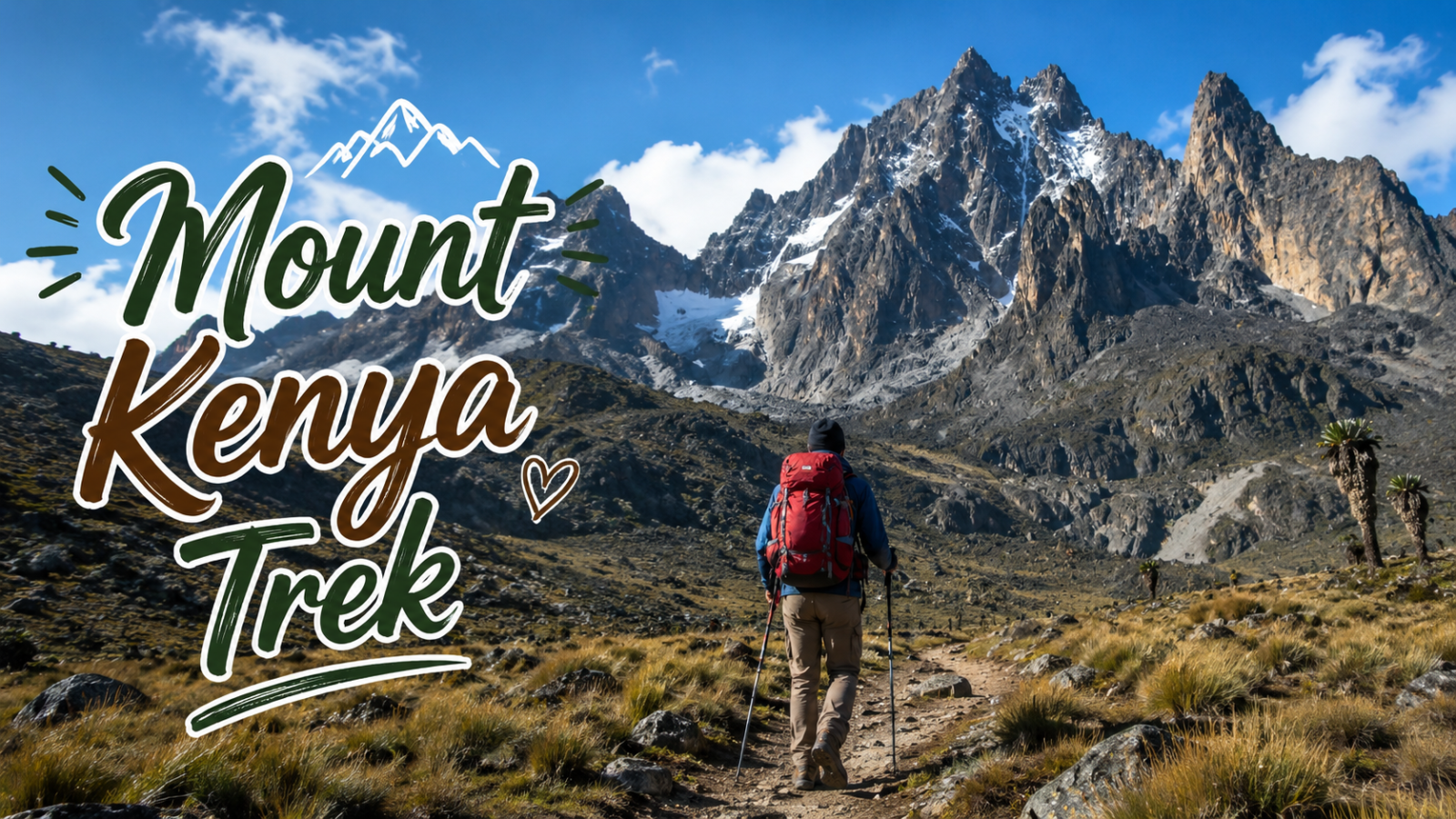

Point Lenana at 4,985m is the third-highest peak on Mount Kenya and one of the most accessible high-altitude summits in Africa. About 15,000 trekkers attempt it each year. Mount Kenya Trek is the honest guide to the routes, costs, weather windows, altitude science, and how to give yourself the best chance of standing on the summit at sunrise.
Mount Kenya is more demanding than Kilimanjaro and almost no one talks about it
Kilimanjaro is taller — 5,895 metres versus Mount Kenya’s 5,199. Kilimanjaro takes more trekkers — roughly 50,000 per year versus Mount Kenya’s 15,000. Kilimanjaro has the global brand recognition; Mount Kenya, the country’s namesake mountain, sits quietly on the equator with a fraction of the visitor traffic. The conventional advice for first-time high-altitude trekkers in East Africa is therefore Kilimanjaro — bigger summit, more famous, more established route infrastructure. The conventional advice is, on closer examination, often wrong.
Mount Kenya’s trekking summit, Point Lenana at 4,985 metres, sits just 215 metres lower than Kilimanjaro’s Uhuru Peak. The altitude profile is similar enough that the acclimatisation challenge is broadly comparable.
The crowds are dramatically fewer, the scenery is at least as dramatic — Mount Kenya is a glaciated extinct volcano with twin technical summits (Batian and Nelion) ringed by lakes, tarns, and Afro-alpine moorland — and the cultural and logistical experience is more authentically Kenyan, with smaller guide companies, community-managed routes, and a much shorter approach drive (3-4 hours from Nairobi versus the full day required to reach Kilimanjaro’s gates from Nairobi or Moshi). The reasons to choose Kilimanjaro over Mount Kenya are real for some trekkers; for many first-time East Africa trekkers, they amount to brand recognition rather than meaningful experiential differences.
This guide takes the position that Mount Kenya is one of the most underrated high-altitude treks in Africa, that Point Lenana is achievable for any reasonably fit beginner who gives themselves the right number of days, and that the standard 5-day Chogoria-Sirimon traverse is among the most rewarding 5-day trips available anywhere in East Africa. It also names the failure modes — the 3-day rush, the Naro Moru speed ascent, the underestimation of altitude — that produce most of the summit failures on the mountain.
Quick reference — the essential Mount Kenya numbers
| HIGHEST PEAK (TECHNICAL) Batian, 5,199m | HIGHEST TREKKING PEAK Point Lenana, 4,985m |
| AVERAGE TREKKERS PER YEAR ~15,000 (90% on Sirimon/Chogoria/Naro Moru) | BEST MONTHS January–March; July–October |
| PARK FEE (NON-RESIDENT, 2025–26) USD 60–80 per 24 hours | 5-DAY CHOGORIA–SIRIMON COST (FROM) ~$900 per person (group of 3+) |
| DISTANCE FROM NAIROBI TO PARK GATES 3–4 hours by road | UNESCO WORLD HERITAGE STATUS Yes — designated 1997 |
Why Mount Kenya rewards the discerning trekker
Beyond the comparison with Kilimanjaro, Mount Kenya delivers a specific set of experiential elements that make it a deeply rewarding mountain in its own right. Understanding what makes it distinctive is the difference between booking it as a Kilimanjaro substitute and booking it for what it actually is.
The geological signature
Mount Kenya is the eroded core of an extinct volcano that was active 2.6 to 3.1 million years ago in the Plio-Pleistocene era. The current jagged form — twin rock spires of Batian (5,199m) and Nelion (5,188m), surrounded by glacial valleys radiating outward like spokes of a wheel — is the result of millennia of glaciation cutting through the original volcanic cone. The dramatic, almost otherworldly skyline of the central peaks is unlike anything Kilimanjaro offers; Kilimanjaro’s summit is a relatively smooth caldera, whereas Mount Kenya’s is a knife-edged geological theatre.
The Afro-alpine ecosystem
The vegetation zones a trekker passes through on the way to Point Lenana are a textbook example of altitudinal banding: lowland farmland (1,500-2,500m), montane forest (2,500-3,000m) with elephant, buffalo and the rare bongo, bamboo zone (3,000-3,500m), Afro-alpine moorland (3,500-4,500m) with the iconic giant lobelias and giant groundsels — Dr Seuss-style plants that exist only at this altitude band on a small number of African mountains — and finally the bare rock and ice of the summit zone. The Afro-alpine vegetation is botanically unique and the mountain’s biological signature.
The wildlife dimension
Mount Kenya is one of the few mountains in the world where high-altitude trekking and serious wildlife sightings coexist. The forest zone on the lower slopes holds elephant, buffalo, leopard, and the elusive bongo (a forest antelope rarely seen elsewhere). Hyrax colonies live among the rocks at Shipton’s Camp. Mountain buzzards circle the moorland. The combination of wildlife encounters in the forest belt and high-altitude trekking on the summit ascent is genuinely unusual.
The 90-minute summit dawn
Summit day on Mount Kenya, like Kilimanjaro, involves a pre-dawn start (typically 2:30am from Shipton’s Camp) to reach Point Lenana at sunrise. The 90-minute window of dawn light over the central peaks — Batian and Nelion catching the first sun while Point Lenana sits in shadow before its own moment of light — is one of the most photographed dawns in African mountaineering. On a clear morning, Kilimanjaro is visible 320km to the south.
The five trekking routes — what each actually delivers
Mount Kenya has six recognised routes to Point Lenana plus several variants. About 90% of trekkers use one of the three established routes (Sirimon, Chogoria, Naro Moru) or a combination of two. The remaining routes (Burguret, Timau, Kamweti, Meru) are wilder, less marked, and typically require KWS ranger accompaniment. The honest comparison:
| Route | Approach | Days (recommended) | Summit success rate | Honest verdict |
| Sirimon | Northwest | 4–5 | High | Best acclimatisation profile. Forgiving for first-timers. Hut + camp options. The default beginner pick. |
| Chogoria | East | 4–5 | High | The most scenic — Gorges Valley, Lake Michaelson. Steeper than Sirimon. Camping only. |
| Naro Moru | West | 3–4 | Lower | Fastest and steepest. The ‘Vertical Bog’ tests endurance. Hut accommodation. Higher altitude-sickness rate. |
| Chogoria–Sirimon (combo) | East→Northwest | 5–6 | Highest | The connoisseur’s choice. Best scenery on ascent, gentle descent. The most-recommended route for fit first-timers. |
| Burguret | West | 6+ | Variable | Remote, wild, basic facilities. KWS ranger often required. For experienced trekkers seeking solitude. |
Sirimon — the beginner’s default
Approaches from the northwest. The most gradual ascent profile of any major route, producing the best acclimatisation outcomes and the highest first-timer success rates. The route follows a vehicle track for day one (the Sirimon Track) through moorland; transitions through the MacKinder Valley on day two; and ascends to Shipton’s Camp at 4,200m on day three. Summit attempt from Shipton’s starts at 2:30am, reaching Point Lenana at sunrise.
Hut accommodation is available at Old Moses Camp (3,300m) and Shipton’s Camp — the only route with hut options at both elevations. Wildlife sightings on the lower section are strong (rock hyrax at Shipton’s are habituated; elephant and buffalo possible in the forest zone). The route is considered the most beginner-friendly and is the default recommendation for trekkers without prior high-altitude experience.
Chogoria — the scenic showcase
Approaches from the east through what is widely considered the most spectacular landscape on the mountain. Day one ascends through dense forest (with genuine wildlife potential — elephant, buffalo, leopard) to Lake Ellis at 3,455m. Day two crosses the dramatic Gorges Valley — a 600-metre-deep glacial canyon — past Lake Michaelson and the ‘Gates’ rock formation to Mintos Hut at 4,200m.
Day three is the summit push, typically with descent via Sirimon to Old Moses Camp. The scenery on Chogoria is genuinely the best on the mountain: the Gorges Valley, the waterfalls and tarns, the dramatic rock pillars. The trade-off is steeper terrain than Sirimon and camping-only accommodation (no huts on the Chogoria approach). Strongly recommended as the ascent half of the 5-day Chogoria-Sirimon traverse.
Naro Moru — the speed route
The shortest and most direct approach, climbing from the west through Met Station (3,050m) to Mackinder’s Camp (4,200m) and summiting via the steep north face of Point Lenana. Famous for the ‘Vertical Bog’ — a steep, muddy section through tussock grassland that tests endurance on day one. The route can be completed in 3-4 days, making it the fastest option for time-constrained trekkers. The trade-off is significant: the rapid ascent profile produces the highest altitude sickness rate of any major route, and summit success on a 3-day Naro Moru itinerary is materially lower than on a 4 or 5-day route via Sirimon. Hut accommodation is available at all camps. Not recommended for first-time high-altitude trekkers.
Chogoria-Sirimon — the connoisseur’s combination
The most-recommended route on Mount Kenya, combining the best scenery (Chogoria ascent) with the most forgiving descent (Sirimon). A typical 5-day itinerary: day 1 Chogoria gate to Lake Ellis; day 2 Lake Ellis to Mintos Hut via Gorges Valley; day 3 summit Point Lenana at sunrise then descend to Shipton’s Camp; day 4 Shipton’s to Old Moses Camp; day 5 Old Moses to Sirimon gate.
The route delivers everything Mount Kenya is famous for: the dramatic Chogoria landscape on ascent, the high-altitude alpine zone, the summit at sunrise, the wildlife of the Sirimon forest descent. The 6-day version adds an acclimatisation day at Mintos Hut and produces the highest summit success rates on the mountain. The 5-day version is the standard recommendation; the 6-day version is the upgrade for trekkers who have struggled with altitude before or who simply want maximum margin for the summit attempt.
Burguret and the wilder routes
Burguret, Timau, Kamweti, and Meru are the four less-trekked routes. They attract roughly 5% of total trekking traffic and offer genuine wilderness — no formal infrastructure, KWS rangers often required for safety, route-finding considerably more demanding than on the main routes. The Burguret route in particular is gaining quiet recognition as the most beautiful of the wild routes, ascending through the North Burguret River valley to Hut Tarn on the Peak Circuit. These routes are not recommended for first-time high-altitude trekkers but offer something genuinely different for experienced mountain travellers seeking solitude. Specialist operators (Adventure Alternative, KG Mountain Expeditions, others) handle these routes specifically; general safari companies typically do not.
Altitude is the variable that determines success
The single most important factor in summit success on Mount Kenya is acclimatisation — the body’s gradual adjustment to reduced atmospheric oxygen at altitude. Mount Kenya tops 4,985m at Point Lenana, which is high enough to produce Acute Mountain Sickness (AMS) in any unacclimatised trekker, regardless of fitness level. Understanding altitude physiology is more important than physical conditioning for the summit attempt.
What altitude actually does
At Point Lenana, atmospheric pressure is roughly 55% of sea-level pressure. Each breath delivers about half the oxygen molecules per inhalation. The body responds by increasing breathing rate, heart rate, and red blood cell production — but the adaptation takes time, typically several days to a week. Trekkers who ascend too quickly experience AMS symptoms (headache, nausea, dizziness, insomnia, fatigue), and a small percentage develop the more serious conditions of High Altitude Pulmonary Oedema (HAPE) or High Altitude Cerebral Oedema (HACE). HAPE and HACE are medical emergencies requiring immediate descent.
How to acclimatise properly
- Add days. The single most effective intervention. A 5-day trek produces materially higher summit success rates than a 3-day attempt. A 6-day version improves the rate further. The cost differential between 4 and 5 days is small; the success-rate differential is substantial.
- ‘Climb high, sleep low.’ On rest days, hike to higher elevations during the day but return to a lower camp for sleep. This stimulates adaptation without forcing recovery at the higher altitude.
- Drink water aggressively. At least 3-4 litres per day at altitude. Dehydration is the most common amplifier of AMS symptoms.
- Avoid alcohol from the moorland zone onwards. The combined effects of altitude and alcohol significantly worsen symptoms.
- Consider Diamox (acetazolamide). The standard altitude medication. Most experienced guides recommend a prophylactic dose starting 1-2 days before ascent above 3,000m. Side effects include increased urination and finger tingling. Discuss with your doctor before travel.
- Listen to symptoms. A persistent headache, especially with nausea or dizziness, is the body warning you that ascent rate is too high. Descend immediately if symptoms worsen rather than improve at a given altitude.
- Do not summit if you are unwell. Summit fever — the psychological pressure to complete the trek you have paid for — is the single largest cause of avoidable HAPE/HACE cases globally. A bad summit attempt is worse than a missed one.
Costs — what you should actually expect to pay
Mount Kenya trekking costs are transparent compared with many adventure activities in East Africa. The major variables are duration (more days = higher cost but better acclimatisation), group size (per-person cost drops with group size), and accommodation type (hut versus camping on the routes where huts are available). The 2026 pricing landscape:
| Trek option | Duration | From (per person) | Group size | Most suited to |
| Day hike (lower slopes) | 1 day | ~$190 | 2+ | Short-time visitors / acclimatisation |
| 3-day Sirimon (Point Lenana) | 3 days | ~$700 | 3+ | Experienced high-altitude trekkers |
| 4-day Naro Moru / Sirimon | 4 days | ~$800 | 3+ | Time-constrained trekkers |
| 5-day Chogoria–Sirimon | 5 days | ~$900 | 3+ | The recommended default |
| 6-day Chogoria–Sirimon | 6 days | ~$1,100 | 3+ | Best acclimatisation / highest success |
| Batian/Nelion technical climb | 7–9 days | ~$2,200–2,600 | 2+ | Experienced rock climbers only |
What is included in the standard 5-day price ($900+): return road transport from Nairobi, KWS park entry fees, certified guide and porters, mountain chef and all meals on the mountain, camping equipment, summit certificate. What is typically not included: pre- and post-trek accommodation in Nairobi, personal hiking gear (boots, layered clothing, sleeping bag for camping options), travel insurance with high-altitude evacuation coverage, optional hut upgrade where applicable, tips for guide team.
When to go — the four climbing windows
Mount Kenya’s location 10km south of the equator produces unusual climbing seasonality. The equatorial position means that the rock routes on the north side of the peaks are in good summer condition during the northern summer (June-August), while the ice routes on the south side are also in good condition. The situation reverses during the southern summer (December-February). For trekkers (rather than technical climbers), the two seasons translate into two main windows.
January–March: the primary dry window
Warm, dry, minimal snow on rock routes. The strongest trekking window. Visibility is typically excellent; nights are cool but not bitterly cold; rainfall is at its annual minimum. February is the peak month — high summit success rates, clear skies, photogenic dawn light. Park infrastructure is fully operational and route conditions are at their best.
July–October: the secondary dry window
The southern winter. Dry, with cooler temperatures than January-March and some risk of light snow at the summit. Summit success rates remain high. The MacKinder Valley and Gorges Valley landscapes are at their most photogenic — the harsh dry-season light brings out the geological texture. Hyrax populations at Shipton’s Camp are particularly active. The peak month within this window is August. Some glaciation-related route challenges can occur at higher altitudes; reputable operators adjust routes accordingly.
April–June: the long rains
Avoid. Heavy rainfall produces dangerous conditions on most routes — the Vertical Bog on Naro Moru becomes effectively impassable, river crossings become risky, and visibility at altitude is consistently poor. Summit success rates drop substantially. Some operators still run treks during these months for budget-conscious trekkers, but the risk-reward calculation is poor.
November–December: the short rains
Variable. Rainfall is less heavy than April-June but unpredictable. Some trekking windows open in mid-to-late November; December is variable until the dry season begins to establish in early-to-mid January. Not the recommended window for first-time trekkers but workable for experienced high-altitude trekkers willing to accept variable conditions.
Practical planning — what to do before you go
Physical preparation
Mount Kenya is not a technical climb to Point Lenana, but it is a serious physical exertion. Realistic preparation involves at least 8-12 weeks of cardiovascular training (running, cycling, swimming, or stair-climbing) plus 4-6 weeks of weighted hiking (loaded daypack, hilly terrain) closer to departure. Trekkers in normal good health who train consistently typically have no significant fitness issues on the mountain. The trekkers who struggle are usually those whose ‘fitness’ is gym-based rather than endurance-based, or who underestimate the cumulative fatigue of consecutive 6-8 hour hiking days at altitude.
Gear — what actually matters
- Properly broken-in hiking boots. The single most important piece of equipment. New boots cause blisters that can end a trek. Boots should be worn for at least 50km before the trip.
- Layered clothing system. Base layer (merino wool or technical synthetic), insulating mid-layer (fleece or light down), shell layer (waterproof breathable jacket). The summit attempt requires all three plus warm hat and gloves; daytime trekking at lower altitudes uses only the base layer.
- Sleeping bag rated to -10°C minimum (for camping routes). Hut routes typically provide bedding but verify with your operator.
- Headlamp with spare batteries. Essential for the pre-dawn summit attempt.
- Trekking poles. Particularly valuable on the steep Chogoria descent through the Gorges Valley and on the Sirimon descent.
- Water bottles or hydration bladder. 3-litre capacity minimum; cold-weather insulation prevents freezing on summit morning.
- High-SPF sunscreen and lip balm. UV exposure at altitude is dramatically higher than at sea level; equatorial sun amplifies this.
Travel logistics
Getting there: Nairobi to Naro Moru, Nanyuki (Sirimon), or Chogoria takes 3-4 hours by road on tarmac highways. Nanyuki has the nearest commercial airstrip with scheduled flights from Wilson Airport (45 minutes). Most operators include road transport in the package price.
Permits: All trekkers require a KWS conservation fee permit ($60-80 per 24 hours non-resident, October 2025 KWS structure). Summit attempts to Point Lenana additionally require a climbing permit, issued together with park entry at the gate. The permit process is handled by your operator if booking through one. eTA visa for Kenya entry is separate ($33 plus surcharges, application via the official Kenyan eTA portal at least 72 hours before travel).
Insurance: Travel insurance with high-altitude evacuation coverage (covering altitudes above 4,000m) is strongly recommended. AMREF Flying Doctors membership ($25-50 per 30 days) provides additional medevac coverage at minimal cost. Standard travel insurance often does not cover altitude-related evacuations; verify before purchase.
Ethical considerations — the porter and guide question
Like Kilimanjaro, Mount Kenya’s trekking economy depends on the local guide and porter workforce. The trek you book finances a network of guides, chefs, porters, and equipment carriers — typically 3-6 staff members per trekker on a standard route. The ethical considerations are real and worth understanding.
- Use operators who pay porters above the minimum wage. Several budget operators run porters at exploitative rates. Licensed guides and reputable operators (Adventure Alternative, KG Mountain Expeditions, Ahambi Tours, others) pay above-market rates and provide equipment.
- Tip guides and porters appropriately. Standard tipping at the end of a Mount Kenya trek is roughly $10-15 per day for the guide, $5-8 per day for the chef, $4-6 per day per porter. For a 5-day group of three with a guide, chef, and four porters, total tip pool is typically $200-300 split among the team.
- Verify porter weight limits are respected. International Mountain Explorers Connection guidelines recommend maximum porter loads of 20kg. Reputable operators enforce this; lower-end operators sometimes do not. Watch for porters carrying obviously excessive loads.
- Pass down gear at the end of the trek where appropriate. Decent quality used hiking gear is genuinely useful to guides and porters. Boots, jackets, sleeping bags, headlamps, and trekking poles passed down at trek’s end are appreciated and put to good use.
The honest position
Mount Kenya is the underrated high-altitude trek of East Africa. Point Lenana is achievable by any reasonably fit beginner who gives themselves 5-6 days, books with a reputable operator using one of the main routes, and respects the altitude. The summit dawn at 4,985m, with Batian and Nelion catching first light and Kilimanjaro visible 320km to the south, is among the most rewarding mountain mornings available anywhere on the continent. The trek costs roughly half what Kilimanjaro costs at the entry level, and delivers a comparable experience to many trekkers without the brand-name crowds.
The honest failure modes are predictable. Trekkers who choose the 3-day Naro Moru speed route fail at higher rates than those who take 5 days. Trekkers who do not train cardio fail more often than those who do. Trekkers who hide altitude symptoms from their guide to avoid ‘missing the summit’ are the cohort that produces the serious incidents. Mount Kenya is forgiving when respected; less forgiving when rushed.
THE BOTTOM LINE Book the 5-day Chogoria–Sirimon traverse, train your endurance for 12 weeks beforehand, use a KPSGA-licensed operator who pays porters fairly, take Diamox if you've struggled with altitude before, and trust your guide's judgement on summit day. Do these things and your chances of standing on Point Lenana at sunrise are very high. The mountain is waiting; the bookings infrastructure is mature; the costs are reasonable; the alternative — Kilimanjaro at twice the price with five times the trekkers — is increasingly the lesser experience.
RELATED READING
- Walking safari Kenya: what to expect and where to go — Trekking the wildlife landscape on foot.
- Best time to visit Kenya — Month-by-month, with the trekking windows.
- Solo safari Kenya: what you need to know — Solo trekking considerations and operator support.
- Laikipia and Ol Pejeta Conservancy — The natural pre/post-trek base on Mount Kenya’s slopes.
- Responsible tourism in Kenya: how to travel ethically — Including porter and guide considerations.
Tell us what you are looking for, and we will tell you honestly whether we can deliver it — and if we cannot, we will tell you who can.