
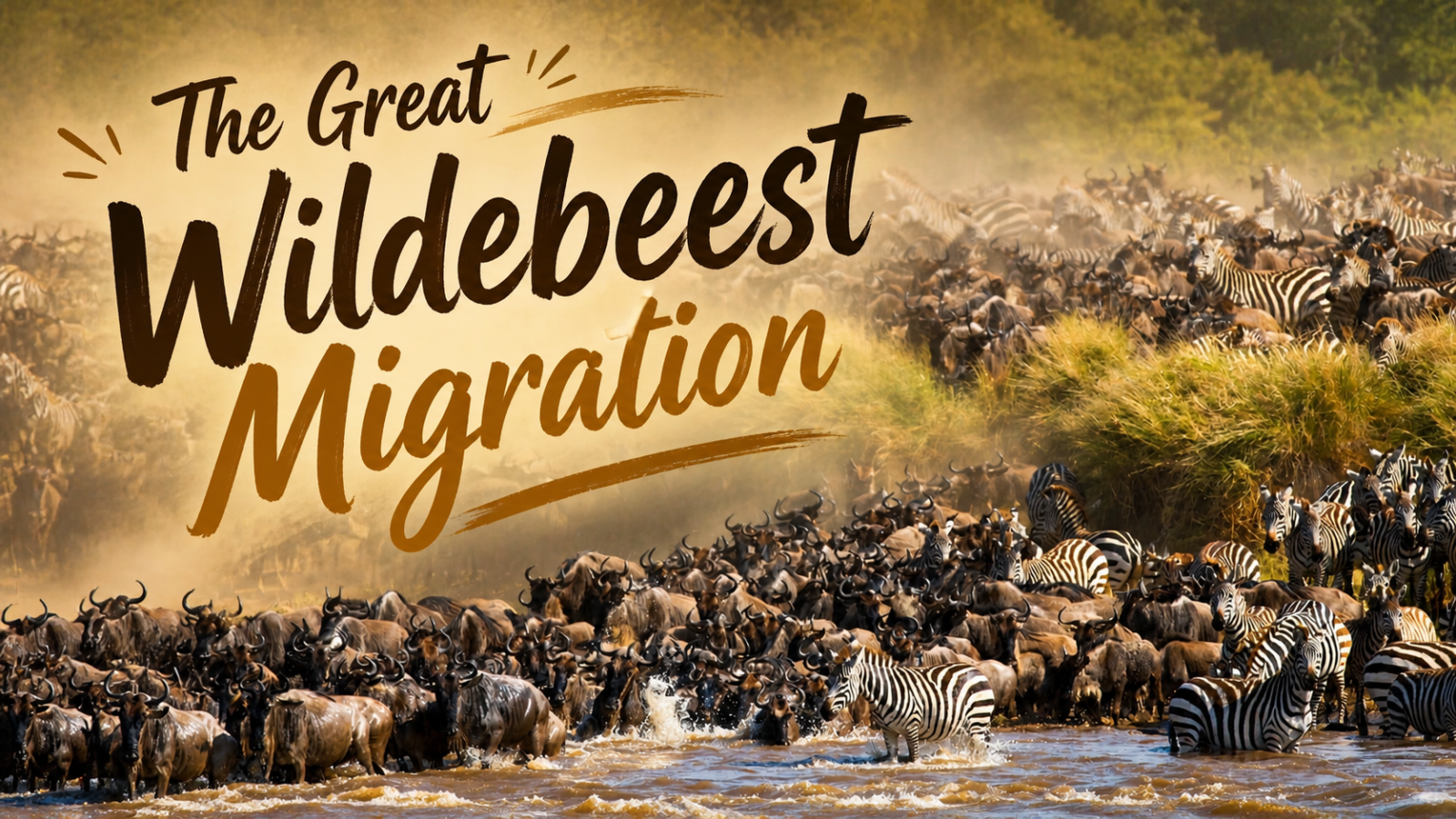

The Great Wildebeest Migration is the most marketed wildlife event in Africa and also the most misunderstood. It is not a river crossing. It is not an August event. It is a year-round circuit of 1.5 million wildebeest and 300,000 zebra across 40,000 square kilometres of Tanzania and Kenya — and the Mara River crossings, spectacular as they are, are one phase of a journey that has eight or nine equally extraordinary chapters, most of which happen in Tanzania in months that the tourism industry barely mentions.
What the migration actually is
The wildebeest and zebra of the Mara-Serengeti ecosystem do not migrate toward a specific destination. They migrate continuously, following rainfall across the ecosystem in a roughly clockwise circuit that takes approximately one year to complete. The herds are always somewhere in this circuit. At any time of year, in any part of the ecosystem, approximately 1.5 million wildebeest are moving through a landscape that spans two countries, two national parks, and multiple private conservancies and game management areas.
The movement is driven by one biological imperative: finding the short green grass that the wildebeest’s broad, flat teeth and restricted jaw movement are specifically adapted to process. The herds follow rain because rain produces this grass. In drought years they move faster and cover more ground. In good rain years they slow and linger in areas of exceptional forage quality.
The annual circuit has been documented by researchers at the Frankfurt Zoological Society, the Serengeti Ecosystem Research Project, and multiple Kenyan conservation organisations over decades. The broad pattern is consistent year to year, but specific timing varies with rainfall and can shift by several weeks in either direction. No operator can guarantee that the herds will be in a specific location on a specific date. What an operator can tell you is which phase of the annual circuit is most likely at your chosen time of year, what the wildlife quality of that phase looks like, and which location in the ecosystem provides the best access to that phase.
The circuit has been mapped in detail. The herds begin calving in the short grass plains of the southern Serengeti in January and February, move north and west through the Serengeti’s central and western sectors from March through May, begin staging for the Mara River crossing in the northern Serengeti from June onward, enter Kenya and cross the Mara River from late June through October, and begin returning to Tanzania in October and November.
Each phase has its own wildlife character, its own predator pressure, its own visual aesthetic. The river crossing is the most concentrated and dramatic single event. The calving season is the most intense for predator activity. The July entry into Kenya is the most spectacular for pure volume. None of these is the “best” phase in any absolute sense; each is the best phase for what it specifically delivers.
| The Great Wildebeest Migration — KEY FACTS | |
| Total wildebeest | ~1.5 million — largest land animal migration on Earth |
| Total zebra | ~300,000 — an integral part of the migration, not an addition to it |
| Total ecosystem | ~40,000 km² across Tanzania (Serengeti) and Kenya (Maasai Mara) |
| Calving season | January–February, southern Serengeti — up to 8,000 calves per day at peak |
| Kenya arrival | Late June through July (varies by year and rainfall) |
| River crossings | Peak late July–September · Can occur anytime within this period |
| Return to Tanzania | October–November · Crossings occur in reverse direction |
| Individual crossing duration | 15–45 minutes · Season: multiple weeks of repeated crossings |
The annual circuit — phase by phase
January–February: Calving season in the southern Serengeti
The most dramatic phase of the migration that almost no one talks about because it takes place entirely in Tanzania. In the short grass plains of the southern Serengeti — the Ndutu area, the Ngorongoro Conservation Area periphery, and the Kusini plains — approximately 500,000 wildebeest calves are born in a six-week period at a rate of up to 8,000 per day at peak. The evolutionary mechanism is predator saturation: by flooding the plains with newborns simultaneously, the wildebeest ensure that predators are overwhelmed and statistically most calves survive the critical first days, even though the predation rate in absolute terms is extraordinary during this period.
For visitors, this phase produces the most intense predator-prey action of the entire annual cycle. Lion prides, cheetah mothers, spotted and brown hyenas, African wild dogs, jackal pairs, and martial eagles are all simultaneously hunting newborns across wide-open plains in excellent visibility. A single morning drive in the southern Serengeti during calving season can produce more predator action than a week of dry-season game drives in the same location. This is the migration’s most dramatic act. It happens in Tanzania in January and February. It is a strong argument for the Kenya–Tanzania combined itinerary, and it is entirely absent from the marketing of “the Great Migration” that focuses exclusively on the July–October Mara River crossing phase.
March–May: Movement through the central Serengeti
The herds move north and west through the Serengeti following the rains, spreading across vast areas of central Tanzania. The drama in this phase is one of scale rather than concentrated action — herds stretching to every horizon in every direction, the dust of their movement visible from kilometres away, the ecosystem alive with the perpetual low-frequency sound of hundreds of thousands of hooves on dry soil. This is the period when the Serengeti’s predator population — which numbers over 3,000 lions and a proportionate number of leopard, cheetah, and hyena — is most widely distributed across the maximum area. Individual predator sightings are less concentrated than during calving season but the total predator encounters across a multi-day safari can be exceptional.
June: Building in the northern Serengeti
The herds build in the northern Serengeti, staging for the Mara River crossing. The animals sense the crossing approaching — or, more precisely, they are following the scent of rain and new grass on the Kenya side — and they mass on the southern bank of the Mara River in increasing numbers through June. The behavioural state of the animals in this staging period is distinctive: a restlessness and directional pressure in the herd that experienced guides read as the prelude to a crossing attempt. The July 1 doubling of the Mara national reserve park fee, from $100 to $200 per person per day, takes effect simultaneously with the typical arrival of significant herd numbers on the Kenya side.
July–October: The Maasai Mara
The herds cross the Mara River into Kenya, typically beginning in late June or July, and spend the next three to four months grazing the Mara’s plains before the rains push them south again. The Mara River crossings — the images that define “the Great Migration” in global popular understanding — happen during this period. The crossings are genuinely spectacular: tens of thousands of wildebeest plunging into the river simultaneously, the Nile crocodiles that have been lying motionless on the banks suddenly becoming violently active, the noise and chaos of thousands of animals in churning brown water.
For guests who witness a major crossing from a well-positioned vehicle — particularly from a private conservancy where vehicle limits are enforced and the guide can move off-track to the best angle — this is one of the genuinely great wildlife spectacles available anywhere on Earth.
The most important thing to understand about Mara River crossings: they do not happen on a schedule. The herds may cross at one point for three days, disappear inland for two weeks, then cross at a different location. Individual crossings begin when a specific animal at the front of a massed group makes a decisive commitment and the herd follows in a surge — a process that can take two hours of massed waiting or can happen suddenly with no apparent trigger. No operator can guarantee a crossing on any specific day.
What a good guide can do is read the animal behaviour, understand the water levels and available crossing points, and position you correctly when conditions appear right. The guests who witness the best crossings are almost always the guests who commit to staying at the river through the heat of the midday hours rather than returning to camp for lunch when the crossing seems to be delayed.
October–November: The return south
The herds drift back toward Tanzania as the short rains begin in Kenya and the Serengeti’s new grass becomes accessible from the south. Crossings in the opposite direction — Kenya back to Tanzania — occur but receive much less attention and fewer vehicles than the southbound crossings. Late October and November crossings are often witnessed by far fewer vehicles than August crossings in the same locations. The wildlife quality of a November crossing is identical to an August crossing; the crowd experience is dramatically different. Guests who specifically target this reverse-crossing period for its combination of crossing access and low crowding consistently rate it among the most satisfying Mara experiences they have had.
The crossing itself — what actually happens
A Mara River crossing typically begins with hundreds or thousands of wildebeest massing on a bank above a known crossing point — usually a section of river with a recognisable exit on the opposite bank, identified by previous crossings’ marks on the clay. The animals at the front pause, mill nervously, and retreat while those behind press forward. This pressure buildup can last 30 minutes or two hours. The tension is visible and audible: the pushing, the calling, the specific restlessness of animals that want to cross but cannot commit.
When an animal finally commits — usually a single wildebeest or zebra making a decisive move down the bank into the water — the herd follows in a chaotic surge. Animals plunge in, the stronger swimmers pulling ahead, the weaker ones struggling in the current. The Nile crocodiles that have been lying motionless in the shallows and on the banks become violently active, targeting animals in difficulty.
The noise — thousands of hooves on wet clay, the churning water, the animals calling, the splash and struggle — is overwhelming at close range. Individual crossings last 15–45 minutes. Some crossings involve only a few hundred animals before the herd loses its collective nerve and turns back. The largest crossings involve tens of thousands of animals over several hours. Both types are extraordinary.
How to maximise your migration experience
- Book a private conservancy camp, not a national reserve lodge — off-road access and enforced vehicle limits are the difference between watching a crossing and watching a parking lot watching a crossing
- Stay at the river through midday — most crossings happen between 10am and 2pm, exactly when most tour groups return to camp for lunch; the guests who witness the best crossings bring packed lunches
- Listen to your guide’s read of the animal behaviour — experienced guides know what building animal behaviour looks like before the crossing begins
- Manage your expectations honestly — a crossing is not guaranteed on any day; the overall Mara experience is excellent even in years when crossings are less frequent than average
- Shoot video for crossings — the sound and movement of a crossing is captured more completely in 60 seconds of video than in still photography; shoot video first, then stills
- October and November offer reverse crossings with dramatically fewer vehicles — a serious consideration for experienced Mara visitors returning for a second time
RELATED READING
- Maasai Mara — Destination Guide
- Maasai Mara Lodges and Camps — Complete 2026 Guide
- Kenya Tanzania Safari — The Complete Combined Guide
- Best Time to Visit Kenya — Month-by-Month Guide
Planning your migration visit — the honest framework
The most important single piece of advice for any traveller planning a Kenya safari specifically for the Great Migration is this: manage the expectation that the river crossing is guaranteed. It is not. The herds move on their own schedule, responding to rainfall, grass quality, and collective behavioural dynamics that no guide or operator can predict with precision more than a few hours in advance.
Guests who build their entire trip around a single specific event — the river crossing, on a specific day, at a specific point — and who do not see that event consistently report disappointment out of proportion to what the overall experience delivered. Guests who come to experience the Mara ecosystem broadly during the migration season, with the crossing as a hoped-for bonus rather than a guaranteed centrepiece, almost universally report extraordinary satisfaction regardless of whether they witnessed a crossing.
The practical implication: stay a minimum of 4 nights in the Mara during the July–October window, not 2. Two nights gives you 4 game drives; 4 nights gives you 8. The statistical probability of the herds being active at a crossing point on one of your specific drive windows is significantly higher over 4 nights than 2.
The guide who has spent four consecutive mornings reading the herd behaviour and positioning the vehicle has substantially more accumulated knowledge of where the action is likely to be on any given day than one who is working with the context of only 24 hours. For the migration experience specifically, trip length in the ecosystem is the most controllable variable available to any visitor.
The vehicle limit difference between the national reserve and the private conservancies is particularly significant during the crossing season. In the national reserve, a crossing point during peak August can accumulate 30–40 vehicles — a crowd that changes the animals’ behaviour, increases stress levels, and changes the auditory and visual quality of the encounter. In a private conservancy, the same crossing at the same time would have 3–5 vehicles at the point, with the guide able to position at the angle and distance that best serves the specific behaviour unfolding. The conservancy premium during crossing season is not a luxury premium. It is a conservation and quality premium that produces a fundamentally different experience of the same wildlife event.
The most practically useful mindset for a migration visit is this: come to experience the Maasai Mara ecosystem broadly during its most dynamic season, with the river crossing as a wonderful possibility rather than a guaranteed centrepiece. Guests who hold this mindset and spend four or five nights in a private conservancy during July through October consistently return describing their experience as extraordinary.
Guests who build their trip around witnessing a crossing on a specific day and do not see one describe the same experience as disappointing — despite having witnessed lion hunts, cheetah families, elephant herds at the river, and the full nocturnal wildlife of the conservancy. The crossing is spectacular when it happens. The migration season is spectacular regardless.
The research behind the migration calendar
The annual wildebeest census that provides the most reliable population and movement data for the Mara-Serengeti ecosystem has been conducted by the Frankfurt Zoological Society in partnership with the Serengeti Ecosystem Research Project since the 1970s. The most recent comprehensive survey confirms a stable Mara-Serengeti wildebeest population of approximately 1.3-1.5 million individuals, with an additional 300,000-350,000 zebra and 500,000 Thomson’s gazelle completing the migration complex.
The Serengeti Wildebeest Monitoring Project, coordinated between the Frankfurt Zoological Society and the Tanzania National Parks Authority (TANAPA), uses aerial survey methodology to track herd distribution across the ecosystem at approximately monthly intervals during the main movement periods. This data, published through the Max Planck Institute’s open research archive, provides the scientific foundation for the migration timing predictions that safari operators use. The honest interpretation of this data: the population distribution curves confirm seasonal patterns that are reliable at the scale of months. They do not confirm that the herds will be at a specific crossing point on a specific day.
Nile crocodile ecology at the Mara River
The Nile crocodiles (Crocodylus niloticus) that make Mara River crossings so dramatic have been studied in the Mara River ecosystem since the 1970s. Research published in the journal Copeia and subsequently in Herpetological Conservation and Biology documents that individual Mara River crocodiles occupy stable home ranges centred on specific bank positions that they defend across years or decades. The large individuals — some documented at over 5 metres in length and estimated at 60-70 years old based on growth rate modelling — are sufficiently established in their positions that experienced guides know their bank locations and can position vehicles accordingly when crossings are building.
The specific crocodile aggregation that forms at known crossing points during migration season is not opportunistic: individual animals move to their established crossing-point positions as migration season approaches, responding to the hydrological cues and the sensory signals of approaching herds. This behaviour has been consistent enough, and individual crocodiles sufficiently long-lived, that researchers and guides speak of specific individuals by name at specific crossing points.
The migration trade-off: timing certainty versus crowd quality
The honest migration trade-off is between timing certainty and experience quality, and the two are in direct tension. The period of highest crossing probability — peak August — is also the period of highest vehicle density in the national reserve. The period of lowest vehicle density — June before the herds arrive, or October as they begin to depart — coincides with the lowest crossing probability.
The private conservancy model partially resolves this tension by providing enforced vehicle limits regardless of season, but even in conservancies the herds cross when they choose to cross, not when the itinerary expects them to. However, the experienced Kenya travellers who report the most satisfying migration encounters are consistently those who released the expectation of a guaranteed crossing and came to experience the ecosystem broadly during the migration season — and who found that the season’s character, even without a crossing, exceeded everything they had expected.