
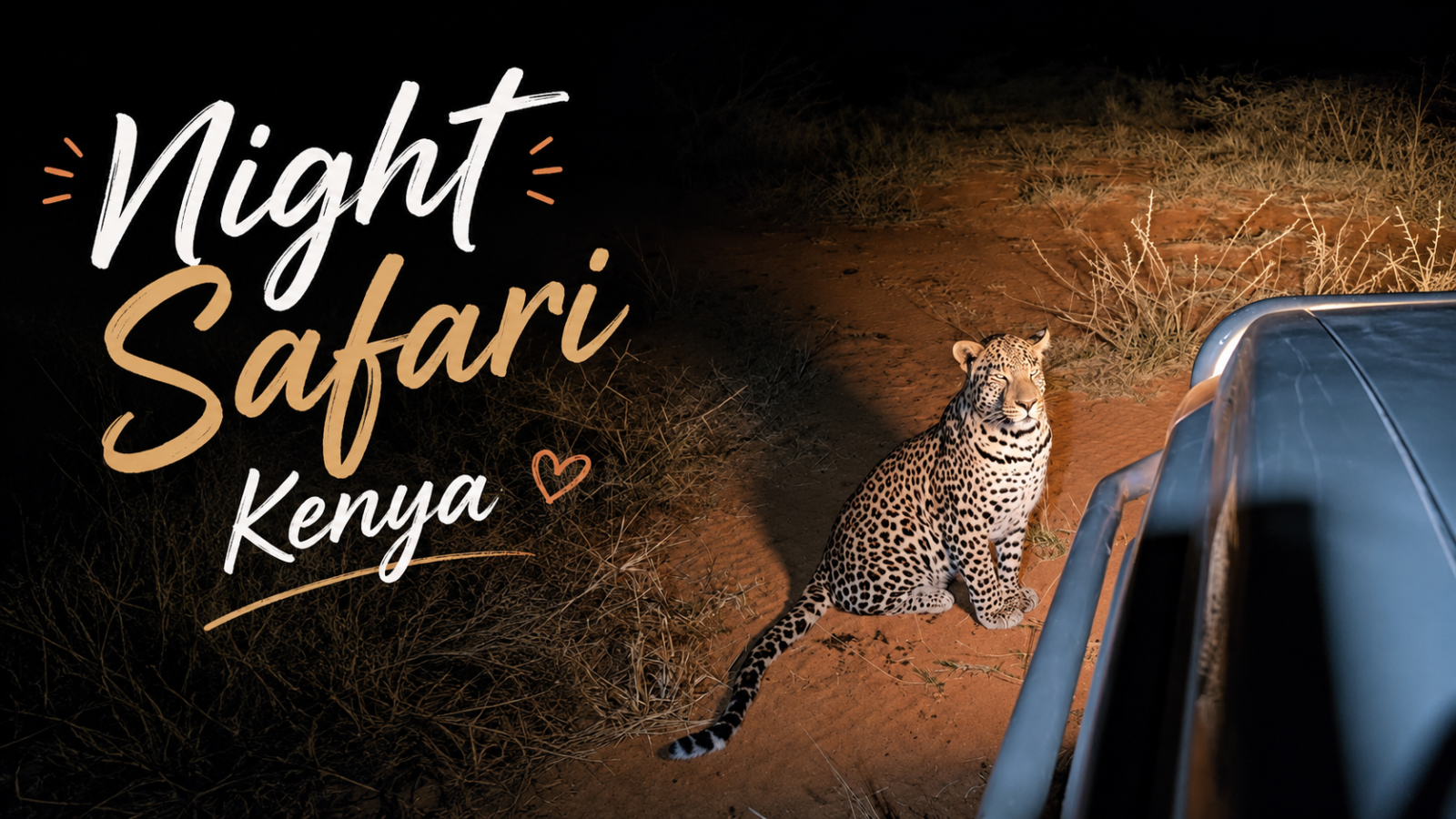

About 80% of Kenya’s mammal species are wholly or partly nocturnal — and the standard safari sees almost none of them. Night drives are permitted only in specific private conservancies, not in the national parks where most visitors stay. This -Night Safari Kenya- is the honest guide to what you can actually see, where you can see it, and why a night element belongs on any serious wildlife itinerary.
The wildlife most safari guests came to see is largely nocturnal — and they miss almost all of it
A standard Kenya safari delivers the daytime visible wildlife: prides of lions resting in shade, elephants browsing in the afternoon light, herds of wildebeest and zebra on the open plains, cheetah scanning from a termite mound. This is the postcard wildlife the brochures lead with, and it is the genuine majority of what most visitors see and photograph. It is also a small fraction of what is actually present. Approximately 80% of mammal species in Kenya’s wildlife landscapes are nocturnal or crepuscular — active wholly at night, or active at dusk and dawn rather than during the high-sun hours that game drives operate in.
Aardvark, pangolin, honey badger, African civet, the various genets, mongoose species, springhare, porcupine, bushbabies, the smaller cats and carnivores — these are the species the daytime safari never reaches, partly because most are simply not active in daylight, and partly because Kenya’s national parks and reserves prohibit vehicle activity after sunset. The visitor who completes a 10-day Kenya safari without ever leaving the standard 06:00-18:30 game drive window has, in mammal-species terms, seen the major daytime fraction and missed most of the country’s actual mammal roster. Night drives are how you access the rest.
This guide takes the position that a night drive component should be a deliberate element of any wildlife-serious Kenya itinerary. It also names the unambiguous geographic constraint — night drives are only permitted in specific private conservancies, not in the KWS national parks where most travellers stay — and explains what that means for trip planning. The decision to include a night drive is, structurally, the decision to spend at least one night at a conservancy lodge rather than at a reserve lodge.
Quick reference — the essential Night Safari Kenya facts
| KENYA MAMMAL SPECIES MOSTLY NOCTURNAL ~80% of recorded species | STANDARD GAME DRIVE OPERATING HOURS 06:00–18:30 (KWS-mandated) |
| TYPICAL NIGHT DRIVE DURATION 2–3 hours after dinner | STANDARD DEPARTURE TIME 20:00–21:00 |
| NIGHT DRIVES ALLOWED IN NATIONAL RESERVES/PARKS No, with limited exceptions | NIGHT DRIVES ALLOWED IN PRIVATE CONSERVANCIES Yes — almost all major conservancies |
| COST (WHERE CHARGED SEPARATELY) $50–$120 per person typical | VEHICLE TYPE Open-sided 4×4 with filtered spotlight (red preferred) |
What changes when the sun goes down
The transition from day to night in the African bush is more than a lighting change. It is a complete shift of the active wildlife population. Understanding what shifts, and why, is the difference between booking a night drive as a checklist item and booking it as a deliberate experiential addition.
The species roster turns over
Daytime safari shows you grazers (wildebeest, zebra, antelope), browsers (giraffe, elephant), the apex predators in their resting hours (lion prides asleep, leopards in trees), and the avian roster (raptors, vultures, the broad bird diversity). Night drive shows you a different list: the small carnivores (civet, genet, honey badger, mongoose species), the genuinely cryptic mammals (aardvark, pangolin, springhare, porcupine, the smaller antelope species), the nocturnal primates (bushbabies, with their distinctive eye-shine), the nocturnal birds (eagle owls, nightjars), and the diurnal apex predators in a fundamentally different mode (lion now actively hunting, leopard now patrolling, hyena now patrolling). The overlap between the two species lists is partial; the night drive list is genuinely different content.
Lion behaviour particularly transforms
The lions you see during the day are largely resting — a lion sleeps or rests for 16-20 hours of a 24-hour cycle. The lions you see at night are working: hunting, patrolling territory, moving in coordinated groups across known prey concentrations, vocalising more frequently. The hunting behaviour itself — the coordinated stalking, the wind reading, the speed of the final approach — is rarely observed on a daytime drive because lions hunt primarily between 20:00 and 04:00. Watching a working lion is structurally a different experience from watching a sleeping one.
Sensory profile shifts completely
Daytime safari is overwhelmingly visual — the landscape stretches to the horizon, the wildlife is photographed at distance, the visual register dominates. Night safari compresses the visible range to roughly 30-50 metres (the effective range of the spotlight) and amplifies the auditory register considerably. The bush sounds at night — hyena whoops at considerable distance, lion roars carrying for miles, the distinctive ‘huh huh huh’ contact call between members of a moving pride, nightjar calls, the rustle of small mammals in the grass — become the primary information source rather than supplementary. The vehicle moves more slowly; conversations are quieter; the experience is more sensorily intimate.
Visibility is paradoxically often better for the visible wildlife
The spotlight, used skilfully by a trained guide, isolates and illuminates wildlife against the dark background in a way that produces unusual visual clarity. Leopards in trees, civet on the ground, nightjars on a track — these are often visually clearer at night under controlled spotlight than during the day when they blend into mottled vegetation. The photographic challenge is different (low light, motion blur risks, specific camera technique), but the basic visibility of certain species is genuinely better at night.
Where night drives are actually allowed in Kenya
The single most important practical fact about Kenya night safaris: they are prohibited in KWS-managed national parks and county-managed national reserves. The Maasai Mara National Reserve, Amboseli National Park, Tsavo East and West, Samburu/Buffalo Springs/Shaba reserves, Lake Nakuru, Aberdares, Meru — none of these permits vehicle activity after sunset within their boundaries. Standard game drives must exit by 18:30. The night safari activity happens almost entirely in private conservancies and community conservancies surrounding the protected areas. The geographic mapping:
| Location | Night drives allowed? | What you actually get |
| Maasai Mara National Reserve | No | All vehicles must exit by 18:30. Night drives prohibited regardless of operator request. |
| Mara conservancies (Olare Motorogi, Naboisho, Mara North, Ol Kinyei, Lemek, Siana) | Yes | The strongest night safari options in Kenya. Resident lion prides hunting; leopard activity peaks; nocturnal mammals (bushbabies, civets, genets, porcupines) routinely encountered. |
| Ol Pejeta Conservancy (Laikipia) | Yes | Excellent night activity. Aardvark, aardwolf, honey badger, porcupine, hippo grazing, leopard, lion hunting. The most-recommended night drive destination in Kenya. |
| Lewa Wildlife Conservancy | Yes | Striped hyena (rare elsewhere), aardvark, leopard, rhino active at night. Strong conservation context. |
| Samburu National Reserve | No | Reserve prohibits night drives. Adjacent conservancies (Kalama, Namunyak, West Gate) do allow them. |
| Samburu conservancies (Kalama, Namunyak, West Gate) | Yes | The unique northern-Kenya night wildlife — striped hyena, caracal occasionally, aardwolf, beisa oryx active at twilight, distinctive nocturnal birds. |
| Amboseli, Tsavo, Lake Nakuru, Aberdares NPs | No | All KWS-managed national parks prohibit night drives within boundaries. Some adjacent private conservancies offer night drives. |
| Nairobi National Park | Limited | Curated night experiences under KWS authorisation. Filtered spotlights, slower pace, ranger accompaniment. Specific time windows only. |
The Nairobi National Park exception
Worth noting as a recent development: Nairobi National Park introduced curated night safari experiences under KWS authorisation. The format is structured — specific time windows, filtered spotlights, slower pace, ranger accompaniment, controlled vehicle speeds — rather than the more flexible commercial night drives that conservancies operate. For travellers transiting Nairobi or staying in the capital, this opens a previously unavailable activity. It is not equivalent to a conservancy night drive in scope or freedom but is genuinely new and worth knowing about.
What you can actually see — the night wildlife roster
Night drive sightings are partly predictable (certain species are reliably present in certain conservancies) and partly genuinely surprising (aardvark sightings are always a moment, pangolin sightings are rare anywhere). The honest roster:
| Wildlife category | Specific species | Where best seen on night drives |
| Nocturnal mammals (small) | Aardvark, aardwolf, honey badger, pangolin, porcupine, springhare, white-tailed mongoose, bat-eared fox | Ol Pejeta is the strongest single destination. Aardvark sightings are particularly notable here. |
| Small carnivores | African civet, large-spotted genet, common genet, white-tailed mongoose, banded mongoose, serval (crepuscular), caracal (rare) | Laikipia conservancies hold the strongest small-carnivore density. Mara conservancies also strong. |
| Primates (nocturnal) | Lesser bushbaby, greater bushbaby (the eye-shine in trees is unmistakable) | Forest-fringe areas. Mara North’s riverine forest. Sarara in Namunyak. |
| Big cats (different behaviour) | Lion (active hunters, not sleeping cats), leopard (active, more visible than during day), hyena (now patrolling), striped hyena (rare daytime) | Mara conservancies and Olare Motorogi for lion hunts. Lewa for striped hyena. Ol Pejeta for leopard. |
| Nocturnal birds | Verreaux’s eagle owl (the largest), spotted eagle owl, Pel’s fishing owl (riverine), nightjars, fiery-necked nightjar | Riverine corridors and forest edges. Mara, Samburu, Ol Pejeta all productive. |
| Plains game (different behaviour) | Hippo (grazing on land at night — only seen here), elephant (drinking and bathing), buffalo, zebra and wildebeest (more skittish) | Anywhere with permanent water sources. Hippos on land at night is a specifically night-drive sighting. |
THE AARDVARK QUESTION Aardvark is the holy grail of African mammal sightings — solitary, nocturnal, deeply cryptic, and absent from most safari trip lists. Ol Pejeta produces the most consistent aardvark night-drive sightings in Kenya, partly because the conservancy holds a strong population and partly because the night drive operations have been running long enough that guides know the territories of specific individuals. Aardvark sightings are never guaranteed; multiple night drives at Ol Pejeta over a 2-3 night stay produce moderate odds. For visitors specifically chasing aardvark, Ol Pejeta is the single strongest destination in East Africa.
The four destinations worth structuring a trip around
Ol Pejeta Conservancy — the strongest single night drive in Kenya
Ol Pejeta in Laikipia is, by most experienced safari operators’ assessment, the strongest night drive destination in Kenya. The combination of large protected area (90,000+ acres), diverse habitat (grassland, riverine forest, acacia woodland), strong nocturnal mammal populations, and a long-established night drive programme produces consistent sightings across the full nocturnal roster. Aardvark, aardwolf, honey badger, porcupine, white-tailed mongoose, civet, genet, and the occasional pangolin are all on the table. Lion night-hunting activity is strong. The conservation context (rhino sanctuary, chimpanzee sanctuary, Northern white rhinos) adds depth that pure wildlife destinations cannot match.
Mara conservancies — the strongest big-cat night activity
Olare Motorogi, Naboisho, Mara North, Ol Kinyei and the other Mara conservancies offer night drives with a different focus: less small-mammal density than Ol Pejeta, more big-cat activity. Lion prides hunting at night in Olare Motorogi or Naboisho are a different category of wildlife encounter from daytime lion sightings. Leopard activity peaks at night, and the conservancy off-road permission combined with night-drive capability produces strong leopard sightings. Hyena clans are active. The Mara conservancies are the strongest destination for night drives focused on the apex predator roster.
Lewa Wildlife Conservancy — the conservation deep-dive
Lewa, the UNESCO World Heritage Site adjacent to Borana, offers night drives with a strong conservation-context focus. The striped hyena population (rare elsewhere in Kenya) is a Lewa specialty; aardvark and other nocturnal mammals are present in good numbers. The conservation programmes at Lewa — rhino monitoring, Grevy’s zebra protection, community partnership — provide depth that the pure wildlife destinations match less directly. Lewa night drives often include guide commentary on conservation operations that elevates the experience beyond wildlife viewing.
Samburu conservancies — the unique northern roster
Kalama, Namunyak, West Gate and other northern Kenya conservancies adjacent to the Samburu reserves offer night drives with a distinctive northern wildlife profile: striped hyena, caracal (rare but possible), aardwolf, beisa oryx active in the cooler hours, and a different bird roster from the southern conservancies. The semi-arid environment produces different sensory conditions (the air is cooler and clearer; the sounds carry further; the night sky is darker due to low light pollution). For travellers already in Samburu, the conservancy night drives are a strong addition to the standard reserve game drive programme.
What makes a night drive operationally good
Night drive quality varies considerably across operators. The differences are mostly invisible to the inexperienced visitor and become apparent only over multiple night drives. Five operational signals separate the strong night drives from the weak:
- Red or filtered spotlight, not white. White spotlight stresses wildlife, particularly nocturnal species whose eyes are adapted for very low light. Red or filtered spotlights provide enough light for viewing without disturbing the animal. Operators using unfiltered white spotlights are corner-cutting on wildlife welfare.
- Spotlight is not held on wildlife continuously. Good night drive technique involves brief illumination, observation, then turning off the spotlight while the wildlife resumes natural behaviour. Continuous spotlighting alters behaviour and is a meaningful welfare concern. Photography sessions in particular should respect this — the picture is not worth the cumulative stress on a hunting cat.
- Vehicle speed is slow. Night drive vehicles move at walking pace or slower for most of the drive. The objective is to spot wildlife by sound and eye-shine, not to cover distance. Operators driving night drives at daytime game-drive speeds are missing the point and the wildlife.
- The guide names species accurately, including small mammals. Differentiating civet from genet, large-spotted genet from common genet, white-tailed mongoose from banded mongoose — these distinctions require trained eyes. KPSGA-rated guides handle this well; less experienced guides often misidentify or under-identify small carnivores.
- Predator hunting sequences are not followed aggressively. A working lion hunt at night should be observed at distance for as long as the lions allow, not chased. Vehicles moving with hunting predators can disrupt the hunt and reduce success rates — which is a welfare concern for both predator and prey. Good guides know when to back off.
What to bring on a night drive
- Warm clothing layers. Bush temperatures drop 10-15°C between sunset and 21:00 in most safari areas. The vehicle is open-sided. A fleece or light jacket is essential; a warm hat and gloves help in cooler months.
- Headlamp with red filter. Useful for tent or camp navigation; the red filter does not destroy your night vision when used.
- Insect repellent. Mosquitoes are most active at dusk and into the night. Long sleeves and trousers reduce dependence on repellent.
- Camera with high-ISO capability. Most night drive photography requires ISO 3200-6400 or higher. Cameras with poor high-ISO performance (older bodies, phone cameras) will struggle. A fast lens (f/2.8 or wider) helps significantly.
- Tripod or beanbag (for the vehicle window/door). Night photography requires slower shutter speeds; stable support is essential.
- No flash. Flash photography is prohibited on most night drives — it disturbs wildlife and disrupts the experience for other guests. Cameras with built-in flash should have it disabled before the drive.
- Binoculars with low-light performance (porro-prism designs or higher-end roof prisms). Standard binoculars work but premium low-light binoculars are noticeably better for night drive use.
Ethical considerations — night drives and wildlife welfare
Night drives sit in a contested space on the wildlife-tourism welfare spectrum. The strong version of the activity, run by reputable operators with disciplined spotlight technique, slow vehicle speeds, and proper guide training, produces minimal disturbance to wildlife and is considered acceptable practice across the conservation community. The weak version of the activity, with continuous white spotlighting, aggressive predator pursuit, and high vehicle volumes at sightings, produces measurable disturbance and is the kind of operation that has generated periodic regulatory pushback.
Kenya has, on balance, handled the regulatory question well. The prohibition of night drives in national parks and reserves means the high-volume tourist segments operate without night drives entirely, while the lower-volume conservancy segments — operating with better-trained guides, smaller groups, and stricter operator selection — handle the activity at appropriate scale. Travellers booking night drives are essentially booking into the controlled-scale segment of the night safari market, which means the welfare profile is structurally better than it would be at higher volume.
The traveller’s responsibility within this structure is to support the operators who run night drives well: KPSGA-rated guides, conservancy-based operations, reputable camps with multi-year track records, properly equipped vehicles, ethical spotlight technique. The traveller’s responsibility is also to opt out of any night drive that does not meet these standards. Continuous white spotlighting, aggressive following of hunting predators, and vehicles racing between sightings are all signs of an operator cutting corners; the appropriate response is to ask the guide to slow down or to report the operator to the conservancy after the drive.
Photography on night drives — the honest assessment
Night drive photography is one of the most technically demanding genres in wildlife photography, and the honest assessment is that most travellers will not produce strong images on their first night drive. The combination of low light, frequent motion, restricted ability to reposition (vehicle-bound), and the no-flash rule produces a specific technical challenge. Useful guidance:
- ISO 3200-6400 minimum on full-frame cameras; 6400-12800 on APS-C or smaller sensors. Modern cameras handle this; older cameras (pre-2015) often do not.
- Wide apertures (f/2.8 or wider). 50mm f/1.8 or 85mm f/1.8 lenses are particularly useful. The standard 70-200mm f/2.8 is the workhorse zoom for night drive use.
- Shutter speed of 1/100 or faster for moving wildlife; 1/30 or slower for stationary subjects with stable camera support. Camera stabilisation helps significantly.
- Manual focus or single-point AF. Autofocus systems struggle in low light; the centre AF point is usually the most sensitive. Manual focus to the spotlit eye is a reliable fallback.
- Don’t shoot during the spotlight phase if the wildlife is sensitive. Strong night photography respects the wildlife welfare framework. Capture the moment, then put the camera down and let the animal continue undisturbed.
- Process aggressively. Night drive raw files require significant post-processing — noise reduction, exposure recovery, white balance correction (red spotlights produce strong red casts). The image you save is rarely the image you captured straight from the camera.
Who night drives are actually for — and who might skip
Night drives are a strong addition for most serious wildlife-focused travellers, but not every Kenya visitor. The honest segmentation:
Strong fit
- Repeat African safari travellers wanting to access species lists they have not yet seen.
- Wildlife photographers (technical challenges accepted) wanting to expand portfolio range.
- Travellers booking conservancy stays anyway — the marginal time and cost of adding a night drive is minimal.
- Travellers interested in apex predator behaviour rather than just sightings.
- Travellers with broad species curiosity (the small carnivore roster, the nocturnal primates, the rare mammals) rather than purely Big Five focus.
Possible skip
- First-time Africa visitors with very short itineraries — the daytime Big Five experience may be enough, and the night drive adds complexity to a short trip.
- Travellers staying only in National Reserve lodges — the geographic constraint means night drives are not available without a conservancy stay.
- Travellers with significant fatigue from full-day safari schedules — night drives extend the day by 2-3 hours and the cumulative tiredness can be substantial.
- Travellers very sensitive to spotlight-based wildlife observation — the welfare framework is acceptable but not zero-impact, and some travellers prefer to opt out on principle.
The honest position
Night drives access roughly 80% of Kenya’s mammal species that the standard daytime safari does not — and the structural reason most travellers miss this fact is that night drives are not available in the national parks and reserves where most visitors stay. The decision to include night drives is, structurally, the decision to stay at a conservancy lodge for at least part of the trip. That decision is generally a good one for other reasons (vehicle density, off-road access, walking activity, conservation economics) and the night drive availability is the additional upside.
For travellers who are already booking conservancy stays — Ol Pejeta, the Mara conservancies, Lewa, Borana, the Samburu conservancies, Laikipia ranches — the night drive should be a deliberate inclusion in the itinerary rather than an optional add-on. Two night drives over a 3-night conservancy stay produces enough exposure to access the meaningful share of the nocturnal wildlife roster. The marginal cost is modest; the wildlife dimension added is substantial.
THE BOTTOM LINE Book at least one conservancy lodge stay specifically because it allows night drives. Choose Ol Pejeta if the small-mammal and aardvark roster is the priority; choose a Mara conservancy if predator night-hunting behaviour is the priority; choose Lewa or Borana if the conservation programme dimension matters. Two night drives over a multi-night stay is the right dosage for most travellers.
RELATED READING
- Ol Pejeta Conservancy: Africa’s rhino success story — The strongest single night drive destination in Kenya.
- Olare Motorogi Conservancy / Mara North Conservancy — Mara night drive options.
- Walking safari Kenya: what to expect and where to go — The other non-standard wildlife format.
- How private conservancies are saving Kenya’s lions — Why the conservancy night drive economics matter.
- Responsible tourism in Kenya: how to travel ethically — Including night drive welfare considerations.
Tell us what you are looking for, and we will tell you honestly whether we can deliver it — and if we cannot, we will tell you who can.