
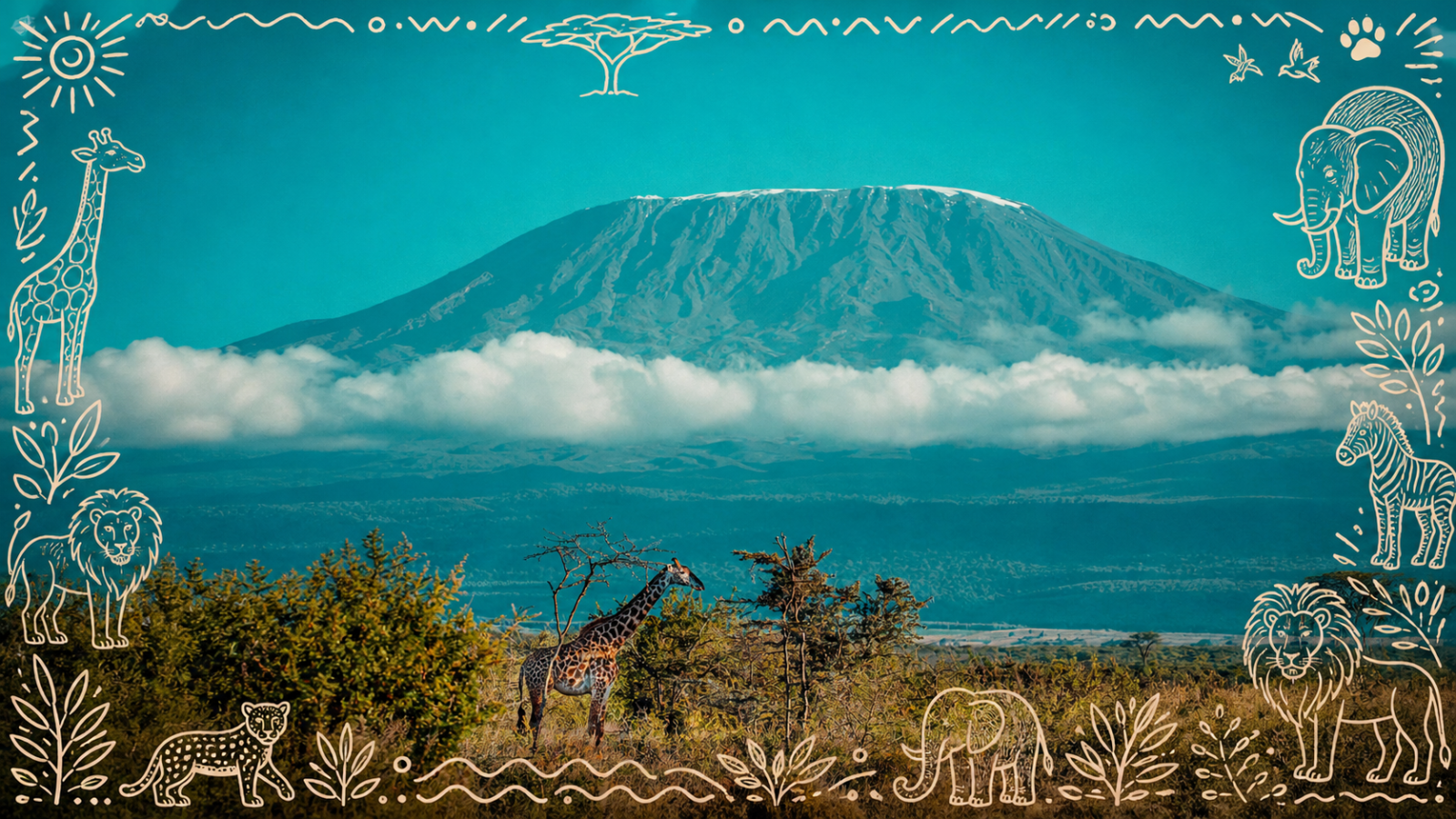

Mount Kilimanjaro generates its own weather system, and that weather system — not Kenya’s seasonal calendar, not the wildlife concentrations, not the park fee structure — is the primary variable determining whether your Amboseli mornings produce the famous dawn photograph or a wall of cloud where the mountain should be. Understanding the mechanics of the mountain’s daily convective cycle, and what those mechanics mean for which months and which hours to be positioned on the Amboseli plain, is the entirety of the Best Time to Visit Amboseli for Kilimanjaro Views planning guide question for any visit where Kilimanjaro photography matters.
Why Kilimanjaro disappears every morning
Kilimanjaro sits 40 kilometres south of the Amboseli ecosystem, rising 5,895 metres above sea level. At that altitude, the mountain creates atmospheric conditions entirely independent of the weather at Amboseli’s 1,100 metre elevation. The mechanism that governs photography timing is the daily convective cycle: as the plains surrounding the mountain heat up through the morning, warm moist air rises over the mountain’s slopes, cools as it gains altitude, and condenses as cloud around the upper elevations — precisely the glacier-capped summit that gives the Amboseli photograph its distinctive character.
By mid-morning on most days this convection cloud has built substantially enough to obscure the summit. By midday the mountain has typically disappeared behind it entirely and will not re-emerge until temperatures begin dropping in the late afternoon.
The reversal of this cycle overnight creates the photography opportunity. As temperatures fall after sunset, atmospheric stability increases above the mountain. The cold dense air from the high elevations settles and the convection that produced cloud during the day goes quiet. Through the pre-dawn hours the sky above Kilimanjaro is at its clearest and most stable.
Sunrise catches the summit ice cap at a low angle that produces the warm orange, pink, and white tones that characterise the best Amboseli photographs — the low light emphasising the mountain’s three-dimensional form and the glaciers reflecting the spectral colours of dawn. The effective photography window on a typical clear day runs from approximately 6am, when sufficient light exists for foreground elephant detail, to approximately 9am, when cloud is usually beginning to rebuild over the upper slopes.
Two additional factors shape visibility quality beyond the basic daily cycle. Atmospheric moisture is the first: lower overall moisture content — which reaches its minimum in January and February — reduces the condensable moisture available to form cloud over the mountain, extending the photography window and increasing clarity. January and February therefore produce not merely more frequent clear mornings but clearer mornings, with greater contrast between the white summit and the sky, richer colour saturation at sunrise, and a clarity that sometimes extends the window to 10am or beyond on the best days.
Atmospheric dust is the second factor: in the later dry season months of August through October, fine dust from the drying plains accumulates in the lower atmosphere and reduces contrast and colour saturation, particularly at the low sun angles that produce the best photography light. The combination of low moisture and low dust in January and February creates the year’s best Amboseli photography conditions.
The Best Time to Visit Amboseli for Kilimanjaro Views- ESSENTIAL TIMING REFERENCE
| Best months | January–February — lowest moisture content, clearest visibility, best colour saturation |
| Reliable dry season months | June–October — good visibility until approximately 9am on most days |
| Most challenging months | April–May long rains — consecutive days of obscured mountain common |
| Primary daily window | 6:00am–9:00am — before daily convection cloud builds over upper slopes |
| Secondary afternoon window | 4:00pm–6:00pm — less reliable, dependent on specific daily conditions |
| Elephant concentration | Year-round at Enkongo Narok and Longinye swamps, peak arrival at dawn |
| Best photography positions | Enkongo Narok swamp north edge · Observation Hill at sunrise |
| January–February bonus | Calving season: clear mountain + intense predator activity simultaneously |
Month-by-month Kilimanjaro visibility guide
January and February — the photographers’ peak
These two months consistently produce the best Kilimanjaro photography of the year for specific and measurable atmospheric reasons. The short dry season brings the year’s lowest moisture content. The harmattan dust from the north has not yet arrived in significant quantity. The sky over the Amboseli basin at dawn is as transparent as it becomes at any point in the annual cycle. The result is not merely a higher frequency of clear mornings but a different quality of visibility — greater contrast between the white summit and the deep blue sky, richer colour saturation at the moment of sunrise, and a clarity that sometimes extends the photography window beyond 10am on the most favourable days.
These exceptional atmospheric conditions coincide with calving season in the Amboseli ecosystem, which produces the most intense predator activity of the year simultaneously. The combination of optimal Kilimanjaro photography and extraordinary wildlife intensity — lion prides tracking calves, cheetah mothers with their own young, predator-prey encounters across the open plains — makes January and February the best overall Amboseli months by almost any measure. Senior Kenya guides consistently choose these months for their own family trips to Amboseli.
June through October — reliable dry season
Kenya’s main dry season produces generally good Kilimanjaro visibility at Amboseli, though with a somewhat shorter effective window and slightly reduced atmospheric clarity compared to January and February. The mountain is reliably visible from 6am to approximately 8:30–9am on most clear days throughout this period. The landscape is at its driest and most open, concentrating wildlife at the permanent swamps in ways that produce reliable and predictable viewing.
July and August coincide with peak tourist season, the highest Mara park fees for combined itineraries, and the most crowded conditions. September and October offer equivalent or better dry season mountain visibility with significantly fewer tourists and beginning accommodation rate reductions. October specifically combines excellent mountain photography with wildlife concentration at its annual peak, as the dry season reaches maximum intensity and elephant family groups from across the broader ecosystem converge on the permanent swamps.
November and December
November brings the short rains with increased atmospheric moisture that makes Kilimanjaro conditions more variable. The mountain is visible on many mornings, but cloud can build over the upper slopes more quickly, shortening the photography window to 6am–7:30am on some days. The landscape transforms rapidly as the first rains arrive — vivid green foreground, elephants in revived grass, and the mountain emerging through its own weather behind them. For photographers who want to work with this more dynamic visual vocabulary, November can be productive, particularly in the first two weeks. December improves significantly as the short rains ease and atmospheric moisture decreases. The pre-Christmas period before December 20 often combines improving mountain conditions with moderate prices and low visitor numbers.
March through May — limited visibility
The long rains substantially reduce Kilimanjaro visibility from late March through May. Persistent cloud regularly obscures the summit for multiple consecutive days during the wettest weeks of April. Photography of the mountain-and-elephant combination requires patience, local knowledge, and a degree of luck that the dry season does not demand. Not recommended for first-time Amboseli visitors whose primary purpose is Kilimanjaro photography. Experienced landscape photographers with genuine schedule flexibility sometimes specifically target late May for a version of the image that is entirely different from the classic dry-season photograph: deeper, lusher, more atmospheric, and completely inaccessible to the peak-season crowds.
The two essential photography positions
Enkongo Narok Swamp — the primary position
Enkongo Narok is the largest permanent swamp in Amboseli and the primary photography position for the elephant-and-mountain combination. Fed by underground water from Kilimanjaro that travels 40 kilometres through volcanic rock beneath the basin on a journey taking several decades, the swamp is genuinely permanent — it never dries completely even in the most severe droughts, which is why the park’s elephant population depends on it. Elephant families arrive every morning from first light, drawn by water and the safety of the open ground around the swamp edges.
Position on the swamp’s northern or western edge, with Kilimanjaro to the south-southwest and the swamp reeds and open water in the middle ground between the elephants and the mountain. The light in the first two hours after dawn illuminates both the mountain ice cap and the elephant skin at the low angle that creates the tonal range the classic image requires. Arrive by 6:15am. The elephant herds and the mountain clarity are both at their peak simultaneously in this window.
Observation Hill — the panoramic position
The only point inside Amboseli National Park where visitors may leave their vehicle without an armed escort. A five to eight minute walk reaches a raised viewpoint with a complete 360-degree panorama: both major swamps visible, Kilimanjaro filling the southern horizon, the alkaline flats and acacia woodland extending in every other direction.
At sunrise on a clear January morning, with the first pink light catching the summit and the swamps reflecting the dawn sky in the foreground, this viewpoint produces one of the genuinely great landscape views in East Africa. The elevated position compresses the spatial relationship between the swamps and the mountain in a way that ground-level photography cannot achieve. Arrive before 6:30am. The light quality at the summit is best in the 15 minutes immediately around sunrise.
Camera technique for the shot
The primary technical challenge of the Amboseli photograph is dynamic range: the bright glacier-covered summit against a blue sky at one extreme, and the darker foreground plain and elephant silhouettes at the other. Without careful technique, the camera will either overexpose the mountain and lose the glacier detail and sky colour, or underexpose the foreground and lose the elephant detail. The solution is RAW or ProRAW format capture, which preserves sufficient sensor data that both extremes can be recovered in post-processing. JPEG capture makes an irreversible exposure decision at capture that typically cannot satisfy both the mountain brightness and the foreground darkness simultaneously in this scene.
Telephoto focal lengths produce the compositional compression that makes the classic Amboseli image work. At 24mm, the mountain appears as a small white element at the top of a wide expanse of featureless plain. At 200–400mm equivalent, the mountain fills the upper half of the frame while the elephant family occupies the lower third, and the two subjects appear spatially proximate — the composition that appears on safari marketing materials and in the archive of professional wildlife photography from this location.
The 5× optical zoom available on iPhone 15 Pro and Samsung Galaxy S24 Ultra provides an effective starting focal length for smartphone photographers, with digital zoom extending further for tighter compositions. Bracket your exposures in the 6–9am window and remain at position through the full window rather than departing early for camp breakfast.
- Arrive at Enkongo Narok swamp by 6:15am — mountain clearest and elephant families arriving simultaneously
- Shoot RAW or ProRAW — essential for recovering both mountain summit and foreground elephant detail
- Use telephoto focal length (200–400mm equivalent) for compositional compression
- Position with mountain to south-southwest and elephants between camera and mountain
- Bracket exposures (–1, 0, +1 stop) during the 6–9am window for post-processing flexibility
- January and February: most reliable months — clear mountain, best colour, calving season intensity
When the mountain is obscured — what Amboseli still offers
On days when cloud cover prevents Kilimanjaro photography — which will happen on some mornings even in January and February — Amboseli continues to deliver one of the richest wildlife experiences in Kenya. The permanent swamps draw elephant families, lion prides, cheetahs, hippos, and an extraordinary diversity of waterbirds regardless of atmospheric conditions above the mountain.
The Amboseli Elephant Research Project’s fifty-year database means that every adult elephant you encounter has a documented family history that your guide can describe in specific, individual terms. On a cloud-covered morning at Enkongo Narok with two hundred elephants at the swamp, the absence of the mountain in the background does not diminish the experience of being in the presence of the world’s most comprehensively documented wild animal population.
Allocate at minimum three nights in Amboseli to achieve a high probability of at least one excellent Kilimanjaro morning. Three nights provide six potential photography windows — three dawn sessions, each with the usable 6–9am window. In January and February, the probability of at least one excellent session across three mornings is very high. In the dry season months of July through October, three nights still provides good coverage.
A single-night Amboseli visit — common in rushed itineraries that try to cover too many destinations — provides only two photography windows and significantly higher probability of missing the mountain entirely if conditions are unfavourable. Arranging a researcher briefing from the AERP headquarters transforms the wildlife experience on any morning regardless of mountain visibility — a 45-minute session with a researcher provides the individual animal context that makes every subsequent elephant encounter qualitatively richer. Arrange this in advance through your camp or operator.
RELATED READING
- Amboseli National Park — Destination Guide
- Elephants at Amboseli: Why This Is Africa’s Best Wildlife Experience
- Where to Stay in Amboseli — Every Lodge and Camp Rated 2026
- How to Photograph the Great Migration with a Smartphone
Combining Amboseli with other destinations
Amboseli combines most naturally with the Maasai Mara and Tsavo West in a logical geographical circuit from Nairobi. For a 10-day trip: charter to the Mara first (45 minutes, northwest), Amboseli second (90 minutes via Wilson from the Mara), Tsavo West or the Diani coast third (45 minutes east from Amboseli). This circuit visits three entirely different ecosystems — open savannah migration corridor, mountain-swamp elephant habitat, and volcanic semi-arid wilderness or Indian Ocean coastline — in a logical flight sequence without backtracking. The Kilimanjaro views from Amboseli are complemented by views of the mountain from Tsavo West’s Chyulu Hills, providing multiple photographic perspectives on the same mountain from different positions within a single trip.
The Amboseli–Tsavo combination specifically suits travellers with a deep interest in elephant behaviour and ecology. Amboseli’s AERP-documented population represents the most intensively studied elephant individuals on Earth. Tsavo’s population — part of the larger Tsavo-Amboseli-Chyulu ecosystem collectively holding approximately 12,000 elephants — includes the rust-red elephants whose colouring comes from iron-oxide volcanic soil, providing a striking visual contrast from Amboseli’s grey-skinned elephants against a pale plain. Seeing both populations within a single trip gives depth of elephant encounter that neither destination alone can provide. The Mbirikani Group Ranch corridor between the two parks is one of the most important elephant movement routes in southern Kenya, protected by the Big Life Foundation’s documented anti-poaching operations.
The honest Kilimanjaro photography trade-off
The honest trade-off of planning an Amboseli trip around Kilimanjaro photography: you are planning around a meteorological variable you cannot control. January and February are the most reliable months — but ‘most reliable’ means clear mountain on approximately 70-80% of mornings, not every morning. A guest who visits for 3 nights in February and experiences cloud cover on all three dawn photography windows has had a disappointing Amboseli experience despite excellent wildlife.
However, a guest who visits for the same 3 nights and frames the trip around the elephant population rather than the mountain — and is rewarded with the mountain unexpectedly on the third morning as a bonus rather than a planned event — consistently reports a richer overall experience. The mountain is more affecting when it surprises you than when it is expected.