
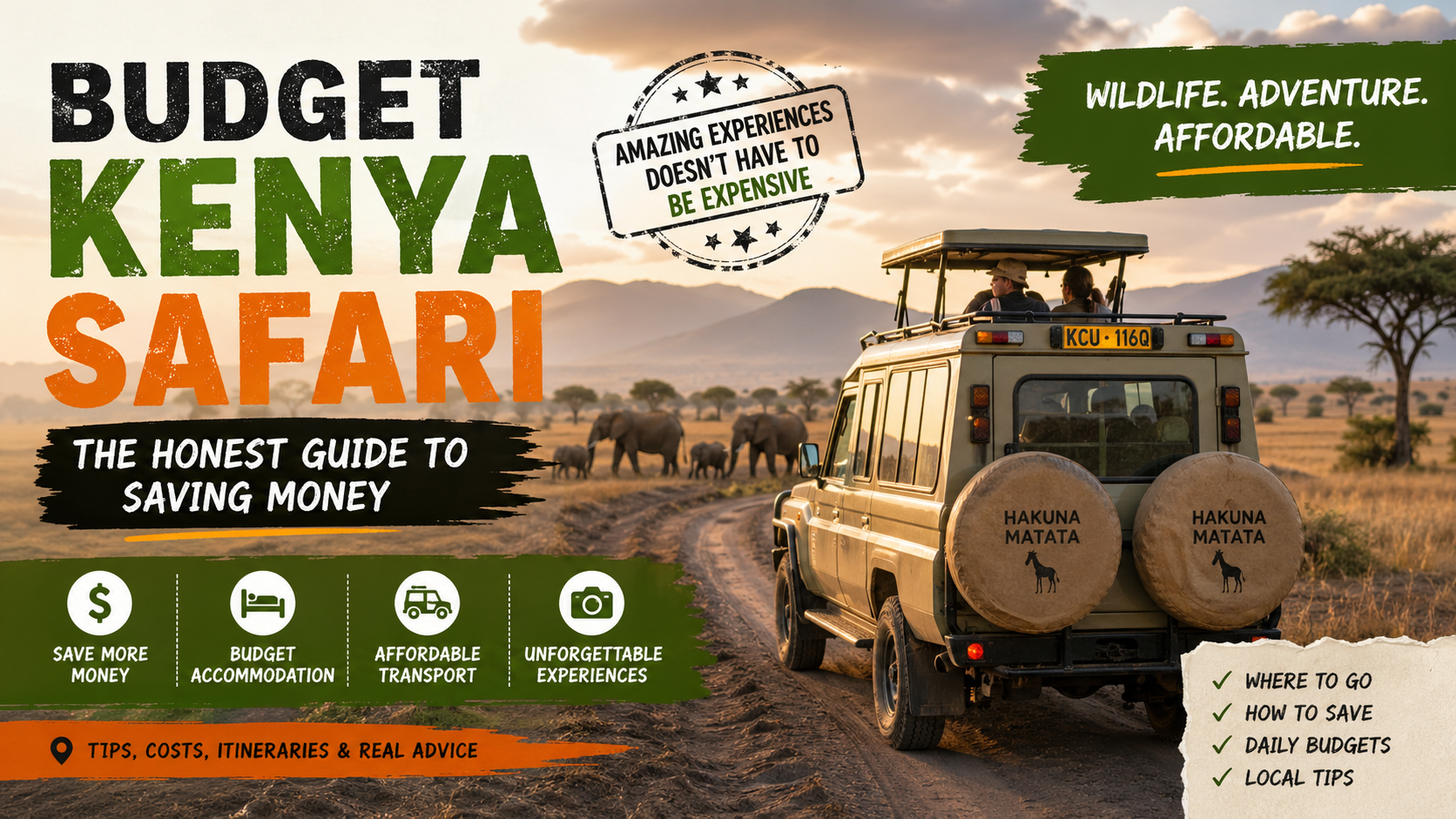

Most budget kenya safari guides bury the one fact that changes everything: Kenya’s park fees are not optional, not negotiable, and in 2026, significantly more expensive than they were two years ago. Before you book a single night of accommodation, the Masai Mara alone costs a non-resident adult $100 per day in low season and $200 per day in peak season — just to enter. That single line item consumes your entire daily budget at the cheapest tier before you’ve paid for a bed, a vehicle, or a guide.
This guide is for travellers who want a real Kenya safari on a constrained budget and need to understand exactly what that budget delivers — and where cutting costs crosses the line from smart to self-defeating. By the end, you’ll know which corners are safe to cut, which are not, and how to structure a trip that gives you genuine wildlife experience rather than the illusion of one.
| QUICK ANSWER |
| How do I do a Kenya safari on a budget? Kenya park fees are the immovable floor: $80–$200 per person per day depending on park and season. Build your budget around these first.The realistic floor for a functional budget safari is approximately $150–$180 per person per day in green season (shared vehicle, basic camp, one main park).A private vehicle with a competent guide and mid-range camp runs $280–$350 per person per day for two sharing — this is where quality and value genuinely meet.Tsavo East, Amboseli, and Samburu offer meaningfully lower park fees than the Masai Mara and are legitimate, wildlife-rich alternatives for budget travellers.Green season (November, April–June) cuts accommodation costs 20–40% with minimal wildlife trade-off in most parks. Peak season (July–October) commands highest prices and requires advance booking 6–9 months out. |
Why Park Fees Are the First Number to Write Down
A budget Kenya safari starts not with accommodation research but with a park fee calculation, because these costs are fixed by government bodies, apply to every visitor regardless of operator or booking channel, and have increased sharply since 2023.
| Park / Reserve | Low Season Fee | Peak Season Fee | Notes |
| Masai Mara (NR) | $100/day | $200/day (Jul–Dec) | Seasonal pricing; 12hr ticket |
| Amboseli (NP) | $90/day | $90/day (flat) | No seasonal surcharge |
| Tsavo East & West (NP) | $80/day | $80/day (flat) | Best-value entry fee |
| Samburu (NR) | $85/day | $85/day (flat) | Flat year-round |
| Lake Nakuru (NP) | $90/day | $90/day (flat) | KWS managed |
All fees above are per person per day, non-resident adults. KWS fees effective October 2025. Masai Mara fees confirmed by Narok County Government.
The Masai Mara’s Fee Structure in 2026
The Masai Mara National Reserve operates on a seasonal pricing model for non-resident adults: $100 per person per day from January through June, rising to $200 per person per day from July through December. Tickets are valid for 12 hours (6am–6pm) for visitors staying outside the reserve. Children aged 9–17 pay $50 per day year-round.
What this means practically: a solo traveller spending three days in the Mara during peak migration season pays $600 in park fees alone, before a single shilling goes toward accommodation, transport, or food. A couple pays $1,200. These are not rounding errors — they are the dominant cost driver on any budget Mara itinerary.
KWS Parks: The Budget-Friendlier Tier
National parks managed by the Kenya Wildlife Service (KWS) — including Amboseli, Tsavo East, Tsavo West, Lake Nakuru, and Samburu — operate on flat, year-round pricing with no seasonal surcharge (KWS Wildlife Conservation and Management Regulations, effective October 2025). Current non-resident adult fees: Amboseli and Lake Nakuru at $90 per day, Tsavo East and Tsavo West at $80 per day, Samburu at $85 per day.
These fees are meaningfully lower than the Mara’s peak-season rate, which is why a Tsavo-anchored or Amboseli-anchored itinerary is a structurally smarter choice for budget travellers visiting between July and October.
What Three Budget Levels Actually Deliver
The following figures are per person, per day, land costs only, and assume two people sharing a private vehicle. Solo travellers paying single supplements should add 30–50% to accommodation costs, or join a group departure. All prices should be verified with your operator for the specific season of travel.
| Budget Tier | Per Person/Day | What You Get | Honest Trade-off |
| Floor | $150–$180 | Shared vehicle, basic camp outside park gates, group tour | Guide quality variable; minibus limits photography |
| Value | $280–$350 | Private Land Cruiser, mid-range tented camp, full board | Mara peak season is tight at this budget |
| Quality | $450–$500 | Entry-level conservancy or inside-reserve Mara stay | Not luxury — high-quality mid-range with better access |
$150–$180 Per Day: The Real Floor
At this level you are in shared-vehicle group safari territory, almost certainly staying in basic tented camps or lodges positioned outside park boundaries to avoid overnight camping fees. You will share a safari minibus — typically carrying six to seven passengers — with other travellers on a fixed departure schedule.
What this gets you: access to the wildlife, a guide (whose quality varies considerably at this price point), meals included in most packages, and the core game-drive experience. What it does not get you: flexibility in timing, a vehicle configured for photography, the ability to spend extra time at a sighting, or meaningful privacy.
At this budget, Tsavo East or Amboseli delivers significantly more value than the Masai Mara, because the park fee differential frees up $20–$110 per person per day for better accommodation or an additional night. A three-day Tsavo East itinerary at this level is a genuine safari. A three-day Mara itinerary at this level, in peak season, is park fees plus very little else.
$280–$350 Per Day: Where Value and Quality Meet
This is the range where a private Kenya safari — your own Land Cruiser, your own guide, your own schedule — becomes viable for two people sharing. It covers park fees, a comfortable mid-range tented camp with private bathroom, full board, and a competent driver-guide in a pop-top Land Cruiser.
The quality jump from the $150 tier to this level is substantial and is felt most sharply in two areas: the guide and the vehicle. A private Land Cruiser allows you to stay at a sighting for as long as you choose, position the vehicle for light, and take directions that a group minibus cannot. For the Masai Mara during peak season, this budget tier is tight — park fees for two people ($400 for two days) consume a significant portion of the daily budget.
$450–$500 Per Day: Entry-Level Private Conservancy or Quality Mara
At this level, private conservancies adjacent to the Masai Mara become accessible. Conservancy fees are typically bundled into lodge rates, but the experience differs from the national reserve: night drives, off-road driving, walking safaris, and far lower vehicle density at sightings are conservancy-specific advantages. The wildlife is the same Mara ecosystem. The experience is measurably better.
At $450–$500 per day, you are not in luxury territory. You are at quality mid-range — permanent tented camps, good food, experienced guides, and meaningful access. For many travellers, this is the most efficient point on the value curve.
The Corners You Cannot Cut Without Degrading the Experience
Honest budget planning requires distinguishing between costs that scale without consequence and costs that directly determine whether your safari delivers.
Guide Quality: The Non-Negotiable
The guide is the single most important variable in your safari experience, and guide quality correlates imperfectly with price. A mediocre guide in a $500-per-night camp still produces a mediocre safari. A skilled guide in a functional $80-per-night camp can produce an outstanding one.
Group departures at $150 per day frequently use less experienced guides, partly because the economics of that price point don’t support competitive guide salaries. Ask directly: your guide’s name, their years of experience in specific parks, and whether they hold a Kenya Professional Safari Guides Association certification (KPSGA certification as industry standard).
Vehicle Type: Minibus vs Land Cruiser
A safari minibus costs less to operate than a Land Cruiser and carries more passengers per vehicle, which is why group budget safaris use them. The practical difference matters most for wildlife photography and at busy sightings where vehicle positioning determines what you see. If photography is a priority at any budget level, a Land Cruiser with a pop-top roof hatch is the minimum workable vehicle. This is not luxury — it is the standard functional tool for the job.
Number of Nights: Fewer Days, Less Wildlife
The strongest budget lever that doesn’t degrade experience is trip duration. Three nights produces a fundamentally thinner safari than six nights, not because the wildlife changes but because encounter frequency accumulates over time. Budget travellers cutting to three nights to save money and then reporting disappointment with wildlife sightings are almost always experiencing a duration problem, not a park or operator problem.
Which Parks Make Sense on a Budget
Not every Kenya park makes equal sense for budget travellers. The choice of park is a direct pricing decision, not just a wildlife preference.
Tsavo East: The Underrated Budget Case
Tsavo East is Kenya’s largest national park and holds substantial elephant populations, predators, and the dramatic red-dust landscape that distinguishes it from the Mara. At $80 per day non-resident entry — flat year-round — it costs less than any other major park to enter, and accommodation covers the full price spectrum.
The honest caveat: Tsavo East’s scale works against visitors on short trips with fixed itineraries. Wildlife is more dispersed across a larger area than the Mara, and sightings require a skilled guide who knows current animal movements. The park rewards longer stays and experienced guiding.
Amboseli: High Value, Fixed Fee
Amboseli’s combination of Kilimanjaro backdrop and reliable elephant herds makes it genuinely compelling, and the flat $90 non-resident fee — unchanged between low and peak season — makes it significantly more budget-friendly than the Mara from July to December. A Nairobi–Amboseli–Tsavo circuit avoids Mara pricing entirely and delivers the Big Five in a region that holds one of the highest densities of large elephant herds in East Africa.
The limitation is that Amboseli does not offer the predator density or the spectacle of the Great Migration. If lions and large cat sightings are the priority, Amboseli is a secondary destination.
The Masai Mara: Worth the Cost, But Only at the Right Budget Level
The Mara’s wildlife concentration, predator density, and — between July and October — the Great Migration make it the most compelling safari destination in Kenya. The honest position is not to avoid it on a budget, but to visit it correctly. Two well-planned nights inside or adjacent to the reserve, with a competent guide, will outperform five nights in a poorly positioned camp with a weak guide.
The budget mistake is spending seven days in the Mara at the lowest possible price point, fighting park fees, sharing a minibus with six strangers, and staying in a camp an hour’s drive from the gate. The smarter move: two strong Mara nights combined with two or three nights in a lower-fee park, within an overall budget that allows for a private vehicle.
Seasonal Timing: The Budget Lever Most Travellers Ignore
Season is the most powerful budget control available to a Kenya traveller, and most generic guides understate the practical difference.
Green Season: April–June and November
The ‘long rains’ (April–June) and ‘short rains’ (November) are Kenya’s green seasons. Accommodation discounts of 20–40% are standard across mid-range and budget camps during these periods. Park fees do not change — KWS rates are flat year-round, and Mara low-season rates ($100 per day) apply January through June regardless of rainfall.
Resident wildlife in Tsavo, Amboseli, and Samburu is present and active year-round. The Mara’s resident lion population is present and active year-round, independent of the wildebeest migration. A green season Mara safari without the migration still produces meaningful wildlife.
The genuine green season trade-off: some dirt roads become difficult after heavy rain, some smaller camps close entirely during April–May, and photography light can be inconsistent. For a budget traveller, the cost saving is frequently worth these limitations.
Peak Season: July–October
The Great Migration river crossings at the Mara River are the defining spectacle of East African safari tourism, and they are real. If this is the primary goal, budget accordingly: $200 per day Mara park fees, premium accommodation rates, and advance booking of 6–9 months are non-negotiable realities of peak season travel.
Budget travellers visiting peak season have two honest options: accept the higher costs and plan for them, or choose a different park — Tsavo East, Amboseli, Samburu — where fees are lower and the wildlife is excellent without the migration premium.
Who This Destination Is Not Right For
Green season is wrong for travellers whose primary goal is witnessing the Great Migration river crossings — those occur between approximately July and October, with August and September typically the most reliable months. It is also wrong for travellers with very limited time (three days or fewer) who cannot absorb weather variability. Budget tier safari economics in peak season at the Masai Mara simply do not work at the $150–$180 level — the park fee alone exhausts the budget.
What Budget Travellers Are Frequently Not Told
The Solo Traveller Premium Is Substantial
Budget safari pricing is almost always quoted per person sharing. A solo traveller in a private vehicle pays a single supplement that can add $80–$150 per day to the base rate, because the fixed vehicle and guide cost is no longer split. The mathematically cleaner option for solo travellers is joining a small group departure — provided the operator maintains guide quality standards on those departures.
Tips Are Not Optional
Guide and camp staff tipping is a standard and expected part of Kenya safari culture, not a discretionary extra. The widely accepted range is $15–$25 per day for your guide and $10–$15 per day for camp staff. On a seven-day safari, this adds $175–$280 to the trip cost per person — real money at the budget tier that should be factored in before booking.
Visa Costs Have Changed
Kenya’s eTA (Electronic Travel Authorisation) currently costs $32.50 for most nationalities. Budget articles that still quote $50 are using outdated figures.
Frequently Asked Questions
Can I do a Kenya safari for under $100 per day?
Not as a functional wildlife experience. Masai Mara park fees alone are $100 per day in low season, which means $100 all-in is mathematically impossible for a Mara itinerary. In lower-fee parks like Tsavo East ($80 entry), the remaining $20 covers nothing. The genuine floor for a functioning budget safari is approximately $150 per day in green season on a shared-vehicle group tour, and that tier involves real quality trade-offs on guide experience and vehicle type.
Is a group camping safari worth it to save money?
It depends entirely on what you prioritise. A group camping safari reduces cost primarily by splitting the vehicle among six to seven people and using basic tented accommodation, often with shared facilities. The wildlife access is real. The trade-offs are guide quality (variable), flexibility (none — fixed schedule), photography conditions (limited from a crowded minibus), and comfort (basic). For travellers who genuinely don’t mind those constraints and prioritise cost, it is a legitimate option.
Which park gives the best wildlife for the money outside of the Masai Mara?
Tsavo East offers the best park-fee-to-wildlife ratio for budget travellers, particularly between July and December when Mara fees double. The park holds large elephant herds, lion prides, and the full range of savannah wildlife across a vast, relatively uncrowded landscape. The caveat is that Tsavo’s scale requires a guide who knows current animal locations. Amboseli is the strongest choice for travellers specifically seeking elephant encounters and Kilimanjaro views, with reliable $90 flat-rate entry.
Should I book through an international agent or a local operator?
Local operators typically offer lower prices for equivalent quality because they have direct lodge relationships and no added agent margin. International agencies frequently add 20–40% above local operator rates. The practical solution is booking with a vetted local specialist, which is what Nova Expedition Tours structures its planning service around. The one case where an international agent adds value is complex multi-country itineraries where coordination complexity justifies the premium.
Can green season wildlife viewing match peak season?
For resident wildlife — elephants, lions, leopards, buffalo, plains game — yes, particularly in Amboseli and Tsavo. The Masai Mara’s resident lion population is present and active year-round, independent of the wildebeest migration. The gap between green and peak season is largest specifically for the Great Migration spectacle: the wildebeest river crossings are a peak-season phenomenon. For every other wildlife experience Kenya offers, green season is a genuine alternative that costs meaningfully less.
Is it worth adding a beach extension to a budget safari?
Financially, a Diani Beach extension adds relatively low cost to an existing itinerary because flights from Nairobi to Mombasa or Ukunda are short. The honest trade-off is time: a beach extension on a seven-day trip reduces safari days. On a ten-day trip or longer, a two-night Diani or Lamu addition makes strong sense and doesn’t materially reduce safari quality.
Conclusion
Three decisions determine whether a budget Kenya safari delivers genuine value or disappointing compromise.
First: choose your park based on park fees, not just wildlife appeal — Tsavo East and Amboseli give you legitimate, wildlife-rich alternatives to the Mara at 40–55% lower entry cost during peak season.
Second: protect the guide and vehicle quality even when compressing other costs — these two variables determine your wildlife experience more than any other.
Third: time your trip honestly — green season in April–June or November cuts accommodation costs by 20–40% with minimal wildlife trade-off in most parks, and that saving buys a better guide, an extra night, or a private vehicle instead of a shared one.
A well-structured budget Kenya safari is not a lesser version of the full experience. It is a different set of choices that, made correctly, delivers everything the destination has to offer. Made carelessly, it produces a trip that confirms every cynical thing anyone has ever said about cheap safaris.
If you’re ready to move from planning to booking, Nova Expedition Tours builds budget Kenya itineraries around the parks, seasons, and operator relationships that make the difference at every price point.
Last updated: April 2026 — prices and conditions reflect both green season (April–June, November) and peak season (July–October, December–January)
References
- Kenya Wildlife Service → Official source for KWS national park entry fees → kws.go.ke
- Amboseli Trust for Elephants → Credibility for Amboseli elephant population claims → amboseliresearch.org
- Narok County Government → Official source for Masai Mara fee structure → narok.go.ke