
The most common answer to “Kenya or South Africa?” is some version of “both are incredible, it really depends on what you want.” That answer is useless. It tells you nothing about the actual decision in front of you, and it protects the writer from being wrong.
This article will be wrong for some readers — because taking a clear position always is. But for the majority of travellers reading this, the verdict below will save weeks of research and thousands of dollars in misallocated budget. Kenya and South Africa are not interchangeable. They deliver fundamentally different safari experiences, at different price points, for different types of travellers. The choice between them is not a matter of preference — it is a matter of matching the destination to what you actually want to see and how you want to travel.
By the end of this article, you will know which destination wins for your specific situation, and why.
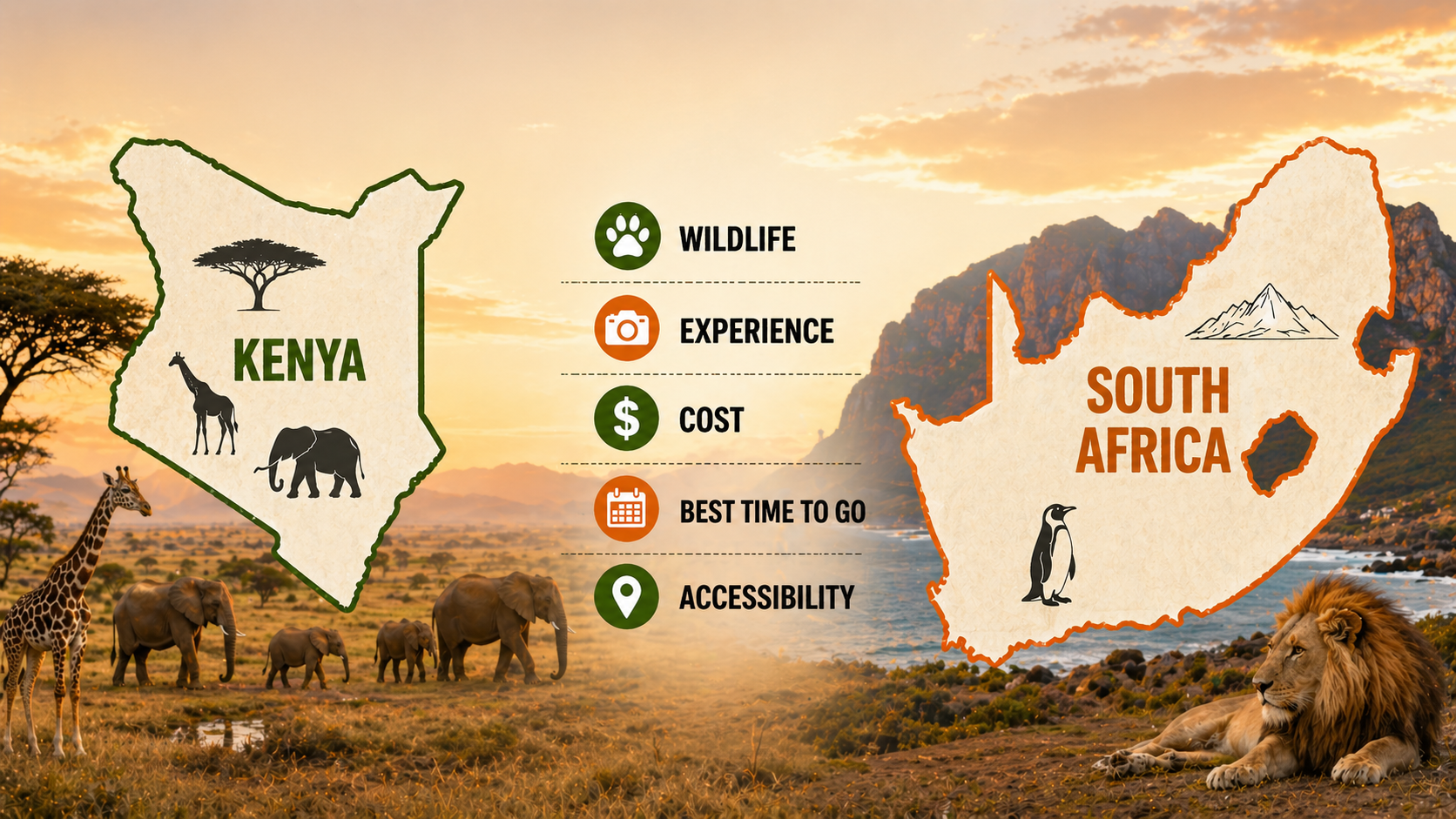
Quick Answer: Kenya vs South Africa Safari?
- Choose Kenya if your priority is the Great Migration, the highest predator density in East Africa, or a classic guided safari with world-class wildlife concentration in a compact area.
- Choose South Africa if you want to self-drive, need a malaria-free option for young children, want to combine Big Five wildlife with Cape Town or the Garden Route, or are working with a budget where the rand’s weakness gives you meaningful value.
- Kenya wins on: wildlife spectacle, migration, predator sightings, guide quality at mid-range, and authenticity of the classic African safari experience.
- South Africa wins on: flexibility, self-drive infrastructure, malaria-free options, destination variety, and accessible budget entry points via Kruger.
- Neither wins outright on cost: Kenya’s park fees are structurally higher in peak season; South Africa’s private reserve lodges are among the most expensive on the continent.
The Wildlife Question: What Each Destination Actually Delivers
Kenya and South Africa both offer the Big Five, but the wildlife experience differs in ways that matter more than the species checklist.
Kenya: Density, Predators, and the Migration
Kenya’s primary safari geography — the Masai Mara and its surrounding ecosystem — holds one of the highest concentrations of large predators of any protected area in Africa. Lion prides are resident and reliably visible year-round. Leopard sightings in the Mara are among the most consistent on the continent. Cheetah, hyena, wild dog, and the full cast of plains game are present in numbers that require no exceptional luck to encounter on a well-guided game drive.
The Great Migration is the headline. Between July and October, approximately 1.5 million wildebeest, accompanied by hundreds of thousands of zebra and gazelle, move from Tanzania’s Serengeti into the Masai Mara. The Mara River crossings — where the herds plunge into crocodile-filled water — are not a guaranteed daily event, but during peak migration season they occur with sufficient regularity that a well-positioned three-night stay produces a reasonable probability of witnessing at least one. Nothing in South Africa replicates this. The wildebeest migration is a Kenya and Tanzania phenomenon exclusively.
Beyond the Mara, Kenya’s other parks deliver different but complementary wildlife. Amboseli’s elephant herds against Kilimanjaro are iconic. Samburu holds species found nowhere else in Kenya — reticulated giraffe, Grevy’s zebra, Somali ostrich — collectively known as the Samburu Special Five. Tsavo East offers vast, uncrowded wilderness with elephant populations numbering in the thousands.
South Africa: Reliability, Rhino, and the Self-Drive Advantage
South Africa’s Kruger National Park and the private reserves bordering it — most notably the Sabi Sands — offer exceptional Big Five viewing with one structural advantage Kenya cannot match: black and white rhino populations that are significantly more accessible to the average visitor. Kenya’s black rhino population, while recovering, remains small and concentrated in specific conservancies where access requires either a premium stay or a specific permit. In South Africa’s Kruger and Greater Kruger ecosystem, both white and black rhino sightings are a realistic daily expectation rather than a rare event.
South Africa also leads on wild dog. The painted wolf — Africa’s most endangered large carnivore — has its strongest population concentrations in southern Africa, including Kruger and Madikwe, where sightings are meaningfully more common than in Kenya.
The self-drive dimension is significant. Kruger operates a network of tarred and well-maintained roads, clearly marked camps, and online booking infrastructure that makes a competent self-drive safari genuinely accessible to first-time visitors. You rent a car in Johannesburg, drive to one of Kruger’s eleven entrance gates, and navigate the park independently. This is not possible in any meaningful sense in Kenya’s primary safari parks — the Masai Mara’s terrain, the requirement for licensed guides in certain areas, and the absence of equivalent road infrastructure make Kenya a guided-safari destination by design.
Cost: The Honest Comparison
Kenya and South Africa appear to compete on similar price tiers but the underlying cost structure is different in ways that are not immediately obvious.
Park Fees: Kenya Is More Expensive at the Top
Kenya’s Masai Mara charges non-resident adults $100 per day in low season (January–June) and $200 per day in peak season (July–December). South Africa’s Kruger National Park charges international visitors ZAR 602 per adult per day — approximately $33 at current exchange rates — year-round with no seasonal surcharge
The park fee gap is substantial. A couple spending five days in the Masai Mara during peak migration season pays $2,000 in park fees alone. The same couple spending five days in Kruger pays approximately $330. That differential can be redirected toward a substantially better lodge, longer trip duration, or additional activities.
KWS-managed Kenya parks — Amboseli ($90/day), Tsavo East and West ($80/day), Samburu ($85/day) — are more competitive with Kruger’s pricing, but still cost more once the exchange rate is factored in.
Accommodation: South Africa’s Private Reserves Are Not Cheap
The park fee comparison reverses sharply when private reserves enter the picture. South Africa’s premier private game reserves — Sabi Sands, Phinda, Madikwe — command accommodation rates that rival or exceed Kenya’s most expensive lodges. Mid-range lodge stays in greater Kruger private reserves run $500–$950 per person per night; luxury properties in Sabi Sands regularly reach $1,500–$2,500 per person per night or beyond.
Kenya’s mid-range tented camps — particularly outside private conservancies — offer quality accommodation at $200–$400 per person per night with park fees, game drives, and full board included. For equivalent quality, Kenya frequently offers better value than South Africa’s private reserves, primarily because the rand weakness does not apply to Kenya’s pricing, which is denominated in USD and structured independently of South Africa’s currency dynamics.
The honest summary: at the budget-to-mid-range tier, South Africa is cheaper overall — lower park fees, rand-denominated accommodation, and the self-drive option eliminate guide costs entirely. At the premium and luxury tiers, Kenya and South Africa’s private reserves compete on similar terms, with South Africa’s most exclusive lodges often costing more than their Kenya equivalents.
Decision by Traveller Type
This is the section most comparison articles refuse to write. Here are clear verdicts.
The First-Time Safari Visitor: Kenya
A first-time visitor’s primary goal is almost always the same: see as much iconic African wildlife as possible in the time available, reliably, with minimal logistical complexity. Kenya’s Masai Mara delivers this better than any other single safari destination on the continent. Wildlife density is high enough that a three-night stay with a competent guide produces multiple daily sightings of lion, elephant, buffalo, and plains game at a minimum. The geography is compact — you are not covering vast distances to find wildlife. The guided format means the guide carries all logistical complexity; you experience the result.
South Africa for a first-timer is a legitimate choice, particularly via Kruger, but the self-drive format demands confidence with African road conditions and navigation, and Kruger’s scale (the park is larger than Wales) means wildlife sightings require more patience and knowledge of animal movement. For someone who has never been on safari, the guided concentration of Kenya is the lower-risk, higher-return choice.
The Great Migration Specifically: Kenya, No Contest
If the Great Migration is the reason for the trip, there is no meaningful comparison to make. The wildebeest river crossings happen in Kenya and Tanzania. South Africa does not host this event. Book Kenya, between July and October, positioned as close to the Mara River as your budget allows.
The Budget-Conscious Traveller: South Africa
At the sub-$250 per person per day level, South Africa offers a functional, rewarding self-drive safari through Kruger that Kenya simply cannot match at equivalent cost. Kruger’s SANParks rest camps — Skukuza, Lower Sabie, Satara — provide clean, well-located accommodation with kitchens, braai facilities, and full park access from approximately $80–$150 per person per night. Add the $33 per day park fee and a rental car split between two people, and a genuine Big Five safari in Kruger costs a fraction of what any comparable Kenya option delivers.
Kenya at $150–$200 per day is achievable but produces meaningful trade-offs in guide quality and vehicle type that South Africa at the same budget does not. The rand-denominated cost structure in South Africa gives budget travellers a structural advantage that the current exchange rate makes particularly favourable.
Families with Young Children: South Africa
Two factors make South Africa the clear family choice. First, malaria-free reserves — Madikwe, Pilanesberg, the Eastern Cape reserves, and the Waterberg — offer Big Five game viewing without the requirement for antimalarial medication for children. Kruger is malarial, but South Africa’s malaria-free Big Five options are extensive and high-quality. Kenya has no equivalent malaria-free Big Five safari option — all of Kenya’s primary wildlife areas carry malaria risk
Second, South Africa’s logistical infrastructure — tarred roads, proximity to Johannesburg’s international airport, the option to self-drive — makes it fundamentally easier to manage with children than Kenya’s more remote camps and longer transfer routes. A family can fly into Johannesburg, drive three hours to Pilanesberg, and be on a game drive the same afternoon. An equivalent Kenya itinerary typically involves Nairobi plus a road transfer or domestic flight to reach any primary wildlife area.
The honest caveat: families choosing Kruger itself must factor in malaria prevention. For families firmly committed to malaria-free travel, the Eastern Cape or Madikwe are the correct South Africa choices.
The Self-Drive Independent Traveller: South Africa
Kenya does not offer a viable self-drive option in its primary wildlife areas. The Masai Mara requires a licensed guide in certain zones, and even where self-drive is technically permitted, the absence of marked roads, the risk of becoming stuck, and the high vehicle density of guided safaris makes independent navigation genuinely challenging and potentially dangerous in the event of a breakdown. Kenya is a guided-safari destination.
South Africa is the opposite. Kruger’s infrastructure — tarred main roads, clearly signed camps, online booking for accommodation, and a detailed self-drive guide culture — makes it one of the world’s most accessible wildlife parks for independent travellers. The self-drive format also allows a quality and pacing that shared-vehicle group safaris do not: you stop where you want, stay at sightings as long as you choose, and set your own itinerary day by day.
The Wildlife Photographer: Kenya for Big Cats, South Africa for Versatility
For photographers whose primary subject is big cats in open savannah — lion, cheetah, leopard — Kenya’s Masai Mara offers superior conditions. The open plains topography, the high predator density, and the quality of a private Land Cruiser with a skilled guide who knows individual animals by name produces consistently better cat photography than Kruger’s more forested terrain. The Mara’s light during golden hours, combined with the open sightlines, is the reason it dominates professional wildlife photography portfolios.
South Africa has advantages in other areas: the private reserves of Sabi Sands produce exceptional leopard sightings, often at close range in vehicles with experienced trackers. Wild dog photography is stronger in South Africa. Rhino photography — both species — is more reliably achievable. For a photographer wanting diversity of subject, South Africa’s range of ecosystems and private reserves offers compelling alternatives to Kenya’s concentration on open plains wildlife.
The Luxury Traveller: A Genuine Draw
At the $1,000+ per person per night level, both destinations offer world-class properties. South Africa’s Sabi Sands lodges — some of the most awarded safari properties on the continent — offer leopard sightings that can be extraordinary in their intimacy, private game drives, and lodge design that integrates architecture with wilderness in ways few Kenya properties match. The rand-denominated pricing still gives dollar-spending luxury travellers value relative to some other African luxury destinations.
Kenya’s luxury conservancy model — private concessions adjacent to the Masai Mara, night drives, walking safaris, off-road access, and game density that the national reserve cannot replicate — delivers a qualitatively different experience: fewer vehicles, wider access, and the migration backdrop during peak season. For a luxury traveller visiting between July and October, a well-chosen Kenya conservancy is arguably the finest safari experience on the continent.
Neither destination wins this category outright. It genuinely depends on the specific lodges, the timing, and whether the migration is the priority.
The Factors Most Guides Ignore
Combining with Other Destinations
South Africa has a structural advantage that Kenya lacks: it is a multi-destination country with a world-class city, a wine region, a dramatic coastline, and one of the best urban food scenes on the continent all within a three-hour drive of each other. Cape Town alone justifies a trip to South Africa independent of any safari. For travellers who want to combine wildlife with non-safari experiences, South Africa’s diversity is unmatched by any single East African destination.
Kenya can be combined with Tanzania for a broader East Africa circuit, or with Zanzibar for a beach extension, but neither of these adds the same breadth of non-wildlife experience that Cape Town and the Garden Route provide.
Flight Logistics and Time in the Air
Both destinations are long-haul for North American and European travellers. South Africa typically requires a flight to Johannesburg or Cape Town, followed by a short domestic flight or drive to the safari area. Kenya requires a flight to Nairobi, followed by either a domestic flight to the relevant airstrip or a road transfer. Neither has a meaningful advantage here for most origin cities, though South Africa’s more developed domestic aviation network — with multiple daily flights between major cities — gives it marginal flexibility.
Who This Comparison Is Not For
This comparison is irrelevant for travellers who have already visited one destination and are choosing the other as a second trip — in which case, go to whichever you haven’t been to. It is also irrelevant if gorilla trekking is on the itinerary, which routes the trip to Uganda or Rwanda regardless of the Kenya-versus-South Africa question. And it does not address Botswana, which for remote wilderness and exclusive water-based safari experiences competes with both destinations at the luxury tier.
FAQ
Is Kenya or South Africa better for seeing leopards?
Both deliver genuine leopard sightings but in different conditions. South Africa’s Sabi Sands private reserves — which share an unfenced boundary with Kruger — have a long-documented history of habituated leopards that tolerate vehicles at extremely close range, often producing sightings of ten minutes or more with cubs. Kenya’s Mara leopards are sighted regularly, but open-savannah encounters can be briefer. For dedicated leopard photography specifically, Sabi Sands has an edge. For overall big cat variety and volume, the Mara wins.
Can I do both Kenya and South Africa on one trip?
Physically yes — flights connect Nairobi and Johannesburg regularly. Practically, it only makes sense on trips of 14 days or more, and even then the combination produces a diluted experience of both rather than depth in either. The exception is a structured circuit: four nights in Kenya for the migration, fly to Cape Town for three nights of city and wine, then two nights in the Eastern Cape for a malaria-free family safari. That structure works logistically and delivers genuine value from both destinations without duplication.
Which destination is safer for solo female travellers?
Both are visited frequently by solo female travellers on guided itineraries with established operators, and both carry the standard precautions applicable to any international travel. Kenya’s safari camps are remote but structured environments where safety within the safari ecosystem is high. South Africa carries more widely publicised urban crime concerns in Johannesburg and parts of Cape Town — not relevant to the safari areas themselves, but relevant to transit days in city centres. On guided safari specifically, neither destination presents exceptional risk for solo female travellers who have booked with reputable operators
Does the weak South African rand make South Africa meaningfully cheaper in 2026?
For accommodation booked in rand, yes — USD and GBP travellers are getting measurably better value than they did five years ago. Kruger’s SANParks accommodation is rand-denominated and represents genuine value. Many of the premium private reserve lodges in South Africa, however, quote in USD and price accordingly, so the rand advantage does not extend uniformly across the market. The budget and mid-range Kruger self-drive tier benefits most significantly from the exchange rate
If I only have five days, which destination should I choose?
South Africa for a first-time visitor on a tight timeline. The reason is logistics: five days in Kenya means one or two nights travelling to and from Nairobi’s connections, which compresses actual safari time significantly. A five-day South Africa trip can be structured as fly into Johannesburg, drive directly to Kruger or Pilanesberg, three full game-drive days, and fly out — with minimal logistical friction. Five days in Kenya works best for repeat visitors who know exactly which park they want and can fly directly to the relevant airstrip.
Conclusion
The honest verdict: Kenya is the stronger destination for the core safari experience — wildlife density, predator sightings, guide quality at mid-range, and the Great Migration spectacle are advantages that South Africa does not replicate. If seeing Africa’s wildlife in the most concentrated, immersive way is the primary goal, Kenya wins.
South Africa is the stronger destination for everything surrounding that core experience — logistical flexibility, self-drive access, malaria-free options for families, destination breadth, and budget accessibility via Kruger. If the trip needs to be more than wildlife alone, or if a young family’s health requirements rule out malaria-risk zones, South Africa wins.
The one answer that is always wrong is choosing based on price at the wrong tier. The Masai Mara on a $150-per-day budget in peak season is not a good deal — it is park fees and very little else. South Africa’s Sabi Sands at $2,000 per night is not overpriced relative to what it delivers. Know what tier you are actually operating in, then choose the destination that performs best at that tier.
If Kenya is the right destination for your trip, Nova Expedition Tours builds itineraries that match your timeline, budget, and specific wildlife priorities — from migration-timed Mara circuits to multi-park circuits that make the most of Kenya’s park fee structure.
References
Kenya Wildlife Service → Official source for Kenya park fee and wildlife population data → https://www.kws.go.ke
SANParks → Official source for Kruger National Park conservation fees → https://www.sanparks.org
IUCN African Wild Dog Red List Assessment → Credibility for wild dog population and range claims → https://www.iucnredlist.org