
Most visitors to Kenya encounter the Maasai through a curated performance rather than a community. The warrior in red who appears at the airport arrivals hall, the jumping dance arranged for lodge guests at 6pm, the “village tour” that lasts 45 minutes and ends at a craft stall — these encounters are real transactions between real people, and there is nothing wrong with them. But they are not Maasai culture. They are a product designed for the encounter, refined over decades by communities that have become expert at giving outsiders what outsiders expect to see.
The distinction matters because the Maasai story — of a pastoralist people who have lived in open relation with some of the most wildlife-rich land on Earth for over 300 years, whose land rights and conservation economics are the direct foundation of the Kenya safari industry that visitors came to experience — is one of the most genuinely interesting cultural and ecological stories in Africa. It deserves more than 45 minutes and a craft stall.
The Maasai are not a museum exhibit and not a tourism performance. They are a living community of approximately 1.5 million people across southern Kenya and northern Tanzania, navigating the collision between traditional pastoral culture and the pressures of land privatisation, climate change, education policy, and a global tourism industry built on land they own. Understanding who the Maasai actually are — their land rights, their conservation model, their current economic realities, and the genuine tensions within their communities — makes every interaction with them more honest, more respectful, and more genuinely interesting than any choreographed cultural encounter can produce.
| MAASAI CULTURE — KEY FACTS | |
| Population | ~1.5 million people across Kenya and Tanzania · One of East Africa’s largest ethnic groups |
| Land | Historically nomadic pastoralists · Now largely settled on group ranches and private land |
| Language | Maa (Eastern Nilotic family) · Most Kenyan Maasai also speak Swahili and English |
| Religion | Monotheistic — Enkai (God) · Traditional beliefs coexist with widespread Christianity |
| Conservancy income | $4 million+ annually in lease payments to Maasai landowners across the Mara conservancies alone |
| Land rights | Group Ranch system in Kenya — communal title held collectively by registered members |
| KPSGA guides | Many of Kenya’s best-certified safari guides are Maasai — direct conservation employment |
| Honest note | Commercial village visits vary enormously in quality and community benefit — choose carefully |
Who the Maasai actually are — beyond the postcard
The Maasai are a Nilotic people who migrated southward from the Nile Valley region of present-day South Sudan between the 14th and 17th centuries, arriving in the Great Rift Valley and the savannah plains of what is now southern Kenya and northern Tanzania. Their traditional economy was built on pastoralism — cattle, sheep, and goats raised on communal land across vast seasonal ranges — and their social structure was built on age-grade systems that organised men and women into defined social roles and responsibilities from childhood through old age.
The warrior class — the il-murran — are the most visible element of Maasai culture to outsiders, but they represent one age grade in a complex social system that includes elders (il-kiama) who hold decision-making authority, women’s organisations with specific land and resource rights, and junior elders who manage community affairs at the intermediate stage. Understanding that the warrior is one role in a structured system, not the totality of Maasai culture, is the beginning of genuinely seeing the community rather than its most photographable element.
The Maasai’s relationship with wildlife is the fact that most directly affects the Kenya safari industry and the least discussed in tourism contexts. Traditional Maasai pastoralism was not incompatible with wildlife. The same land management practices that produced the open savannah that the Maasai managed for cattle — controlled burning, seasonal movement, avoidance of certain areas during wildlife calving seasons — also produced habitat that supported the extraordinary wildlife density that today generates billions of dollars annually in tourism revenue.
The Mara ecosystem’s wildlife is not a product of national park protection alone. It is a product of centuries of Maasai land management that maintained open grassland rather than converting it to cropland. Research published by the Maasai Mara Wildlife Conservancies Association (MMWCA) documents that approximately 65% of the wildlife in the greater Mara ecosystem exists outside the national reserve, on Maasai-owned land. The safari industry exists, in a direct and quantifiable way, because of Maasai land management decisions.
The contemporary Maasai community is navigating a collision of pressures that has no simple resolution. Land privatisation — the conversion of communal group ranch land to individual title — has fragmented the open landscape that traditional pastoral culture requires and that wildlife depends on. Climate change has reduced the predictability of the rainfall patterns that determine where cattle can graze and when.
The Kenyan education system, which teaches in English and Swahili rather than Maa, pulls young Maasai toward urban employment while simultaneously creating a generation gap in the transmission of traditional ecological knowledge. And the tourism industry — which generates significant income from Maasai land — distributes that income unevenly, with some families and communities receiving substantial conservancy lease payments and others receiving almost nothing from tourism on land their ancestors managed. The Maasai are not a culturally static people preserved for visitor inspection. They are a dynamic community working through genuine and difficult changes.
Maasai land rights and the conservancy model — the economic foundation
The private conservancy model that produces Kenya’s best safari experiences — the off-road access, the night drives, the vehicle limits at sightings, the walking safaris — is built on a specific legal and economic arrangement with Maasai landowners. In the Mara ecosystem, Maasai families and group ranches lease their land to conservancy operators in exchange for monthly or annual payments, with the understanding that they will not graze cattle on the leased area during the lease period and that the land will be maintained as wildlife habitat.
The operator builds a camp, sells safari experiences, and pays the lease from the revenue generated. The Maasai family or group ranch retains land ownership and receives income without having to operate a tourism business themselves.
The financial scale of this system in the Mara ecosystem alone is documented by the Mara Conservancy and the MMWCA at approximately $4 million in annual lease payments to Maasai landowners across the 19 registered conservancies surrounding the national reserve. This is not a vague claim of “community benefit.” It is a specific, auditable cash transfer from tourism revenues to the families who own the land. The direct employment dimension adds further: the conservancy camps employ Maasai guides, rangers, camp staff, and conservation workers, with the best-run operations prioritising employment from the communities immediately adjacent to the camp.
Research by Maliasili Initiatives — a conservation consulting organisation that has audited multiple Kenya conservancy operations — documents that well-structured conservancy arrangements can generate 3–4 times more income per hectare of land than cattle grazing alone, providing the economic incentive that makes conservation-compatible land use more rational than agricultural conversion.
The honest limitation of this model: the income distribution is uneven. Communities whose land is inside the most productive conservancy zones — those with the highest wildlife density and the most attractive camp positions — receive substantially higher lease payments than communities whose land is peripheral to the main wildlife areas. The system also creates dependencies: communities that have restructured their land management around conservancy income are vulnerable when tourism drops (as it did dramatically during the COVID-19 pandemic) and lease payments are suspended or reduced.
The Maasai communities that weathered the 2020–2022 tourism collapse best were those that had maintained some cattle on non-leased land and had diversified income sources beyond conservancy payments. The conservancy model is genuinely good for conservation and genuinely beneficial for the communities involved. It is not a complete solution to Maasai economic development.
What to understand before any Maasai encounter
The age-grade system — social structure that determines everything
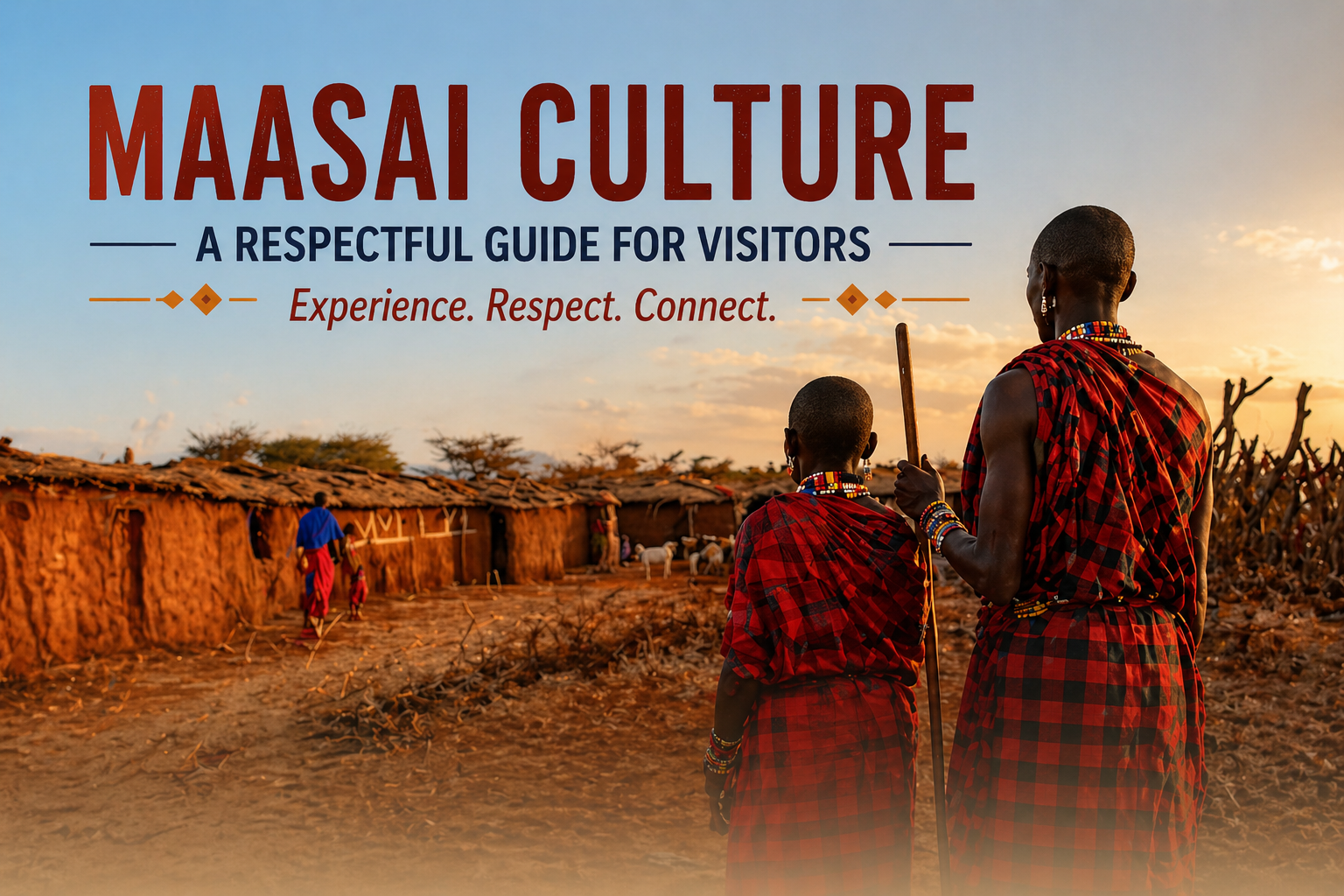
Maasai society is organised into age grades (ilkiama) that define the social roles, responsibilities, and rights of every community member throughout their life. Boys pass through a circumcision ceremony (emorata) that initiates them into the il-murran (warrior) age grade, where they remain for approximately 10–15 years. Il-murran are responsible for cattle herding and community defence; they are recognisable by their red shukas (cloaks), ochre-red hair styled with fat and ochre, and the elaborate beadwork jewellery that signals their status.
After graduating from the warrior grade through a ceremony called eunoto — which involves shaving the warrior’s long ochre hair — men become junior elders and take on governance and decision-making responsibilities. Senior elders (il-kiama) hold the highest authority in community decisions. Women have their own parallel system of status markers through marriage, motherhood, and the production of beadwork, which serves not merely as decoration but as a communication system encoding identity, community affiliation, marital status, and social position.
Beadwork as language — what you are actually looking at
Maasai beadwork is one of the most sophisticated visual communication systems in East African culture, and it is almost universally misread by visitors who see it as decoration. The colours, patterns, and forms of Maasai beadwork carry specific social meaning that varies by community, region, and the status of the wearer. Red represents bravery, strength, and unity — the dominant colour of the il-murran warrior grade. Blue represents energy and the sky. White represents purity and health.
Green represents land and nourishment. Orange and yellow represent warmth and generosity. The specific combination of colours and the forms they take — the flat disc collars (osungu) worn by senior women, the long beaded chains worn by junior elders, the specific earring forms that indicate marital and maternal status — are a legible system for community members and an opaque but visually compelling one for outsiders. The women who produce Maasai beadwork are not crafting tourist souvenirs by default. They are producing communication objects whose meaning extends beyond what any visitor is positioned to read without instruction.
Cattle — the measure of wealth and the measure of everything
Understanding the Maasai relationship with cattle is understanding the central organising principle of the culture. Cattle in Maasai society are not primarily food production units. They are a measure of wealth, a medium of exchange, a form of social insurance, a religious offering, and the primary currency of the bridewealth (lobola) that structures marriage and family alliance. A Maasai man’s social position, his ability to marry, his standing in community decisions, and his spiritual relationship with Enkai are all mediated through cattle.
The Maa language has over 40 words for cattle, distinguishing animals by colour pattern, horn shape, temperament, age, and breeding history. When a conservancy lease arrangement asks a Maasai family to remove their cattle from a section of land, this is not a neutral economic transaction. It is a renegotiation of a relationship that structures identity, social position, and spiritual life — which makes the conservancy model’s economic achievements more impressive, and its limitations more comprehensible.
How to engage respectfully — specific guidance
At a camp with Maasai staff
The most natural and genuinely respectful Maasai encounter available to most safari visitors is with the Maasai guides and rangers employed by their camp. A Gold-certified KPSGA Maasai guide who has spent a decade working in the specific conservancy surrounding the camp has a relationship with the landscape — with specific lion families, specific elephant matriarchs, specific seasonal patterns — that the camp’s cultural programme cannot replicate in a 45-minute session.
The guide who explains the specific Maasai name for the acacia species you are stopped beside, and what that name tells you about how the community has understood that tree’s role in the landscape over generations, is giving you access to Maasai ecological knowledge in its functional context rather than in its performance context. Ask your guide questions. Not “tell me about Maasai culture” — which invites the performance — but “what does this landscape mean to your community?” or “how has this specific area changed in your lifetime?” These questions invite the guide’s specific knowledge rather than their rehearsed cultural presentation.
Visiting a boma (Maasai homestead)
A boma is the fenced homestead compound where a Maasai family lives — the cattle enclosure at the centre, the mud-and-dung houses (inkajijik) arranged around it, the thorny acacia perimeter fence. Visiting a boma is the closest encounter most tourists have with the lived reality of Maasai domestic life. The quality and authenticity of boma visits varies enormously across Kenya.
At one end: visits that are clearly commercial performances, with residents who are not the actual occupants of the boma and an experience that has been designed to produce a particular impression in a predictable sequence. At the other end: genuine invitations into a working household where you are drinking tea with the actual family that lives there and looking at an actual cattle enclosure whose inhabitants your host can describe individually.
The practical way to distinguish these: ask your guide or operator to describe specifically which family runs the boma you are visiting, how long they have lived there, and what their relationship is to the community the camp works with. A genuine community partnership produces answers that are specific and personal. A commercial production produces answers that are vague or formulaic. The genuine visit may be less visually polished. It will be more interesting.
Conduct during a boma visit: ask before photographing individual people, not as a pro forma gesture but as a genuine request. Some Maasai people actively enjoy being photographed; others do not. A photograph taken with consent of someone who is genuinely happy to be photographed produces a better image than one taken of someone who is tolerating the lens because the transaction is understood. Do not photograph rituals, ceremonies, or private spaces without specific invitation. Bring a small, practical gift if you know in advance you are visiting — not tourist trinkets, but items that have genuine utility: sugar, tea, or a cash contribution to a community fund. The cash contribution is often the most honest option.
At a commercial village visit
Commercial Maasai village visits — arranged through lodges and camps, priced at $20–50 per person, lasting 30–60 minutes — range from genuinely valuable community encounters to extractive performance tourism. The honest assessment: even the most commercial of these visits involves real Maasai people receiving real income, and is preferable to taking photographs of Maasai people from a vehicle without any transaction or relationship.
The hierarchy of options, from least to most authentic: the lodge-arranged group visit with a fixed programme; the operator-arranged smaller group visit with more flexibility; the guide-facilitated introduction to a specific family or community member; and the genuine community relationship built over multiple visits with the same families. If you have only one visit available, choose the option with the smallest group size and the most latitude for unscripted conversation.
Photography — the honest conversation
Photography of Maasai people is one of the most contested and most misunderstood elements of the visitor experience. The contest has two legitimate sides. Maasai communities — particularly the il-murran who are most frequently photographed — have experienced decades of being framed by cameras held by strangers who made no relationship with them, took images that were then commercialised globally, and generated no benefit whatsoever for the people in the photograph. The expectation of payment for photographs is not greed or performing. It is a rational response to a history in which images of Maasai people were extracted and commodified without consent or compensation. Respect this expectation.
The counter-argument, equally legitimate: photographs taken after a request, after a refusal or acceptance, after a brief human exchange — photographs that involve even a minimal relationship between the person holding the camera and the person being photographed — are qualitatively different from photographs taken at range with a telephoto lens from a moving vehicle. The visitor who approaches a il-murran warrior, asks whether they may take a photograph, and receives a genuine yes has a different interaction than the one who holds a camera out of a window. The first approach produces better photographs, produces a relationship rather than an extraction, and produces an interaction the person being photographed has chosen to participate in.
Payment rates for photography: there is no fixed rate, and attempts to impose one are generally counterproductive. Many Maasai people who are comfortable being photographed name a price; others accept whatever is offered in good faith; others decline regardless of payment. The correct approach is to ask, to accept the answer without negotiation, to offer a payment that feels proportionate to the value of what you are receiving, and not to attempt to take the photograph regardless of the answer. A rate of $1–3 per photograph or $5–10 for an extended session is consistent with what visitors report as fair in most Mara and Amboseli area contexts in 2026.
The current reality — what Maasai communities are actually navigating
The most important thing a visitor can understand about contemporary Maasai culture is that it is neither static nor dying. The il-murran who appears at your lodge cultural evening may have a YouTube channel documenting Maasai ecological knowledge. The woman whose beadwork you buy may run a cooperative that exports directly to European buyers through a fair-trade platform. The elder who conducts the boma visit may have grandchildren at university studying environmental law to protect community land rights.
The Maasai are adapting their culture to contemporary conditions with the same intelligence and resilience that allowed them to manage one of Africa’s most challenging ecosystems for centuries. They do not need visitor sentimentality about a “vanishing” culture. They need fair land rights, equitable tourism income distribution, quality education in Maa as well as English, and recognition that their traditional ecological knowledge is one of the most valuable bodies of applied environmental science in Africa.
The land rights question is the most urgent. Land privatisation — converting group ranch communal title to individual freehold titles — has accelerated across Maasailand in Kenya since the 1980s. The process has fragmented the open landscape that both traditional pastoralism and wildlife require. An individual who subdivides a family’s share of a group ranch into a private parcel has both a legal right and a logical reason to do so — individual title provides security that communal ownership does not.
But the aggregate effect of subdivision is a landscape that can no longer support the wildlife that produces the tourism income that makes the conservancy model viable. The communities that have resisted this pressure most successfully are those where conservancy income has been consistently high enough to make wildlife-compatible land management economically superior to subdivision and sale.
The conservancy model is therefore not merely a tourism product. It is a land rights defence mechanism: a structure that makes keeping land open as wildlife habitat more financially rational than converting or selling it. For visitors who want to support Maasai communities through their tourism spending, the most direct and effective action is to stay at well-structured conservancy camps that pay documented and substantial lease payments to adjacent communities, employ local staff at senior levels, and have transparent governance of how tourism revenues flow to community benefit.
These camps are identifiable: their operators can tell you specifically how much they pay per hectare per year, which specific communities receive those payments, and what percentage of their staff come from adjacent Maasai communities. Ask these questions before booking.
The most effective way to support Maasai communities is to stay at conservancy camps with documented, substantial, and community-transparent lease payments — then ask your operator to name the specific communities and the specific per-hectare rates. If they cannot answer, the community benefit claim is marketing rather than fact.
Practical guidance — what to do and what not to do
Dress and presentation
- Dress modestly in Maasai communities — shoulders covered, knees covered for both men and women. The casual approach acceptable at the camp pool is not appropriate at a boma visit.
- Remove shoes when invited into an inkajijik (house) — this is standard practice across Maasai communities.
- Avoid ostentatious displays of expensive equipment (multiple camera bodies, large lenses) during boma visits — this creates a social distance that makes genuine interaction harder.
- Ask your guide about any specific local customs or sensitivities before a community visit. Practices vary by region and community.
Interaction
- Greet people in Maa: Sopa (general greeting) · Hepa (response to a senior person) · Learn these two before any community visit — the response is always disproportionate to the effort.
- Never touch a Maasai person’s head without invitation — the head has specific spiritual significance in Maasai culture and uninvited contact is offensive.
- Do not attempt to negotiate the price of beadwork significantly below the asking price — this is both economically marginal for you and disrespectful to the maker.
- Accept food or drink offered to you unless you have a genuine health reason not to — refusal is discourteous. Maasai hospitality through shared food is substantive, not performative.
Photography
- Ask before photographing any person — accept the answer without negotiation or pressure
- Pay the rate requested without bargaining — you are paying for the right to use someone’s image, not purchasing a commodity
- Do not photograph ceremonies, rituals, or private spaces without specific invitation
- Share photographs if asked — having the means to send a phone photo to the person photographed is a gesture that is both practical and meaningful
Purchasing beadwork and crafts
- Buy directly from the maker when possible — craft cooperatives where the seller is the maker are preferable to resellers
- Ask about the specific significance of pieces you are buying — the conversation is interesting and the maker’s knowledge of their own work is part of what you are purchasing
- Fair price guidance: simple beaded bracelet KES 300–600 ($2–5) · Elaborate flat collar (osungu) KES 2,500–5,000 ($20–40) · Large ceremonial pieces more. These are approximate — the maker’s asking price is the correct starting point.
The most authentic encounters available to visitors
Your guide — the most overlooked resource
If your safari guide is Maasai — and many of Kenya’s most qualified KPSGA guides are — the most genuinely enriching cultural exchange available to you is happening every morning in the vehicle. A Maasai guide working in their ancestral landscape, explaining the ecological significance of what you are seeing through the lens of both Western conservation science and traditional Maasai land management knowledge, is giving you something that no arranged cultural encounter can replicate: the integration of cultural knowledge with environmental reality, in its natural context.
Ask your guide to tell you the Maa name for the species you encounter. Ask what those species meant to communities that lived here before the tourism industry. Ask how the landscape has changed in their lifetime and what they think is driving that change. These conversations, conducted over four or five morning drives, produce a genuine cross-cultural engagement that is far more valuable than any 45-minute village visit.
Il Ngwesi Lodge — community ownership as the model
Il Ngwesi Lodge in Laikipia is the benchmark for genuine Maasai community tourism ownership. The lodge is owned and operated by the Il Ngwesi Group Ranch — a Maasai community of approximately 400 families — with all revenues flowing to community benefit through a governance structure the community controls. Guides are community members with specific knowledge of the landscape their families have managed for generations. Conservation decisions are made by the community rather than by an external operator.
The model has been studied by the International Institute for Environment and Development (IIED) and cited as demonstrating that genuine community ownership of wildlife tourism produces both better conservation outcomes and more equitable income distribution than operator-lease arrangements. Staying at Il Ngwesi is a direct investment in the most rigorously documented community-benefit model in Kenyan tourism.
Entim Camp — transparent community partnership
Entim Camp in the Mara National Reserve area demonstrates the conservancy lease model at its most transparent, with publicly documented lease payment rates to the adjacent Iltilal community, priority employment protocols for community members, and a community liaison committee that meets monthly with camp management to discuss the community impact of camp operations. Rarely appears in mainstream “top camp” lists despite consistent high ratings from independent safari specialists — the property does not invest in international media partnerships and relies on operator referrals and direct client recommendations. This is the “hidden gem” dynamic that the Maasai conservancy context produces: genuine community benefit and good wildlife, undermarketed because the operator prioritises doing the thing over advertising it.
RELATED READING
- Maasai Mara — Destination Guide
- Private Conservancy vs National Reserve — What the Difference Actually Means
- The Great Wildebeest Migration — The Full Story
- How to Choose a Kenya Safari Operator
- Kenya Travel Tips: 25 Things to Know Before Your First Trip