
In this guide
While driving offers a ground-level view of the landscape, a kenya fly-in safari experience is not merely a logistical choice; it is a profound shift in perspective. By reclaiming 6–8 hours of travel time per leg and providing exclusive access to remote conservancies, it transforms a standard trip into an unhurried, intimate immersion. At a cost of approximately $150–$350 per flight leg, the investment buys the most valuable luxury of all: the freedom to be truly present.
The Illusion of Proximity: Why We Must Look Down to See Clearly
In the conventional world of luxury travel, opulence is often measured by the thread count of the linens or the vintage of the champagne. But in the Kenyan wilderness, these are secondary. True luxury is defined by Access, Intimacy, and Time.
For many, the “classic” safari involves long, bone-jarring drives on the C12 road toward the Masai Mara or the dusty transit from Nairobi to Samburu. While these journeys offer a glimpse of rural life, they often come at a hidden cost: the erosion of your most precious resource—time. A 6-hour drive is not just 6 hours lost; it is 6 hours of “transit fatigue” that dulls the senses before you even reach the gate.
The fly-in safari Kenya framework challenges this status quo. It posits that the journey should not be a hurdle to the destination, but a revelation in itself.
The God’s-Eye View of Conservation
Why it’s worth the cost: A Kenya charter flight or scheduled bush service reveals the “why” behind the wilderness.
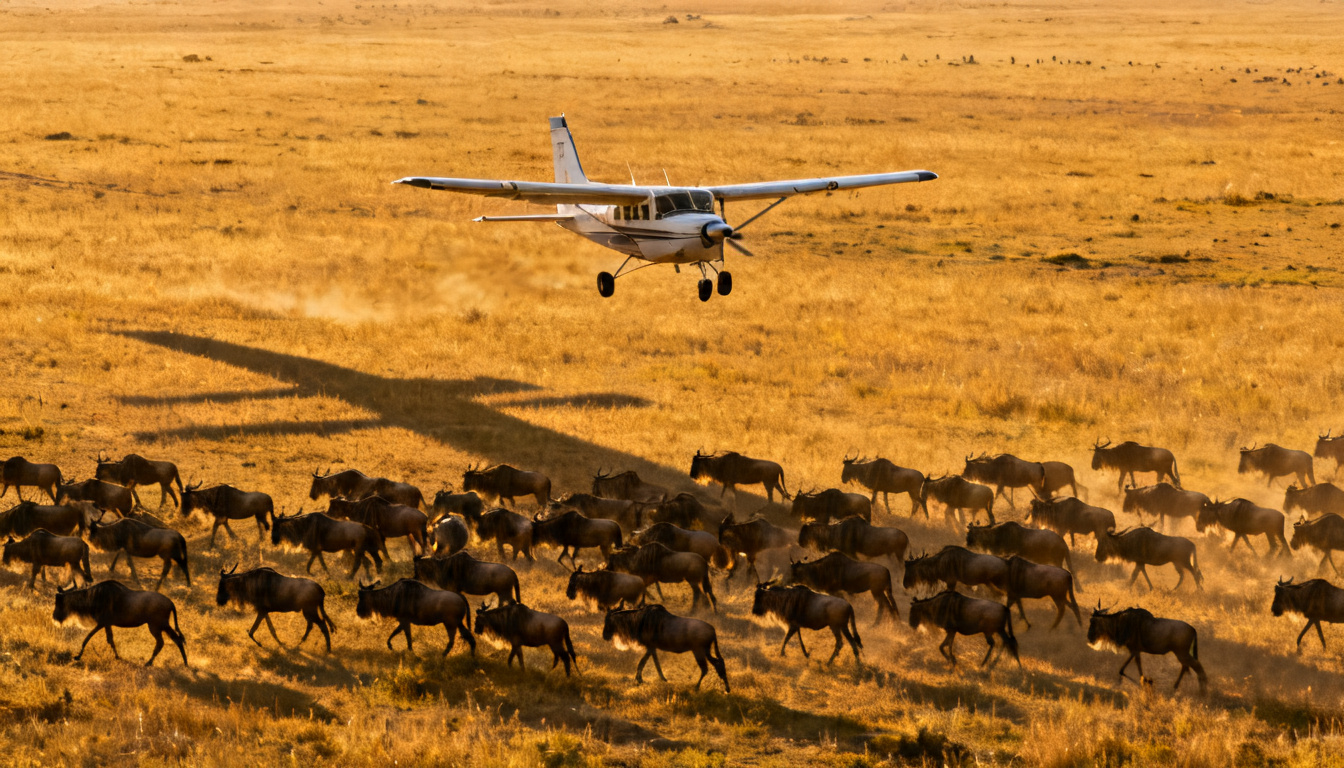
From the window of a Cessna Caravan, the geography of conservation becomes startlingly clear. You see the invisible boundaries where human settlement meets the wild—the sharp line where the green of a private conservancy meets the encroaching charcoal pits or livestock bomas.
The Aerial Advantage
- Geographic Context: Witness the Great Rift Valley’s dramatic escarpments and the shimmering pink of Lake Nakuru from an angle that ground travel simply cannot replicate.
- Remote Reach: Flights grant you access to airstrips like Naboisho or Kogatende, placing you directly into the heart of exclusive conservancies where vehicle density is strictly limited.
- Wildlife from Above: Watch the geometric patterns of the Great Migration or the solitary shadow of a “Big Tusker” elephant in Tsavo—sights that are often missed when restricted to the 2D plane of a dirt track.
Landing in the Heart of the Story
Why it’s worth the cost: Landing at a bush airstrip is the ultimate transition from “tourist” to “guest.”
There is a specific, quiet thrill in descending onto a red-dirt runway where a 4×4 from your camp is already waiting. There are no crowded park gates, no ticket queues, and no “safari traffic jams.” Your safari begins the moment your feet touch the dust.
The Power of the “First Contact”
When you fly in, your first interaction isn’t with a gate guard, but with your guide—often a local expert whose knowledge of the specific pride of lions near the airstrip is intimate and immediate. This charter flight safari Kenya model prioritizes the human connection. You aren’t just another vehicle in the park; you are a guest of the land, welcomed by those who live there.
The Mathematics of Presence
Why it’s worth the cost: The “Permit Math” makes flying a logical financial decision for the discerning traveler.
As of 2026, Masai Mara park fees have risen to $200 per adult per 24 hours in peak season. If you spend 6 hours driving in and 6 hours driving out, you are effectively paying for a full day of “luxury” access that you are spending in the back of a van on a highway.
| Mode of Travel | Transit Time (Nairobi to Mara) | “Wild” Time Gained | Cost Impact |
| Driving | 6–7 Hours | 0 Hours | Included in base cost |
| Fly-In | 45 Minutes | ~6 Hours per leg | +$300 – $500 (Round trip) |
By choosing a fly-in safari Kenya, you are purchasing two extra game drives. For the medium-to-high-spending traveler, the cost of the flight is often lower than the pro-rated cost of the lost time and the physical toll of the road.
The “Substance” Angle: A Lighter Footprint
Beyond the personal benefits, flying is often a more ethical choice for the modern explorer. Bush planes operate on established routes with minimal ground disturbance compared to the constant wear and tear of heavy vehicles on fragile park roads. Furthermore, many of the airlines serving these routes, such as Safarilink or Airkenya, are deeply integrated into local conservation efforts, often providing medical evacuation services or transporting vital supplies to remote ranger stations.
Frequently Asked Questions
What are the luggage restrictions for a Kenya fly-in safari?
Most bush flights in Kenya have a strict 15kg to 20kg (33–44 lbs) limit, which must be packed in soft-sided bags. This is due to the small luggage compartments of aircraft like the Cessna 208 Caravan. Hard-shell suitcases are generally not permitted as they cannot be manipulated to fit the hold.
Is a private charter flight better than a scheduled bush flight?
A scheduled bush flight is cost-effective ($150–$250 per leg) and reliable. However, a private charter flight Kenya offers total flexibility, allowing you to set your own departure times and fly directly between remote camps without stopping at intermediate airstrips. For families or small groups, the cost of a private charter can often be comparable to multiple scheduled seats.
Can I fly directly from the Masai Mara to the coast?
Yes. One of the greatest benefits of the fly-in model is the ability to have a “Bush and Beach” experience. You can fly directly from the Mara to Diani or Watamu in about 2 hours, avoiding the chaos of Nairobi transit entirely.
Conclusion: Reclaiming the Narrative
A safari should not be a test of endurance; it should be an exercise in wonder. By choosing to fly, you aren’t just “skipping the traffic.” You are choosing to honor the scale of the landscape, the expertise of your guides, and the value of your own presence. In the end, the cost of the flight is not an expense—it is the price of admission to a more profound, unhurried version of Africa.
Ready to elevate your perspective? Explore our bespoke fly-in itineraries or contact our expert planners to design a journey that respects your time as much as the wild.