
Table of Contents
The Samburu Special Five: Africa’s Rarest Animals Explained
Most safari travellers know the Big Five, but far fewer understand why northern Kenya offers one of the continent’s most distinctive wildlife experiences. In Samburu, the real headline is not only the familiar safari icons. It is a remarkable group of animals specially associated with the dry north: the Samburu Special Five.
The Samburu Special Five are Grevy’s zebra, reticulated giraffe, beisa oryx, gerenuk, and Somali ostrich. They are strongly associated with the arid and semi-arid landscapes of northern Kenya, and seeing them is one of the main reasons to visit Samburu, Buffalo Springs, and Shaba.
These species give Samburu a wildlife identity that is very different from the Maasai Mara. Where the Mara is famous for open grassland drama, predator density, and migration spectacle, Samburu stands out for rarity, adaptation, and ecological character. For well-informed travellers, this makes Samburu not a secondary add-on, but one of Kenya’s most rewarding safari regions.
The short answer
Why the Samburu Special Five matter
The Samburu Special Five are important because they represent a different ecological story from the classic southern safari circuit. These are animals shaped by harsher climates, sparse vegetation, and dry-country survival strategies. They are not merely alternative checklist species. They are part of what makes northern Kenya biologically and visually distinct.
For travellers, that distinction matters. A Kenya itinerary that includes both the Maasai Mara and Samburu is often stronger than one that repeats only more familiar plains game settings. Samburu adds rarity, conservation relevance, and a sense of discovery that many experienced safari travellers value highly.
1. Grevy’s zebra
Grevy’s zebra is the most conservation-sensitive member of the group in the eyes of many travellers. It differs clearly from the more familiar plains zebra. It is larger, more upright in build, and marked by narrower, more closely packed stripes. Its ears are also noticeably larger, giving it a distinctive alert expression.
In conservation terms, Grevy’s zebra matters because it is endangered, and northern Kenya remains one of its most significant strongholds. For safari visitors, seeing Grevy’s zebra in Samburu is not just aesthetically rewarding. It is also a reminder that Kenya still protects species that are under real pressure in the wild.
2. Reticulated giraffe
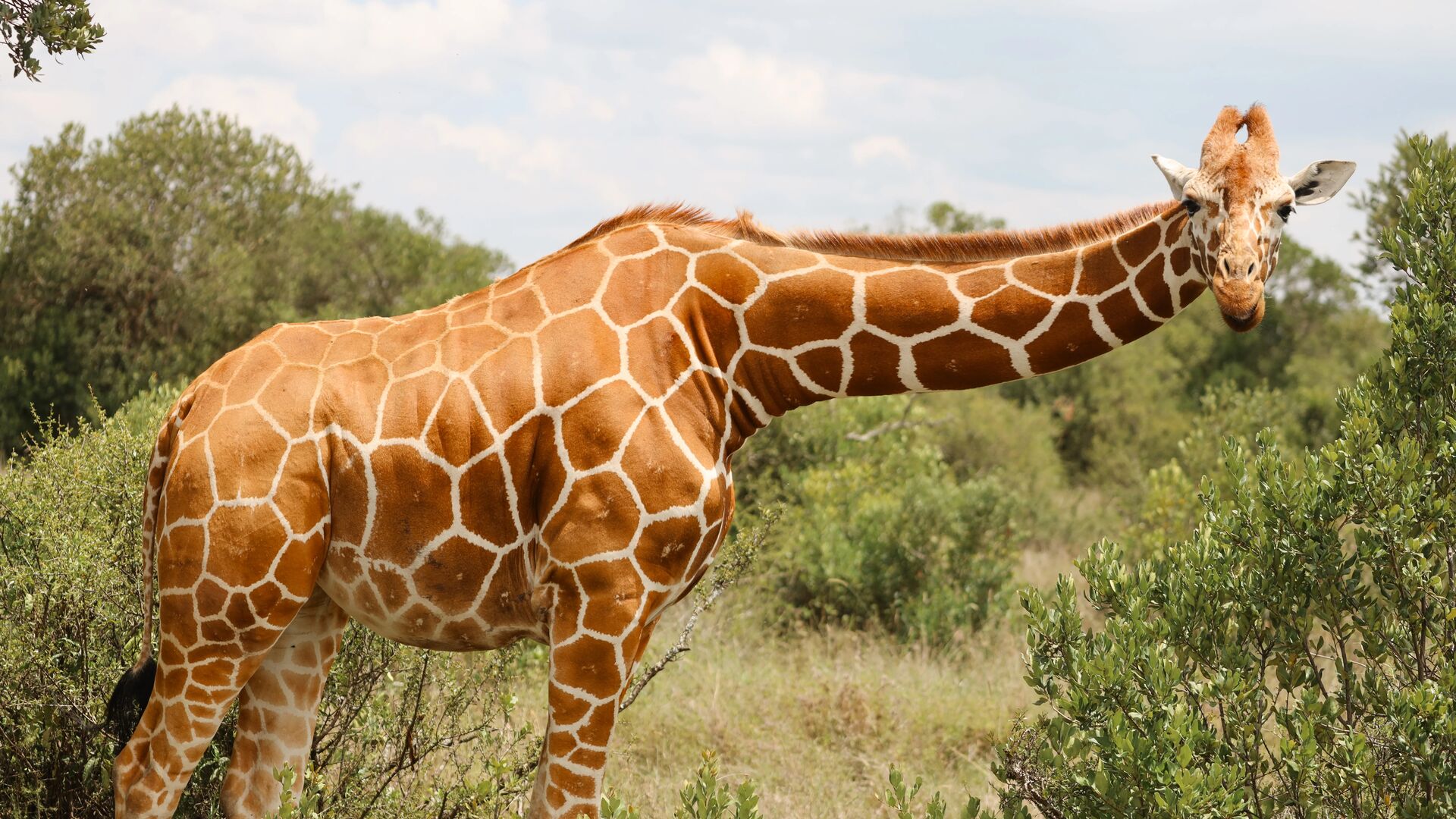
The reticulated giraffe is one of the most visually striking giraffes in Africa, with sharply defined polygonal patches separated by bright pale lines. Even travellers who are not usually interested in subspecies or taxonomy tend to notice immediately that this giraffe looks different.
Its presence is one of the strongest arguments for including Samburu in a Kenya safari. While many visitors know the Masai giraffe from southern Kenya, the reticulated giraffe adds a northern counterpart that feels rarer and more architecturally elegant in pattern. It is also of conservation concern, which increases its significance beyond photographic appeal.
3. Beisa oryx
The beisa oryx is the desert antelope of the group, adapted to dry country and instantly recognisable by its long, straight horns and clean facial markings. It carries the kind of poised, severe beauty that often becomes more impressive the longer you watch it.
For travellers, the beisa oryx represents the quiet sophistication of Samburu wildlife. It is not as globally famous as lions or elephants, but it embodies the dry-land ecology of northern Kenya in a way few animals do. Its inclusion in the Special Five helps explain why Samburu feels so different from greener safari areas.
4. Gerenuk
The gerenuk is perhaps the most unusual member of the group and often the one guests remember most vividly. With its long neck, refined head, and slim limbs, it can seem almost surreal. What makes it truly extraordinary is its feeding posture: it can stand upright on its hind legs to browse leaves and shoots above ground level.
That behaviour alone makes the gerenuk one of the most distinctive antelope species on any Kenya safari. In editorial terms, it gives the Samburu article a strong explanatory hook because it illustrates adaptation in a way that is easy for readers to picture and understand.
5. Somali ostrich
The Somali ostrich is the avian member of the group and a reminder that Samburu’s uniqueness is not limited to mammals. The males are particularly distinctive, with blue necks and legs that separate them visually from the more familiar common ostrich.
Because many travellers do not realise there are notable differences within ostrich populations, the Somali ostrich gives Samburu another edge as a destination for those who appreciate wildlife detail. It also strengthens the case that northern Kenya rewards travellers who look beyond generic safari expectations.
Where to see the Samburu Special Five
The best-known places to look for the Special Five are Samburu National Reserve, Buffalo Springs National Reserve, and Shaba National Reserve, together with parts of the wider northern Kenya ecosystem. Key habitats include the Ewaso Ng’iro River corridor, acacia woodland, dry scrub, and open plains.
This matters for trip planning because wildlife viewing in Samburu is shaped by habitat. River zones can be highly productive, but so are the drier stretches where oryx, gerenuk, and ostrich feel more at home. Travellers who spend enough time in these contrasting habitats usually come away with a deeper appreciation of the region.
Samburu vs Maasai Mara
The most useful comparison is not to ask whether Samburu is better than the Maasai Mara. It is to ask what each destination does best. The Mara offers classic East African safari drama at scale. Samburu offers rarity, northern-adapted species, and a more differentiated wildlife identity.
For many strong Kenya itineraries, the answer is not one or the other. It is both. Samburu gives travellers something they are less likely to see elsewhere in Kenya, and that makes it commercially powerful as a trust-building recommendation.
Our view
The Samburu Special Five are not a gimmick. They are a legitimate wildlife reason to travel north. For travellers who want more than a standard safari, Samburu offers species diversity with depth, conservation importance, and a visual character all its own.
FAQs
What are the Samburu Special Five?
They are Grevy’s zebra, reticulated giraffe, beisa oryx, gerenuk, and Somali ostrich.
Where can you see the Samburu Special Five in Kenya?
The best-known area is Samburu, together with Buffalo Springs and Shaba in northern Kenya.
Are the Samburu Special Five rare?
Yes. Several members of the group are of conservation concern, and the set is strongly associated with the north of Kenya rather than the standard southern safari circuit.
Is Samburu worth adding to a Kenya safari?
Yes, especially for travellers who want rarer wildlife, different habitats, and a safari experience that complements the Maasai Mara.
What is the most unusual animal in the Samburu Special Five?
Many travellers would say the gerenuk, because of its long-necked appearance and habit of standing upright to browse.
More Safari Guides:
All-inclusive safari Kenya, How many days do you need in the Maasai Mara? and Nairobi travel guide.