Things to Do in Nairobi
What Nairobi actually is — past the stereotypes
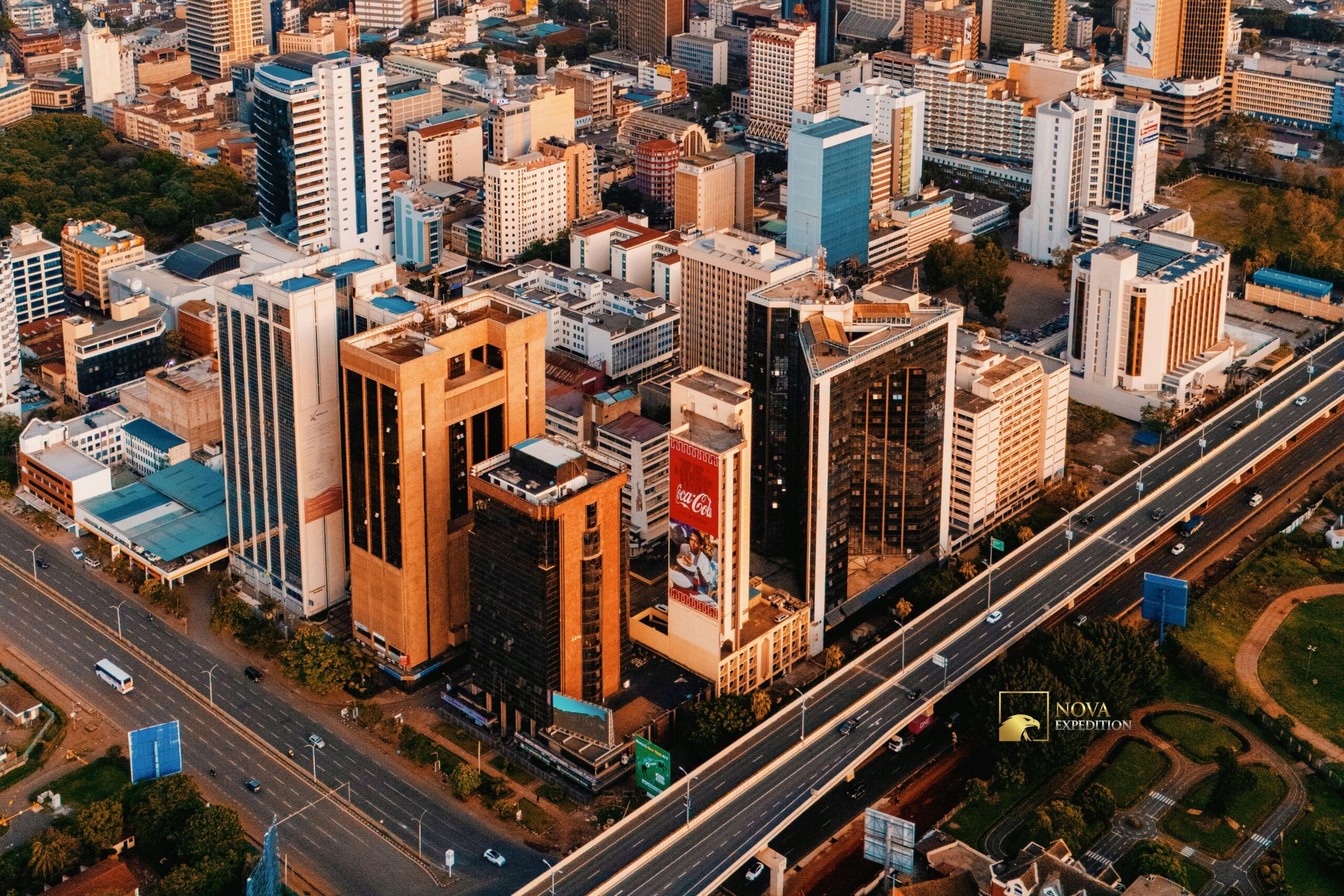
Nairobi is one of the most written-about cities in Africa and one of the most misunderstood. The writing typically goes one of two ways: either it focuses on the city’s colonial history, its wildlife adjacency, and its Out of Africa associations — which is real and worth exploring — or it focuses on its reputation for danger and difficulty, which is real in specific contexts and routinely overstated in others. Both framings miss the city that actually exists in 2026: a dense, creative, demographically young, economically complex metropolis of approximately five million people that has produced some of Africa’s most consequential innovations, maintains 60 square kilometres of national park within its boundaries, and whose neighbourhoods contain more interesting places to eat, drink, think, and explore than any comparable African city.
Nairobi was founded in 1899 as a rail depot for the Uganda Railway — the construction project that brought the Man-Eaters of Tsavo into existence and opened the East African interior to British colonisation. Its name comes from the Maasai phrase Enkare Nairobi — cool water — after the cold stream that ran through the marshy site chosen for the depot. It was described by early colonists as malarial, temperamentally hostile, and unsuitable for a city. Within a decade it was the capital of British East Africa. Within a century it was the largest city between Cairo and Johannesburg.
It sits at 1,700 metres above sea level, which means its climate is perpetually pleasant — warm days, cool evenings, no extreme heat — and which makes it one of the more comfortable African capitals for visitors arriving from cooler climates. Most safari travellers spend one or two nights here at the beginning or end of their trip. This guide is for making those nights genuinely worthwhile rather than purely transitional.
Nairobi National Park — lions against the city skyline
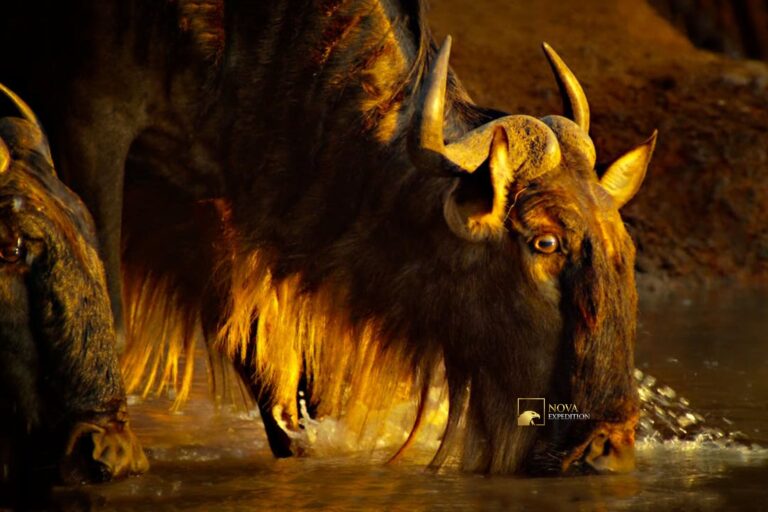
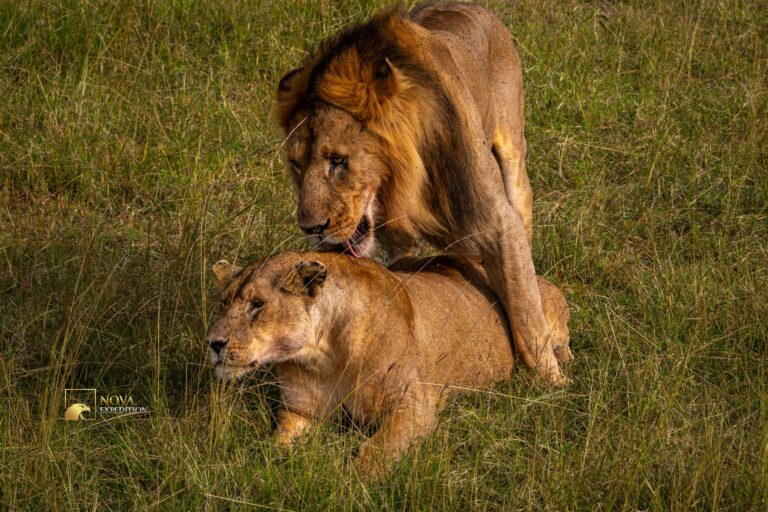
117 square kilometres of functioning savannah ecosystem, fenced on three sides, open to the south, home to lions, leopard, cheetah, black rhino, buffalo, giraffe, zebra, wildebeest, and over 400 bird species. The northern boundary fence runs seven kilometres from the Central Business District’s glass towers. This is Nairobi National Park — the most improbable safari destination in the world, and the one fact about Nairobi that consistently produces disbelief in people who haven’t experienced it personally.
Established in 1946, it was Kenya’s first national park. It contains Kenya’s highest-density black rhino population — over 50 individuals in 117 square kilometres, making rhino sightings more reliable here than almost anywhere else in the country. Lions, leopard, and cheetah are all present and regularly sighted. From the right viewpoint inside the park, you can see a giraffe silhouetted against the Nairobi skyline — a visual that every photographer who visits produces and every editor who sees it considers doctored until they check the metadata.
The park is open 6am to 7pm. Entry via KWS eCitizen portal (cashless, confirm current fees before visiting as they change). Most Karen and Langata-area hotels can arrange dawn game drives from the park’s main gate. A two-hour morning drive will typically produce the full complement of plains game, a near-certain black rhino sighting, and a reasonable chance of encountering the park’s resident lion pride.
The park’s southern boundary is unfenced — the wildlife corridor to the Kitengela Conservation Area and the wider Athi-Kapiti plains is the ecological artery that sustains the park’s gene pool and allows seasonal migration. This corridor is under growing pressure from real estate development. The campaign to preserve it is one of Nairobi’s most active conservation debates, which adds a dimension to the game drive that visitors with any interest in conservation will find worth exploring with their guide.
David Sheldrick Wildlife Trust — the 11am hour
Every morning at 11am at the Sheldrick Trust’s facility in the Karen suburb, infant elephants orphaned across Kenya are walked out onto a clearing by their individual keepers, fed large bottles of milk, and allowed to roam, play, and interact with visitors for approximately one hour. The visiting fee is around $50 for non-residents. This one hour is the most emotionally affecting single experience available in Nairobi — not excluding the wildlife in the national park — and it is the most important preparation available for a first-time safari visitor who wants to encounter wild elephants with something approaching the understanding they deserve.
The trust, founded by David Sheldrick in 1977 and continued by his wife Daphne and subsequently their daughter Angela, has raised over 260 elephant orphans since 1987. The orphans come from across Kenya — calves found beside dead mothers killed by poaching or human-wildlife conflict, animals that have fallen into wells, elephants separated from their herds by floods or drought. Each has an individual story, narrated by dedicated keepers who sleep beside the animals at night and provide round-the-clock milk feeding for the first years of life. The rehabilitation process takes 8–10 years and involves gradual reintroduction to wild herds through staging areas in Tsavo.
The moment that stays with visitors is not the elephants playing in the mud, though that is charming. It is learning that a specific elephant has a specific name, a specific rescue story, and specific keepers who are irreplaceable to that animal’s psychological stability — and then going into the bush the following day and encountering wild elephant families with that framework in mind. The Sheldrick Trust makes the Amboseli Elephant Research Project’s decades of documentation emotionally accessible in 60 minutes. Arrive before 10:50am. Sponsoring an elephant from $50/year keeps you updated on your animal’s progress indefinitely.
The Giraffe Centre — Rothschild’s last stand
The African Fund for Endangered Wildlife established the Nairobi Giraffe Centre in 1979 to protect the Rothschild’s giraffe — one of the most endangered giraffe subspecies, with fewer than 1,600 individuals remaining in the wild. The breeding and conservation programme it operates has contributed meaningfully to preventing extinction. The visiting experience, in which guests feed the resident herd from a raised wooden platform at exact giraffe-head height, is entirely straightforward and genuinely delightful in a way that is difficult to prepare for.
The giraffes are large, curious, and entirely comfortable with people. Their tongues — approximately 40 centimetres long, dark purple in colour, prehensile enough to retrieve a food pellet from an open hand with considerable precision — are one of those physical details that photographs cannot quite convey and direct contact makes immediately vivid. The platform ensures eye-level contact with the giraffe’s face, which at close range is unexpectedly expressive and clearly attentive to the person in front of it. Forty-five minutes here, combined with the Sheldrick Trust, creates a complete introductory wildlife day in Nairobi that sets up the bush experience more effectively than any briefing or documentary could.
The centre is in the Langata suburb, adjacent to the Karen area, approximately 15 minutes by Uber from most Karen hotels. Arrive at opening (9am) to avoid the mid-morning school group visits that arrive at 10–11am.
Karen Blixen and the Ngong Hills — real vs myth
Karen Blixen was a Danish author who farmed in the area now called Karen — named after her — between 1914 and 1931. Her memoir of the period, Out of Africa, published in 1937 under her pen name Isak Dinesen, became one of the most widely read books about colonial Kenya and the basis for the 1985 Sydney Pollack film starring Meryl Streep and Robert Redford. The film version — romantic, visually lush, emotionally affecting — created an image of a romantic colonial Africa that has been influential and contested in equal measure ever since.
The Karen Blixen Museum occupies her former farmhouse, maintained as it was during her time: original furniture, personal effects, the view of the Ngong Hills she wrote about in the book’s most famous lines. It is small, carefully curated, and notable for being more honest about the complexity of Blixen’s position — a European farmer in colonial Africa, dependent on the labour of the Kikuyu community, shaped by and simultaneously critical of the colonial structures she inhabited — than the film was. The house itself, a low-slung, unpretentious colonial bungalow set among indigenous trees, is worth visiting not for the mythology but for the material reality: this is what an early 20th century Kenya farm actually looked like, and the landscape it looks out on — the Ngong Hills visible on the western horizon — has barely changed.
The Ngong Hills themselves are accessible by road and offer excellent hiking with views of the Great Rift Valley on one side and the Nairobi plain on the other. Guided walks on the ridge (hire a guide from the gate — solo walking is not recommended) take 2–3 hours and provide one of Nairobi’s most physically engaging half-day experiences.
Karura Forest — Wangari Maathai’s victory
In 1999, the Kenyan government attempted to allocate sections of Karura Forest — a 1,000-hectare indigenous forest in the Gigiri suburb, adjacent to the UN complex and the US Embassy — for commercial development. Wangari Maathai, founder of the Green Belt Movement and later the 2004 Nobel Peace Prize laureate, organised a series of protests at the forest that brought together NGO workers, students, activists, and local residents. The protests were met with violence from hired guards; Maathai was physically assaulted at one event. The international attention the violence generated ultimately reversed the allocation decision.
Karura Forest remains today as a direct consequence of that campaign — 1,000 hectares of functioning indigenous forest within Nairobi’s boundaries, with walking and cycling trails, waterfalls, a café, and birdlife that includes over 200 species. It is free to enter. The best time to visit is early morning on a weekend before the families arrive. Walking the forest trails — under a closed canopy that reduces the noise and heat of the city to near-zero — is one of the more surprising urban experiences in Africa, and the context provided by knowing what it took to keep it makes it impossible to experience neutrally.
Silicon Savannah — M-Pesa and Africa’s tech capital
Nairobi has been the most innovative financial technology hub in Africa since 2007, when Safaricom and Vodafone launched M-Pesa — a mobile money transfer service that allowed Kenyans without bank accounts to send money using basic mobile phones. M-Pesa is now used by over 50 million people across Africa and has been cited by economists as one of the most significant poverty-reduction tools in recent African economic history. It moved faster than any government or development programme and addressed a market failure — the exclusion of the unbanked majority from financial services — that formal institutions had failed to solve in decades.
The iHub, established in 2010 as a co-working space and incubator for Kenyan tech startups, catalysed what has become one of the most active technology ecosystems on the continent. Startups that have emerged from Nairobi’s tech scene include Twiga Foods (agricultural supply chain), Flutterwave (pan-African payment infrastructure), and BRCK (robust internet connectivity hardware designed specifically for African conditions). The density of this ecosystem relative to Nairobi’s population size — and the speed at which it has developed — has attracted the regional headquarters of Google, Microsoft, Cisco, and IBM. Nairobi’s “Silicon Savannah” identity is not a marketing aspiration; it is a description of something that is visibly, documentably happening.
For visitors: the iHub is in Ngong Road and occasionally runs open events. Westlands is where most of the tech community’s social infrastructure — the Alchemist bar and event space, Artcaffé, numerous co-working spaces — is located. Walking through Westlands in the early evening is the best single observation point for what Nairobi’s young, educated, internationally connected workforce looks like when it is not at work.
Where to eat in Nairobi
- Carnivore Restaurant (Langata) — Nairobi’s most famous restaurant and a genuine institution since 1980. A vast charcoal pit and long skewers of game and domestic meats on an all-you-can-eat basis. Touristy by its nature but genuinely excellent and worth experiencing once. The game meat selection has reduced over the years due to conservation regulations but the format and atmosphere remain distinctive.
- Talisman (Karen) — The most consistently beloved Karen neighbourhood restaurant, with excellent food, a garden setting, and a menu that reflects Nairobi’s cosmopolitan character without trying too hard. Reliable, warm, and good for a relaxed dinner.
- Alchemist (Westlands) — A converted warehouse and outdoor space that functions as the heart of Nairobi’s young creative social scene. Multiple bars, rotating street food vendors from different Nairobi communities, and live music on weekends. Not a restaurant in the conventional sense — more of a social ecosystem. Excellent for understanding what Nairobi’s youth culture looks and sounds like.
- Mama Oliech’s (Hurlingham) — The most beloved local restaurant in Nairobi for Victoria Nile perch (tilapia), prepared in traditional Luo style with ugali. Queue at lunch, order at the counter, eat at communal tables. This is Nairobi as it actually eats, not as it presents itself to visitors. A 45-minute experience that produces more understanding of the city than most day of tourism.
- Lord Erroll (Runda) — Nairobi’s most formal special-occasion restaurant, with excellent European-influenced food and a colonial-era building. For visitors who want a genuinely high-end dinner experience.
Day trips from Nairobi
- Hell’s Gate National Park (1.5 hours) — The only park in Kenya where you cycle and walk freely without a vehicle or ranger escort. Volcanic gorges, geothermal steam vents, and populations of zebra, baboon, and cliff-nesting raptors. Hire bikes at the main gate. The gorge cycling loop takes 2–3 hours and is one of Kenya’s most unusual and underrated experiences. No lions or elephants inside the fence — which is what makes the cycling possible.
- Lake Naivasha (1.5 hours) — A freshwater Rift Valley lake with hippos, enormous birdlife, and Crescent Island — a small car-free island where giraffe, zebra, and wildebeest roam freely and visitors walk among them without a vehicle or fence. Boat trips from the lake shore are 30–45 minutes and almost always include close hippo sightings.
- Ol Pejeta Conservancy (3.5 hours) — The last two northern white rhinos, Kenya’s largest chimpanzee sanctuary, and outstanding general wildlife. A full day or overnight stay. The conservancy is accessible by road from Nairobi, and the drive through the Laikipia plateau provides a genuine landscape transition from the highlands down to the conservancy.
Practical information
- Transport — Use Uber or Bolt for all movement. Both work reliably across Nairobi’s main areas. Do not use unmarked taxis. Do not walk at night in any area.
- Wilson Airport — All domestic safari flights depart from Wilson Airport in the Langata area, not from JKIA. Allow 45 minutes from Karen or Westlands. Confirm your departure terminal when booking.
- Safe areas — Karen, Langata, Westlands, Gigiri, Kilimani, Lavington, and Runda are the main visitor-appropriate areas. Eastleigh and Kibera should be avoided. The US Embassy and UN complex area (Gigiri) is well-secured and pleasant for walking.
- Altitude adjustment — At 1,700m, Nairobi is significantly higher than most visitors’ home cities. Arriving on an overnight flight and heading directly into a 6am game drive the next morning compounds jet lag with altitude. One night of proper sleep before the bush dramatically improves the quality of the first day’s wildlife experience.
- Currency — Kenya Shilling is the local currency. US Dollars are accepted at most tourist facilities. ATMs are widely available and reliable in Westlands, Kilimani, and Karen. Credit cards accepted at most restaurants and larger shops.