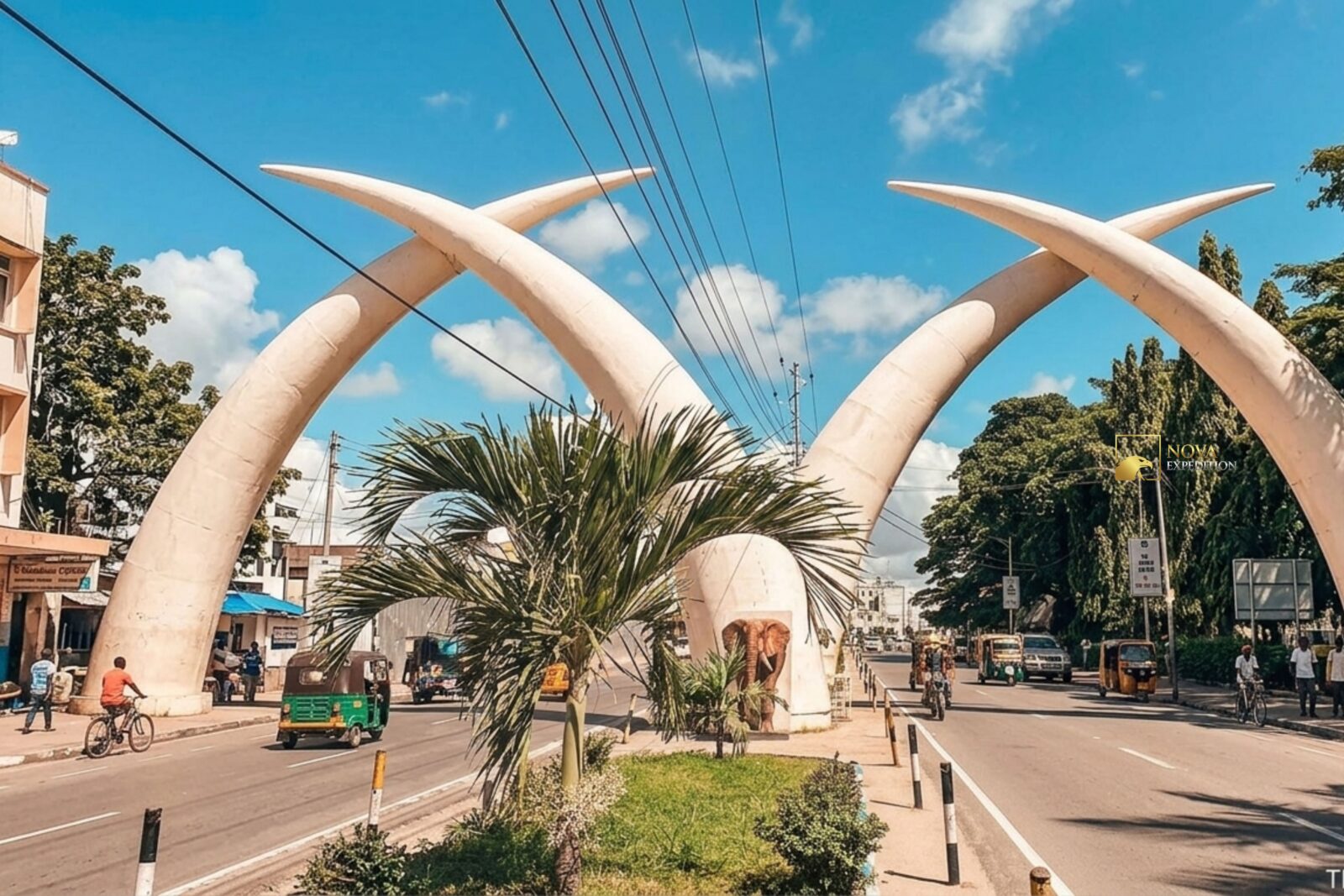
Most visitors to Mombasa arrive with a single image in mind: white sand, a turquoise ocean, and a cold Tusker at a beach bar. The image is accurate. It is also about a third of what Mombasa actually is. The city that greets you when you step beyond the beach hotels is Kenya’s oldest urban settlement — a layered, complex, genuinely fascinating place whose recorded history runs from at least the 11th century through Arab traders, Chinese fleets, Portuguese fortifications, Omani rule, and British colonial administration to the present. The narrow lanes of Old Town hold carved Swahili doors that are 200 years old.
Fort Jesus, completed by the Portuguese in 1596, is a UNESCO World Heritage Site whose walls contain archaeological evidence of every civilisation that fought for control of this harbour over four centuries. The Swahili food — slow-cooked biryani, fresh-caught octopus grilled over charcoal, spiced kahawa coffee served in cups the size of a child’s fist — reflects a culinary tradition that absorbed Indian, Arab, and Persian influences across a thousand years of maritime trade. Mombasa rewards travellers who arrive expecting complexity as much as it rewards those who arrive expecting beaches. It delivers both, often within the same afternoon.
Mombasa is Kenya’s second city and the most important port in East and Central Africa. It sits on an island connected to the mainland by bridges north and the Likoni Ferry south. The beaches are not on the island itself but on the mainland coast stretching north toward Malindi and south toward Diani and Shimba Hills. The island holds the history: Fort Jesus, Old Town, the Swahili lanes, the spice market, the carved doors, and the concentrated street food culture that no beach hotel can replicate. Understanding this geography — island for culture, mainland for beaches — is the foundation of any good Mombasa plan.
| MOMBASA — ESSENTIAL FACTS 2026 | |
| Location | Southeast Kenya coast · 480km from Nairobi · Island city connected to mainland |
| Status | Kenya’s second largest city · East Africa’s most important port |
| History | Inhabited since at least 11th century · UNESCO World Heritage Site (Fort Jesus) |
| Fort Jesus | Built 1593–1596 by Portuguese · Fought over by 8 different powers · Museum since 1962 |
| Getting there | 45 min flight from Nairobi (Moi International Airport) · overnight train available |
| Best time | December–March · July–October · Avoid April–June long rains |
| North Coast beaches | Nyali, Bamburi, Shanzu · 15–30 min from island · Most beach hotels here |
| South Coast beaches | Diani, Tiwi · Via Likoni Ferry or Dongo Kundu bypass · Better sand, fewer crowds |
Fort Jesus and the contested harbour — four centuries of history in one building
Fort Jesus is the most historically significant structure in Kenya. Built between 1593 and 1596 by Portuguese architect Giovanni Battista Cairati on a coral ridge commanding the entrance to Mombasa’s Old Port, it is a masterpiece of 16th-century military architecture — the angled bastions, the fields of fire, the well that could sustain a garrison under siege. The Portuguese built it to control the trade routes of the Indian Ocean, to anchor their East African empire, and to keep the Ottomans and the Swahili city-states in check. They held it for most of the following century, losing it briefly to the Omani Arabs in 1631 and recapturing it, before the most significant siege in the fort’s history began in 1696.
That siege lasted 33 months. The Omani Arabs, supported by forces from Pate and Lamu, blockaded the fort from December 1696 until December 1698. By the time the fort fell, almost all of its approximately 2,500 defenders — the Portuguese garrison, their Indian soldiers, and the Swahili loyalists who had chosen the Portuguese side — had died of plague or starvation.
The fort changed hands multiple times over the following century, passing between Portuguese, Omani, and briefly British control, until the Omani Busaidi family consolidated rule over the coast. Fort Jesus became a prison in 1837, which it remained under British administration until 1958, when it was gazetted as a national monument. It opened as a museum in 1962, the year before Kenya’s independence.
The museum inside the fort is genuinely excellent — one of the best in Kenya. The exhibits document the archaeological excavations that have uncovered layers of occupation: Chinese porcelain from the Ming dynasty that arrived as trade goods in the 15th century, Omani weaponry, Portuguese tiles, the personal effects of soldiers who died in the 1696 siege. The Omani house inside the fort’s eastern wall is a rare surviving example of 18th-century Omani domestic architecture on the East African coast.
The views from the battlements at sunset — the dhows in the Old Port below, the creek stretching northward, the ocean to the east — are among the finest in Kenya. A guided tour is strongly recommended: without context, the fort is an impressive ruin; with it, it is one of the most compelling historical sites in Africa. Allow two hours minimum. Morning visits avoid the midday heat.
Old Town Mombasa — the lanes, the doors, and the living city
Old Town begins immediately north of Fort Jesus, on the same coral ridge above the Old Port. Walking north from the fort on Ndia Kuu Road, the transition is immediate: the streets narrow, the buildings rise on both sides, and the architecture shifts from colonial-era to something much older. Coral stone buildings with carved wooden balconies overhang the lane. Arched doorways are framed by intricately carved wooden frames — the carved Swahili door is one of the defining art forms of the East African coast, its geometric and floral patterns reflecting centuries of Arab, Indian, and African aesthetic influence. Some of these doors are genuinely 150 to 200 years old. Others are quality reproductions. Your guide can tell the difference.
Dress code matters in Old Town and is worth stating clearly: shoulder-to-knee coverage is not merely advisable but directly affects the quality of your experience. Mombasa’s Old Town is a living, working community, not a tourist precinct. The mosques are active. The markets are for residents as much as visitors. Walking through in a tank top and shorts signals a disregard for the community’s norms that will be reflected in how you are received: higher prices, less engagement, less willingness to show you the things that are genuinely interesting rather than the things that are for tourists. Respecting the dress code produces the opposite experience. It also reflects a basic courtesy that the neighbourhood deserves.
The food culture of Old Town is the most compelling reason to spend time here. Jahazi Coffee House on Ndia Kuu Road serves kahawa — Swahili coffee brewed with cardamom and sometimes ginger — in a cushioned sitting room where you remove your shoes at the door. The coffee is strong and served in small cups; the custom is to drink several.
The biryani, which Old Town’s restaurants produce in the slow-cooked Swahili style rather than the fast hotel version, is available at several places along the main lanes but sells out by early afternoon — arrive by 1pm if biryani is the plan. The seafood at the waterfront restaurants — octopus, prawns, crab, freshly caught reef fish grilled over charcoal — is the freshest available in the city because the dhow fishermen sell directly to these kitchens. This is not the seafood at the beach hotel buffet. The difference is categorical.
Old Town is best experienced with a guide for the first visit — not because it is unsafe, but because the lanes are genuinely confusing and the context that a knowledgeable local provides transforms the architectural and food experience entirely. Several excellent guides operate from the Fort Jesus entrance area.
The beaches — North Coast vs South Coast
North Coast — Nyali, Bamburi, Shanzu
The North Coast beaches — Nyali, Bamburi, and Shanzu — stretch northward from the island along the mainland coast, accessible via the Nyali Bridge without any ferry crossing. This accessibility makes the North Coast the more popular and more developed option: most of Mombasa’s large beach resort hotels are here, the infrastructure is better, and the journey from Mombasa island or Moi International Airport is straightforward.
The beaches themselves are good — white sand, warm water, the Indian Ocean reef that protects the inshore area and keeps the water relatively calm for swimming. Shanzu, the furthest north and least developed of the three, is the quietest and has the best-quality sand of the North Coast beaches. Nyali, closest to the island, is the most convenient but also the most crowded. Bamburi has the highest concentration of beach bars and nightlife.
South Coast — Diani, Tiwi, Shimba Hills
The South Coast is universally acknowledged to have better beaches than the North, and the assessment is accurate. Diani Beach — 25 kilometres south of Mombasa island — is one of the finest beaches in Africa: powdery white sand, shallow turquoise water over a protected coral reef, a palm-lined shore that stretches for kilometres without significant development breaking the view. The trade-off is access. Reaching the South Coast from Mombasa island historically required the Likoni Ferry, a necessary but sometimes slow crossing.
The Dongo Kundu Bypass, completed in 2024, now allows drivers to bypass the ferry entirely by routing south of the island on a new elevated road — reducing the journey significantly and eliminating the ferry queue. For visitors travelling directly from Moi International Airport to South Coast accommodation, the bypass makes the South Coast more accessible than it has ever been.
Shimba Hills National Reserve lies 30 kilometres inland from Diani and is the most accessible wildlife experience from the Mombasa coast. It is small — 192 square kilometres — and primarily interesting for a specific conservation reason: it holds one of the last viable populations of sable antelope in Kenya, a species that has been lost from most of its former East African range. Elephant, leopard, and buffalo are also present. For guests based on the South Coast who want a wildlife experience without travelling to Tsavo, Shimba Hills is a half-day or full-day option.
Mombasa Marine National Park — snorkelling and diving
The Mombasa Marine National Park protects a 10-square-kilometre section of coral reef and ocean directly offshore from Bamburi and Nyali beaches. It is one of Kenya’s most accessible marine protected areas and holds some of the best snorkelling available on the East African coast: coral formations in generally good condition, reef fish in high density, occasional green turtles, and the visibility that comes from a protected reef where fishing is prohibited.
Glass-bottom boat trips provide the experience for non-swimmers. Snorkelling equipment is available for rent from the beach. Diving with qualified operators reaches the outer reef where shark and ray sightings are more common. The best conditions are from October through March when the sea is calmer and visibility is highest. The long rains (April through June) bring rougher seas and reduced visibility.
The Mombasa-Tsavo connection — safari from the coast
Tsavo East and Tsavo West National Parks together form one of the largest protected areas in Africa, covering approximately 21,000 square kilometres. The parks begin approximately two to three hours inland from Mombasa by road, making a safari-and-beach combination from a Mombasa base genuinely practical without the long-haul flights and transfers that a Nairobi-based Mara itinerary requires. The most common routing is three to four nights safari in Tsavo East or West followed by three to four nights on the South Coast — or vice versa, with the beach providing recovery time after the early morning drives.
Tsavo East is flat, dry, and defined by the red laterite soils that give its elephants their distinctive rust-coloured appearance — the dust that coats them is iron-rich and acts as both sunscreen and insect deterrent. The landscape is spectacular in a different way from the Mara: vast, austere, the acacia-dotted plains stretching to the horizon without the green hills of the highland parks.
Tsavo West is more varied in topography, including the Mzima Springs — volcanic rock springs that feed crystal-clear water to a pool where hippo, crocodile, and large freshwater fish can be observed from an underwater viewing chamber. The Shetani lava fields, hardened black basalt flows from an eruption approximately 200 years ago, are one of the most visually striking landscapes in Kenya. Neither Tsavo East nor West has the Mara’s conservancy model — all drives are inside the national park on designated tracks — but the scale of the landscape and the quality of the elephant encounters make Tsavo a genuinely distinctive and underrated safari destination.
Swahili food — what to eat and where
Swahili cuisine is the product of a thousand years of Indian Ocean trade: Arab spice routes, Indian merchants, Persian flavours, African ingredients, and Portuguese influences all absorbed into a coastal cooking tradition that is entirely distinct from the nyama choma and ugali culture of Kenya’s interior. The defining technique is slow cooking: the biryani that is the centrepiece of Old Town food culture is cooked for hours, the spices — cumin, cardamom, coriander, turmeric, saffron — absorbed into the rice and meat over time rather than applied at the end.
The seafood tradition is equally serious: the Indian Ocean reef and deep-water fishery provide octopus, prawns, crab, lobster, snapper, and tuna that arrive daily at the Old Town market and the beach fishing villages, and go directly into restaurant kitchens rather than through the cold chain that strips flavour from seafood elsewhere.
- Biryani ya mbuzi (goat biryani): the definitive Old Town dish, cooked in the slow Swahili style, available at several restaurants on Ndia Kuu Road but selling out by early afternoon on most days. Arrive by 1pm.
- Kahawa: Swahili coffee brewed with cardamom, served strong and small. The correct way to drink it is several cups. Jahazi Coffee House on Ndia Kuu Road is the most atmospheric setting.
- Mishkaki: marinated and grilled meat skewers, available at street stalls throughout Old Town and the CBD. Best eaten standing at the stall where they are freshest.
- Viazi karai: fried potatoes in a spiced batter, one of the most ubiquitous coastal street foods. Available from vendors throughout the city for a few shillings.
- Fresh seafood: the Forodhani Seafront Restaurant near the waterfront serves genuinely fresh octopus, prawns, and reef fish at prices well below what the beach hotels charge for the same ingredients. The Tamarind Restaurant, in a converted Old Port building, is the established upmarket seafood option with a reputation for consistency that has endured for decades.
Best time to visit Mombasa
Mombasa has two distinct good-weather seasons and one period to avoid. The best conditions are December through March — the northeast monsoon brings dry, warm weather, calm seas, and the lowest humidity of the year. This is the peak season for beach holidays, with temperatures in the high 20s to low 30s, excellent marine visibility, and the most reliable diving and snorkelling conditions. July through October is the second good window: the southeast monsoon has passed, seas are calmer, and the slightly lower temperatures make walking in Old Town and exploring the city more comfortable. Visitor numbers in this window are somewhat lower than December through March, and accommodation rates reflect this.
April through June is the long rains season and is genuinely challenging for a beach holiday. Persistent rainfall, rough seas, reduced marine visibility, and some accommodation closures make this the period to avoid unless the specific goal is the dramatic green-season landscape or extreme budget travel. The rains are not the occasional afternoon shower of Nairobi’s short rains — they are sustained, heavy, and genuinely affect outdoor activities. November has shorter rains that are more variable: sometimes excellent conditions, sometimes wet. Check current conditions before booking November travel.
Where to stay — matched to purpose
The accommodation decision in Mombasa is primarily a location decision: Mombasa island (Old Town and CBD area) for cultural immersion; North Coast (Nyali, Bamburi, Shanzu) for convenience and beach resort infrastructure; South Coast (Diani) for the best beaches and quieter environment. The categories below reflect this geography.
Serena Beach Resort & Spa
SHANZU BEACH, NORTH COAST · 5-STAR · UNESCO ECO-CERTIFIED
The most consistently acclaimed beach resort on the North Coast and one of Kenya’s finest coastal properties. Designed to replicate the architecture of a 13th-century Swahili village, its 120 rooms and suites are arranged along winding coral-stone lanes shaded by bougainvillea and coconut palms, with every room or suite facing either the ocean or the tropical gardens that lead to the beachfront. The Jahazi Grill — built in the form of a traditional dhow and facing directly onto the Indian Ocean — is the best seafood restaurant of any beach resort in Mombasa. The Maisha Spa has an established reputation for quality.
The conservation credentials are specific and verifiable: Eco-certification from Eco-Tourism Kenya, an on-site turtle conservation programme, a butterfly park open to the community, and 2,500+ recycled flip-flops turned into decorative elements throughout the property. The guiding philosophy is genuine rather than performative. For families, the children’s programme, pizza parlour, and interconnecting family rooms make this one of the most practically family-friendly resorts on the coast.
From $280 per room per night · Breakfast included
5-star · Eco-Tourism Kenya certified · Best seafood restaurant on North Coast · Turtle conservation programme · Family-friendly · Shanzu Beach · 30km from Moi Airport
Sarova Whitesands Beach Resort & Spa
BAMBURI BEACH, NORTH COAST · 4-STAR · DIRECT BEACH ACCESS
Set on one of the longest stretches of North Coast beach protected by Mombasa Marine National Park, Sarova Whitesands is the most established large resort on the North Coast with a reputation built over decades of consistent delivery. Five swimming pools, direct beach access, the Lido Lounge seafood restaurant (consistently cited as one of the best seafood options on the North Coast), and a beach bar are the defining features. The Cocoa Bar, a beachfront evening spot, is the most atmospheric feature of the property.
Honest assessment: this is a large resort hotel (several hundred rooms) with the advantages and trade-offs that implies. Service is professional and the infrastructure is well-maintained, but the intimacy of the smaller boutique properties is absent. Best suited for families, groups, and travellers who want a full-service beach resort with comprehensive facilities rather than a quieter or more characterful stay.
From $160 per room per night · Bed and breakfast
4-star · Bamburi Beach · Lido Lounge · Best seafood on North Coast · Direct beach access · Marine park views · 5 swimming pools
Severin Sea Lodge
BAMBURI BEACH, NORTH COAST · BOUTIQUE · CONSISTENTLY TOP-RATED
The most consistently highly-rated accommodation on the North Coast by independent traveller reviews across all major platforms. Smaller and more intimate than the large resorts, with a personal service standard that larger properties cannot match. Severin is often cited by reviewers as the hotel that exceeded expectations most significantly — a consistent pattern that reflects the quality of the staff and management rather than the physical infrastructure, which is comfortable but not extraordinary.
Specific differentiator: Severin has maintained its staff and management continuity over many years, producing the kind of institutional knowledge of returning guests and accumulated service culture that large chain resorts cannot replicate. For couples and independent travellers who want quality and character over scale and facilities, Severin is the correct North Coast choice.
From $120 per room per night · Breakfast included
Most consistently top-rated · All review platforms · Boutique scale · Personal service · Bamburi Beach · Long-serving staff team · Best for couples and independents
Tamarind Village Hotel
NYALI, OVERLOOKING TUDOR CREEK · OLD PORT SETTING · HISTORIC CHARACTER
The Tamarind is not a beach resort but a boutique hotel overlooking Tudor Creek and the Old Port, in a building with genuine historical character and rooms with views of the dhow anchorage that no beach property can offer. The attached Tamarind Restaurant is the most celebrated seafood restaurant in Mombasa, with a reputation sustained over decades: fresh crab, lobster, and reef fish prepared in both Swahili and international styles, in a setting that faces directly onto the creek with the lights of the dhows reflected in the water at night.
For travellers whose primary interest is the historical and cultural dimension of Mombasa rather than the beach, Tamarind Village offers a base closer to Old Town and Fort Jesus with considerably more character than the mainstream beach hotel options. The Tamarind Dhow, a traditionally styled vessel that departs for sunset cruises with dinner on the creek, is one of the most celebrated experiences in Mombasa and is bookable by non-guests.
From $200 per room per night · Room only
Best seafood restaurant in Mombasa · Tudor Creek views · Historical character · Tamarind Dhow sunset cruises · Best base for cultural visitors
Getting there and getting around
Getting to Mombasa
Moi International Airport (IATA: MBA) is 9 kilometres west of Mombasa island and served by Kenya Airways, Jambojet, and Safarilink with multiple daily flights from Nairobi Wilson and JKIA. Flight time is approximately 45 minutes. The flight is strongly recommended over the road alternative (8 to 10 hours on the A109 Mombasa Highway, which passes through Tsavo and can be slow) for most visitors. The SGRL overnight train (Standard Gauge Railway) departs Nairobi in the evening and arrives in Mombasa the following morning — a genuinely enjoyable journey through the Tsavo landscape that is worth considering for travellers who are not time-constrained.
Getting around Mombasa
Within Mombasa island and between the island and the beaches, the practical options are Uber, Bolt, and taxi. Both Uber and Bolt operate reliably in Mombasa and are the recommended option for most journeys. Tuk-tuks (bajaji) are everywhere in Old Town and are the correct vehicle for navigating the narrow lanes where a car cannot pass.
The Likoni Ferry connects the island to the South Coast mainland; it operates 24 hours and is free for pedestrians and cyclists, with a nominal charge for vehicles. The Dongo Kundu Bypass, completed in 2024, now offers a direct road connection to the South Coast without the ferry, reducing journey times significantly for those driving from the airport or North Coast directly to Diani.
The most common Mombasa planning mistake is treating it as only a beach destination and never leaving the hotel. The Old Town, Fort Jesus, and the food culture of the island are the experiences that make Mombasa genuinely memorable. Plan at least one full day on the island regardless of which beach property you are staying in.
RELATED READING
- Diani Beach Kenya — The Complete Guide
- Tsavo East and West — Kenya’s Largest Safari Parks
- Kenya Safari and Beach — How to Combine Both
- Lamu Island — The Swahili Coast at Its Most Intact
- Kenya Safari Cost 2026 — The Honest Breakdown