
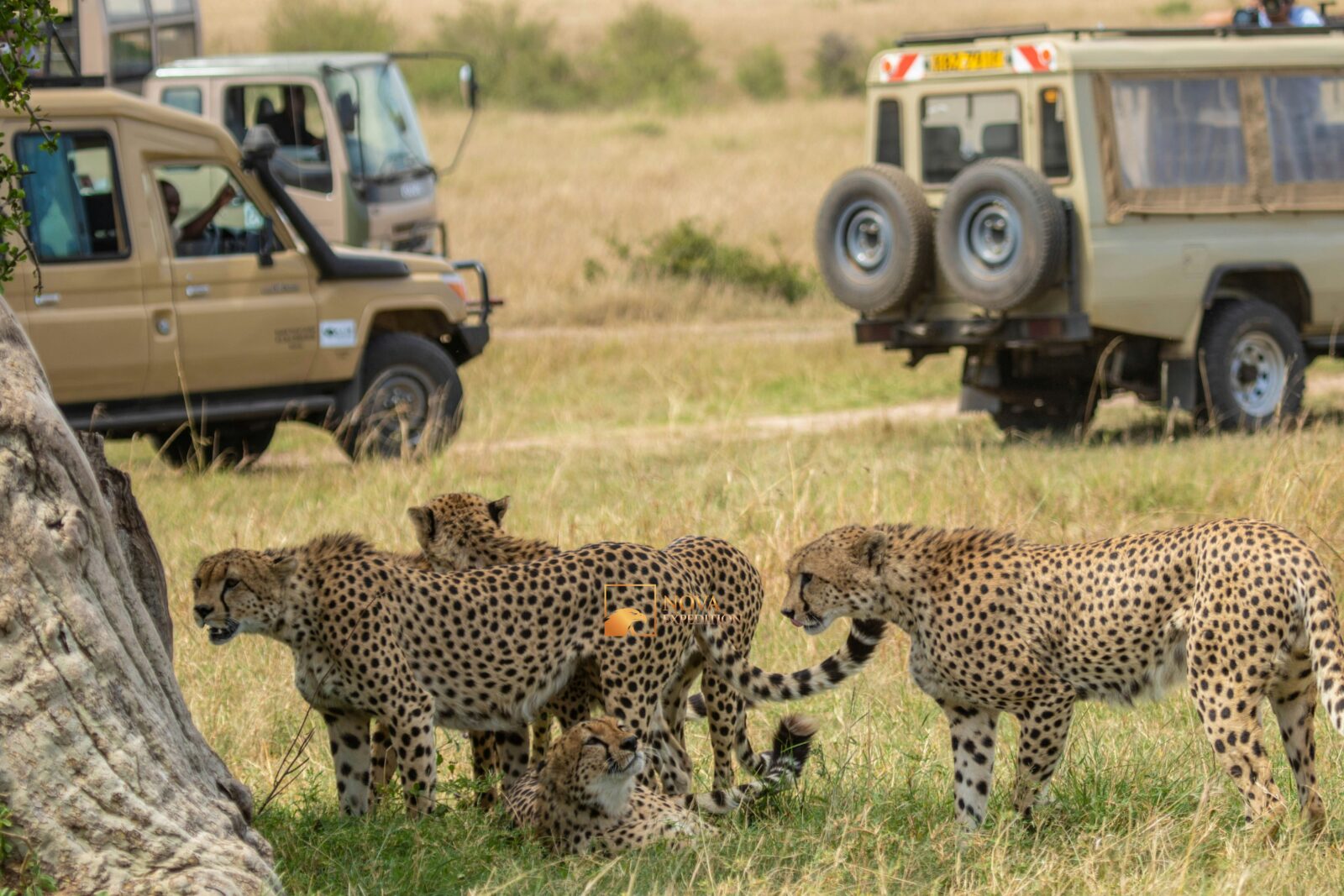
There is no single best time to visit Kenya — there is a best time for what you want to see. The Mara migration peaks in August, but August is also peak crowds and peak prices. The Aberdares are at their best in January, when nobody is talking about them. Mount Kenya climbers want January-February or July-September, not the safari peak. This guide covers what each month delivers across every major destination — the savannah parks, the highlands, the deserts of the north, the coast, and the mountains — so you can plan around what actually matters to you, not the calendar of the herd.
Understanding Kenya’s seasons
Kenya sits on the equator and does not have a four-season climate. The country has two dry windows and two wet windows, and they fall at the same time across most of the country — but with significant local variation by altitude, latitude, and proximity to the Indian Ocean.
The long rains run from approximately mid-March through May, with April typically the wettest month nationally. The short rains run from late October through early December, with November the wet centre. Between these two rainy periods sit two dry seasons: a long dry season from late June through October, and a shorter dry window from late December through early March. The dry seasons are when the safari industry does most of its business, and the rains are when prices drop and crowds disappear.
Two further dynamics matter. First, Kenya’s coast operates on a separate rhythm driven by the Indian Ocean monsoons — the dry northeast kaskazi wind from November to March/April, and the wetter southeast kusi wind from April/May to October. The coast’s wettest months are April through June, not April alone. Second, altitude matters more than most articles admit. The Aberdares, Mt Kenya foothills, and the central highlands receive significantly more rain than the Mara or Amboseli and can stay wet well into June. Laikipia, sitting on a high plateau in the rain shadow of Mt Kenya, is meaningfully drier than nearby areas of the same latitude.
One last reality check: Kenya’s rainy seasons are not what most northern-hemisphere readers expect. “Rainy” usually means a heavy late-afternoon downpour for an hour, followed by clear skies. It rarely means a week of unbroken grey. The green seasons are genuinely viable for safari — the photography is better, the prices are lower, and the wildlife is still there. The only real “avoid if possible” window is the heart of the long rains, particularly April, when some camps close, roads in remote parks become impassable, and the value-for-money equation gets uncomfortable.
January
Snapshot: One of the strongest all-round months. Hot, dry, low crowds for January’s first half, and a meaningful predator-action window.
January is a quietly excellent month for Kenya travel. The short rains have ended, the long rains are still 10-12 weeks away, and the landscape is in that brief sweet spot where the recent rain has greened the plains without softening them into mud. Daytime temperatures in the Mara and Amboseli run 27-30°C, dropping to around 12-14°C overnight. The coast is at its hottest and driest, with calm seas and the best diving and snorkelling visibility of the year.
Maasai Mara
The migration herds have left for the Serengeti, but the Mara is far from empty. Resident wildlife — the lion prides, the leopard population in Olare Motorogi and Naboisho, elephants, buffalo, the resident wildebeest and zebra — is excellent. The non-resident park fee is at the low season rate of $100 per person per day (it doubles to $200 from July 1). Calving season for many herbivores begins in January, which means predator action is intense. Roughly 40-50% fewer vehicles than August.
Amboseli
Kilimanjaro views are at their peak. The clear, dry air after the short rains delivers the iconic backdrop more reliably than any other month except February. Elephant herds concentrate near the swamps. This is the month most photographers chase.
Samburu, Laikipia and the north
Hot — daytime temperatures in Samburu can hit 35°C — but excellent wildlife. The Ewaso Ng’iro River pulls everything down to drink. Reticulated giraffe, Grevy’s zebra, gerenuk, beisa oryx, and Somali ostrich (the Samburu Special Five) are all reliably visible. Laikipia conservancies are at their classic best.
Tsavo and the coast
Tsavo’s elephants are at their red-dust photogenic best. The coast — Diani, Watamu, Lamu — is warm (30-32°C), dry, and busy with holiday traffic in the first two weeks before settling. Whale shark season is in full swing along the south coast through February.
Highlands and Mount Kenya
January is one of the two prime windows for climbing Mount Kenya, alongside February. Clear skies, dry trails, stable conditions on both the Sirimon and Chogoria routes. The Aberdares are at their best — drier than most of the year, with better road access. Treetops and The Ark deliver their classic nocturnal viewing without the wet-season fog that often spoils the view.
Verdict: A genuinely excellent month, particularly the second half. Strong for first-time visitors who want everything Kenya offers except the migration. Lower prices, fewer crowds, dramatic predator activity around calving.
February
Snapshot: The driest month nationally. Peak calving in the Mara, peak Kilimanjaro views in Amboseli, and the best month of the year for Mount Kenya.
February typically records the lowest rainfall of any month in the Mara and Amboseli, and the second-lowest at the coast. The air is crisp at altitude and hot near the coast. Daytime temperatures are similar to January but slightly drier — humidity drops noticeably away from the coast.
Maasai Mara
Calving season is in full swing. Tens of thousands of wildebeest, zebra, and gazelle young are born, drawing extraordinary predator activity from the resident lion prides, cheetahs, and hyena clans. This is one of the underrated wildlife windows of the year — the photography is intense, the vehicles are few, and the prices are still at low season. The standard guidance among guides who don’t have a peak-season interest to defend: February delivers wildlife action of a quality entirely comparable to August, without the crowds, and at roughly half the price for a comparable trip.
Amboseli
The signature month. Kilimanjaro views are typically at their clearest in late January and February. Elephant herds against the snow-capped backdrop is the iconic Amboseli image, and February is when the conditions cooperate most reliably.
Samburu and the northern frontier
Still hot, still dry, still excellent. Conditions begin to harden into the pre-rains heat by month’s end, but wildlife concentration around the river remains exceptional.
The coast
February delivers the best diving and snorkelling visibility of the year — up to 30 metres in protected areas like the Watamu and Kisite-Mpunguti marine parks. Whale shark season continues. Sea temperatures around 28-29°C. The kaskazi winds are still steady, keeping conditions stable for kite surfing in Diani.
Mount Kenya and the highlands
February is widely considered the best single month of the year for climbing Mount Kenya. Dry trails, stable weather, excellent visibility on all routes. The Aberdares remain accessible and quieter than January.
Verdict: If you can’t go in February, January or September are your best substitutes. February’s combination of predator action, mountain conditions, coastal diving, and dry-season visibility is hard to beat. The only reason not to recommend it universally is that it lacks the Great Migration.
March
Snapshot: A transition month. The first two weeks are dry-season conditions; by month’s end, the long rains are arriving in the highlands and coast.
Early March is a genuinely good time to visit; late March is increasingly compromised by the onset of the long rains. The shift is not uniform — coastal and highland areas typically get rain first, while the Mara and Amboseli often remain dry until late in the month. Operators who know what they’re doing schedule client trips for the first 10-14 days of March when possible.
Maasai Mara and Amboseli
Strong through the first half of the month. Wildlife viewing remains excellent. Tracks are still firm. Skies begin showing more cloud build-up by mid-month and afternoon thunderstorms become possible. The herbivore young from the January-February calving are still vulnerable and predator activity remains high.
Samburu and Laikipia
The transition is most pronounced in the central highlands and coast — Samburu and the northern frontier stay drier longer because they’re in a rain shadow. Laikipia and Ol Pejeta remain strong through most of March.
Mount Kenya
Early March is still acceptable for climbing, but by mid-month the long rains are starting and the Chogoria route (which is exposed to moisture from the Indian Ocean) becomes wet, muddy, and prone to limited visibility. The Sirimon route stays drier longer thanks to its rain-shadow position on the northwest slope.
Aberdares
Begin closing windows by mid-March. The Aberdares are higher altitude (often above 2,000m) and receive significant rainfall during the long rains. Roads to viewing lodges can become difficult.
The coast
Early March is excellent — the kaskazi wind is still strong and dry. By mid-to-late March, the kusi winds begin replacing kaskazi and humidity rises. Sea conditions become less predictable for diving as the month progresses.
Verdict: Book early March, not late March. The first two weeks deliver dry-season quality at low-season prices. Anyone with flexibility should treat late March the way they treat April — viable, but with real compromises.
April
Snapshot: The wettest month of the year. The honest “avoid if possible” window. Heavy rain, some camp closures, roads in remote areas affected, but prices crater.
April is the only month most reputable operators will steer first-time clients away from. The long rains are at their peak. Thunderstorms can occur daily. Tracks in remote parks deteriorate. Some camps in the Mara, Amboseli, and Samburu close for annual maintenance during April and May. The wildlife is still there — animals don’t disappear in the rain — but the access, the comfort, and the photography conditions all take a hit.
The savannah parks
The Mara, Amboseli, and Tsavo are all affected. Wildlife disperses widely as water becomes available across the landscape, making sightings less predictable. Vegetation grows rapidly, reducing visibility. Some game-drive tracks become impassable. Mara non-resident park fees remain at the low-season $100 rate.
Samburu and Laikipia
Less affected than southern parks because of their rain shadow positions, but still wetter than normal. Some operators consider Samburu in April a quiet, viable option for repeat visitors.
Mount Kenya
Effectively off-season. Both Sirimon and Chogoria routes are wet, muddy, and prone to limited summit visibility. Some operators stop running scheduled climbs entirely until June.
The coast
The kusi monsoon is now established. April brings significant rainfall to Mombasa, Diani, Watamu, and Lamu — typically the wettest period of the coastal year. Sea conditions deteriorate for snorkelling and diving. Beach time is genuinely compromised. Some coastal hotels close.
Verdict: April is the month for serious photographers chasing dramatic skies, very low budgets, and repeat visitors who already know what dry-season Kenya looks like. For first-time travellers, choose another month. Discounts of 30-40% off peak rates are common, and some specialist operators still run good trips at the right properties — but the value calculation only works if you understand the trade-offs going in.
May
Snapshot: The long rains continue. May is still wet, but by the second half of the month, the back end of the rainy season is in sight. A photographer’s month, not a tourist’s month.
May is wet but transitioning. The first half is similar to April — heavy rain, muddy tracks, some closures. The second half typically dries progressively. Skies become more dramatic as storm systems break up. The landscape is at its greenest of the year, which is either a feature or a problem depending on what you’re there for.
Maasai Mara
The first wildebeest and zebra herds from the southern Serengeti begin moving north in May, though they don’t typically reach Kenya in significant numbers until June. Resident wildlife is excellent but harder to see in tall grass.
Amboseli, Samburu, Laikipia, Tsavo
Improving through the month. Late May begins to feel like a viable shoulder-season window. Photographers actively seek out this period for the green landscape and storm-light conditions.
Mount Kenya
Still off-season. Conditions begin improving in the final week but the standard climbing windows do not really reopen until June.
Lewa
The Lewa Safari Marathon, held annually in late June, draws an early-arriving crowd to Lewa Wildlife Conservancy in late May. Worth knowing if you’re planning a Lewa-based trip — the conservancy gets busier than its usual quiet rhythm.
The coast
May is the wettest coastal month. Sea conditions remain poor for diving. Beach hotels are often quiet enough that walk-up rates drop significantly.
Verdict: A month for the budget-conscious and the genuinely curious. The standard tourism advice is to avoid May. The standard photographer’s advice is that May produces some of the best landscape work of the year. Both are right — it depends what you want.
June
Snapshot: The dry season begins. June is the underrated month of the safari calendar — last month of low-season pricing, dramatically green landscape, and the first migration herds arriving.
June is one of the best months on the Kenya safari calendar and almost nobody talks about it. The long rains are ending. The landscape is still beautifully green from the recent rains, but tracks are drying and accessibility returns to normal. Crucially, the non-resident Mara park fee is still at the low-season $100 rate through June 30 — the doubling to $200 happens on July 1. Prices at camps remain at low-season levels through most of June.
Maasai Mara
The early migration herds — typically wildebeest at the front, with zebra interspersed — begin arriving in southern Mara through late June. Numbers build through the month. River crossings are uncommon in June but the herds themselves are present, often in surprisingly large concentrations, before the peak-season crowds arrive. The combination of green landscape, increasing herd numbers, and absence of August crowds makes late June a connoisseur’s window.
Amboseli
Excellent. The long rains have refreshed Kilimanjaro’s snow cap, the swamps are full, and elephant herds are concentrated. Daytime temperatures begin cooling — June through August are the coolest months of the year in southern Kenya.
Samburu and Laikipia
Strong. The river is full. The big herds of reticulated giraffe and Grevy’s zebra are visible. Lewa Marathon in late June draws a specific crowd if you’re avoiding that destination during the event weekend.
Mount Kenya
The second climbing window opens. June through September is reliably dry on Sirimon, with progressively better visibility through the month.
The coast
Sea conditions improve from late May. June is cooler at the coast (28°C is the typical daytime high), drier than May, and notably less crowded than December-January. Humpback whales begin arriving by late June — early arrivals are typical in mid-month, with the main migration following from July.
Verdict: Quietly the strongest month for value seekers. Dry-season wildlife quality, last-of-low-season pricing, green landscape, and you can still combine with the first migration arrivals if you time the back half of the month. Recommended.
July
Snapshot: Peak safari season begins. Migration herds are now in Kenya. Park fees double. Camps are busy.
July is the month the safari industry has been waiting for. The Great Migration herds are now established in the Mara. The dry season is firmly set. Skies are clear, mornings are crisp, and the visibility across the plains is excellent. The non-resident Mara park fee jumps from $100 to $200 per person per day on July 1 — peak-season pricing is in effect across most camps. Camps that have been quiet since March suddenly fill.
Maasai Mara
The migration is the dominant story. Herds are present throughout the Mara ecosystem — the Triangle on the west, the main reserve in the centre, and the conservancies on the north and east. River crossings are possible from late July onwards, though the famous Mara River crossings typically peak in August and September. Predator activity is exceptional. Crowds at popular sightings build through the month.
Amboseli
One of the strongest months. Cool, dry, excellent Kilimanjaro visibility, large elephant herds. Less crowded than the Mara because Amboseli does not carry the migration narrative.
Samburu and Laikipia
Reliably excellent. The river concentrates wildlife. Both regions are at their classic dry-season best.
Mount Kenya
Prime climbing month. The Sirimon and Naro Moru routes are both at their driest. Summit success rates are at their annual peak. Book well in advance — the same July-October window draws Kilimanjaro climbers across the border, and East African mountain logistics overlap.
The Aberdares
Re-entering their dry window. Treetops and The Ark deliver good viewing. Cool nights — sometimes below 5°C at lodge altitude. Pack warmly.
The coast
Cooler than December-March (typical highs around 28°C), drier than May, and humpback whale season opens with sightings off Watamu, Diani, and elsewhere along the coast. The whale shark season has wound down for the southern coast. Snorkelling and diving conditions are good but visibility is slightly lower than the January-February peak.
Verdict: The default “best time to visit Kenya” answer for first-time travellers who can absorb peak-season pricing. Migration herds are present, weather is reliable, Mount Kenya is climbable, the coast is open and the whales are arriving. The downside is the doubled park fees, the crowds at popular Mara sightings, and the necessity of booking 9-12 months ahead.
August
Snapshot: The Mara migration peak. The most expensive, most crowded, most photogenic single month of the year.
August is when most international clients want to be in Kenya, and the operators have priced accordingly. The Mara River crossings — the iconic wildebeest leaps that define the migration in the public imagination — are at their statistical peak in late July through early September, with August the most reliable single month. The trade-off is everything that comes with peak demand: the highest prices, the largest crowds, the fullest vehicles at sightings, and the most aggressive booking lead times.
Maasai Mara
The migration is the story and the story is the migration. Herds of wildebeest and zebra in the hundreds of thousands. Crocodiles in the Mara River are well-fed. Lion prides are following the herds and predator-prey interactions are constant. The reality on the ground: river crossings are unpredictable on any given day — the herds may stand at the riverbank for hours, then leave. Guests who arrive expecting a specific crossing on a specific morning report the highest disappointment rates of the year. Guests who arrive expecting to see extraordinary wildlife in the Mara ecosystem for a week report the highest satisfaction rates of the year.
Amboseli
Excellent month with good Kilimanjaro views, cool temperatures, and significantly fewer vehicles than the Mara. Many high-end Kenya itineraries pair 4-5 nights in the Mara with 2-3 nights in Amboseli precisely to escape the August Mara crowds for half the trip.
Samburu, Laikipia, Tsavo, Meru
All at their classic dry-season best. Meru in particular — long overlooked by mainstream tourism — delivers excellent August wildlife with almost no vehicle traffic. The Big Five are all present, big-cat density is lower than the Mara but the experience is far more private.
Mount Kenya
Peak climbing month. Book ahead.
The coast
Whale watching peaks in August. Humpbacks are reliably visible from Watamu and from boats off Diani. The shoreside bars at Hemingways Watamu and Ocean Sports occasionally yield whale sightings from a breakfast table — among Kenya’s most distinctive coastal experiences. Sea temperatures are at their annual coolest (25-26°C). Coastal accommodation is significantly cheaper than December-January despite the whale watching.
Verdict: The right month if your primary objective is the Mara migration river crossings and you can absorb the cost. Otherwise, August in Amboseli, Samburu, or Meru delivers equally extraordinary wildlife at half the price and a fraction of the vehicle pressure. Photographers without a specific river-crossing objective should consider September or October.
September
Snapshot: The connoisseur’s month. Migration still present, school holidays ending, vehicle numbers thinning, prices easing slightly. Quietly the best month of the year for many repeat visitors.
September is the month operators recommend to clients who’ve been to Kenya before. The migration is still in the Mara — herds typically remain until mid-October. The weather is at its dry-season best. School holidays in Europe and North America have ended, which thins out family-trip traffic. Vehicle numbers at the popular sightings drop noticeably from August. Prices remain at peak-season levels but discounts begin appearing for last-minute bookings.
Maasai Mara
Migration herds are still present. River crossings continue, often in the second half of the month as the herds begin moving south. The combination of full migration density and reduced crowds makes September genuinely competitive with August on wildlife quality without the same vehicle pressure.
Amboseli
One of the strongest months. The dust that builds through August begins clearing, the elephant herds are still concentrated near the swamps, and visibility is excellent.
Samburu and Laikipia
Classic. The dry season has hardened the landscape and concentrated wildlife along permanent water. Both regions are at their statistical peak for wildlife viewing density.
Mount Kenya and the Aberdares
Mount Kenya remains in prime climbing window through to early October. The Chogoria route returns to its scenic best as the wet season recedes. The Aberdares deliver good viewing — pack warm layers for evening at lodge altitude.
The coast
Spring conditions begin returning to the coast. Temperatures warm slightly, humidity remains manageable. Whale sightings continue through to early October. Diving visibility improves.
Verdict: For travellers who can be flexible on dates and don’t have a hard need to be in Kenya in August specifically, September delivers virtually everything August does at a marginally lower cost and with measurably fewer vehicles at sightings. Recommended for repeat visitors and serious photographers.
October
Snapshot: The end of the dry season. Last call for the migration, last call for clear skies, before the short rains arrive late in the month.
October is a strong month through approximately the first three weeks, then progressively softens as the short rains arrive in late October or early November (timing varies by year). The migration is wrapping up in the Mara. The dry season is ending. Crowds continue thinning as the peak window closes. The Mara non-resident park fee remains at the peak-season $200 through October 31, then continues at $200 to year-end under the current Narok schedule.
Maasai Mara
Migration herds depart through October, with most having left by the third or fourth week. The Mara remains excellent for resident wildlife after the herds leave — the lion prides, leopards, and elephants don’t migrate. Late October sees the first rains in some years, which freshens the landscape dramatically.
Amboseli, Samburu, Laikipia
All excellent through to mid-month. Late October begins to show the first signs of the short rains in some years, particularly in the highlands. Wildlife concentrations remain strong.
Mount Kenya
The dry climbing window is closing. Chogoria remains usable through mid-month; Sirimon is more forgiving as the rains arrive. By month’s end, conditions are deteriorating.
The coast
Whale shark season is beginning at Diani and Chale Island — the first sightings typically occur in early October, with the season building through November and peaking December-February. Humpback whales are in their final weeks of the season. Diving visibility improves through the month.
Verdict: A genuinely excellent first three weeks, with a soft fourth week as the rains begin. The migration tail and the start of the whale shark season at the coast create a rare possibility for a single trip to see both — a Mara safari into a Diani extension in late October can deliver both spectacles in one itinerary.
November
Snapshot: The short rains arrive. A shoulder month that is far better than its reputation. Prices drop, crowds disappear, and the rains are typically afternoon-only.
November is the start of the short rains. The reputation is worse than the reality. Unlike the long rains of April-May, the short rains are typically brief, intense afternoon downpours that leave the rest of the day clear. Mornings often start sunny and dry. The landscape greens rapidly. Migratory bird species arrive in significant numbers from Europe and Asia — November is one of the best birding months of the year. Some camps drop into low-season pricing from mid-November.
Maasai Mara
Migration herds have left. Resident wildlife remains excellent. Vehicle traffic drops dramatically — late November conservancies often run 60-70% fewer vehicles than August. Mara park fees remain at $200 per person per day through year-end under current rates.
Amboseli, Samburu, Laikipia
All strong through to mid-month. Short-rain showers add atmospheric photography conditions without significantly affecting wildlife viewing. The first wave of European migrant birds arrives, which transforms the birding.
Mount Kenya
Off-season for climbing. The short rains are at their peak. Most professional operators do not schedule climbs in November.
The Aberdares
Returning to off-season conditions. Misty, wet, and atmospheric. Treetops and The Ark continue operating but views are often limited.
The coast
Mixed picture. Sea conditions can be unpredictable as the wind shifts from kusi back to kaskazi. Some operators consider November a softer beach month. However, whale shark season is building, diving visibility is improving, and rainfall along the coast is significantly less intense than during the long rains.
Verdict: Significantly underrated. The combination of low crowds, reasonable prices (outside Christmas peak), strong wildlife, and exceptional birding makes November a serious option for repeat visitors and birding-focused travellers. The first three weeks particularly so.
December
Snapshot: Short rains taper off, holiday peak demand spikes. The first half is quiet and value-priced; the second half is peak-season pricing for a different reason — the Christmas/New Year coastal market.
December divides cleanly into two halves. The first two weeks are quiet, value-priced, and recovering from November’s rains. The third and fourth weeks see prices and demand spike across the entire country — especially at the coast — driven by the European and domestic Christmas holiday market. Beach camps in Diani, Watamu, and Lamu often hit their annual peak occupancy and pricing during the last two weeks of December and first week of January.
Maasai Mara
The short rains end and the dry conditions return progressively. Resident wildlife is excellent. By mid-December, the Mara is dry and green simultaneously — one of the best photographic windows of the year. Park fees remain at $200 through December 31.
Amboseli
Strong. Kilimanjaro views begin returning as the air clears. Elephant herds concentrate again.
Samburu, Laikipia
Returning to classic conditions. Wildlife concentrations along the Ewaso Ng’iro increase as the short rains end.
Mount Kenya
By late December, the dry climbing window is reopening. Sirimon and Naro Moru become viable from approximately mid-December onwards. Chogoria takes slightly longer to dry out.
The Aberdares
Drying out and returning to good conditions by the third week.
The coast
Peak season. Christmas and New Year demand pushes prices to their annual maximum. Diving and snorkelling conditions are excellent and improving. Whale shark season is at full strength. The beach hotels are packed; the cultural festivals in Lamu Old Town (occasional, check current calendar) draw a specific crowd.
Verdict: Book early December for value, mid-to-late December for the coastal beach experience at peak pricing. The Christmas-week premium at the coast is significant — typically 50-100% above November rates. Safari destinations remain reasonably priced through Christmas, which makes a 5-night-Mara/3-night-coast itinerary work well financially compared to a coast-heavy itinerary.
Decision frameworks: when to go for what
The month-by-month view above is the complete picture. The framework below is the cheat sheet — what most travellers are actually trying to decide.
If you want to see the Great Migration river crossings
Late July through mid-October. Statistical peak: mid-August through mid-September. Book 9-12 months ahead. Stay in a conservancy bordering the Mara River (Mara North, Olare Motorogi, Mara Triangle) for the best access. Realistic expectation: river crossings are not guaranteed on any specific day. Build a 4-5 night Mara stay to maximise opportunities.
If you want the best wildlife at the lowest prices
January and February. Calving season delivers exceptional predator action. Park fees and camp rates are at low season. Conservancy availability is meaningfully better than peak season. Late June is the value champion — last week of low-season pricing combined with the first migration herds. November is the quiet value option for travellers who don’t mind occasional rain.
If you want to climb Mount Kenya
January-February or late June through September. February is generally considered the best single month. Avoid March-May and November entirely. The Sirimon route is more forgiving in transitional weather; Chogoria is at its scenic best in clear dry conditions.
If you want clear views of Kilimanjaro from Amboseli
January-February is the statistical best window. Late June through September is the secondary window. Avoid March-May. Photographers chasing the specific shot of elephants against the snow-capped peak typically prioritise late January through late February.
If you want to see flamingos
An important update most travel guides have not caught up with. The famous “pink carpet” at Lake Nakuru is no longer a reliable spectacle. Rising water levels since 2012 have diluted the lake’s alkalinity, reducing the spirulina algae that lesser flamingos feed on. Numbers have crashed from an estimated 850,000 in 2000 to roughly 6,000 in 2021, with continued decline reported in the 2025 National Wildlife Census. The flamingos have largely relocated to Lake Bogoria and Lake Elementaita, which remain more reliable. For flamingo viewing in 2026, plan a Rift Valley circuit (Nakuru-Bogoria-Elementaita) rather than a Nakuru-only trip, and confirm current sightings with your operator close to travel date. Nakuru itself remains a strong wildlife destination — it’s Kenya’s first rhino sanctuary and one of the best places to see both black and white rhino — but go for rhino, not flamingos.
If you want to see whale sharks and humpback whales
Whale sharks: November through February at Diani and Chale Island, with peak December-February. Humpback whales: late June through October along the entire Kenyan coast, with peak August at Watamu. The brief overlap in October — when the last whales are still leaving and the first whale sharks are arriving — creates a unique window. Pair with a late-October safari for a true twin-migration trip.
If you want a beach holiday
December through March is the prime window. January and February deliver the best diving visibility. Late June through early October is the secondary window — cooler, less crowded, less expensive, and aligned with humpback whale season. Avoid April through early June — the long rains hit the coast hardest in May.
If you want birding
November through April. The European and Asian migrants arrive in November and stay through to April. Combined with Kenya’s exceptional resident birdlife, the country becomes one of the world’s top birding destinations during these months. The Rift Valley lakes circuit (Naivasha, Nakuru, Elementaita, Bogoria, Baringo) is particularly strong in this window.
If you want the Samburu Special Five
Year-round in Samburu, Buffalo Springs, Shaba, or northern Laikipia. The dry season (June-October, January-February) offers easier viewing due to wildlife concentrating around the Ewaso Ng’iro River. Wet seasons remain viable because the species are resident.
If you want the fewest other vehicles at sightings
February, November, and the first three weeks of June. October has approximately 40% fewer vehicles than August in the Mara while still delivering migration wildlife. Conservancies always have stricter vehicle limits than the national reserve regardless of season — book conservancy properties first if vehicle pressure is a priority.
If you want to see calves and predator action
January and February. The herbivore calving season concentrates vulnerable young, which concentrates predator activity. This is the underrated wildlife window of the year — comparable in intensity to migration viewing, with none of the crowds.
Destination cheat sheet
A quick reference for every major Kenyan destination, ranked by month.
Maasai Mara
Excellent: July, August, September, October, January, February. Good: June, November, December. Acceptable: March (early), May (late). Avoid: April, mid-March to mid-May.
Key dynamics: Migration herds present roughly late June to mid-October. Park fees double to $200 from July 1 to December 31. Calving season January-February delivers exceptional predator action. Conservancies offer better experience than the National Reserve at all times — particularly in peak season when reserve sightings can have 20+ vehicles.
Amboseli
Excellent: January, February, June, July, August, September, October. Good: March (early), November, December. Avoid: April, May, mid-March.
Key dynamics: Kilimanjaro visibility peaks January-February. Elephant herds present year-round but concentrate near swamps in dry season. Less affected by crowds than the Mara — viable even in August. Open-grass plains make wildlife visible regardless of season once tracks dry.
Samburu, Buffalo Springs, Shaba
Excellent: June, July, August, September, October, January, February. Good: November, December, March (early). Avoid: April, May.
Key dynamics: Located in a rain shadow, drier than southern Kenya for longer in the year. Hot — daytime temperatures can hit 35-38°C in January and March. The Ewaso Ng’iro River is the wildlife concentrator. The Samburu Special Five are resident. Fewer vehicles than the Mara at all times.
Laikipia (Ol Pejeta, Lewa, Borana, Loisaba)
Excellent: June, July, August, September, October, January, February. Good: November, December, March (early). Acceptable: late May. Avoid: April.
Key dynamics: High-altitude plateau, cooler than the Mara (typical highs 22-25°C). Ol Pejeta has the last two northern white rhinos. Walking safaris, night drives, and conservation-focused experiences are typically more developed here than elsewhere in Kenya. Lewa Safari Marathon (late June) draws a specific crowd.
Meru National Park
Excellent: July, August, September. Good: June, October, January, February. Acceptable: November, December, March (early). Avoid: April, May.
Key dynamics: Significantly less visited than the Mara despite hosting all of the Big Five and the northern Kenya special species. The dry season concentrates wildlife around the Rojewero and Tana Rivers. Tall grass in the wet season makes viewing harder than equivalent months in the Mara.
Tsavo East and West
Excellent: June, July, August, September, January, February. Good: October, November (Tsavo West), December (Tsavo West), March (early). Avoid: April, May.
Key dynamics: Tsavo East delivers the famous red-dust elephants at Aruba Dam, particularly photogenic in the dry season. Tsavo West has more varied terrain — Mzima Springs, Chyulu Hills. Combined area is huge (over 22,000 km²) and game viewing is far more spread out than in the Mara. Often paired with a coastal extension to Diani.
Lake Nakuru and the Rift Valley lakes
Excellent: January, February, July, August, September. Good: June, October, November, December (early), March (early). Avoid: April, May.
Key dynamics: Update the flamingo expectation. Nakuru is now primarily a rhino and big-game destination, not a flamingo destination — Bogoria and Elementaita are the more reliable flamingo lakes. Naivasha works year-round for boat safaris on Lake Naivasha and walking safaris at Crescent Island. Hell’s Gate (cycling, hiking) is best in dry months.
Mount Kenya
Excellent: February, July, August, September. Good: January, June, October (early). Acceptable: December (late), March (early). Avoid: April, May, November.
Key dynamics: Two clear climbing windows. Sirimon is the dry route (rain shadow), Chogoria is the scenic route, Naro Moru is the fastest but steepest. Book 3-6 months ahead for July-September. Summit attempts are pre-dawn for clearest visibility regardless of month.
The Aberdares
Excellent: January, February, June, July, August, September. Good: December, October. Avoid: March (mid), April, May, November.
Key dynamics: High altitude (above 2,000m at most viewing lodges), much wetter than nearby Mara or Amboseli. Famous for nocturnal viewing from elevated platforms at Treetops and The Ark. Black rhino and the elusive bongo are signature species, both genuinely rare. Pack warm layers — nights drop below 10°C even in dry season.
The northern frontier (Marsabit, Lake Turkana, Chalbi)
Excellent: June, July, August, September. Good: January, February (very hot), October. Acceptable: November, December, March (early). Avoid: April, May.
Key dynamics: Mostly arid to desert landscape, with daytime temperatures often above 35°C and reaching the high 40s in some areas at certain times. Wildlife viewing is not the primary draw — culture, landscape, and the Lake Turkana experience are. The Marsabit forest and Marsabit National Park are an oasis exception, with elephants and notable birdlife. Access requires significant time investment (long drives or charter flights).
The coast (Diani, Watamu, Lamu, Mombasa)
Excellent for beach: January, February, December (second half). Excellent for diving visibility: January, February, October. Excellent for whale watching: July, August, September. Excellent for whale sharks: November, December, January, February. Good: June, July, August, September. Avoid for beach: April, May, early June.
Key dynamics: Tropical climate, temperatures 25-32°C year-round. Two monsoon winds: dry kaskazi (November-March) and wet kusi (April-October). Most rainfall in April-June. Christmas/New Year is peak demand and peak pricing. June-September is cooler, less crowded, and underrated.
A note on these recommendations
Every month in Kenya is viable for someone. The framework above is built on long-running operator experience and verified climate data, but Kenya’s weather is changing — recent years have shown shifts in the timing and intensity of both rainy seasons, the long-running flamingo collapse at Lake Nakuru being one visible example. The standard guidance of “dry seasons are best” still holds, but the specific dates have become slightly less predictable.
The best month for you depends on what you actually want. If you’ve never been to Kenya and want to see everything Kenya is famous for in one trip, late August or early September is the default high-value answer. If you’ve been before, or you have specific priorities (mountain climbing, photography, birding, family travel, budget), other months will serve you significantly better.
The most productive use of this guide is as a framework for the conversation with your operator. Tell them your dates and what you want to see; let them tell you whether you’ve got the timing right. A reputable operator will tell you to shift your dates if your dates are wrong for your objective — and the conversation is worth having before you book a flight, not after.
RELATED READING
Frequently Asked Questions About Kenya Safaris
Kenya Safari Cost 2026 — The Honest Breakdown
How to Choose a Kenya Safari Operator
Kenya Travel Tips: 25 Things to Know Before Your First Trip