

Why Kenya is the honeymoon destination others imitate
There is a specific quality to the Maasai Mara at sunset that professional travel writers have been attempting to describe accurately for decades without complete success. The light turns amber and then gold. The acacia trees become black silhouettes. The plains extend in three directions without boundary. Somewhere in that middle distance something moves — a pride of lions heading toward the river, a giraffe breaking into its improbable loping canter — and the scale of the scene, its absoluteness, its complete freedom from any human frame of reference, produces in most people a stillness that is the emotional equivalent of deep breath. This is the experience that the honeymoon safari kenya industry is built on, and it is the experience that Kenya delivers more reliably, more dramatically, and with more supporting infrastructure than any other destination on Earth.
The reason Kenya specifically — rather than Tanzania, Botswana, or South Africa — has become the honeymoon safari benchmark is partly the Mara’s wildlife density, partly the conservancy system’s ability to deliver complete privacy at a sighting (two people in a vehicle, no other vehicles, a cheetah hunting thirty metres away), and partly the accumulation of lodges and camps that have been specifically designed for couples with the intention of creating experiences that cannot be replicated elsewhere. Angama Mara’s cliff-edge glass-fronted suites. Mahali Mzuri’s private butler and outdoor shower with plains views. Loisaba’s star beds — the original, hand-carved wooden platform on wheels, positioned anywhere on 57,000 acres, with nothing between the couple and the Milky Way. These are not generic luxury hotel amenities relocated to a bush setting. They are experiences specific to Kenya that emerged from the landscape itself.
What makes a camp genuinely romantic vs nominally romantic
Most luxury safari camps describe themselves as romantic or ideal for honeymoons. Few are applying rigorous criteria to that claim. These are the dimensions that distinguish genuinely romantic Kenya camps from camps that happen to be expensive:
Size. The most romantic camps have fewer than 20 guests. Some of the best — Cottar’s 1920s Camp, Saruni Mara, Galdessa — routinely have fewer than 10 guests on the property simultaneously. Privacy is structural, not achieved through design tricks.
Tent or suite configuration. Genuinely romantic accommodation has an unobstructed view from the bed or the private deck — not a view of another tent’s back wall. Private plunge pool is the strongest physical signal that a camp has thought carefully about couples. Private outdoor bathtub (Saruni Mara has what is reportedly the largest outdoor bathtub in the Mara ecosystem) elevates this further.
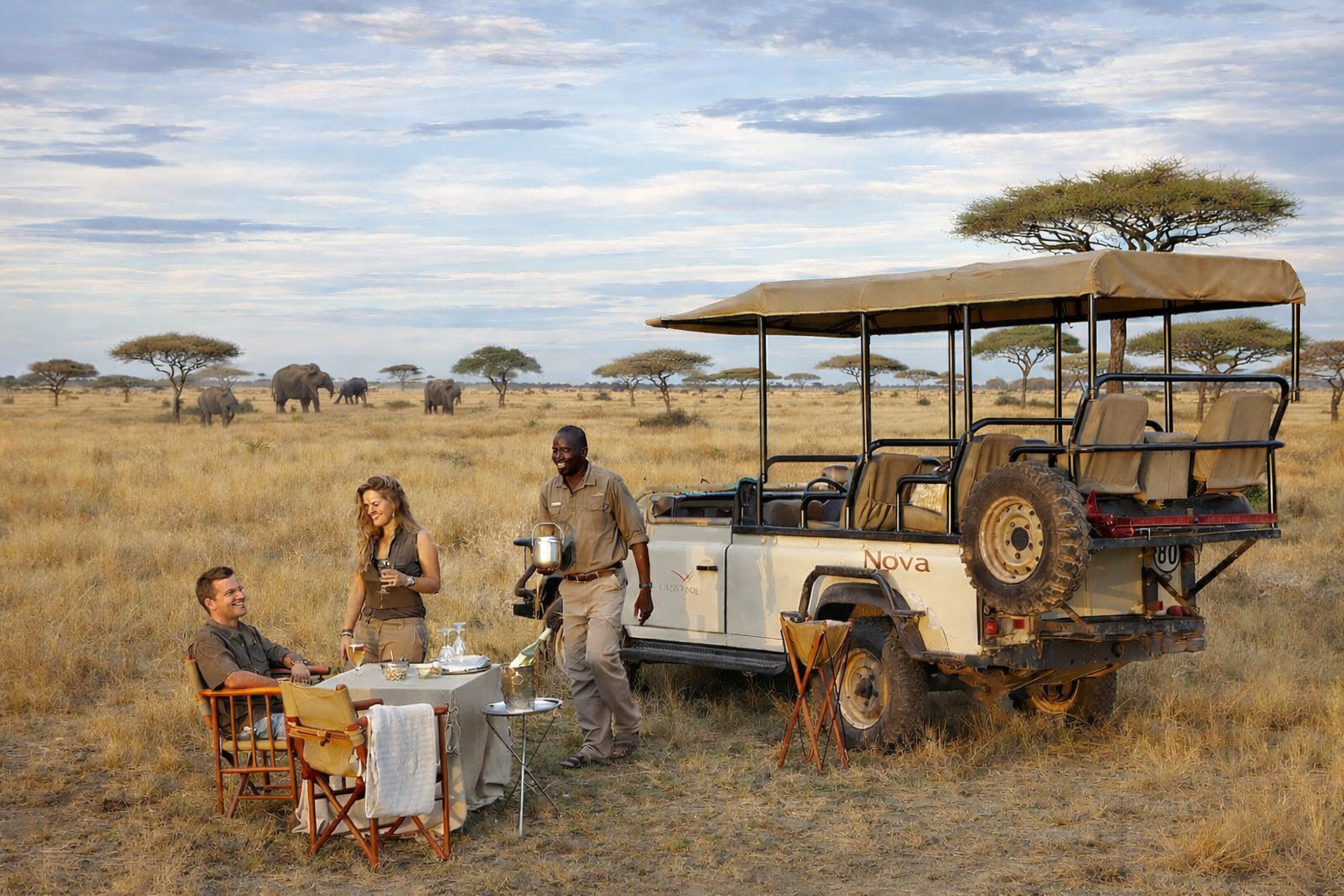
Dining flexibility. Romantic camps will move dinner anywhere on the property — the riverbank, the top of a kopje, the open plains — with enough advance notice. A candlelit dinner on the Mara plains with a private chef, no other guests in sight, and the sounds of the bush in the dark is one of the most consistently described peak honeymoon memories in any Kenya travel review database. Camps that only serve dinner in the dining room are good lodges, not romantic lodges.
Guide relationship. The best honeymoon guides understand that their role is partly that of a facilitator of romance — positioning the vehicle for the most beautiful light at sunset, knowing when a couple wants silence and when they want information, being unhurried enough to allow the moment to breathe. This is a skill specific to guides who work with couples rather than groups, and it is worth asking about specifically when booking.
Sunrise and sunset rituals. Every romantic Kenya camp should offer sundowners — drinks served at a specific viewpoint chosen that day by the guide, set up with candles and a small table in the open bush. This is standard but varies enormously in quality. The best camps choose the viewpoint for the specific light conditions of that evening. The least effort ones stop at the same kopje every evening at 5:30pm.
The top honeymoon camps in Kenya
The coast add-on — where to go after the bush
Most Kenya honeymoons end with the coast — and the transition from bush to beach is one of the most satisfying two-act structures available in any honeymoon destination. The inland safari delivers intensity: early mornings, wildlife, dust, movement, the controlled drama of predator-prey encounters. The coast delivers release: warm water, slow time, food that arrives unhurried, the specific pleasure of having nowhere urgent to go.
Lamu Island — The most romantic Kenya coast option for couples who want culture with their beach. No motor vehicles, 700 years of Swahili architecture, the Peponi Hotel on Shela Beach (family-run since 1967, the most beloved hotel on the Kenya coast), private dhow charters at sunset, and Swahili houses available to rent from $250/night with private cooks. Lamu is specifically recommended for honeymooners who find Diani’s resort infrastructure slightly too generic for a honeymoon context. The sense of arriving somewhere genuinely different — reached by propeller aircraft and a short boat crossing, with no cars and no familiar brands — is part of the romance.
Diani Beach — The most logistically straightforward coast option. A 1-hour charter flight from Wilson Airport (or 2.5 hours by road from Tsavo East). The best honeymoon properties here are Kinondo Kwetu — a 14-room boutique hotel on a private beach stretch with horse riding, intimate scale, and a Swedish-Kenyan ownership that creates a personal warmth uncommon in resort environments — and Alfajiri Cliff Villa, a private villa perched on a coral cliff above the Indian Ocean with a private pool and an infinity view that photographs look manipulated until you are actually standing in front of it. Kinondo Kwetu was reportedly a personal favourite of the King of Sweden.
Manda Bay, Lamu Archipelago — For couples who want the absolute maximum in privacy. A small lodge on Manda Island, accessible only by the hotel’s own boat, with individual beachfront bandas separated by enough distance to feel genuinely private. The Lamu Archipelago surrounding it — dhow channels, mangrove systems, uninhabited islands — constitutes one of the most beautiful and unspoiled coastal environments in East Africa. A honeymoon at Manda Bay is the experience that the Kenya coast industry aspires to and rarely matches.
Best time for a Kenya honeymoon
The honest answer is that Kenya is romantic in any month that is not the long rains of April and May — and even then, there are couples for whom the lush, rain-green Mara and an intimate rain-quiet camp constitutes a deeply romantic setting. The conventional wisdom — go July to October for the migration — is correct for wildlife intensity and the Mara River crossings. But it is worth examining what you are actually optimising for.
For maximum wildlife drama and the Great Migration — July to October. Specifically: late July through September for Mara River crossings; July and October for lower vehicle numbers in the reserve (avoid August if vehicle queues at sightings would compromise the intimate experience a honeymoon requires); the private conservancies throughout for isolation regardless of month.
For a more private, more intimate, more affordable experience — January to March. The long dry season is ending or has ended; the landscape is warm and clear; Kilimanjaro is at its most visible from Amboseli and Tsavo; the Mara park fee is at the lower January–June rate; camps are at 50–70% occupancy rather than 95%; and the ratio of private moments to crowded viewpoints is dramatically better than August. Many experienced Kenya guides consider January their personal favourite month for couples. The wildlife is outstanding. The crowds are absent.
For green season romance — November is the most underused romantic month in Kenya. The short rains fall mostly in the afternoons and evenings. Morning game drives are clear, the landscape is intensely green and photogenic, migratory birds fill the acacia trees, and accommodation rates are 20–30% below peak. A November honeymoon at Cottar’s or Saruni — near-empty camps, gorgeous green landscapes, full wildlife — is as romantic as August at twice the price.
What a Kenya honeymoon actually costs
The range of Kenya honeymoon options is genuinely wide, and understanding the cost structure is necessary for managing expectations and making good decisions.
| Tier | Camp examples | Per person per night | 7-night total (per person) |
|---|---|---|---|
| Romantic mid-range | Saruni Mara · Offbeat Mara · Rekero | $650–900 | ~$5,000–6,500 |
| Luxury romantic | Mahali Mzuri · Angama Mara · Cottar’s | $1,000–1,500 | ~$8,000–12,000 |
| Ultra-luxury | andBeyond Bateleur · Finch Hattons · Lewa House | $1,500–2,500+ | ~$12,000–20,000+ |
Add to camp rates: charter flights ($150–300 per person per leg), Kenya eTA ($30), balloon safari if desired ($450–550 per person), beach extension accommodation, and tips ($15–20 per guide per day, $10–15 per camp staff member per night). A complete 10-night Kenya honeymoon — 7 nights safari, 3 nights coast — at the luxury tier typically totals $15,000–25,000 per couple excluding international flights. At the romantic mid-range tier, the same duration runs $8,000–13,000 per couple.
The most important cost optimisation for a honeymoon: prioritise camp quality over park diversity. Two camps of exceptional quality, 4–5 nights each, will produce a more romantic and memorable experience than four camps of moderate quality covering four parks in the same duration. The depth of relationship with a specific landscape, a specific wildlife community, and a specific guide — achieved through 4–5 nights rather than 2 — is the foundation of the Kenya honeymoon experience that couples describe for the rest of their lives.
The romantic experiences money can buy — and one it can’t
These are the specific add-on experiences that distinguish a honeymoon safari from a regular safari and that are worth the additional investment:
- Private balloon safari ($450–550 per person) — Dawn departure, an hour above the plains, champagne bush breakfast on landing. Worth doing once in a lifetime. The Mara is the classic location; the Laikipia balloon from Loisaba provides a less-marketed alternative with Bortle Class 2 visibility at dawn.
- Private bush dinner (usually complimentary when honeymoon is flagged, otherwise $100–200) — Table, chairs, candles, a dedicated chef, no other guests. The location chosen by your guide for that evening’s conditions. The best-remembered single meal of most Kenya honeymoons.
- Sunrise game drive in a private conservancy — Not the standard camp departure. An earlier, private departure, specifically timed and positioned for the first light over the Mara or the Laikipia plains. This requires advance coordination with the guide — ask before you arrive.
- Private dhow charter in Lamu (approximately $150–300 for a half-day charter) — A traditional sail dhow, a captain, a packed lunch, and the Lamu channel at sunset with no agenda. This experience exists nowhere else and requires no infrastructure beyond the willingness to stop moving.
- The one experience no money can provide: sitting quietly in a vehicle while a female lion nurses three cubs twenty metres away in the evening light, with no other vehicle in sight, your guide not speaking, the plains extending to the horizon, and the specific realisation that this moment exists in no brochure, no itinerary, and no previous human plan — it simply happened because you were here. This is what Kenya keeps. It costs nothing and cannot be scheduled. It is also, reliably, what couples talk about for the rest of their lives.
More Guides:
Mara River Crossing: How to Be There at the Right Time
Where to Stay in Diani Beach and Lamu — Every Hotel Rated 2026
Lamu Island Travel Guide: Kenya’s Most Extraordinary Coastal Destination (2026)
Where to Stay in Tsavo East and West — Every Lodge Rated 2026
Private Conservancy vs National Reserve Kenya: The Complete Honest Guide (2026)
Kenya Tanzania Safari — The Complete Combined Guide 2026
How much does a Kenya safari cost in 2026? The honest breakdown