
The question no one answers honestly
Every Kenya safari website answers “best time to visit” the same way: go in July to October for the Great Migration, dry season is better, book early. This is accurate and nearly useless. It is accurate because July to October genuinely is peak season with outstanding wildlife. It is nearly useless because it tells you nothing about whether April is actually as bad as everyone says, whether January beats October for photography, what the Mara is like in June before the crowds arrive, or why some of the most experienced Kenya guides quietly prefer March over August.
This guide is different. It will tell you that August is overrated — the most crowded, most expensive, and often most frustrating month to be at the Mara, where the combination of school holidays and migration marketing creates vehicle queues at river crossings that no amount of photographic opportunity fully compensates for. It will tell you that October is underrated — dry, hot, excellent predator activity, the first rains beginning to green the landscape, and about 40% fewer vehicles at sightings than August. It will tell you that the short rains of November fall mostly in the afternoons and rarely affect morning game drives, meaning you get lush, post-rain photography conditions with green season prices and dry season wildlife. And it will tell you that January and February are when the guides who live in the Mara choose to bring their own families.
Kenya’s four seasons — what they actually mean on the ground
Kenya sits on the equator, which means it does not have the conventional four-season structure of temperate climates. Instead, it has two dry seasons and two wet seasons, whose character and impact vary dramatically by region, altitude, and the specific parks you are visiting. Understanding this structure is the foundation of any useful timing decision.
The Long Dry Season (June–October) is the classic safari period. Rain is minimal or absent across most of Kenya. Vegetation thins and dries, exposing soil and making wildlife visible at greater distances. Animals concentrate at permanent water sources — rivers, swamps, dams — creating spectacular viewing at predictable locations. Temperatures are comfortable: warm days in the 22–28°C range, cool or cold nights at altitude. This is the Great Migration period in the Maasai Mara. Park fees in the Mara double on July 1 (to $200/day) and remain elevated through December. Lodges and camps are at peak occupancy and peak pricing. The best camps book out 9–12 months in advance for August.
The Short Dry Season (January–February) is the most underappreciated window in the Kenya safari calendar. Two months of dry, warm, clear weather — warmer than June to October, with daytime temperatures reaching 28–32°C in most parks. The vegetation is shorter than at the end of the long rains, making wildlife visibility excellent. Park fees are at the lower rate in the Mara ($100/day). Visitor numbers are significantly lower than peak season. Kilimanjaro is most visible from Amboseli and Tsavo West during these months. The coast is at its best. Baby animals are abundant — many herbivores calve in January and February, creating intense predator activity. This is when senior guides bring their families.
The Long Rains (March–May) are Kenya’s most challenging period for traditional safari. Rain falls persistently, often for extended periods, making many unpaved tracks impassable — particularly in Tsavo East and parts of the Mara. Some camps close for maintenance in April and May. Wildlife disperses away from permanent water as temporary water sources appear everywhere, making game viewing harder and less predictable. Visibility is reduced by dense green vegetation. However: the landscape is extraordinary to photograph, prices drop 30–40%, and some camps and parks — particularly Laikipia, which drains well, and the Mara Triangle — remain accessible throughout. If you are flexible about specific wildlife encounters and primarily motivated by cost, the long rains are an option.
The Short Rains (October–December) are frequently misunderstood and systematically underused. The rains begin in late October or November and typically fall as afternoon or evening showers — not the persistent all-day rain of April and May. Morning game drives are almost always unaffected. The landscape greens rapidly, producing the lush, photogenic “green season” aesthetic with brown-season wildlife density. Migratory birds arrive from Europe and Asia, making this the best birdwatching period. Camps remain open and accessible. Prices in November are significantly below peak season. October specifically — the final month of the dry season, before significant rain — is arguably the best-value month in the Kenya calendar: dry conditions, excellent wildlife, lower prices, and dramatically fewer vehicles at sightings than August and September.
Month-by-month guide — every month rated honestly
The Great Migration timing — the honest calendar
The Great Migration is the most marketed wildlife event in Africa and also the most misunderstood. Every piece of Kenya safari marketing implies the migration is in the Maasai Mara from July to October, that river crossings are reliably spectacular throughout this period, and that seeing the migration is primarily a matter of showing up. All of this is partially true and significantly misleading.
The truth: the migration is a year-round circuit of approximately 1.5 million wildebeest and 300,000 zebra across the Mara-Serengeti ecosystem. At any given time, the animals are somewhere in the circuit. Here is what is actually happening month by month:
- January–February — The herds are in the southern Serengeti (Tanzania) for calving season. Between 8,000 and 10,000 calves are born every day in late January and February. This is extraordinary wildlife viewing — lion and cheetah predation on calves is relentless. It is not in Kenya, but it is the most dramatic predator-prey event in the annual cycle.
- March–May — The herds move north and west through the Serengeti, following the rains. This movement is gradual and the animals are spread across vast areas. Not the river crossing spectacle but genuinely impressive in scale.
- June–early July — The herds begin approaching the Mara River from the south, staging in the northern Serengeti. First animals may enter Kenya in late June.
- July–October — The Mara phase. The herds cross the Mara River into Kenya, graze the Mara’s plains, and eventually return to Tanzania. The famous river crossings happen during this period — but not on a predictable schedule. The herds may cross at one point for three days, disappear for two weeks, then cross at a different location. No one can guarantee a crossing on any given day. The guests who see the best crossings are those who commit to staying near the river for extended periods rather than racing back to camp for lunch.
- October–November — The herds gradually return to Tanzania, following the short rains south. Crossings in the opposite direction (Kenya to Tanzania) are less dramatic but still occur.
The single most important piece of advice about migration timing: a good guide in a private conservancy in late September will out-perform a bad guide in a shared vehicle on the reserve in peak August, every time. The crossing itself lasts 20–40 minutes. The guide who positioned you correctly for that crossing spent 3 hours reading animal behaviour, water levels, and herding patterns. Position and interpretation matter more than the calendar.
Best time by park — comparison table
| Park / Destination | Peak Season | Best Value Window | Avoid | Distinctive Factor |
|---|---|---|---|---|
| Maasai Mara (reserve) | Aug–Sept (migration) | Oct · Jan–Feb | Apr–May | Park fee doubles Jul–Dec ($200/day) |
| Mara Conservancies | Jul–Oct | Jan–Feb · Jun | Apr–May | Vehicle limits make Aug manageable |
| Amboseli | Jan–Feb (Kili views) | Jun–Sept | Apr–May | Best Kilimanjaro photography Jan–Feb |
| Samburu | Jun–Oct | Jan–Feb | Apr–May | Year-round but driest Jun–Oct |
| Laikipia | Jun–Sept | Jan–Mar | Apr–May (partial) | Higher altitude — better Apr–May than most |
| Tsavo East / West | Jun–Oct | Jan–Feb | Apr–May | Red elephants best Jul–Oct (dusty season) |
| Diani Beach | Dec–Mar · Jul–Oct | Nov | Apr–Jun | Whale sharks Oct–Apr · Kitesurfing Jul–Sept |
| Lamu Island | Jul–Oct · Jan–Mar | Nov–Dec | Apr–Jun | Cultural festival Jan–Feb · Kite season Jul–Sept |
| Nairobi | Year-round | Any | None | Altitude keeps it cool year-round |
Best time for the Kenya coast and beaches
The Kenya coast operates on a different seasonal logic from the interior safari parks. The coast is hotter and more humid year-round (temperatures 28–35°C), experiences the same two rainy seasons but with different intensity patterns, and has its own set of activity-specific timing considerations.
The single best combined Kenya itinerary for timing: arrive late January, 3–4 nights Amboseli (Kilimanjaro photography at its best), 3–4 nights Maasai Mara conservancy (excellent wildlife, lower prices, lighter crowds than peak season), 3–4 nights Diani Beach (peak coast season). This itinerary misses the Great Migration river crossings but delivers everything else Kenya is famous for at lower prices, with more space, and better Kilimanjaro photography than any August trip will produce.
The honest case for going in the green season
The long rains (April–May) are the period that Kenya safari marketing most aggressively discourages. The prices are also 30–40% lower than peak season. Before you dismiss the green season entirely, consider what it actually offers:
- The landscape is extraordinary. The Mara in May is a completely different visual experience from the Mara in August. The plains are a deep, vibrant green — the yellow-brown dustiness of the dry season replaced by a lushness that makes the same landscape look like a different country. For landscape photography, this is arguable Kenya’s most photogenic period.
- Resident wildlife doesn’t leave. Lions, leopards, cheetahs, elephants, giraffes, buffalo, and the resident zebra and wildebeest populations are present year-round. The animals haven’t gone anywhere. The vegetation is denser, making them harder to spot — but an experienced guide in a private conservancy can still find them.
- Birdlife is extraordinary. Migratory birds from Europe, Asia, and other parts of Africa are present in vast numbers from November through April. November and April specifically are peak birding months in Kenya. If you have any interest in birds, the green season is dramatically better than August.
- The camps are nearly empty. The experience of having a camp, a guide, and a vehicle essentially to yourself — an experience that costs $1,500/night in August — is available in some properties for under $600 in April. The exclusivity that luxury guests are paying enormous premiums for is simply the ambient condition of the green season.
- Laikipia works in all seasons. The plateau’s volcanic soil drains quickly, and most conservancy tracks in Laikipia remain accessible throughout the year. If you are determined to visit Kenya in April or May, Laikipia is the best destination choice.
The honest limitation: some tracks in Tsavo East, parts of the Mara reserve, and lower-lying areas become genuinely impassable after heavy rain. If you are planning a green season trip, choose camps with good track records for accessibility during rain — conservancy camps with active track management are more reliable than reserve camps that share tracks with unlimited vehicle traffic.
Peak season: what the crowds and costs actually look like
August in the Maasai Mara National Reserve is the most crowded game viewing experience in East Africa. During the peak of school holiday season, with the migration crossings at their most active, the main reserve crossing points can see 20–40 vehicles queued and waiting at a single point on the Mara River. When a crossing begins, the spectacle is extraordinary but the experience is mediated through a wall of other vehicles, telephoto lenses, and noise. This is the reality of “peak season in the reserve” that migration marketing rarely addresses.
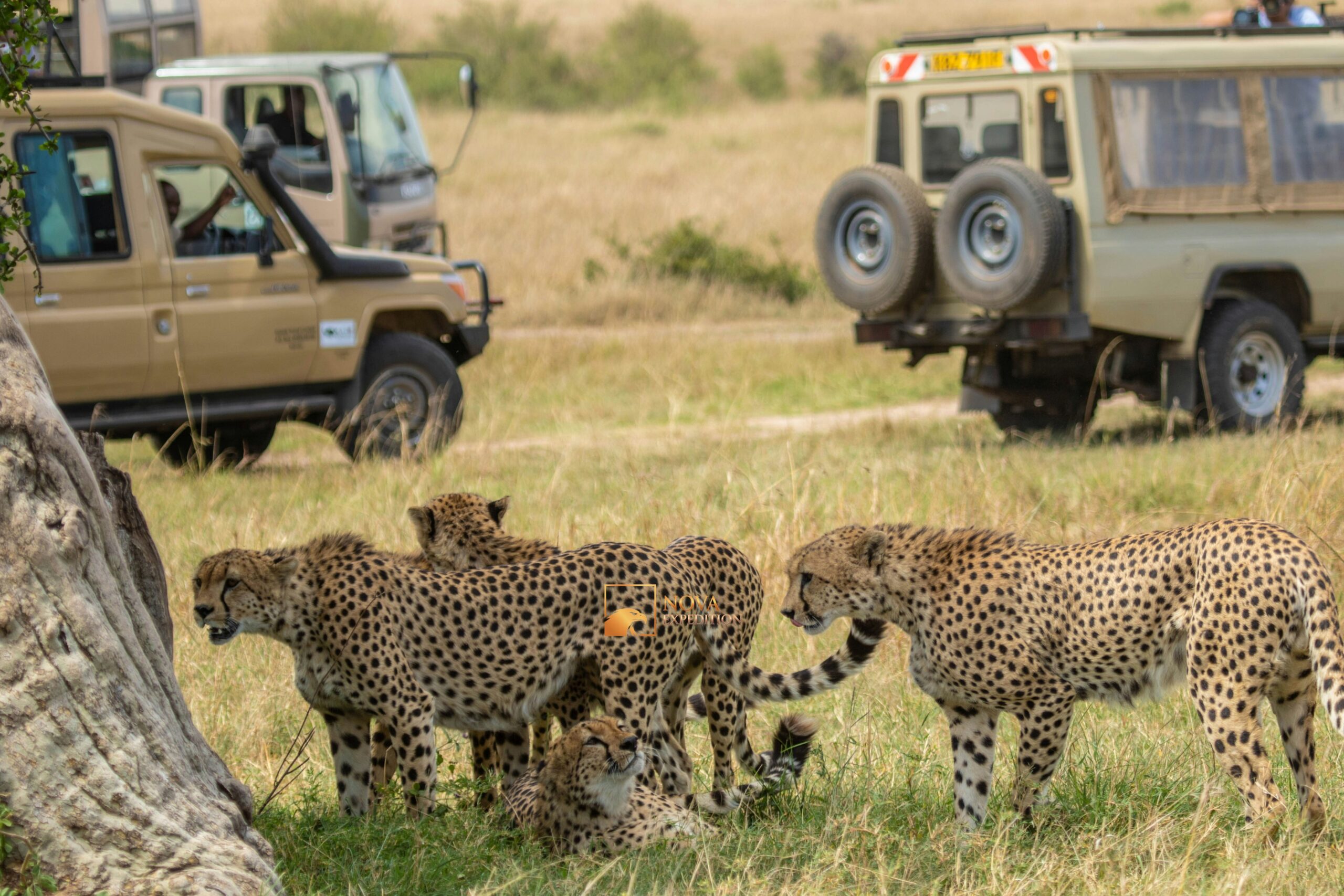
The private conservancies surrounding the reserve operate with strict vehicle limits — typically 3–5 vehicles maximum at any single sighting. In August, these limits are enforced regardless of season. A Mara North Conservancy cheetah hunt in August looks nothing like the same event in the reserve: two vehicles, no noise, animals behaving naturally, a guide who can position without competing with 30 other drivers. The cost difference between a reserve camp and a conservancy camp in August is often only 15–25%. The experience difference is categorical.
The underrated sweet spots most guides miss
June — the best value month in Kenya. The long rains are ending. The landscape retains its green-season lushness while tracks are drying and becoming accessible. The first migration herds begin appearing in the Mara from late June. The Mara park fee is still at the lower January–June rate ($100/day). Camps are at 50–70% occupancy rather than 95%. There are almost no vehicles at wildlife sightings. The animals are active and concentrated. A 5-night June trip to the Mara in a mid-range conservancy camp delivers better guiding attention, more exclusive wildlife encounters, and a more beautiful landscape than a 5-night August trip at significantly higher cost.
October — the quiet peak. The migration is winding down but the resident wildlife is at its best — concentrated at water sources, lean and predatory after months of competition, with the landscape still dry and open for visibility. Park fees remain at the $200 rate in the Mara reserve, but conservancy fees are unchanged. Visitor numbers are 30–40% below August. Short rains begin in late October — usually afternoon showers that don’t affect morning drives. October is consistently the month that experienced Kenya travellers list as their personal favourite.
Late January — Amboseli and Tsavo. The clearest Kilimanjaro photography conditions of the year, combined with the best predator activity (calving season brings intense lion and cheetah action), combined with lower-than-peak-season prices and crowd levels. A 7-night itinerary combining Amboseli (3 nights, Kilimanjaro dawn photography, elephant research context) and Tsavo West (4 nights, Mzima Springs, Shetani Lava, maneless lions) in late January is one of the most rewarding and underpriced Kenya itineraries available.
What to ask your operator before you book
Armed with this information, the right questions to ask any Kenya safari operator before committing to dates:
- “What are the vehicle limits at sightings in this camp’s conservancy or reserve?” The answer reveals whether your wildlife encounters will be shared with 30 other vehicles or observed by 3.
- “What is the park or conservancy fee, and is it included in your quoted rate?” The Mara fee doubles on July 1. A quote that doesn’t include this suddenly costs $200/person/day more than it appeared.
- “In your experience with this specific camp, what month produces the best wildlife combined with the best value?” Honest operators will often say June or October, not August.
- “If we’re travelling in [your month], are there any tracks or areas of the park that may be inaccessible?” This is essential for March, April, May, and November visits.
- “Is the camp fenced or unfenced?” Relevant for families with children. Unfenced is more authentic; fenced is more manageable with small children.
- “What is your guide’s specific experience in this ecosystem?” A guide who has worked the same conservancy for 10 years has irreplaceable knowledge. A guide who rotates between parks is competent but not specialist.
More Safari Guides:
Mara River Crossing: How to Be There at the Right Time
Private Conservancy vs National Reserve Kenya: The Complete Honest Guide (2026)
Where to Stay in Tsavo East and West — Every Lodge Rated 2026 | Nova Expedition Kenya
Maasai Mara vs Serengeti: Which African Safari is Better? (2026 Honest Guide)
Lamu Island Travel Guide: Kenya’s Most Extraordinary Coastal Destination (2026)
Best Lodges in the Maasai Mara 2026: From Ultra-Luxury to Best Value