
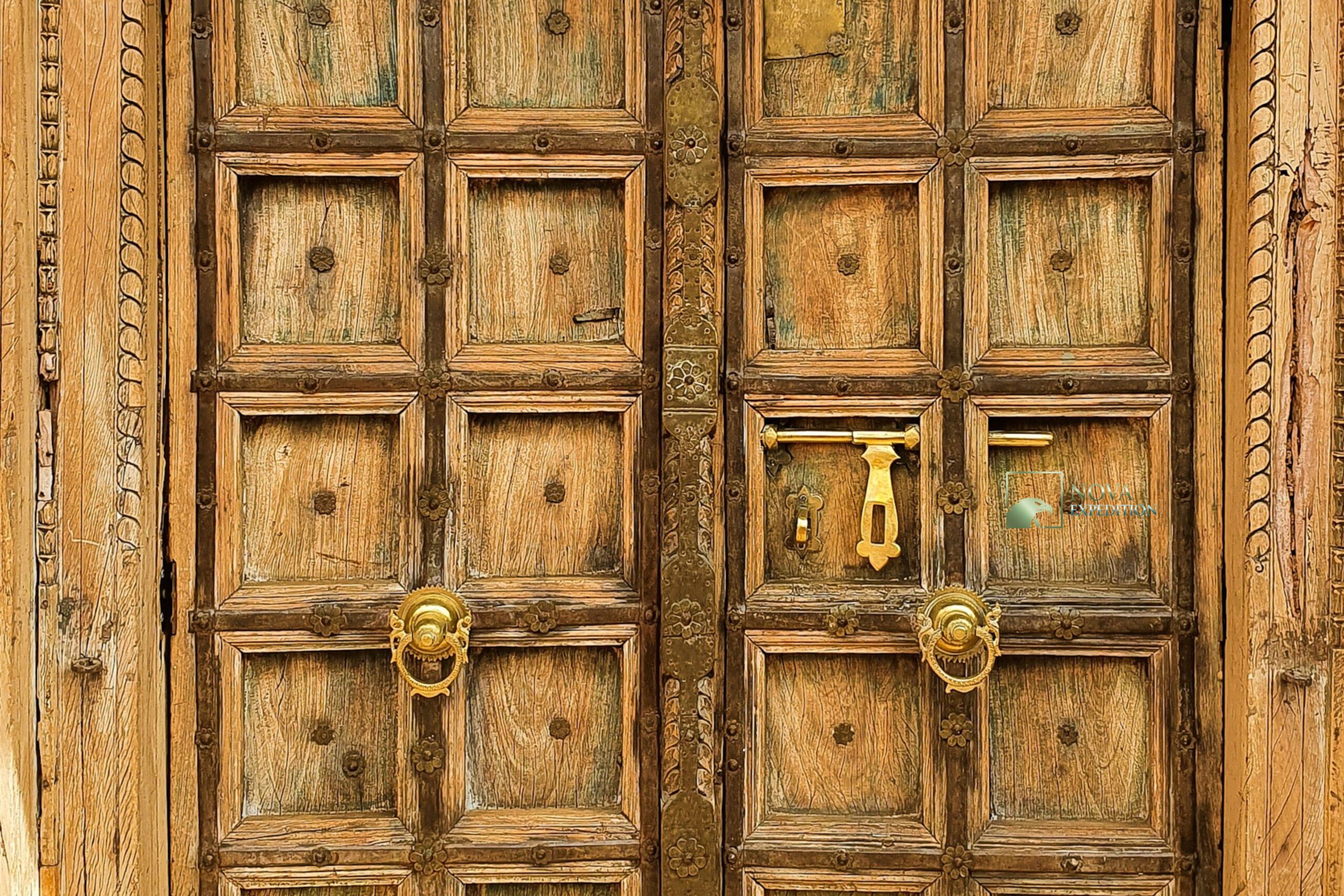

Every alleyway in Lamu holds a communication system most visitors photograph without reading. The carved doors encode a civilisation — African, Arab, Persian, Indian, and European convergence over seven centuries. A field guide to reading them, the master carvers who keep the craft alive, and the honest history behind the beauty.
What the doors are actually saying
The most photographed thing in Lamu — the feature on every magazine feature, every travel post, every visitor’s camera roll — is the carved wooden doors. They appear in the narrow alleyways of the Old Town with a casual magnificence that stops you mid-stride: three to four metres high, covered in interlocking geometric patterns, calligraphic inscriptions, floral motifs, and brass fittings. No two are identical. Some are well over a century old; the carving styles behind them stretch back centuries further. Most visitors photograph them and move on, unaware that they are looking at a text rather than an ornament.
What they are photographing, without knowing it, is a communication system. In Lamu’s Swahili society, a door was never merely decorative. Every carved panel encoded information about the household behind it: the family’s ethnic origin, religious affiliation, social standing, trade connections, and wealth. A literate member of the old Swahili merchant class, walking through Lamu’s alleyways, could read the town’s social structure from its doorways without entering a single building. The doors functioned as the public-facing identity of the families behind them — a status display, a statement of origin, and a record of the trade networks that built the household’s fortune.
This is what makes Lamu’s doors extraordinary in a way that goes beyond their visual beauty. They are not art objects that happen to function as doors; they are a communication medium, a social record, and a living architectural tradition that emerged from seven hundred years of cultural convergence — the point where African, Arab, Persian, Indian, and eventually European influences met and produced something that exists nowhere else on Earth. This article is a field guide to reading them: the styles and what they signify, the master carvers who keep the craft alive, the history (including the uncomfortable parts) that produced them, and how to actually look at a door when you are standing in front of one.
Lamu's carved doors are a written record of a civilisation, legible to anyone who learns the vocabulary. Reading them transforms a walk through the Old Town from sightseeing into something closer to reading the town's biography in wood — and it is the single richest cultural experience the island offers.
| DOCUMENTED DOOR STYLES Eight, per National Museums of Kenya (Lamu curator M. A. Mwenje) | OLDEST CARVING INFLUENCES Trace back centuries; surviving doors largely 18th-19th century |
| PRINCIPAL LIVING MASTER CARVER Ali Abdalla Skanda (Wiyoni workshop, carving since age 12) | KIJUMWA STYLE NAMESAKE Mohamadi/Ahmed Kijumwa, b.1876 Lamu, d.1946 — poet, carver, historian |
| SKANDA’S CARVING LINEAGE Kijumwa → his son Helewa Ahmed → Skanda | TIME TO CARVE A STANDARD DOOR Up to ~2 months of full-time work |
| COST OF A QUALITY CARVED DOOR KSh 120,000-500,000 (approx. $900-3,800) | PRIMARY TIMBER African mahogany and other indigenous hardwoods |
The eight door styles — a field guide
According to the National Museums of Kenya’s curator at Lamu, Mohammed Ali Mwenje, eight distinct door styles have been documented in Lamu Old Town. Each reflects a different strand of the archipelago’s history, and learning to distinguish them is what turns a wall of beautiful doors into a readable record of who built the town and where they came from.
The Lamu style
The baseline Swahili door — the original, from which the others diverge. It features a central panel flanked by narrow side panels, geometric patterns based on interlocking triangles and squares, and a characteristic round brass central boss. The carving is deep and bold. When you see a Lamu door that looks ‘typical,’ you are almost certainly looking at a Lamu-style door or a close derivative. It is the foundation grammar of the whole tradition.
The Siyu style
Named after the settlement of Siyu on nearby Pate Island, a rival Swahili city-state that developed its own architectural vocabulary. Siyu doors tend to have more elongated proportions and a distinctive treatment of the central panel that experienced observers distinguish immediately. Their presence in Lamu town reflects the commercial and cultural connections that ran between the islands of the archipelago — the doors travelled, or the carvers did, or both.
The Bajuni style
Associated with the Bajuni fishing people who occupy the islands between Lamu and the Somali border. The Bajuni style is simpler and more linear than the Lamu style, with less deep-relief carving and more emphasis on inscribed geometric patterns. It represents the craft tradition of communities whose primary economic activity was maritime rather than mercantile — a working aesthetic rather than a merchant’s display.
The Omani style
Arrived during Lamu’s Omani-influenced period and introduced elements from the Islamic decorative tradition of the Arabian Peninsula: larger-scale geometric patterns, more prominent calligraphic inscriptions (often Quranic verses), and a broader overall visual statement. A defining technical feature of the Omani style is that each decorative element is carved out simply in a V-shaped groove, rather than being modelled into three-dimensional form. Carvers consistently describe the Omani style as difficult and its patterns as limited mainly to doors, which is part of why modern Lamu carvers tend to prefer the more adaptable Swahili-derived styles for furniture and general work.
The Gujarati style
Reflects the Indian merchant community whose presence in Lamu dates back centuries. Gujarati craftsmen from western India brought a highly developed woodcarving tradition of their own — intricate lattice work, carved vegetal patterns, and a characteristic treatment of the lower panel with small repeated foliate motifs. When Gujarati merchants settled in Lamu and commissioned doors, their craftsmen brought this tradition with them, creating a fusion that sits distinctively between the Swahili and Indian decorative vocabularies. Its free-flowing design is admired but, because of its complicated technique, it is rarely copied by modern carvers.
The Zanzibar style
Also of Indian origin but evolved through Zanzibar’s own merchant class, tending toward even richer surface decoration than the Gujarati style — more intricate lattice, deeper carving, and elaborate brass-stud details that create a three-dimensional surface texture visible from a distance. Critically, where the Omani style carves each element as a simple V-groove, the Zanzibar style requires modelling decorative elements into much more realistic, sculptural form — a far harder technical task. Carvers from Lamu, Malindi, and Mombasa generally do not attempt the Zanzibar style, because it demands skills most of them do not possess; its finest examples remain concentrated in Zanzibar’s own old town.
The Indian neoclassical style
Arrived later, reflecting European architectural ideas filtered through the colonial-era Indian merchant community. These doors often incorporate pilaster elements, pediment-like arrangements above the frame, and a more symmetrical, monumental composition influenced by Western classical architecture. They are the most obviously hybrid objects in the Lamu door canon — Indian craft, European form, Swahili setting, Islamic context, all in one doorway.
The Kijumwa style
The eighth style, and the one most beloved by Lamu’s contemporary craft community. It is the only style named after an individual carver, and it is the subject of its own section below, because the story of Kijumwa is also the story of how the tradition stayed alive into the present.
Lamu’s Golden Age and the Omani influence
To understand the doors fully, you need to understand when Lamu built them. The town’s architectural peak — the period when the grandest houses were constructed and the most elaborate doors carved — coincides broadly with the era of Omani Arab ascendancy on the Swahili coast, which displaced Portuguese control through the late seventeenth and eighteenth centuries and extended through the mid-nineteenth. This was Lamu’s Golden Age, and the surviving grand doors of the Old Town are overwhelmingly products of the eighteenth and nineteenth centuries.
The Omanis arrived as political overlords replacing the Portuguese, who had contested the coast since the early sixteenth century. What the Omanis found at Lamu was a sophisticated Swahili merchant society with its own architectural tradition, artistic vocabulary, and social hierarchy. Rather than imposing an alien culture wholesale, they became part of the existing social fabric — intermarrying with Swahili families, adopting local building techniques, and contributing their own decorative traditions to an already syncretic culture. The result was an architectural flowering that filled the Old Town with the buildings and doors that still define it today. The Omani style of carving is one visible legacy of this period; the broader Omani influence runs through the town’s whole built environment.
A note on dates: specific years attached to Lamu’s Omani period (such as a precise 1698 start) appear in some accounts, but the transition from Portuguese to Omani dominance on this stretch of coast was a process spanning decades rather than a single dated event, and the historical record is less precise than round numbers suggest. The directional history is solid — Portuguese contested control gave way to Omani ascendancy across the late 1600s and 1700s, and Lamu’s golden age of building followed. The exact year is less certain than the trajectory.
The honest history — Lamu’s Golden Age and the slave trade
Any honest account of Lamu’s prosperity must include the part the heritage-tourism narrative tends to elide: the town’s wealth was built substantially on its position in the Indian Ocean slave trade. The grand houses, the elaborate doors, the imported porcelain and the painted ceilings were financed in significant part by an economy in which enslaved people were among the traded commodities, alongside ivory, gold, mangrove poles, and the goods that flowed in return.
The British pressure that forced the closure of the East African slave trade in the latter nineteenth century — the key treaties came in the 1870s — removed the economic foundation on which much of that prosperity rested. Lamu’s wealth collapsed, and the town entered a long, quiet decline. The irony of preservation is that this decline is precisely why Lamu survives as it does: no one had the money or motivation to demolish the old houses and build something new, so the Golden Age architecture was preserved essentially intact, frozen at its nineteenth-century peak. The beauty visitors photograph today exists partly because the economy that built it died and left the buildings standing.
This is not a reason to avoid Lamu or to feel guilt while admiring its architecture. It is a reason to look at the doors with fuller understanding. The carved doors are genuinely magnificent works of craft and culture; they are also artefacts of a complex and partly painful history. Holding both truths at once — the beauty and the history that financed it — is what distinguishes informed cultural travel from decorative consumption. The best Lamu guides tell this fuller story; the best visitors want to hear it.
Inside the houses — madaka, porcelain, and painted ceilings
The door is the public face. The interior of a Lamu merchant house is an entirely different world — an intimate, inward-facing environment of courtyards, decorated rooms, and accumulated cultural objects that reveals more about the occupants than any exterior could.
The most distinctive interior feature is the madaka — large decorative plaster niches set into the walls of the main reception room at regular intervals, often reaching from shoulder height toward the ceiling. In historical houses, the madaka held oil lamps, incense burners, Quranic texts, and the most prized decorative objects of the household. They are functional display cases built into the architecture itself, an expression of the Swahili aesthetic principle that objects of beauty should be integrated into their setting rather than merely placed in it.
More surprising to most visitors is the Chinese porcelain. Throughout the most prominent Lamu houses, antique Chinese porcelain — bowls, plates, and decorative pieces — was embedded into the walls, particularly around the madaka and above doorways. This is not modern decorative appropriation; these are objects that arrived in Lamu as trade goods from the Far East through the Indian Ocean network, in the same ships that brought Arab scholars, Indian merchants, and Persian craftsmen. Their presence in the walls is a silent record of Lamu’s position at the centre of a trading system that connected East Africa to China, India, the Arabian Peninsula, and beyond, across the world’s largest ocean.
The painted ceilings of Lamu’s best-preserved historic houses are a separate tradition entirely — geometric patterns in ochre, white, and deep blue on plaster, reflecting both African and Islamic decorative traditions and applied with skill that required specialist craftsmen. The Swahili House Museum on the main street of Lamu Old Town is the best surviving example of a fully furnished and restored Lamu merchant house, with madaka, painted ceilings, and original furniture intact. Visiting it is the single most revealing experience available to any visitor trying to understand how the Old Town actually worked as a living environment, rather than as a streetscape of beautiful facades.
The master carvers — Skanda and the Kijumwa legacy
The person most responsible for the continuation of Lamu’s carving tradition is Ali Abdalla Skanda, working from his workshop in the Wiyoni area of Lamu Island. Skanda has been carving since he was twelve years old — over four decades of continuous practice in a craft that requires sustained patience and deep technical knowledge. He learned not in a classroom but through apprenticeship, in the traditional manner.
He is not primarily a tourist-facing craftsman: his major commissions include the main door of Kenya’s Parliament Buildings in Nairobi (carved in the Kijumwa style) and an estimated ninety per cent of the major door decorations in Lamu’s most significant historic buildings. He comes from a family of craftsmen and dhow-builders whose trade once reached as far as Egypt and Arabia, and he has been recognised internationally, including at the Smithsonian Folklife Festival.
Skanda works in African mahogany and other indigenous hardwoods. The carving process begins with the framework — the door’s structural proportions, the division of panels, the overall visual hierarchy — before moving to the surface decoration, built up in layers from the deepest relief to the finest detail. A standard carved door of high quality takes up to around two months of full-time work, and a quality piece currently costs between roughly KSh 120,000 and KSh 500,000 (approximately $900 to $3,800) depending on complexity, size, and timber. Qualifying as a competent carver takes roughly six months of dedicated learning for those genuinely committed; mastery takes a lifetime.
The style Skanda is most associated with — and the one contemporary Lamu carvers most study — is the Kijumwa style, developed by the master carver Mohamadi (Ahmed Abubakar Omar) Kijumwa, born in Lamu in 1876 and died in 1946. Kijumwa was far more than a carver: he was a celebrated poet, calligrapher, historian, and musician, one of the significant Swahili cultural figures of his era.
As a carver he was the first in Lamu to develop a truly personal vocabulary — a system of abstract V-shapes and original floral compositions that blended Omani and Zanzibar elements with motifs entirely his own invention, creating a style simultaneously rooted in the tradition and individual enough to be identified immediately by a trained eye. The doors of the Lamu Museum and the Old German Post Office Museum are among his celebrated masterpieces.
The lineage matters, and it is more specific than most accounts state. When Kijumwa died in 1946, he had passed his skills to his son, Helewa Ahmed. It was Helewa Ahmed who in turn trained Ali Abdalla Skanda. So the line runs Kijumwa to his son to Skanda — a direct, three-generation transmission of a named master’s personal style into the present day.
This is why Skanda’s work in the Kijumwa style carries genuine authority: he learned it from the source’s own family. Kijumwa’s larger contribution was conceptual as much as technical — he demonstrated that the Swahili carving tradition was alive enough to produce genuine innovation rather than merely repeating historical templates, and his successors have followed that principle, maintaining historical knowledge while continuing to develop it.
What the Swahili coast actually was
A door cannot be understood without understanding the civilisation that built it. The Swahili coast — the string of trading settlements stretching from Mogadishu in the north to Mozambique in the south, of which Lamu is the most important surviving example — was not a marginal edge of Africa or a colonial construct. It was one of the most cosmopolitan civilisations of the pre-modern world: a maritime trading network that connected East Africa to the entire Indian Ocean basin for over a millennium before sustained European contact.
The people who built Lamu were not Arabs who had settled in Africa, nor Africans who had simply absorbed Arab culture. They were Swahili — a distinct ethnic and cultural identity that emerged from the encounter between Bantu-speaking African coastal communities and traders from the Arabian Peninsula, Persia, the Indian subcontinent, and eventually further east. The language they spoke, Kiswahili — now one of the most widely spoken languages in Africa — is grammatically Bantu but saturated with Arabic vocabulary, itself a product of the same fusion that produced the carved doors. The doors and the language are parallel expressions of a single cultural process: African foundations enriched by centuries of Indian Ocean exchange.
Lamu’s position in this network was specific: a point of exchange, where goods, people, ideas, and artistic traditions converged and were transformed into something new. The ivory and other commodities of the East African interior passed through Lamu’s port; the porcelain, textiles, and spices of Asia arrived in return. The carved doors, with the simultaneous presence of Lamu, Omani, Gujarati, and Zanzibar styles in the same town, are the architectural record of this convergence — each style a different thread in the weave, all of them coexisting in a few hundred metres of alleyway.
How to read a door — a practical guide for visitors
The following framework, drawn from how locally trained carvers and guides describe the doors, gives visitors a way to understand what they are looking at in Lamu’s alleyways rather than simply admiring the surface.
- The central panel. The most important single element. In Lamu-style and Omani-style doors it typically carries the most elaborate carving — either deep geometric interlace or a prominent calligraphic inscription. Quranic inscriptions indicate a Muslim household (which in Lamu means almost all of them), but the specific verses can hint at the family’s religious orientation. The roundness or angularity of the central panel’s framing is one of the quickest ways to identify the style.
- The side panels. Usually a repeating geometric pattern — chains, interlocking stars, diagonal grids. The density and regularity of this pattern is a marker of the carver’s skill: the finest work maintains perfect geometric regularity across panels hand-carved without mechanical guides. Irregularity betrays a lesser hand.
- The brass fittings. The central boss and the rows of studs along the door’s face were originally functional — designed in some coastal towns to deter damage from large animals — but in Lamu’s urban context they became decorative status markers. More fittings, larger fittings, and more complex patterns indicated greater prosperity. Read them as the household’s statement of wealth.
- The lintel inscription. The text carved above the door, typically a Quranic blessing for the household. In the most elaborate examples the inscription wraps around the entire frame. The calligraphic style can sometimes indicate the period of construction, as particular conventions were fashionable at particular moments.
The single most useful thing you can do in Lamu is hire a guide who can read Arabic — ideally a locally born resident, or better still a working carver who knows the craft from the inside. The inscriptions are not difficult to read if you know the script, and hearing the words spoken aloud — the blessings carved into doors that have stood for two or three hundred years — adds a dimension no photograph captures. Guided carved-door walking tours led by practising carvers now exist in Lamu, and they are among the richest cultural experiences the island offers.
What is being lost — and what is being saved
The carved-door tradition faces two simultaneous pressures. The first is economic. Authentic handmade mahogany doors of the quality Skanda produces cost serious money — money many Lamu families no longer have as the island’s economy struggles with tourism dependency, the lingering effects of pandemic-era collapse, and the long-term decline of the fishing industry. Cheaper modern doors, made from imported timber with machine-cut rather than hand-carved decoration, increasingly replace historic doors when they wear out, eroding the streetscape one doorway at a time.
The second pressure is the loss of skilled carvers. The apprenticeship model — the system through which Skanda himself was trained, learning by watching and doing from childhood — is breaking down as young people pursue education and employment that takes them away from the craft. The number of carvers working at the level the historical tradition demands is small and not obviously replenishing. A working carver in Lamu today may earn modest daily wages; the economics do not strongly incentivise the years of patient apprenticeship that mastery requires.
Against these pressures, several forces work to preserve the tradition. The Lamu World Heritage and Conservation Office, under the National Museums of Kenya, monitors the condition of the Old Town’s historic buildings and advocates for their protection. Tourism — imperfect as a conservation mechanism — creates economic value for authentic historic buildings that would otherwise be demolished or left to decay. The annual Lamu Cultural Festival, now in its third decade and drawing over 20,000 visitors, provides both income and visibility for carvers and the wider craft community. New ventures, including carver-led woodcarving workshops and guided door tours, are creating fresh economic models that pay carvers to teach and interpret rather than only to produce.
And the Kijumwa legacy — the idea that the tradition is alive enough to generate genuine innovation rather than mere repetition — continues to attract carvers who see in the craft something worth inheriting. The alleyways of Lamu Old Town will have carved doors in them for as long as there are people who understand what those doors are saying. The question the next few decades will answer is how many of those people there will be.
700 years of Lamu FAQs
How old are Lamu’s carved doors?
The carving styles trace back centuries, but most of the grand surviving doors in Lamu Old Town date from the eighteenth and nineteenth centuries — the town’s Golden Age under Omani influence. Some individual doors are older; many have been restored or recarved over generations. The tradition is continuous: working carvers like Ali Abdalla Skanda still produce new doors in the historical styles today, so the doors you see range from genuinely antique to recently carved in centuries-old patterns.
What do the carvings on Lamu doors mean?
Historically, the carvings encoded the household’s identity: ethnic origin, religious affiliation, social standing, trade connections, and wealth. The style indicated origin (Lamu, Omani, Gujarati, Zanzibar, and so on), the central panel and lintel often carried Quranic inscriptions marking a Muslim household, and the elaborateness of the carving and brass fittings signalled prosperity. A literate observer could effectively read a family’s identity from its door without entering the house.
How much does a genuine Lamu carved door cost?
A quality hand-carved door currently costs between roughly KSh 120,000 and KSh 500,000 (approximately $900 to $3,800), depending on the complexity of the carving, the size, and the timber quality. A standard door takes up to around two months of full-time work to carve. Cheaper machine-cut doors in imported timber are available at a fraction of the price, but they lack the hand-carved character and the cultural authenticity of the traditional work.
Who is the most famous Lamu door carver?
Historically, Mohamadi (Ahmed Abubakar Omar) Kijumwa (1876-1946) — a poet, calligrapher, historian, and carver who created the personal Kijumwa style and carved masterpieces including the Lamu Museum and Old German Post Office Museum doors. Today, the most prominent living master is Ali Abdalla Skanda, who learned the Kijumwa style through Kijumwa’s son Helewa Ahmed, and whose work includes the main door of Kenya’s Parliament Buildings and most of Lamu’s significant historic-building doors.
Can I see the doors on a guided tour?
Yes. Guided carved-door walking tours of Lamu Old Town now operate, some led by practising woodcarvers who can interpret the doors from the craftsman’s perspective — the styles, the techniques, the meanings, and the histories. This is the recommended way to experience the doors: a knowledgeable guide (ideally one who can read the Arabic inscriptions) transforms the alleyways from a beautiful streetscape into a readable cultural record. Hotels can usually arrange a guide, and dedicated carving tours and workshops are increasingly available.
Honest limits to this guide
Two things to flag.
First, oral and craft traditions are not always precisely documented, and some of the historical specifics around the doors — exact dates for the Omani transition, the precise antiquity of individual doors, the attribution of particular styles to particular communities — carry more uncertainty than confident accounts admit. This article has tried to state the well-supported version and flag where round numbers (like a precise 1698) oversimplify a longer process.
Second, the carving tradition is living and contested: carvers, curators, and scholars do not always agree on the precise number of styles, their boundaries, or their origins. The eight-style framework from the National Museums of Kenya is a useful and widely-used schema, but it is a way of organising a fluid tradition rather than a fixed taxonomy. Treat it as a guide to looking, not as the last word.
THE HONEST TAKEAWAY Lamu's carved doors are a legible record of a great Indian Ocean civilisation — and reading them, rather than just photographing them, is the richest cultural experience the island offers. Hire a knowledgeable local guide, ideally a working carver. Learn to spot the central panel, the side patterns, the brass, and the lintel inscription. And hold the full history in mind: the beauty and the slave-trade economy that helped finance it are part of the same story. Informed admiration is better than decorative consumption.
Who this Guide is for, and who should look elsewhere
Travellers visiting Lamu who want to understand what they are looking at — this is the field guide. Read it before you go, hire a guide who can read the inscriptions, and the Old Town becomes legible in a way it never is to the visitor who only photographs the doors.
Travellers interested in Swahili history and Indian Ocean trade more broadly — the doors are a doorway (literally) into one of the great pre-modern civilisations. The companion Lamu Island travel guide covers the practical visit; this article covers the cultural depth.
Collectors or buyers considering a carved door or carving — understand the difference between hand-carved authentic work (KSh 120,000-500,000, up to two months of labour) and cheap machine-cut imports. Buying from a working carver like Skanda’s workshop supports the living tradition; buying a machine-cut souvenir does not, though both have their place.
Travellers wanting a quick beach holiday with photogenic backdrops — this depth may be more than you need, and that is fine. But even a single guided door walk will repay the time many times over, and it is the thing most former Lamu visitors say they wish they had done.
Tell us what you are looking for, and we will tell you honestly whether we can deliver it — and if we cannot, we will tell you who can.
RELATED READING
- Best time to visit Kenya: timing a Lamu cultural trip
- Kenya safari for beginners: building Lamu into a bush-and-beach itinerary
- Amboseli National Park guide: the safari half of a Kenya trip
- Kenya safari packing list: what to pack for Lamu’s Old Town and beach
- Smartphone Photography Guide – Capture the Great Migration with a smartphone – a practical guide
- Where to Stay in Diani Beach and Lamu — Every Hotel Rated 2026
- Lamu Island Travel Guide: Kenya’s Most Extraordinary Coastal Destination (2026)
- Kenya Tanzania Safari — The Complete Combined Guide 2026
- The 7 best private conservancies in the Maasai Mara — and why they matter more than the national reserve