
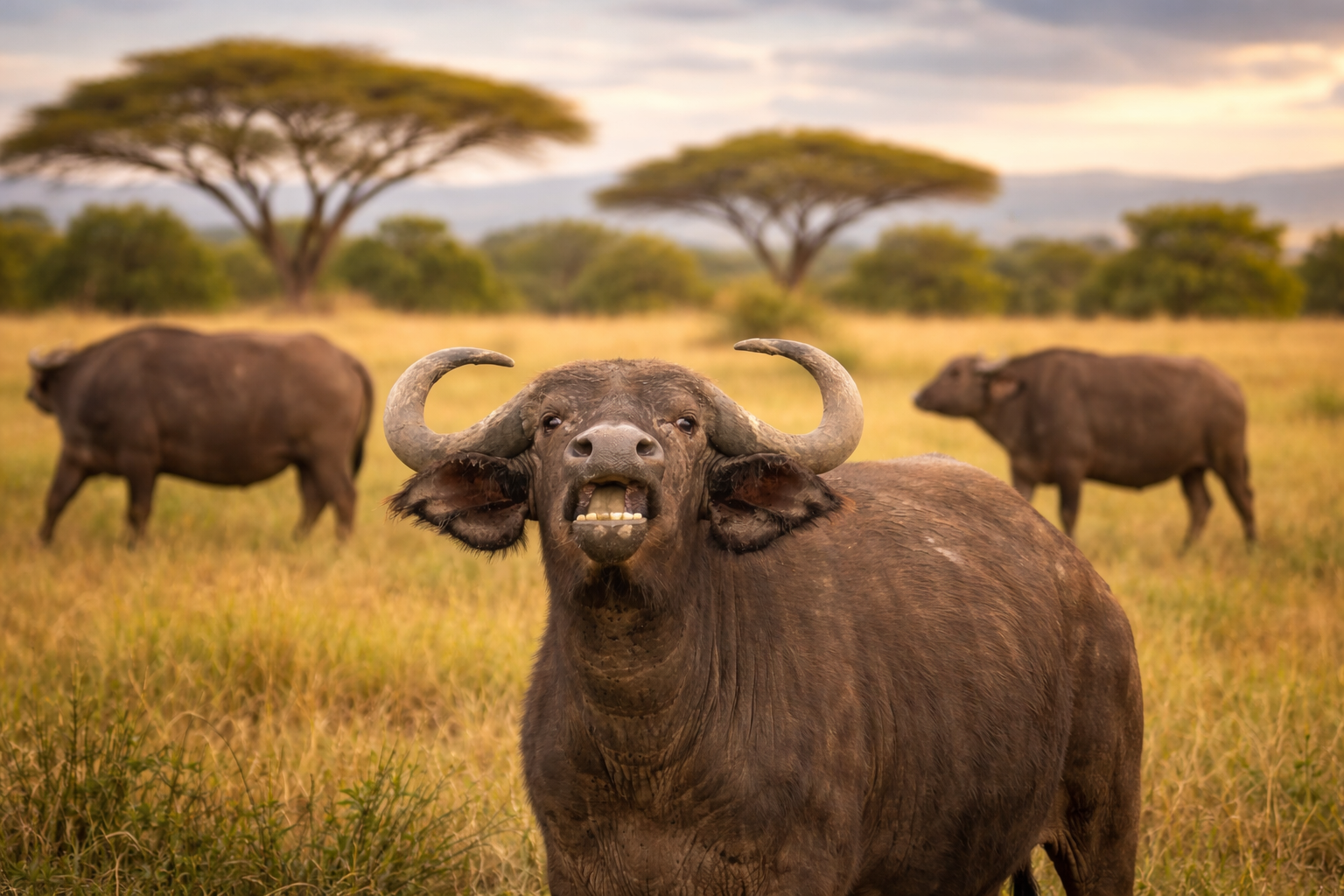

Same ecosystem, different sections, fundamentally different trips. The honest answer is not which is better — it is which suits what you specifically want to do, when you’re going, and what you’re willing to pay for the privilege.
The honest view
Maasai Mara vs Serengeti is the most searched safari question in East Africa, and it is most honestly answered with a single word: neither. The Maasai Mara and Serengeti are not competing destinations. They form the Mara-Serengeti ecosystem — one continuous, unfenced stretch of East African savannah that 1.5 million wildebeest cross every year without a visa. The animals don’t know they’re switching countries; they’re following grass.
What makes the question genuinely worth answering is that each section has distinct characteristics, different access rules, different cost structures, and different best-fit traveller profiles. The Mara is smaller, more concentrated, and produces more wildlife encounters per square kilometre. The Serengeti is vast, more varied in landscape, quieter in remote areas, and hosts the migration for a longer period annually. Which suits you depends on when you travel, what you most want to see, your budget, your tolerance for vehicle congestion at sightings, and whether logistics simplicity or scale of wilderness matters more to you.
This article works through the comparison honestly. Verified 2026 park fees on both sides. The wildlife reality at species level rather than blanket claims. The migration timing breakdown that determines which side wins in your specific window. The cost comparison most operators won’t surface clearly. And the structural verdict for first-time visitors against repeat travellers. Most articles on this topic are written from one side’s perspective and are softer on the other side’s flaws than they should be. This one tries to be honest about both.
The Mara delivers more wildlife per hour of driving and simpler logistics. The Serengeti delivers more landscape variety and a longer migration window. Both are extraordinary. Choose based on what you specifically want and when you can travel — not on marketing romance from either side.
| MAASAI MARA SIZE 1,510 km² reserve + 2,000+ km² of community conservancies | SERENGETI SIZE 14,750 km² — nearly 10× the Mara reserve area |
| MIGRATION IN MARA July through October; Mara River crossings peak August-September | MIGRATION IN SERENGETI Year-round somewhere in the park; calving Jan-March in Ndutu |
| MARA PARK FEE 2026 $100/day non-resident Jan-Jun · $200/day Jul-Dec | SERENGETI PARK FEE 2026 $70/day peak (16 May-14 Mar) · $60/day low (15 Mar-15 May) + 18% VAT |
| CONCESSION FEE INSIDE SERENGETI $60/day peak + $50/day low for lodge stays inside park | NIGHT DRIVES Permitted in Mara conservancies; prohibited in Serengeti NP |
Same ecosystem, different section
The Serengeti occupies the Tanzanian portion of the ecosystem: roughly 14,750 square kilometres of grassland, kopjes (granite outcrops that punctuate the plains), riverine forest, and acacia savannah. The Maasai Mara is the northern extension in Kenya — 1,510 square kilometres of state reserve land plus over 2,000 square kilometres of private community conservancies wrapping the reserve’s eastern and northern edges. Because they share the same landscape and resident species, the wildlife experience is remarkably similar at species-encounter level. Differences lie in scale, density, access rules, and migration timing.
The Serengeti’s name derives from the Maasai word siringet, which means endless plains — and that captures the structural reality. Driving from the southern Serengeti (Ndutu) to the northern Serengeti (Kogatende) takes most of a full day on the park roads. Different regions of the park feel like different places: the southern short-grass plains, the central Seronera woodland and riverine forest, the western corridor’s Grumeti River system, the northern Mara River area. The Mara, by contrast, feels contained. Most wildlife areas are within 30-45 minutes of any well-positioned camp. A 4-night Mara stay can cover most of the ecosystem’s principal habitats; a 4-night Serengeti stay covers one region thoroughly.
The structural implication: travellers wanting depth in one place with high encounter density should weight the Mara. Travellers wanting breadth and habitat variety, with the understanding that you’ll spend time travelling between regions, should weight the Serengeti. A combined trip — Mara plus northern Serengeti during the August-October crossings window — produces both sides of the same crossings (wildebeest leaving Tanzania and arriving in Kenya), which is one of the strongest African safari itinerary options available.
Wildlife comparison — species by species
Both parks support the full Big Five and reliably deliver lion, leopard, elephant, buffalo, and rhino year-round. The differences lie in density and ease of finding specific species. The summary below reflects long-term sighting frequency data from the principal monitoring programmes (Mara Predator Conservation Programme on the Kenya side; Serengeti Lion Project and Frankfurt Zoological Society’s monitoring on the Tanzania side).
| Species | Maasai Mara | Serengeti |
| Lion | ★ Higher density per km². Easier sightings per hour. MPCP documented 459 lions in Mara ecosystem (Q1 2025). | Higher absolute numbers (~3,000 total). Spread across vast area. Iconic Seronera prides well-monitored. |
| Leopard | ★ Riverine forest along Talek and Mara rivers. Reliable daily sightings at established territories. | Present throughout. Seronera Valley known for leopard density, but spread makes encounters less predictable. |
| Cheetah | ★ Open plains habitat ideal. Among Africa’s most reliable cheetah sightings, particularly in Mara North and Naboisho conservancies. | Good throughout, especially on southern Ndutu plains during calving season. Stronger seasonality. |
| Rhino (black) | ★ Mara Triangle has Kenya’s most reliable wild black rhino sightings. Population recovered to 30+ individuals. | Present but very difficult to find. Moru Kopjes region has a small protected population. |
| Elephant | Good year-round. Strong herd presence along river systems. | ★ Stronger populations across the broader park. Particularly visible in Western Corridor and northern Serengeti. |
| Wild dog | Rare. Occasional sightings, generally outside the main reserve. | ★ Slightly more frequent sightings, particularly in the southern Serengeti and Loliondo corridor. |
| Habitat diversity | Open savannah, riverine forest along Mara and Talek rivers. Limited variation across the ecosystem. | ★ Grassland, kopjes, woodland, riverine forest, Western Corridor swamps. Significant landscape variation. |
The consistent pattern is that the Mara’s higher wildlife density per km² produces more encounters per hour of driving. Game drives in the Mara consistently deliver more sightings than equivalent drives in the Serengeti’s central areas. That said, the Serengeti’s habitat diversity gives it a breadth of wildlife experience the Mara cannot match over a longer stay. For a 4-night first-time safari, the Mara is the stronger choice on encounter frequency. For an 8-10 night stay where you have time to move between regions, the Serengeti rewards patience with variety.
Migration timing — when each side wins
The migration is a continuous, year-round movement of approximately 1.5 million wildebeest, 300,000 zebra, and 500,000 gazelle in a clockwise circuit. The Serengeti’s advantage is duration — herds are present somewhere within the park for most of the year, including the famous calving season (January-March) in the southern Serengeti’s Ndutu area where up to 8,000 calves are born daily. The Grumeti River crossings (June-July) in the Western Corridor offer a preview of the main Mara crossings, with extremely large crocodiles waiting at specific points.
The Mara’s advantage is the river crossings themselves — from late July through October, wildebeest plunge into crocodile-filled water in surging columns at multiple Mara River points. Peak crossing activity is typically late August through September. These are the iconic images that have defined East African safari globally. Tanzania has river crossings (Grumeti in June, Mara River within northern Serengeti in July-August before the herds cross into Kenya), but the Kenya Mara crossings are larger in scale and more concentrated in time.
| Window | Winner | What is happening |
| January – March | Serengeti | Calving season in southern Serengeti (Ndutu). Up to 8,000 calves born daily. Extraordinary predator density. Mara has excellent resident wildlife but no migration presence. |
| April – May | Both green season | Both parks in long-rains season. Wildlife dispersed. Mara cheaper (low-season fees); Serengeti’s vast area absorbs visitors well. Neither is at peak. |
| June | Serengeti edges it | Herds moving north and west through Serengeti. Grumeti River crossings in the Western Corridor. Mara in excellent condition but pre-migration arrival. |
| July | Both — transition | First herds crossing into Mara from Sand River area. Early Mara River crossings happen. Northern Serengeti also has Mara River crossings on the Tanzania side. |
| August – September | Maasai Mara | PEAK Mara River crossings in Kenya. The iconic spectacle. Book 9-12 months ahead. Northern Serengeti also strong but lower crossing frequency. |
| October | Maasai Mara (winding down) | Crossings continue early in the month, often with smaller groups attempting to recross south. By late October most herds heading back to Tanzania. |
| November – December | Both good (short rains) | Herds returning south through Serengeti’s eastern plains. Both parks in excellent wildlife condition. Significantly fewer vehicles than peak August-September. |
Cost comparison — the structural pricing reality
The Maasai Mara is generally less expensive than the Serengeti for comparable-quality accommodation. The cost structure differs in three structural ways.
Park fees
Mara peak-season fees (July-December 2026) are $200/day for non-residents — the highest park fee in mainstream African safari. Low-season Mara fees (January-June) are $100/day. Serengeti fees are $70/day peak ($60 low season) but add 18% VAT plus a $60-70/day concession fee if you’re staying at a lodge inside the park. The combined Serengeti peak rate inside the park is therefore $70 + $60 + 18% VAT = $153.40 per adult per 24 hours. Mara peak fees are higher in absolute terms; Serengeti concession-plus-VAT structure brings the gap closer.
For travellers staying at lodges adjacent to (rather than inside) the Serengeti, the concession fee doesn’t apply, making the Serengeti substantially cheaper than the Mara at $70/day base versus $200/day. For travellers in Mara conservancy camps, conservancy fees of $80-150/day replace reserve fees and are usually included in camp rates. The pricing comparison depends materially on where you stay, not just which country.
Accommodation pricing
Comparable-quality accommodation runs higher in the Serengeti for structural reasons: greater remoteness, longer supply chains, harder logistics, smaller lodge market with less competitive pressure. Rough benchmarks: comparable mid-range quality starts from $400-600 per person per night in the Mara’s conservancies versus $600-900 in the Serengeti. Top-tier luxury runs $1,000-1,500 in the Mara against $1,200-2,000+ in the Serengeti. Premium ultra-luxury sites like Singita’s Serengeti properties or Asilia’s Sayari reach $2,500-4,500+ per person per night.
Logistics and transit cost
Internal flights from Nairobi Wilson to the Mara take 45 minutes ($200-400 per person one-way on Safarilink/AirKenya). Serengeti access from Nairobi requires routing through Kilimanjaro International Airport via Auric Air or Coastal Aviation, adding flight time, transfer time, and cost ($300-500 per person one-way internal flights plus Kenya-Tanzania transit logistics). For Kenya-based travellers or travellers arriving in Nairobi, the Mara is the structurally simpler choice. For travellers arriving directly into Tanzania (Kilimanjaro International), the Serengeti is the closer destination.
THE PRICING POSITION
For travellers with budget flexibility and clear migration priorities, both parks are worth the cost. For travellers cost-constrained who want maximum Big Five and migration access at the lowest credible price, the Mara is the structurally cheaper choice — particularly in low season (January-June) when reserve fees drop to $100/day. For travellers who specifically want the Serengeti's scale, calving season, or Ngorongoro Crater extension, Tanzania is worth the premium. Neither is universally better.
Crowds, access, and logistics
The Mara’s smaller size creates genuine vehicle congestion during peak migration season. Popular crossing points (Lookout Hill, Paradise Plains in the main Reserve) can attract 30-50 vehicles simultaneously during August-September peak. This is why staying in a private conservancy (Mara North, Olare Motorogi, Naboisho, Ol Kinyei) rather than the national reserve makes such an enormous difference to the experience. Conservancy guests access crossing points via private tracks, bypassing the main reserve road vehicle queues entirely. The vehicle-density rules in conservancies (often 3-5 vehicles maximum per sighting) create a fundamentally different game-drive experience.
The Serengeti distributes visitors more thinly across its vast 14,750 km² area. Its remote northern Kogatende region and western corridor’s Grumeti section can feel genuinely empty even in peak season. However, the central Seronera region concentrates vehicles comparably to the Mara reserve during busy periods — and even more so during the Western Corridor’s June migration window. The Serengeti’s size advantage works for travellers who can position themselves in less-visited regions; for travellers staying at Seronera-based lodges in peak season, the vehicle pressure feels similar to the Mara reserve.
Access logistics within each park also differ. The Mara’s road network is well-maintained, conservancy tracks are extensive, and 45-minute charter flights from Nairobi keep transit short. The Serengeti requires longer internal flights to reach optimal locations (Kogatende for northern crossings, Kusini for southern Ndutu calving), and the park’s size means a multi-region itinerary involves either internal flights or multi-day road transits. For first-time visitors with limited time, the Mara’s logistics simplicity is a genuine advantage.
Activities — what each park allows
This is the single most consequential difference between the two parks that few articles surface clearly. Activities allowed inside the Serengeti National Park are far more restricted than what conservancies adjacent to the Mara permit.
| Activity | Mara National Reserve | Mara conservancies | Serengeti National Park |
| Game drives | Yes — designated tracks | Yes — anywhere | Yes — designated tracks |
| Off-road driving | Prohibited | Permitted | Prohibited |
| Night drives | Prohibited | Permitted | Prohibited (limited exceptions) |
| Walking safaris | Prohibited | Permitted with ranger | Prohibited in core park (permitted in some private concessions) |
| Hot air balloon | Yes (Governors’ Balloon) | Yes (multiple operators) | Yes (multiple operators) |
| Vehicle density at sightings | Uncapped | Hard caps (3-5 vehicles) | Uncapped |
The implication: travellers who specifically want walking safaris, night drives, off-road predator tracking, or low-vehicle-density sightings should weight Mara conservancies above either the Mara Reserve or the Serengeti National Park. Private concessions adjacent to the Serengeti (Grumeti Game Reserve, Loliondo concessions, the Klein’s Camp area) replicate some of these activity rules but at premium pricing. For activity range plus reasonable pricing, the Mara conservancies are the structurally strongest position.
Ngorongoro Crater — the Serengeti’s killer extension
Most articles comparing the two parks miss the structural advantage of the Tanzania side: the Ngorongoro Crater extension. The Crater is a UNESCO World Heritage Site, an intact volcanic caldera 19km in diameter and 600m deep, hosting one of Africa’s highest concentrations of wildlife including some of the most reliable black rhino sightings on the continent. A 1-2 night Ngorongoro stay combines naturally with a Serengeti itinerary — the road transfer between the Serengeti (Naabi gate or Ndutu) and Ngorongoro is 2-3 hours, and many itineraries route through Ngorongoro on the way to or from the Serengeti.
The Crater is not a substitute for the open plains — it is a complementary experience. The wildlife density inside the caldera is genuinely extraordinary; the visual setting of game viewing on the crater floor under 600m cliff walls is unique. The $295 per vehicle Crater Service Fee plus the $70 conservation fee means a half-day Crater visit costs roughly $90-100 per person on top of accommodation. For travellers building a Tanzania itinerary, Ngorongoro should be an automatic inclusion. The Mara has no equivalent landscape feature, and this is one area where Tanzania’s offering is structurally stronger than Kenya’s.
The verdict — which should you choose?
CHOOSE THE MAASAI MARA IF: You are visiting July-October and want Mara River crossings — the iconic spectacle. Maximum wildlife encounter frequency in a smaller area. First safari. Want night drives, walking safaris, or off-road access (via a conservancy camp). Travelling from or via Kenya with minimal transit time. Want strong Maasai cultural experiences alongside wildlife. Budget-constrained with peak migration as the priority. Travelling with limited time and want maximum wildlife per safari day.
CHOOSE THE SERENGETI IF: Visiting January-June and want calving season or Grumeti crossings. Prefer vast wilderness over concentrated sightings. Want more habitat diversity. Combining with Ngorongoro Crater (the natural Tanzania pairing). Have experienced the Mara before and want something different. Travelling for 10+ nights and have time for the park's scale. Direct international access via Kilimanjaro International.
The recommendation for first-time safari visitors
The Maasai Mara. The concentration of wildlife, accessibility from Nairobi, the private conservancy system’s advantages (which the Serengeti National Park structurally cannot match for activity range), the Maasai cultural dimension, simpler logistics, and generally lower total cost make it the more reliable and rewarding first safari for most people. Visit July-October and the migration is a bonus. Visit any other time and the wildlife is still extraordinary.
This recommendation comes with one important caveat: travellers prioritising Ngorongoro Crater alongside wildlife should consider Tanzania as a unit (Serengeti plus Ngorongoro plus optional Tarangire or Lake Manyara). The combination delivers something the Kenya side cannot replicate. For travellers building East Africa around a single country’s logistics, Kenya works for any first-time visitor; Tanzania works better when the Crater is a non-negotiable inclusion.
Can you visit both? The combined-trip case
Yes — and a growing number of travellers do. The combined Mara-Serengeti itinerary requires crossing the Kenya-Tanzania border by road or charter flight, coordinating visas for both countries (Kenya eTA $30; Tanzania tourist visa $50 single-entry), AMREF Flying Doctors membership extending to both countries, and budgeting 2-3 additional days for the transitions. The most natural routing for migration peak season.
The structurally strongest combined itinerary: Maasai Mara conservancy (3-4 nights, August-September) for the crossings → charter flight from Mara to Kogatende airstrip in northern Serengeti (2-3 nights) for the Tanzania-side crossings and broader park → road transfer south through central Serengeti to Ngorongoro Crater (1-2 nights). This 7-9 night route covers the full migration circuit, the Crater, and produces both sides of the same crossings. Total cost runs $7,000-12,000 per person at mid-luxury tier excluding international flights — roughly 30-50% premium over either park alone, but combining experiences neither park can deliver in isolation.
If budget or time is limited, choose one park and do it properly. Four nights in either park is far more rewarding than a rushed two-night visit to both with travel days consuming half the trip. The single most common combined-trip mistake is trying to fit too much in too little time and ending up exhausted with shallow exposure to both parks.
Frequently asked questions
Is the Serengeti or Maasai Mara better for first-time visitors?
Maasai Mara. Higher wildlife density per drive, simpler logistics from Nairobi, conservancy access provides activities (night drives, walking, off-road) the Serengeti National Park does not permit, and generally lower total cost. First-time visitors prioritising Ngorongoro Crater are the exception — those travellers should plan Tanzania as a unit including Crater plus Serengeti.
Where do the Mara River crossings actually happen?
The Mara River runs east-west across the northern Maasai Mara and continues into the northern Serengeti. Both countries have Mara River crossings. Kenya-side crossings (July-October, peak August-September) at Lookout Hill, Paradise Plains, Cul-de-Sac, Serena Pump House, and Triangle crossings. Tanzania-side crossings (July-August primarily) within the northern Serengeti near Kogatende. The Kenya crossings are the iconic global images; the Tanzania crossings are less crowded and less photographed but equally dramatic.
How much does a Serengeti safari cost versus Maasai Mara?
Comparable mid-range quality runs $400-600 per night per person in Mara conservancies versus $600-900 in the Serengeti. A 7-night safari at mid-range tier: approximately $4,500-7,000 in Kenya including park fees and charter flights versus $6,500-9,500 in Tanzania. At luxury tier: $8,000-12,000 in Kenya versus $10,000-15,000 in Tanzania. Tanzania’s higher cost reflects greater remoteness, longer supply chains, and the concession-plus-VAT fee structure.
Is night drive available in the Serengeti?
Generally no. Night drives are prohibited in the Serengeti National Park core area. Limited exceptions exist at specific luxury camps with special permits (Nimali, Four Seasons Serengeti Lodge), but these are unusual rather than standard. For night drives as a routine safari activity, Mara conservancies are the structurally correct choice — every quality conservancy camp includes night drives as part of the standard itinerary.
Can you combine the Maasai Mara with the Serengeti?
Yes. The standard combination requires crossing the Kenya-Tanzania border (visa $50 single-entry Tanzania), with charter flights or road transfer between parks. Best itinerary: Mara conservancy 3-4 nights plus Serengeti 3-4 nights during August-September for both sides of the same crossings, optionally adding Ngorongoro Crater 1-2 nights. Total trip: 8-10 nights minimum, $7,000-12,000+ per person mid-luxury tier excluding international flights.
When is the cheapest time to visit either park?
April-May for both parks. Long rains in both countries bring 30-40% discounts at most camps. The wildlife does not go on holiday in the rainy season. Both parks remain genuinely strong; some specific routes may flood requiring itinerary flexibility. For cost-conscious travellers willing to accept some weather variability, the April-May window is the strongest value in East African safari.
Honest limits to this comparison
Three things this article cannot resolve.
- First, individual preference variability. Some travellers genuinely prefer the Serengeti’s scale aesthetic to the Mara’s density aesthetic, even with all the structural Kenya advantages. The wildlife quality argument has a ‘feel of the place’ dimension that data cannot fully capture.
- Second, year-on-year variability. Migration timing shifts each year. The 2026 specific peak window may differ from the long-term August-September pattern. Travellers booking 9-12 months ahead are betting on long-term patterns rather than current-year specifics.
- Third, the contested KWS fee structure on the Kenya side and the 18% VAT on Tanzania fees mean total cost comparison can shift in 2026 with policy changes. Confirm rates at booking.
Who this Guide is for, and who should look elsewhere
Travellers planning a first East African safari and deciding between Kenya and Tanzania — this article is the structural framework. For most first-time travellers, Kenya/Mara is the better answer; the Tanzania case is strongest for travellers wanting Ngorongoro Crater as a non-negotiable inclusion.
Repeat East Africa travellers who’ve done the Mara and are weighing what’s next — the Serengeti is the natural progression, with Ngorongoro and the Western Corridor’s Grumeti adding depth Kenya cannot replicate. The 2nd-trip Serengeti experience is often the most rewarding.
Travellers building combined itineraries — proceed with both parks but commit to a longer trip (8-10 nights minimum) and use the structural August-September window to capture both sides of the same crossings. Shorter combined trips produce shallow exposure to both.
Travellers cost-constrained below $5,000 per person for 7 nights — focus on a single Kenya itinerary in low season (April-June or November). The Serengeti at this budget compromises quality at most camps.
Tell us what you are looking for, and we will tell you honestly whether we can deliver it — and if we cannot, we will tell you who can.
RELATED READING
- Kenya safari cost 2026: the structural pricing comparison referenced in this article
- Private conservancy vs national reserve: why Mara conservancies beat Serengeti National Park on activities
- Great Migration complete guide: the crossings that drive Mara vs Serengeti positioning
- Best lodges in the Maasai Mara 2026: where to position for the Kenya side of the comparison
- Maasai Mara, Kenya — Destination Guide | Nova Expedition Kenya
- Mara River Crossing: How to Be There at the Right Time
- How to See the Great Migration: The Complete Guide (2026)
- Maasai Mara Lodges and Camps — Reserve vs Conservancy
- Best Lodges in the Maasai Mara 2026: From Ultra-Luxury to Best Value
- The 7 best private conservancies in the Maasai Mara — and why they matter more than the national reserve