Private Conservancy vs National Reserve Kenya: The Complete Honest Guide (2026)
The definitive guide to private conservancies vs national reserves in Kenya — activities allowed, wildlife experience differences, costs, community impact, and which is right for your safari.
What is a private conservancy?
A private conservancy in Kenya is a wildlife area established on land leased from private landowners — typically Maasai community members in the Mara ecosystem — and managed by a tourism or conservation company in partnership with those landowners. The landowners receive a guaranteed lease income; the management company controls access, limits visitor numbers, and operates safari camps on the land.
Because the land is privately managed, conservancies set their own rules for wildlife interactions. This is the critical difference: conservancies allow activities that are illegal inside national parks and reserves. Off-road driving, night drives, walking safaris, and fly camping are all standard conservancy activities — and none of them are permitted inside the Maasai Mara National Reserve itself at any price.
What is a national reserve?
The Maasai Mara National Reserve is Kenya’s most famous wildlife area — 1,510 square kilometres of savannah managed by Narok County. It is publicly accessible: any safari vehicle can enter upon paying the park fee ($100–200 per person per day depending on season). There is no limit on the number of vehicles that can be inside simultaneously, and no restriction on which operators can access it. This open access creates the reserve’s biggest weakness: vehicle congestion at popular sightings. During migration season, a single river crossing can attract 30–50 vehicles simultaneously. This is not what most people are paying for — and it is precisely what the conservancy model was designed to solve.
Activities — what is allowed where
| Activity | National Reserve | Private Conservancy |
|---|---|---|
| Game drives (vehicle) | Yes — designated tracks only | ★ Yes — off-road permitted anywhere |
| Off-road driving | Strictly prohibited | ★ Permitted — follow the animal anywhere |
| Night drives | Strictly prohibited | ★ Standard inclusion at most camps |
| Walking safaris | Prohibited | ★ Available with armed ranger |
| Bush meals anywhere | Designated areas only | ★ Anywhere on the conservancy |
| Fly camping / star beds | Not available | ★ Available at select camps |
| Vehicle limits at sightings | None — unlimited vehicles | ★ Strict limits (often 3–5 per sighting) |
The off-road driving difference is particularly significant. In the national reserve, your guide must stay on designated tracks even if a predator is 50 metres off-track in tall grass. In a conservancy, guides drive directly to wherever the animal is. This fundamentally changes wildlife encounter quality — especially for big cats that move through dense vegetation. Night drives reveal Kenya’s nocturnal world: serval cats, aardvarks, porcupines, genets, and hunting predators almost never seen during daylight. This experience is simply unavailable inside the national reserve.
Wildlife experience comparison
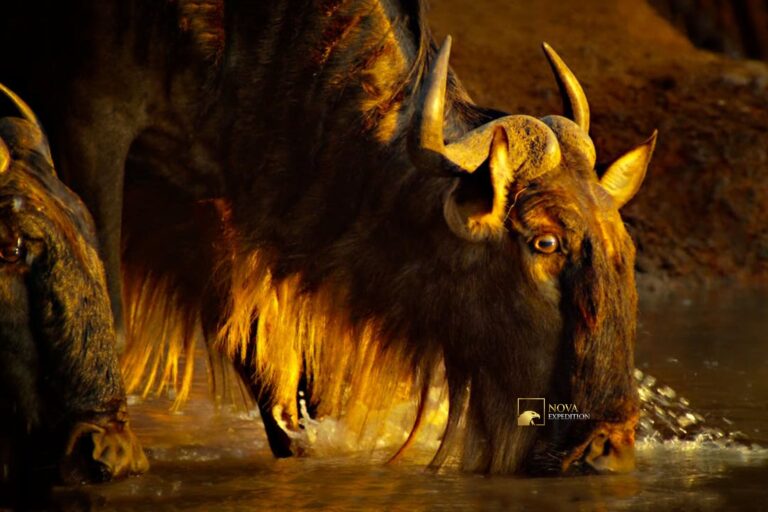
Counterintuitively, wildlife density in Kenya’s private conservancies is often higher than in the national reserve. The lower vehicle count creates less disturbance — animals in conservancies are habituated to a small, predictable number of vehicles and behave more naturally. A cheetah in a conservancy will frequently hunt in front of 2–3 vehicles without changing its behaviour. The same cheetah in the national reserve, surrounded by 20 vehicles, will often abandon a hunt due to the disturbance and noise.
“The difference between the reserve and a conservancy is not just what you are allowed to do. It is how wildlife behaves toward you. In the conservancy, a lion pride walked within three metres of our vehicle and never looked up.”
— Nova Expedition guest, Mara North Conservancy, September 2024
Cost comparison
Private conservancy camps are more expensive than equivalent-quality reserve camps. However, because conservancy rates are usually all-inclusive (activities, meals, drinks, game drives), and reserve guests pay $100–200/day in park fees on top of accommodation, the total cost difference is often smaller than it appears. A mid-range conservancy camp at $600 per person per night all-inclusive versus a reserve camp at $350/night plus $150–200/day in park fees — the conservancy works out roughly comparable in total while delivering a significantly better experience.
Conservation and community impact
The conservancy model is one of the most important conservation tools in Kenya. Before it existed, Maasai landowners received little financial benefit from wildlife on their land and actively chased animals away to protect livestock. Conservancy lease payments change that equation: wildlife generates guaranteed community income, creating a direct financial incentive to protect it. In the Mara ecosystem, the conservancy model is directly linked to lion population recovery, elephant range expansion, and the survival of predator species that were declining inside the national reserve alone. When you stay in a conservancy camp, your fees go to the Maasai landowners whose land you are on — and that economic relationship is what keeps the land as wildlife habitat rather than farms.
Which is right for you?
Our honest recommendation: for most first or second-time Kenya travellers, a private conservancy camp delivers a significantly better overall experience than an equivalent national reserve camp. The night drive alone is worth the difference. Off-road access changes every game drive. And the absence of vehicle congestion at sightings is something you notice immediately and remember permanently.