

Lamu
Why Lamu is unlike anywhere else in Africa
Lamu has been continuously inhabited for over 700 years and stands as the oldest, best-preserved Swahili settlement in East Africa. UNESCO recognised it as a World Heritage Site in 2001, and the criteria were unusually specific: the town demonstrates an outstanding example of the confluence of European, Arab, Persian, and Indian influences through Swahili building tradition. But what no UNESCO citation can quite capture is what it feels like to arrive by boat at the Lamu waterfront — the smell of salt and spice and old wood, the sound of the call to prayer echoing across the channel, the absolute absence of engines because there are no cars here and there never have been.
Lamu is not a heritage site that has been preserved. It is a living town of approximately 15,000 people who have maintained their traditional way of life, their architecture, their language, and their Islamic faith through seven centuries of Arab traders, Portuguese colonisers, Omani sultans, British colonial administrators, and finally the modern tourist era. The fact that it has survived all of this — and still functions, breathes, prays, and fishes in essentially the same pattern it always has — is the extraordinary thing about Lamu.
Lamu Old Town — the living UNESCO city
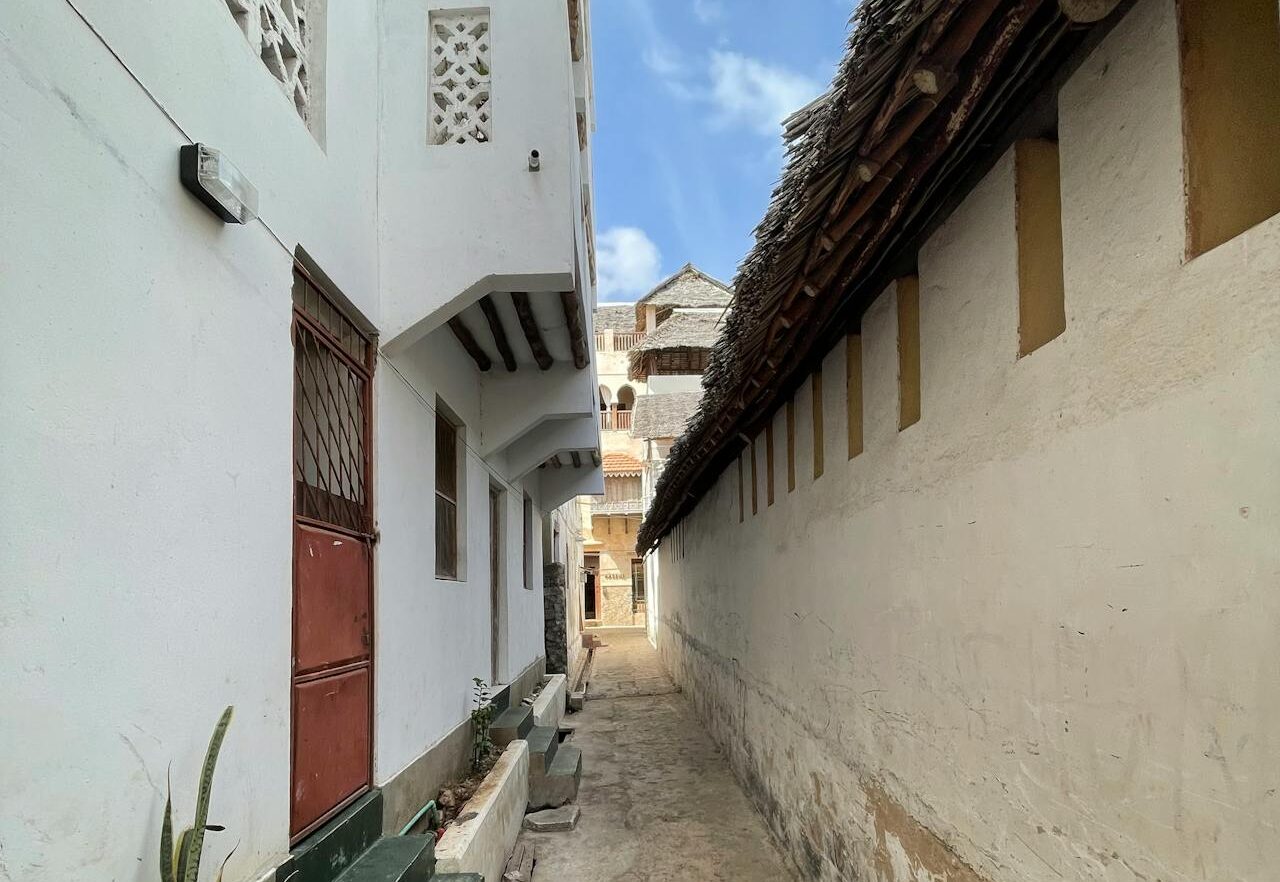
The Old Town occupies just 16 hectares — a dense, labyrinthine grid of coral-stone buildings, narrow alleyways no wider than a donkey’s load, and inner courtyards where bougainvillea spills over walls that have stood since the 17th century. It was built using two locally abundant materials: coral stone, quarried from the reef and shaped into blocks that stay cool in the coastal heat, and mangrove timber, harvested from the surrounding estuaries and used for structural beams, doors, and decorative ceilings.
The town’s social structure is organised into mitaa — neighbourhood districts where closely related lineages live in clusters. This Arab-influenced land distribution pattern explains the labyrinth street layout: the alleyways were designed for specific communities, not for strangers passing through. Walking through Lamu Old Town is, in this sense, an act of mild trespass that the community has graciously accommodated for several decades of tourism.
The buildings on the seafront present their most open face — arcades, verandas, and open porches that catch the ocean breeze. Go deeper into the town and the buildings become more introverted, with blank external walls concealing elaborate internal decoration: madaka (large decorative plaster niches), zidaka (smaller niches), painted ceilings, and antique Chinese porcelain embedded into walls — a testament to Lamu’s position at the centre of Indian Ocean trade networks that extended all the way to the Far East. Those pieces of Ming dynasty porcelain in the walls are not decoration. They are a record of who your neighbours were trading with 500 years ago.
The town’s Golden Age arrived between 1698 and the mid-1800s, when the Omani Arabs took control and made Lamu a regional power. The grandest houses, the most elaborate carved doors, and the peak of Swahili architectural confidence all date from this period. In 1812, Lamu defeated the neighbouring town of Pate in the Battle of Shela — the last traditional naval battle on the Swahili coast — and briefly emerged as the dominant city-state in the region. The victory was short-lived. The slave trade on which much of Lamu’s prosperity depended was forcibly ended by the British in 1873, and the town entered a long, quiet decline that paradoxically preserved it exactly as it was.
The carved doors — 700 years of coded history
Nothing in Lamu is more immediately striking than the doors. Every major building in the Old Town has an elaborately carved wooden entrance — intricate geometric patterns, floral motifs, calligraphic inscriptions, and brass fittings — and no two are identical. The doors are not decoration. They are a communication system that any Lamu resident could read: the patterns encoded the household’s social status, religious affiliation, ethnic origin, and wealth. A visitor who could read a Lamu door knew everything about the family inside before knocking.
According to the National Museums of Kenya, eight distinct door styles are currently documented in Lamu. These include the Lamu style (the local baseline, featuring geometric patterns and a distinctive central panel), Siyu doors (named after the settlement of Siyu on nearby Pate Island), Bajuni doors (associated with the fishing Bajuni people of the archipelago), and Omani doors — introduced during the Arab Golden Age and among the earliest surviving styles in the region. Indian influence produced the Gujarati doors and the richer Zanzibar style with its deeper relief carving and more elaborate decorative hierarchy. The Indian neoclassical style arrived with later merchant communities.
The most celebrated individual style is the Kijumwa style, developed by master carver Ahmed Abubakar Omar Kijumwa — a Lamu-born craftsman who blended Omani and Zanzibar elements with distinctly personal abstract V-shaped motifs and unusual floral compositions. Kijumwa’s patterns are now so admired that contemporary carvers across the island study and replicate his work as a standard of excellence. Today, the foremost working master carver in Lamu is Ali Abdalla Skanda of the Wiyoni area — a craftsman who has been carving since age twelve and who was among the artisans who decorated Nairobi’s old parliament building. A single major door from his workshop takes weeks to complete and costs between KSh 120,000 and KSh 500,000 depending on the complexity of the carving, the timber quality, and the size.
The interiors behind those doors are equally remarkable. The houses built by prosperous Omani merchants feature central courtyards open to the sky, intricate plasterwork in the main reception room, and carved coral niches along the walls where oil lamps and porcelain bowls were displayed. Visiting the Swahili House Museum — a lovingly restored merchant’s home on the main street — is the single most revealing way to understand how life in Lamu actually worked: the spatial logic, the light, the cool stone, the glimpsed sky above the courtyard.
Shela Village and the beach
Shela is a 30-minute walk or 10-minute boat ride along the waterfront from Lamu Old Town, and it is where most visitors actually stay. The contrast between the two is instructive: Lamu Town is a functioning community that has absorbed tourism without fundamentally changing; Shela is a quieter, wealthier village where restored Swahili houses have become boutique hotels, private villas, and vacation rentals for an international clientele.
Shela’s beach is one of East Africa’s finest — a 12-kilometre stretch of powdery white sand backed by a system of sand dunes (the Shela aquifer beneath them is the island’s primary fresh water source) and the warm, calm waters of the Indian Ocean. The dune system is the largest remaining on the Kenya coast and gives Shela an otherworldly quality at dawn and dusk when the light catches the sand and turns it gold.
The social heart of Shela is the Peponi Hotel, a family-run institution since 1967 managed by three generations of the Korschen family. The restaurant and bar are genuinely beloved by the island’s community of long-term residents, artists, writers, and boat captains — not just by tourists. Eating on the Peponi terrace as the sun drops behind the channel and dhows cross silently in the last light is one of those experiences that lodges permanently in memory.
In June through September, the kaskazi trade winds create ideal kitesurfing conditions at the northern end of Shela beach. Equipment rental and instruction are available near the Peponi jetty. Outside of kite season, the beach is simply an extraordinary place to slow down completely — the kind of place where ambitious travel itineraries quietly dissolve into long breakfasts and afternoon swims.
Getting to and around Lamu
By air (strongly recommended) — Daily scheduled flights from Nairobi Wilson Airport and JKIA to Manda Airport (LAU) on Manda Island. Safarilink, Jambojet, and Skyward Express all serve the route. Flight time from Nairobi is approximately 90 minutes. After landing at the small, charmingly unhurried Manda airstrip, a 10-minute motorboat crossing takes you to Lamu Town or Shela. Confirm your transfer with your hotel — most properties arrange this.
By road — Drive or take a bus from Nairobi or Mombasa to Mokowe Jetty on the mainland, then cross by public or private boat. Journey time from Nairobi is approximately 8–10 hours through remote northeastern Kenya. Flying is strongly recommended for most travellers.
On the island, there are no motor vehicles. Movement is on foot through the Old Town’s alleyways, by boat between Lamu Town and Shela, and occasionally by motorbike (boda-boda) on the narrow paved road along Lamu’s western edge. Critical practical note: Lamu has almost no ATMs, and those that exist are unreliable. Withdraw sufficient cash — in Kenyan Shillings and US Dollars — before leaving Nairobi or Mombasa. Most hotels accept cards; almost nothing else does.
Best time to visit Lamu
Where to stay
What to do in Lamu
- Walk Lamu Old Town with a locally born guide — Not a tour guide from a hotel desk. Hire someone who grew up in the mitaa, who knows the difference between a Kijumwa door and an Omani door, who can tell you which family built the house you’re standing in front of and what trade they ran. Two to three hours, unhurried, in the early morning before the heat builds.
- Private sunset dhow charter — The classic Lamu experience for good reason. The old town turns amber at 6pm and the channel fills with the last dhows of the day. Your captain will tell you more about Lamu in two hours on the water than any guidebook. Peponi Hotel can arrange this for guests and non-guests alike.
- Manda Island snorkelling and beach — A short dhow ride across the channel to coral gardens, or to Manda’s long empty beach. Some of the best easy snorkelling on the Kenya coast, accessible without a long boat journey.
- The Lamu Museum — The seafront museum holds an exceptional collection of Swahili household objects, boat models, historical photographs, and examples of Omani Arab furniture that give physical weight to the town’s history. Small, excellent, and consistently overlooked by visitors in a rush.
- Takwa Ruins — A deserted Swahili town on Manda Island, abandoned in the 18th century. Accessible by dhow at high tide through the mangroves. The ruins sit in deep bush, mostly reclaimed by vegetation, with a mosque and carved tombs still standing. Quietly extraordinary.
- Kitesurfing at Shela Beach — July–September. Lessons and equipment rental near Peponi Hotel. Lamu is one of East Africa’s most consistent kitesurfing locations during this season.
- The morning market — Arrive before 8am. Fish just brought in from the channel, mangoes and tamarind from the mainland, Swahili bread still warm. This is how Lamu has provisioned itself for 700 years.
Cultural etiquette in Lamu
Lamu is a deeply Islamic community with its own social rhythms and expectations that visitors should understand before arriving. None of these are onerous; they are simply expressions of respect for a community that has chosen to maintain its traditional character while welcoming strangers.
- Dress modestly in Lamu Old Town and Shela village — Cover shoulders and knees. Light linen or cotton clothing in this style is also far more practical in the coastal heat than shorts and vest tops.
- Swimwear belongs on the beach and at hotel pools only — not in town, at the market, or in any non-beach public space.
- Ask before photographing people — particularly women. A brief, respectful word — heshima in Swahili — goes a long way. Many women will decline; that answer should be accepted without argument.
- The call to prayer is not a tourist attraction — It is a living religious observance that punctuates daily life five times a day. Treat it as you would a church bell in a European village — a background sound, not a photo opportunity.
- Alcohol is available at Peponi and other tourist-facing establishments. It is not available at local restaurants, the market, or most shops. This is consistent with Lamu’s character and should not be treated as an inconvenience.