The highest diversity of mammals in Africa
Laikipia is not one place. It is a plateau — a vast, high, largely unfenced expanse of privately owned ranches and community conservancies stretching from the northwestern slopes of Mount Kenya to the rim of the Great Rift Valley, covering approximately 9,500 square kilometres at altitudes between 1,700 and 2,600 metres. It is cool here — genuine sweater weather in the evenings, even in the dry season — which distinguishes it immediately from every other major Kenyan wildlife destination and gives the landscape a different quality of light, a different ecology, and a different rhythm.
The headline claim about Laikipia — that it has the highest diversity of mammals in Africa — is documented by the Laikipia Wildlife Forum (LWF), the umbrella organisation that coordinates conservation across the plateau’s private ranches and community conservancies. The reason is landscape heterogeneity: Laikipia spans multiple ecological zones, from semi-arid scrubland and open grassland in the north to dense cedar and olive forest in the south, creating niches for an extraordinary range of species. Northern species — reticulated giraffe, Grevy’s zebra, beisa oryx, Somali ostrich — overlap with southern species in a way that doesn’t happen anywhere else. The Ewaso Nyiro River system drains the entire plateau and supports a continuous wildlife corridor between the northern and southern sections.
Why Laikipia works differently from every other Kenyan wildlife area
Laikipia has no national parks. There are no entrance gates with fees, no designated tracks you must stay on, and no game wardens patrolling for vehicles off-road. The conservancies and ranches operate as private landholdings, which means the full range of wildlife activities — night drives, walking safaris, horse riding, camel safaris, cycling — are standard offerings rather than special permissions. This is the most activity-diverse wildlife destination in Kenya, by a considerable margin.
The landscape is also largely unfenced between conservancies, which means animals move freely across the entire plateau. An elephant that was photographed near Mount Kenya’s forest edge yesterday may be at a waterhole in Loisaba today. The wildlife is not performing within a bounded arena; it is living across a genuinely open system in which human communities are integrated rather than excluded.
Seven distinct communities coexist across Laikipia — Maasai, Samburu, Kikuyu, Pokot, Turkana, Meru, and European settler families who converted cattle ranches to conservation beginning in the 1980s and 1990s. The Laikipia Wildlife Forum provides the coordination framework that allows these very different communities to share conservation goals, manage wildlife corridors, and address human-wildlife conflict collectively. The result is a model of coexistence that conservation organisations around the world study and attempt to replicate.
Key conservancies in Laikipia
Ol Pejeta Conservancy (90,000 acres) — The most visited Laikipia conservancy and the most important rhino sanctuary in East Africa. Ol Pejeta is home to Najin and Fatu, the last two northern white rhinos on Earth — a mother-daughter pair whose genetics have been preserved through IVF programmes in the hope of eventually restoring the subspecies. The conservancy also holds Kenya’s largest population of eastern black rhinos, a significant chimpanzee sanctuary (the only one in Kenya recognised by the Jane Goodall Institute), and a full complement of savannah wildlife including lion, leopard, cheetah, and wild dog. The scale and infrastructure make Ol Pejeta Kenya’s most accessible single-day conservation destination, reachable from Nairobi by road and open to day visitors.
Lewa Wildlife Conservancy (45,000 acres) — A pioneering private conservancy established by the Craig family in 1995 on what had been a cattle ranch. Lewa holds approximately 10% of Kenya’s entire black rhino population — the largest single concentration — and has become one of Africa’s most-studied conservation models for the integration of rhino protection, community development, and high-value tourism. The annual Lewa Marathon, held in June, is the world’s highest-altitude marathon and raises millions for community projects in the region. Lewa and the adjacent Borana Conservancy removed the fence between them, creating a contiguous protected landscape of over 100,000 acres.
Loisaba Conservancy (58,000 acres) — A dramatically positioned conservancy in northern Laikipia, covering open plateau grassland in the north and escarpments, valleys, and riverine forest in the south. Loisaba is credited with inventing the star bed — a hand-carved wooden platform on wheels that can be positioned anywhere on the conservancy, with a proper bed under the open sky and nothing between you and the Milky Way above. This concept has been widely copied but never quite matched. Loisaba became Kenya’s newest black rhino sanctuary in 2025, making it the third Laikipia property with resident rhinos.
Il Ngwesi Group Ranch (16,500 hectares) — A community-owned and operated conservancy north of Mount Kenya, managed entirely by the Il Ngwesi Maasai community. The lodge here was built by community members, staffed by community members, and directs all revenue to community development projects including schools and a mobile health clinic. Il Ngwesi represents the community conservation model in its most developed form — conservation happening on Indigenous land, for Indigenous benefit, by Indigenous decision-making.
Endangered species that Laikipia protects
The concentration of endangered species in Laikipia is exceptional even by East African standards. The plateau holds the highest populations of black rhino, Grevy’s zebra, reticulated giraffe, wild dogs, and Lelwel hartebeest of any area in Kenya — all species in significant decline elsewhere. Over 600 elephants range through the Ewaso ecosystem in northern Laikipia. The wild dog population — occasionally seen in Laikipia conservancies but virtually absent from the Mara and other southern destinations — is particularly notable; Laikipia is the most reliable place in Kenya for wild dog sightings, though they remain unpredictable.
Activities unlike anywhere else in Kenya
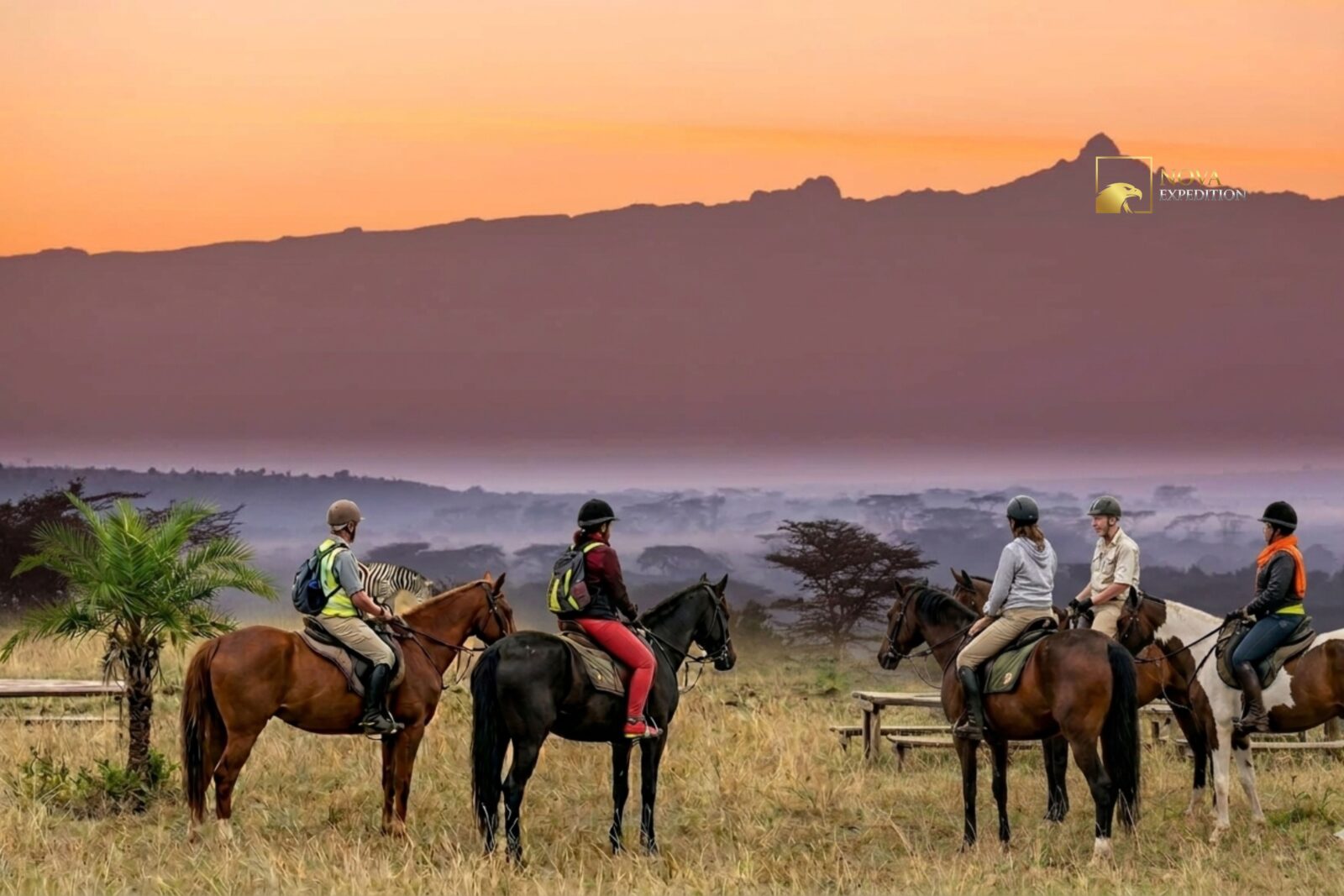
- Horse riding safari — Exclusive to Laikipia in Kenya. Riding among giraffe, zebra, and elephant at dawn, following game trails through acacia woodland — the experience of being at animal level, mobile and silent, is categorically different from anything available in a vehicle. Lewa Downs and Borana both offer multi-day riding safaris for experienced riders. Day rides are available at several properties for guests of any riding ability.
- Camel safaris — Riding or walking with camels through the semi-arid northern section of the plateau. Camels are silent and unthreatening to the resident wildlife — some of the most relaxed animal encounters available in northern Kenya happen from the back of a camel.
- Helicopter experiences — Solio Ranch and Loisaba both operate helicopter game viewing, tracking rhino and elephant from the air and landing in remote areas of the conservancy. The scale of Laikipia becomes comprehensible from the air in a way it never does from the ground.
- Night drives — Available at all Laikipia conservancies as a standard inclusion. The nocturnal wildlife of northern Kenya — aardvark, serval, African wildcat, zorilla (striped polecat), and occasional honey badger — is exceptional and largely absent from vehicle-based day drives.
- Rhino tracking on foot — At Ol Pejeta and Lewa, guided walking with an armed ranger to track black rhino. The closest encounter with rhino available anywhere in Kenya.