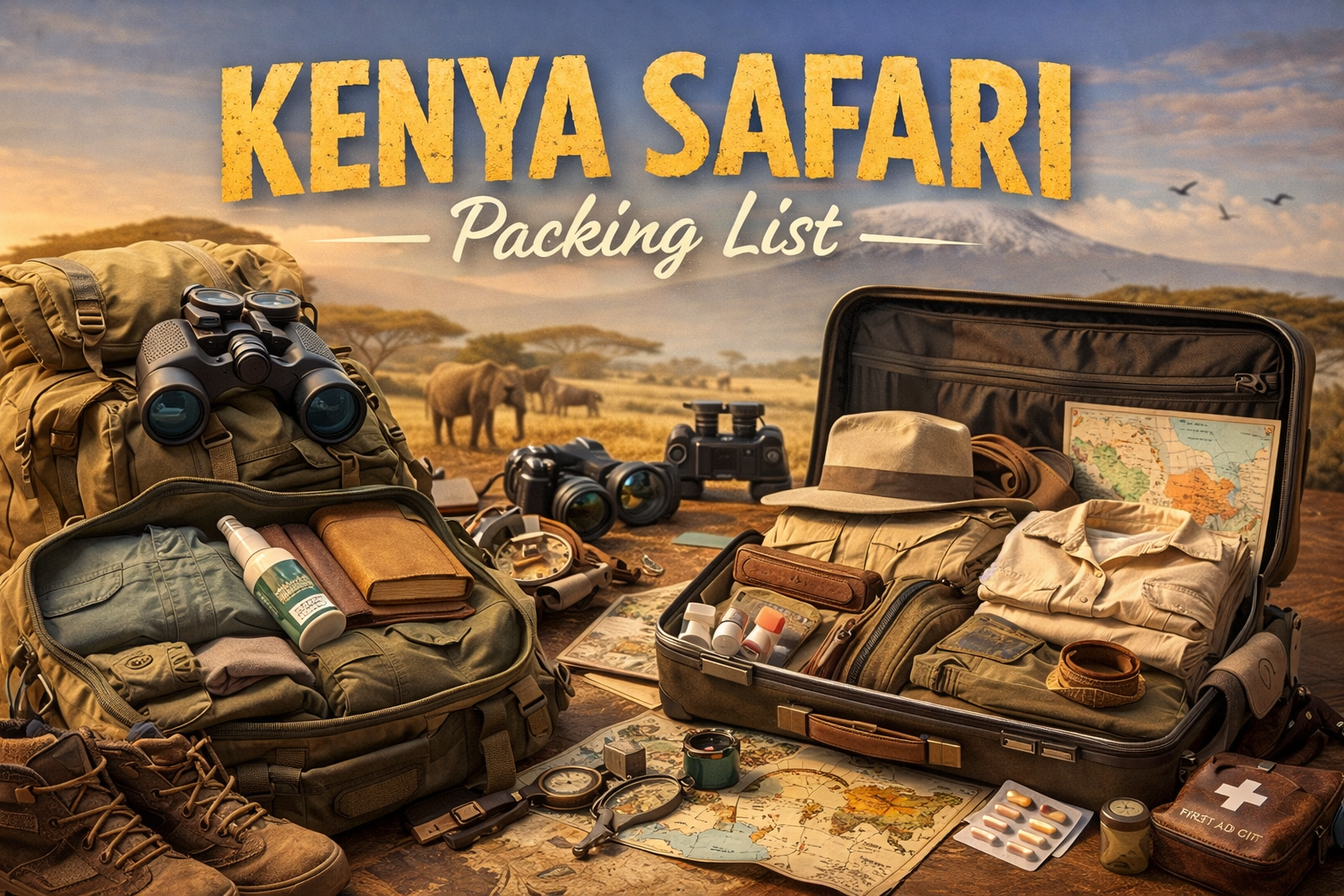

The strict 15kg charter rule. The Kenya plastic bag ban. The camouflage law. The dawn-temperature gap. The malaria prophylaxis decision. Pack right and the trip works. Pack wrong and you’ll spend money fixing it in Nairobi.
The 15kg charter rule and the Kenya plastic bag ban — two laws to know before packing
Two things to understand before packing a single item.
First, charter flights between Kenya’s safari destinations enforce a strict 15kg total luggage allowance per person including carry-on. This is not a guideline that gets waived — Safarilink, AirKenya Express, and the other Wilson Airport bush carriers actively weigh bags at check-in and refuse oversized luggage.
Soft-sided duffel bags are required because rigid suitcases cannot be stored in the small Cessna Caravan and similar aircraft used on safari circuits. Pre-purchase of additional weight is available with Safarilink at $50 for 1-10kg, $80 for 11-20kg, $145 for 21-30kg if booked 96 hours before flight. Many first-time visitors discover the 15kg rule at Wilson Airport and leave their cases in Nairobi storage for the duration of the safari.
Second, plastic bags are completely illegal in Kenya. The 2017 plastic bag ban is enforced with fines up to KES 4 million (around $30,000 USD) or jail time for repeat violations. This applies to all single-use plastic shopping bags. Use fabric packing cubes, mesh bags, or cloth bags throughout your trip. Most lodges provide same-day laundry service, so two sets of safari clothing layered well is genuinely sufficient for most 5-7 night safaris. Pack lighter than you would for almost any other destination, and don’t waste your 15kg allowance on items you’ll wear twice.
This Kenya Safari Packing List Guide covers the complete packing list with verified 2026 requirements: the clothing rules that aren’t always articulated in standard packing guides (camouflage law, neutral colours, layering reality), the gear that matters most (binoculars, camera, electronics), the health and medical requirements that you genuinely cannot skip (malaria prophylaxis, yellow fever, AMREF), and the season-specific additions for green season versus dry season trips. Where source material recommends $50 sunscreen brands or specific products, this article gives you the principle and lets you choose. Where the source material gets a fact wrong (15kg includes carry-on, not ‘just luggage’), this article corrects it.
Pack neutral colours only. Pack soft-sided bags only. Pack lighter than you think. Bring your own binoculars rather than relying on the lodge's. Get the malaria prophylaxis prescribed before you leave. The 15kg weight limit, the camouflage ban, and the plastic bag law are the three rules that catch first-time visitors most often — every one of them is enforced.
| CHARTER FLIGHT LUGGAGE LIMIT 15kg total per person including carry-on (Safarilink, AirKenya, all bush carriers) | LUGGAGE TYPE ALLOWED Soft-sided bags are best — rigid suitcases cannot be stored |
| EXCESS BAGGAGE PRE-PURCHASE $50 for 1-10kg, $80 for 11-20kg if booked 96+ hours ahead | PLASTIC BAG STATUS Illegal in Kenya since 2017 — fines up to KES 4 million for violations |
| CAMOUFLAGE CLOTHING STATUS Illegal — reserved for armed forces. Confiscated at airports if discovered | CLOTHING COLOUR RULE Neutral earth tones only (khaki, olive, tan, beige). No white, no bright. |
| PLUG TYPE Kenya uses UK Type G three-pin plugs. Bring one adapter and multi-socket extension. | VOLTAGE 240V/50Hz. Same as UK and most of Europe. US devices may need converter. |
Clothing — the complete list with the rules behind it
The fundamental rule for safari clothing is neutral earth tones only. Khaki, olive green, tan, sand, dark beige, dark grey. These colours help you blend into the bush, avoid startling wildlife on walks, and don’t attract biting insects the way white and bright colours do. Tsetse flies in particular are strongly attracted to dark blue and dark black — so even within neutral tones, avoid dark blue specifically. White attracts insects and shows dust immediately. Bright colours disturb wildlife on walking safaris and mark you conspicuously as a tourist.
Camouflage or military-pattern clothing is illegal in Kenya. This is genuinely enforced — reserved for Kenya’s armed forces. Camouflage items will be confiscated at Jomo Kenyatta International Airport on arrival if discovered. Even if you got it through, no professional guide will take you into the bush wearing it. Never pack it.
The complete clothing list
| Item | Qty | Notes |
| Long-sleeve lightweight shirts | 2-3 | Neutral colours. Quick-dry fabric (Merino wool or synthetic). Protects against sun and insects on open-vehicle drives. |
| Short-sleeve shirts | 2 | For lodge downtime and warmer afternoon hours. Neutral colours only. |
| Lightweight long trousers | 2 | Convertible zip-off trousers ideal — two items in one. Look for ones with deep pockets for binoculars and phone. |
| Shorts | 1-2 | For lodge and casual use. Not for walking safaris (where insect bite risk and thorn scratches matter). |
| Fleece jacket or pullover | 1 | ESSENTIAL. Dawn game drives are cold. Mara at 5am can be 10-12°C. Highland conservancies (Laikipia) can be colder still. |
| Windproof outer layer | 1 | For open-vehicle drives at dawn and balloon safaris at altitude. Hardshell or softshell — packable matters more than waterproof rating. |
| Compact rain jacket | 1 | Brief rain arrives even in dry season. Essential in green season (March-May, November-December). |
| Swimsuit | 1-2 | Most lodges have pools. Add a second for beach extensions to Diani or Lamu. |
| Smart-casual evening wear | 1 outfit | No tie required at any safari camp. Light linen trousers and a collar shirt sufficient at all camps including ultra-luxury. |
| Wide-brimmed hat | 1 | ESSENTIAL. Full-brim protection, not a baseball cap. Equatorial sun is intense and brimmed hats protect neck and ears. |
| Buff or neck gaiter | 1-2 | For dust on long drives, as a lightweight morning layer, and for sun protection on the neck during walking safaris. |
| Underwear and socks | 4-5 sets | Merino wool socks ideal — warm, quick-dry, odour-resistant. Most camps offer daily laundry so you don’t need a full week’s supply. |
Footwear — simpler than most articles suggest
You do not need specialist hiking boots for a standard vehicle-based safari. The vast majority of safari time is spent in or near a vehicle. The footwear recommendations are simple.
Comfortable closed-toe walking shoes for lodge grounds, short walks, and game drives. Trail runners or low hiking shoes are ideal — sturdy enough for short bush walks, comfortable enough for all-day wear, light enough for the 15kg charter limit. Lightweight trail runners or proper hiking boots if walking safaris are included in your itinerary. Sandals (Tevas, Chacos, or similar) for pool time, evenings at camp, and lodge use. Smart-casual shoes are unnecessary unless adding a Nairobi city stay. Avoid white or pale shoes — they show dust immediately and look conspicuous in the bush.
Specialist boots only required for: multi-day walking safaris with serious distance, fly camping with significant terrain coverage, or trips combining safari with Mount Kenya trekking. For 95% of Kenya safari travellers, a single pair of trail runners plus sandals is the complete footwear list.
Camera and optics — the equipment that genuinely matters
More than any other equipment category, camera and optics quality affects the wildlife experience materially. The minimum gear list for a strong wildlife photography experience.
- Binoculars — ESSENTIAL. Bring your own. Lodge-supplied binoculars are almost universally poor quality and shared among rotating guests. Minimum specification: 8×42 or 10×42. The first number is magnification, the second is the objective lens diameter (larger = more light gathered). Mid-range binoculars run $200-400 and last decades. Premium options ($800-1,500) from Swarovski, Zeiss, or Leica are noticeably superior but not necessary for an enjoyable experience. The single most consistent regret of first-time safari guests is not having their own binoculars.
- Camera with longest available zoom. Bridge camera with 40x+ zoom (Sony RX10, Nikon P1000) is the most practical single-camera option for safari — strong zoom, manageable weight, weather-resistant. DSLR or mirrorless body with a 100-400mm or 150-600mm lens is the photography-priority option. A smartphone with telephoto is adequate for most general scenes but reaches its limits on river crossings, distant predators, and birds. If only one camera, prioritise reach over megapixels.
- Extra memory cards and batteries. Bring at least 2x what you think you need. Most safari guests photograph more in 7 days than in the previous year combined. Cards: 128GB minimum, 256GB ideal. Bring at least 2 spare batteries for any DSLR or mirrorless — game drives can stretch 4 hours without charging access.
- Dust bag or insert. Game drives generate significant dust that damages unprotected equipment. A simple zip-lock bag works for emergency situations; purpose-built dust covers ($30-80) protect equipment for repeat trips. Wipe down all gear daily with a microfibre cloth — dust accumulation degrades sensors and lens mounts.
- UK-type plug adapter (Type G). Kenya uses three-pin rectangular plugs identical to the UK. Bring one adapter and a multi-socket extension to charge multiple devices simultaneously from a single outlet. Voltage is 240V/50Hz; US-spec devices may need a voltage converter, though most modern electronics are dual-voltage. Check the back of your charger before assuming it works.
- Portable power bank. For all-day drives when in-vehicle charging is unavailable. A 20,000mAh power bank covers 4-5 phone charges or 2 tablet charges and weighs around 400g. Useful for charging cameras during longer drives if your camera supports USB-C charging.
Health and medical — the requirements you cannot skip
Kenya is a malaria-risk area throughout most of the country. The coast and the major safari destinations (Maasai Mara, Amboseli, Tsavo, Samburu, Lamu) all carry malaria risk year-round, with higher transmission rates after the long rains (May-June) and short rains (November-December). Nairobi itself sits at sufficient altitude that malaria risk is minimal in the city, but transit through the lowland areas during your safari means prophylaxis is non-negotiable.
The malaria prophylaxis decision
Three principal options. Malarone (atovaquone-proguanil) — taken daily, started 1-2 days before travel, continued 7 days after return. Side effects mild. Most travellers’ default choice. Cost: $4-8 per tablet. Doxycycline — taken daily, started 1-2 days before travel, continued 4 weeks after return. Cheaper but causes sun sensitivity (problematic in Kenya’s intense sun) and stomach upset for some. Cost: $0.50-1 per tablet. Mefloquine (Lariam) — taken weekly, started 2-3 weeks before travel, continued 4 weeks after return. Strong neuropsychiatric side effects in some users (vivid dreams, anxiety). Generally not recommended for first-time users.
Consult a travel health clinic at least 6 weeks before departure. They will assess your specific risk profile (current medications, history, destination specifics) and recommend the right prophylaxis. Do not skip this consultation — malaria is genuinely dangerous and Kenya’s transmission rates are high in the bush. Even with prophylaxis, take insect bite prevention seriously (DEET 50%+, long sleeves at dusk and dawn, treated clothing on walking safaris).
The complete health checklist
- Malaria prophylaxis. ESSENTIAL. Prescription required. Start before departure as directed. Continue after return per regimen. Do not stop early.
- DEET-based insect repellent (50%+). Apply to exposed skin at dusk and dawn. Picaridin-based alternatives work as well for many users and are less harsh on clothing.
- SPF50+ sunscreen. Reapply every 2 hours on open-vehicle drives. Equatorial sun is intense year-round. Reef-safe formulations if extending to the coast.
- Antihistamine, Imodium, rehydration sachets. Dietary changes and heat are the most common guest health issues. Pack enough for the trip plus a margin.
- Personal prescription medications. More than you need, in original packaging with pharmacy labels, with a doctor’s note if controlled substances. Carry in hand luggage — checked bag delays can leave you without essential medication for days.
- Yellow fever certificate. Required for entry to Kenya if arriving from a yellow fever-risk country. Required for entry to Tanzania (including Zanzibar) from Kenya regardless of starting country — the certificate is checked at Zanzibar airport. The vaccination is valid for life under current WHO guidance.
- Travel insurance with medical evacuation cover. AMREF Flying Doctors is the standard Kenyan medical evacuation service. Membership ($25 per person per trip) provides emergency evacuation to Nairobi from anywhere in Kenya, plus medical assistance coordination. Mandatory not optional — serious medical incidents in remote camps require air evacuation. Your home country insurance must explicitly cover medical evacuation in Kenya, or you should add AMREF separately.
THE FRAMING ON HEALTH PLANNING
The malaria prophylaxis decision, AMREF Flying Doctors membership, and yellow fever certificate are non-negotiable for any Kenya safari traveller. Travellers who skip these because the safari sounds 'safe' miss that the risk is not the wildlife — it is the mosquito and the rural location making medical evacuation slow. Spend the $50-100 on health protection. It is the cheapest insurance you'll buy for the trip.
Documents and money — what to carry and where
- Kenya eTA confirmation. Apply at etakenya.go.ke at least 72 hours before departure. Cost $30 (some sources show $34). Print a copy and save it to your phone. The eTA is checked at boarding for the international flight to Kenya, and at Kenya immigration on arrival.
- Passport. Valid for at least 6 months beyond travel dates with at least 2 blank pages. East Africa countries are strict on this — passports under 6 months from expiry will be refused at the boarding gate.
- USD cash. Accepted almost everywhere. Mix of $1, $5, $10, $20 for tips; larger notes for emergencies. Bills from 2009 or later only — older USD notes are not accepted at most Kenyan banks. Budget $400-700 in cash for a 7-night safari for tips, incidentals, and emergencies.
- Tipping budget. $15-25 per guide per day. $5-10 per camp staff per day. Cash only. Most lodges provide tipping envelopes at check-out and tip pools for shared camp staff.
- Copies of all documents. Photographs of passport, eTA, insurance documents, prescription medications, and travel itinerary stored separately from originals and emailed to yourself. Cloud storage of all critical documents is the simple backup.
- Credit and debit cards. Visa and Mastercard work at most lodges and city establishments. American Express has limited acceptance. Notify your card issuer of travel dates to avoid fraud-prevention freezes. Keep one card separate from your wallet as emergency backup.
Season-specific additions — pack different items for different windows
Kenya’s two distinct safari seasons require different additions to the baseline packing list. Pack the wrong items for your window and you’ll feel it on day one.
Dry season packing (January-February, June-October)
Add to the baseline: stronger sun protection (the dry-season sun is fierce). Bandana or buff specifically for dust (vehicles generate significant dust in dry-season conditions). Lip balm with SPF (cracked lips are a common dry-season complaint). Eye drops (dust irritation). Extra polarising sunglasses (you’ll genuinely wear them constantly). Lighter sleeping clothes (lodges can be warm overnight in dry season). Remove from the baseline: heavy rain jacket (a compact emergency shell is enough). Heavy waterproofing on bags (dust is the bigger threat). Mud-proof footwear (irrelevant in the dry season).
Green season packing (March-May, November-December)
Add to the baseline: serious rain jacket (not a shell — proper waterproofing). Waterproof bags for cameras and electronics. Quick-dry trousers (cotton stays wet for hours). Travel umbrella (compact one for short showers). Insect repellent in increased volumes (mosquito activity is higher). Add an extra layer of warmth (green season can be cooler, particularly in highlands). Waterproof footwear or quick-drying shoes (boots specifically dry slowly when wet). Remove from the baseline: extensive sun-protection extras (the sun is less intense). Heavy dust protection (irrelevant in wet conditions).
Family-specific additions for children
Travellers with children under 12 should add the following: kid-sized binoculars (8×21 or 8×25, lighter than adult sizes — Bushnell Falcon or similar at $40-70 work well). Kid-sized hat with chin strap. Children’s malaria prophylaxis (consult travel clinic — dosages and options differ from adult). Snacks the child likes (long game drives can be challenging with hungry kids; lodges supply snacks but kids’ food preferences vary). Entertainment for drive transit (downloaded movies or audiobooks on a tablet). Sun-protective swimwear for pool time. Sturdy closed-toe shoes for outdoor exploration.
Note on age restrictions: most premium safari camps have minimum age requirements (typically 6-8 years for game drives; some 12+). Confirm before booking. Walking safaris generally require children to be 12+. Mara North and Olare Motorogi conservancies have stricter age limits than the open Reserve.
Beach extension additions
If combining your safari with Diani Beach, Lamu Island, or Watamu, add the following to your packing. Two to three swimsuits total. Reef-safe biodegradable SPF50+ sunscreen (Mexico, Hawaii, and other regions ban non-reef-safe sunscreens; Kenya doesn’t enforce this but it matters for ocean health). Lightweight cotton or linen beach cover-up. Modest clothing for Lamu Old Town — covered shoulders and knees in the predominantly Muslim old town, where dress codes are observed (a long-sleeved linen shirt and lightweight trousers cover both safari and Lamu needs). Waterproof phone case or dry bag for snorkelling and dhow trips. Sandals (which most safari packing lists already include).
Practical Lamu note: Lamu has very limited ATM access (one or two in town, occasionally offline). Withdraw all the cash you need in Nairobi before travelling to the coast. M-Pesa mobile money works on the Kenyan SIM card if you set one up on arrival; otherwise plan for cash-heavy operations.
What NOT to pack — five categories of items to leave home
- Plastic bags. Illegal in Kenya since 2017. Use fabric alternatives throughout your entire trip. Confiscated at Jomo Kenyatta International Airport on arrival if discovered.
- Camouflage clothing. Illegal — reserved for Kenya’s armed forces. Leave at home entirely. Even camouflage hats and bandanas can cause issues at airports and gates.
- Bright or white clothing. Counterproductive on game drives. Attracts insects, disturbs wildlife on walks, marks you as conspicuously tourist. Pack neutral tones only.
- Hairdryer. Most safari camps cannot support the power draw from a personal hairdryer running on the camp’s solar-and-generator system. Ask your lodge before packing one; most camps provide one in higher-tier rooms.
- Rigid suitcases. Cannot be stored in small charter aircraft. Soft duffels only for safari legs of your itinerary. If you must travel internationally with a hard case, plan to leave it in Nairobi storage during the bush portion.
- Strong perfume or cologne. Avoid during bush walks (animals can detect human scent from significant distance, including artificial scents). Unscented or lightly-scented products preferred throughout the safari.
- Drones. Drones require special permits in Kenya issued through KCAA (Kenya Civil Aviation Authority). They are completely prohibited in national parks and reserves without explicit research permits. Personal recreational drone use is not permitted in any wildlife area. Leave at home unless you have pre-arranged commercial filming permits.
Frequently asked packing questions
How heavy is too heavy?
The 15kg charter limit is the binding constraint for most Kenya safari trips. A well-organised soft duffel should run 10-12kg fully packed, leaving margin for camera gear in the carry-on. Pre-purchase additional weight ($50 for 1-10kg extra) if you genuinely need more. Travellers consistently overpack — focus on items you’ll use every day rather than items ‘just in case’.
Do I need different clothes for different camps?
No. Safari camps from budget to ultra-luxury all expect smart-casual evening wear at the highest end. A single linen-trouser-and-collar-shirt outfit covers every camp in the country. Premium camps may suggest ‘smart-casual’ but no Kenya safari camp has a dress code requiring jackets, ties, or formal wear. The wider clothing list is functional rather than aesthetic.
What about laundry?
Most lodges and camps offer daily laundry service, included at premium camps and at modest cost ($5-15 per item) at mid-range. This means two sets of safari clothing layered well is genuinely sufficient for most 5-7 night safaris. Some lodges close laundry service on Sundays or during heavy occupancy; ask at check-in. Plan to do laundry within the first 24 hours so it’s ready for your next outfit rotation.
Should I bring my own binoculars or use the lodge’s?
Bring your own. Lodge-supplied binoculars vary enormously in quality, are typically shared and not maintained as well as personal pairs, and may not be available simultaneously when both you and your travel partner want them. Investing $200-400 in a competent pair of 8×42 binoculars transforms every safari you’ll ever do and is the single most consistent piece of advice from experienced safari travellers.
Can I buy items in Kenya if I forget something?
Yes, for some items. Nairobi has good shopping at Westgate Mall, The Hub Karen, and Sarit Centre. Outdoor and safari clothing is available at Total Outdoors, Sketchers Outdoor, and others. Camera gear is limited and expensive — bring everything photography-related from home. Toiletries and basic health items are widely available. Specialist items (specific medications, specialist optics, dietary supplements) should be brought from home.
Honest limits to packing advice
Two things this article cannot fully resolve. First, individual preference variability. Some travellers genuinely require specific products (specific sunscreen formulations, specific insect repellents, specific cosmetics). The principles in this article hold; the brand specifics may vary. Don’t trust any ‘must-bring’ brand recommendation without testing it at home first. Second, seasonal weather variability. Even the dry season can produce unexpected rain; even the green season can produce dry stretches. Pack the recommended layered system for your window, but don’t be surprised by occasional weather outside expectations.
THE HONEST PICK FOR THE FIRST-TIME KENYA PACKER
Two soft duffels at 12-13kg each. Neutral-colour clothing only. Your own 8x42 binoculars. A camera with the longest zoom you can manage. Malaria prophylaxis, sunscreen, DEET, and antihistamines. UK plug adapter and multi-socket. AMREF membership. USD cash for tips. Kenya eTA on your phone. Yellow fever certificate if from a risk country. This is 90% of what matters. The rest is personal preference and seasonal additions.
Who this article is for, and who should look elsewhere
First-time Kenya safari travellers planning a 2026 trip — this article is the complete packing framework. Print the checklist, work through it methodically over 2-3 weeks before departure, and you’ll arrive prepared.
Repeat Kenya travellers refreshing their packing — the verified 2026 specifics (15kg charter rule, plastic bag enforcement, KWS fee context, AMREF current pricing) update what may be outdated information from previous trips. The principles haven’t changed but some specifics have.
Travellers combining Kenya with other African countries — the Kenya packing list works for Tanzania, Uganda, and Rwanda with minor additions (Rwanda gorilla trekking requires more serious hiking footwear; Uganda gorilla trekking similar). South Africa, Botswana, and Namibia have different packing dynamics (different weather, different vehicle types, different camp infrastructure). Specific destination packing lists for those destinations are outside this article’s scope.
Tell us what you are looking for, and we will tell you honestly whether we can deliver it — and if we cannot, we will tell you who can.
RELATED READING
- Best time to visit Kenya: how season affects packing requirements
- Kenya safari cost 2026: the AMREF and prep cost line items
- Private conservancy vs national reserve: how camp type affects packing needs
- Maasai Mara vs Serengeti: cross-border packing considerations
- Best lodges in the Maasai Mara 2026: how camp tier affects the clothes you need
- Lamu Island Travel Guide: Kenya’s Most Extraordinary Coastal Destination (2026)
- Honeymoon Safari Kenya — The Definitive Romantic Guide 2026
- Kenya Safari for Beginners: Everything You Need to Know (2026 Complete Guide)
- Kenya Tanzania Safari — The Complete Combined Guide 2026