
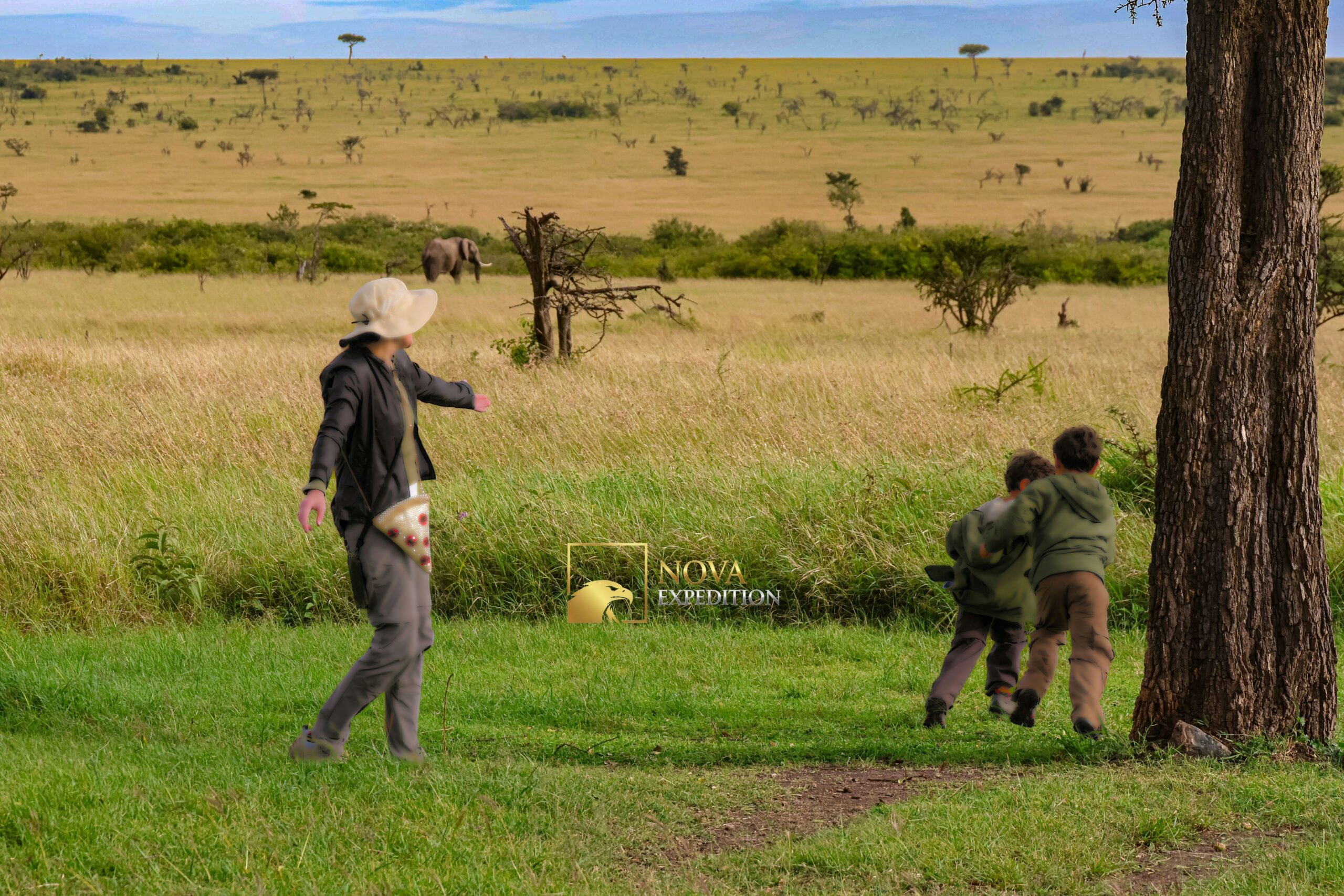

Why Kenya is Africa’s best family safari destination
A child seeing a wild elephant for the first time at close range in its natural habitat is one of those experiences that families talk about for decades. Not because it is dramatic — though it frequently is — but because it is irreducibly real. The elephant is not behind glass. The distance between the vehicle and the animal is measured in metres. The smell, the sound of enormous feet on earth, the scale of something 20 times the child’s weight moving with complete indifference through its landscape — this is contact with the natural world at a depth that no wildlife documentary, zoo, or safari park equivalent can come close to replicating.
Kenya Safari for Families is specifically well-suited and among th best African safari destinations for several reasons that are not obvious from the outside. It has the best family safari infrastructure on the continent — more dedicated family camps, more children’s programmes, more child-friendly guides, and more properties that have genuinely thought through what bringing a 7-year-old on a game drive requires — than any comparable destination. It has Nairobi, with the David Sheldrick Elephant Orphanage and the Giraffe Centre as pre-safari experiences that prime children for the bush in ways that engage rather than overwhelm. It has the combination of safari and beach that gives families the rhythm of active days and recovery days that the best family itineraries require. And it is logistically straightforward from Europe and North America — direct flights to Nairobi, domestic charter connections to parks, and an established operator network that has handled family logistics thousands of times before.
The age question — honest minimum ages by activity
There is no single Kenya-wide minimum age for safari. The rules are set by individual camps and operators, and they vary considerably. The following is what most reputable camps apply, based on research across the sector:
| Activity | Typical minimum age | Notes |
|---|---|---|
| Game drives (shared vehicle) | 6–8 years | Most standard camps. Some require 8+ for open vehicles. |
| Game drives (private vehicle) | No restriction at most camps | A private vehicle is the key that unlocks most family safari logistics. |
| Hot air balloon safari | 7–8 years (varies by operator) | Weight minimums also apply. Confirm before booking. |
| Walking safaris | 14–16 years | Armed ranger required. Most camps are strict on this. |
| Mobile camping safaris | 12+ (most operators) | Long drives, less infrastructure — not suitable for young children. |
| Night drives | 6+ at most conservancy camps | Children often find night drives the most memorable experience. |
| Canoe/boat activities | Varies — check individually | Life jackets provided. Most suitable from age 6+. |
| Horse riding safaris | 8–12+ (varies significantly) | Laikipia properties vary. Confirm child’s riding experience in advance. |
The single most important logistical decision for a family safari is booking a private vehicle. A shared group vehicle — the budget and mid-range default — cannot accommodate a family’s needs: you cannot stop for toilet breaks, you cannot cut a game drive short when a child needs to rest, you cannot linger when you want to and move when others want to stay. A private vehicle turns the game drive from a group activity managed by consensus into a personalised experience managed by your family and your guide. It costs more but is genuinely essential rather than merely preferable for families with children under 12.
Under 6 — safaris are possible, with the right approach
Most safari guides and camp managers will tell you that children under 6 are not ideal safari companions, and they are right in the sense that the game drive experience as conventionally structured — 3–4 hours in a vehicle, quiet observation, patience — is genuinely difficult for toddlers to manage. This does not mean families with young children should wait. It means they should approach the trip differently.
The key adaptations for under-6 travel:
- Choose Laikipia over the Mara for very young children. Laikipia’s higher altitude (1,700–2,600m) gives it significantly lower malaria risk than the Mara or Samburu. For toddlers whose malaria medication options are more limited and whose parents are more concerned about exposure, Laikipia — with properties like Lewa House (which accepts children of all ages), Ol Pejeta, and El Karama — provides excellent wildlife in a lower-risk environment. Ol Pejeta specifically is almost malaria-free at its altitude and accepts families with very young children.
- Maximum 90-minute game drives. Young children can sustain attention and good behaviour for about 90 minutes in a vehicle. Plan two 90-minute drives rather than one 3-hour drive. Morning drives leave at 6am and return by 7:30am — children eat breakfast and rest. Afternoon drives at 4pm, back by 5:30pm before dinner.
- Choose a fenced camp. Unfenced camps are part of the authentic bush experience — but for toddlers who cannot understand why they must stay within certain boundaries, a fenced camp perimeter provides safety without requiring constant supervision during the hours between drives.
- Swimming pool is non-negotiable. The hours between morning and afternoon drives need to be filled with something. A pool turns potential mid-day boredom into the best part of the day.
- Don’t try to do too much. Two parks maximum. Three nights minimum in each location. The travel between destinations — airport waits, charter flights, vehicle transfers — is exhausting for young children and manageable only if it is not constant.
Ages 6–12 — the golden safari age
Child development researchers and safari guides agree on this: the window between approximately age 6 and age 12 is when a Kenya safari has the greatest impact on a child’s imagination, curiosity, and relationship with the natural world. A five-year-old will be thrilled in the moment and partially forget the details. A fourteen-year-old will appreciate the experience as a sophisticated traveller. A nine-year-old will come home with a specific relationship to a specific animal — the leopard they watched for two hours in Mara North, the elephant matriarch their guide told them about as they watched the family cross the road — that will last for the rest of their life.
At this age, children can genuinely engage with what they are seeing. They can use binoculars. They can listen to a guide explain predator-prey relationships and understand it. They can hold still when the guide says “don’t move” because they understand why. They can remember names, identify species, and develop preferences. They will almost certainly return to Kenya as adults specifically because of a childhood trip.
What to do differently at 6–12:
- Choose camps with structured children’s programmes. The Saruni Mara Warriors Academy (children learn with Maasai guides — tracking, bead-making, spear-throwing in a safe context), andBeyond Kichwa Tembo’s WILDchild programme, and Kicheche’s children’s activities (Maasai bracelet-making, fire-starting, identifying animal tracks and bones) all provide educational depth that generic game drives don’t. The camps that have genuinely thought about children’s engagement produce the experiences children remember longest.
- Give children their own role. A pair of binoculars, a field guide, and the job of spotting and identifying birds creates a completely different level of engagement. Guides who are experienced with children will naturally assign tasks — “your job today is to count every species of hornbill we see.” This transforms a passive observation experience into an active one.
- Extend morning drives to 3 hours. By age 6–8, most children can sustain a full morning drive if it is engaging. The earlier concern about 90-minute limits relaxes considerably once children are genuinely interested rather than just compliant.
Teenagers — when safari becomes genuinely life-changing
Teenagers — particularly those from 14 upward — can engage with a Kenya safari at an adult level while still experiencing the raw emotional impact that adult travellers sometimes lose to over-familiarity with travel. A sixteen-year-old on a walking safari with an armed Samburu ranger in the early morning, tracking elephant in the dawn light — physically present in a landscape that is genuinely and obviously wild — is having an experience that reshapes their understanding of the world in ways that no structured educational environment can replicate.
For teenagers, the activities that most resonate are those that create physical engagement rather than vehicle observation: walking safaris (available to 14+), night drives revealing a nocturnal world they have never encountered, rhino tracking on foot at Ol Pejeta or Lewa, and — for the conservation-minded — the ability to meet researchers working on specific projects. Teenagers who visit the Amboseli Elephant Research Project and meet a researcher who is tracking a specific matriarch they saw that morning leave with a completely different understanding of conservation science than anything a textbook or documentary provides.
Best parks for families — and why Laikipia often beats the Mara
The Maasai Mara is Kenya’s most famous park and the one that most family safaris default to. For families with children over 8, a Mara conservancy (not the reserve itself) in July through October is outstanding. But for younger children, and for families whose priority is exclusivity, lower malaria risk, and activity diversity beyond the game drive, Laikipia is the answer most family travel specialists give when parents trust them with a blank slate.
Laikipia’s advantages for families are specific and significant:
- Altitude (1,700–2,600m) significantly reduces malaria transmission — making it one of the most medically sensible choices for families with children under 5
- The activity diversity — horse riding, camel safaris, walking with rangers, night drives, rhino tracking at Ol Pejeta — prevents the game-drive fatigue that affects young children
- The conservancy model means virtually no crowds at sightings — a family in Laikipia frequently has wildlife entirely to themselves
- Lewa House accepts children of all ages — one of the few truly all-ages-welcome camps in Kenya
- The rhino encounters at Ol Pejeta, including the last two northern white rhinos on Earth, are experiences children find uniquely compelling
Amboseli is the other frequently underestimated family destination. The compact park, near-guaranteed elephant sightings (children find elephant herds far more engaging than distant lion spots on a plain), the Kilimanjaro backdrop, and the research project’s educational dimension all suit children well. The drives are shorter (the park is smaller), which manages attention spans naturally. Tortilis Camp’s private conservancy allows walking safaris and more flexible activities than the main park.
What to look for in a family safari camp
Not all camps marketed as “family-friendly” are genuinely designed for families. These are the seven criteria that distinguish the real from the nominal:
- Family interconnecting rooms or suites. The best family camps have purpose-built family accommodation — two bedrooms connected by a shared lounge, or large suites with separate sleeping areas. Not simply two adjacent tents with a shared outdoor space. Confirm the physical layout before booking.
- Fencing or clear safety perimeter. Essential for children under 8. Some camps are beautifully designed and genuinely unfenced — which is wonderful at night with lions calling in the distance and functionally stressful with a curious four-year-old.
- Swimming pool. Mid-day heat recovery and the hours between game drives require a pool. It is listed as optional in most camp descriptions and is genuinely essential for families with children under 12.
- Children’s programme or activities beyond game drives. The camps that have genuinely invested in family programming — Saruni Mara, Kicheche, andBeyond Kichwa Tembo, Lewa House — produce better experiences than camps that simply permit children but haven’t thought through what children do between drives.
- Flexible mealtimes. Children eat at different times from adults. The best family camps accommodate this naturally — earlier dinners, flexible breakfast timing. A camp that serves dinner at 8pm and offers no flexibility will produce exhausted, overtired children by the end of day two.
- Child-experienced guides. Ask specifically: “Do your guides have experience leading game drives for families with children?” A guide who has never worked with a seven-year-old will not know how to engage them, how to read their attention span, or how to make the experience work for the whole family.
- Private vehicle guaranteed. This should be non-negotiable for any family. Confirm in writing that your vehicle and guide are exclusively yours — not shared with other guests from other families.
The best family safari camps in Kenya
Nairobi with kids — building the safari before the bush
Most family Kenya itineraries begin with a night or two in Nairobi, which experienced family travel specialists use strategically to prime children for what they are about to experience. The two Nairobi experiences most important for children are the David Sheldrick Wildlife Trust (11am elephant orphanage hour) and the Giraffe Centre — and the order matters.
Start with the Sheldrick Trust on the first morning. The 11am visiting hour — when orphaned infant elephants are walked out by their keepers to be fed milk from enormous bottles in front of visitors while keepers narrate each elephant’s rescue story — produces an emotional response in children that is difficult to manufacture through any other means. Children who meet a three-month-old elephant orphan whose mother was killed by poachers carry that story into the bush as a framework for understanding what they are seeing. A herd of wild elephants encountered later on a game drive is not just wildlife; it is a family, a social structure, and a conservation story that they now have personal emotional access to.
The Giraffe Centre follows naturally — feeding Rothschild’s giraffes by hand from a raised platform at eye level, learning that fewer than 1,600 individuals of this subspecies remain, and having the physical experience of a giraffe’s 40cm tongue retrieving a pellet from an open palm. Children who have done both experiences before arriving in the bush are already engaged naturalists rather than passive observers.
Health, safety, and malaria — the honest conversation
Malaria is a genuine consideration for families visiting Kenya, particularly with young children. The Kenya safari regions with highest malaria transmission are the Maasai Mara, Samburu, Tsavo, Lake Nakuru, and the coast — all below 1,500m altitude. Laikipia, at 1,700–2,600m, has significantly lower (though not zero) malaria transmission, which is one of the primary reasons family travel specialists recommend it for trips with children under five.
What to do before any family Kenya safari:
- Consult a travel medicine physician at least 6–8 weeks before departure. Antimalarial medication options for young children are limited — your physician will advise on the appropriate options for your children’s ages.
- Bring high-DEET insect repellent (at least 30–50% DEET for children; lower concentrations for children under 2). Apply morning and evening, particularly at dawn and dusk when mosquitoes are most active.
- Long-sleeved, light-coloured clothing for morning and evening drives.
- All reputable safari camps provide mosquito nets over beds and spray rooms at dusk. These are genuinely effective when used consistently.
- Familiarise yourself with malaria symptoms (fever, chills, headache) and carry a rapid malaria test. If any fever develops within 3 months of return, seek medical attention and mention Kenya travel.
Safety at camps: wild animals are always present and potentially dangerous. Most family camp incidents involve children leaving tents or camp areas unsupervised. The rule is simple and absolute: children do not move around the camp without an adult. Guides and camp staff are excellent at maintaining this rule if parents make it clear from day one.
Best time for a family Kenya safari
July to October is peak family season — school holidays globally align with Kenya’s Great Migration period. Wildlife is outstanding, the landscape is dry and open, and the Mara is at its most spectacular. The trade-offs: maximum crowds (particularly at reserve sightings), maximum prices, and the need to book 12 months ahead for the best camps.
For families who can travel outside school holidays, January and February are the best overall family safari months. Lower Mara park fees, shorter game drives in the dry heat (animals concentrate at water by mid-morning), excellent predator activity from herbivore calving season, and the best Kilimanjaro photography conditions of the year — all delivered at 20–30% below peak season pricing with significantly fewer vehicles at sightings.
For December travel: early December is underpriced and genuinely excellent. After December 20, holiday premium pricing applies everywhere and some popular camps sell out months in advance.
Adding the beach — why Kenya families love the combination
The Kenya safari-and-beach itinerary exists because it solves a real problem: children who have had three or four days of intense wildlife experience need recovery time that is itself enjoyable. A beach extension of three to four nights at Diani Beach or Watamu — warm Indian Ocean water, calm lagoons safe for swimming, fresh seafood dinners, and nothing urgent to do — provides the physical and mental recovery that makes the whole trip sustainable rather than exhausting.
The logistics are simple: fly from Wilson Airport to Ukunda (Diani, 1 hour) or Malindi (Watamu, 1 hour) from the Mara or Amboseli. From Tsavo East, Diani is a 2–3 hour road transfer from Bachuma Gate — manageable and eliminating the charter flight cost. The transition from bush to beach takes about two hours by air and produces a complete change of pace, temperature, and activity that most families find refreshing rather than jarring.
For families: Diani’s Sands at Nomad has a good dive centre for children old enough to snorkel, a reliable beach, and family-appropriate rooms. Kinondo Kwetu offers horse riding on the beach — one of the more magical experiences the Kenya coast offers children who ride.
More Guides:
Maasai Mara, Kenya — Destination Guide | Nova Expedition Kenya
Kenya Tanzania Safari — The Complete Combined Guide 2026
Maasai Mara vs Serengeti: Which African Safari is Better? (2026 Honest Guide)
Where to Stay in Diani Beach and Lamu — Every Hotel Rated 2026
Where to Stay in Laikipia — Every Conservancy Lodge Rated 2026
How much does a Kenya safari cost in 2026? The honest breakdown
Kenya Safari for Beginners: Everything You Need to Know (2026 Complete Guide)
Best Lodges in the Maasai Mara 2026: From Ultra-Luxury to Best Value