The Mara — Kenya’s most famous wildlife landscape, and how to do it properly
The Maasai Mara is the destination almost every first-time Kenya visitor names before they have even booked a flight. It is also the destination that is most frequently done badly. Lodges inside the National Reserve that sleep 200 guests; mini-bus circuits at popular sightings with twenty vehicles jostling around a single lioness; sunrise game drives that leave the gate in a convoy. The Mara is genuinely the wildlife landscape its reputation describes — but the difference between a great Mara trip and a mediocre one comes down to a small number of decisions made before you arrive, and almost none of those decisions are about which week to visit.
The Greater Mara Ecosystem covers roughly 1,500 square kilometres of the National Reserve plus around 350,000 acres of surrounding community conservancies — collectively, the northernmost extension of the Serengeti-Mara ecosystem, which spans the Kenya-Tanzania border. The reserve itself is bounded by the Oloololo (Siria) Escarpment to the west, the Tanzania border and the Serengeti to the south, and the conservancies to the north and east. The wildlife is among the densest in Africa: roughly 459 resident lions over the age of one across the protected areas, leopard populations habituated over years and known to guides as individuals, the second-largest elephant range in Kenya, and during July through October, the annual arrival of more than a million wildebeest from the Serengeti. The Mara is not understated — it is what the rest of African safari travel is measured against.
The National Reserve vs. the conservancies — the decision that shapes your entire trip
If you remember nothing else from this guide, remember this: the Maasai Mara is not one place, it is two systems that share a name, and choosing between them is the single most consequential decision you will make for your trip. The Maasai Mara National Reserve is a public protected area managed by Narok County. The conservancies are private and community-managed lands surrounding the reserve. Wildlife moves freely between them — there are no fences — but the rules governing what you can do, how many other vehicles you’ll share a sighting with, and what activities are available are completely different.
| What you get | National Reserve | Conservancies |
|---|---|---|
| Vehicles at a sighting | Unlimited (10–20+ common in peak season) | Capped at 3–5 vehicles by rule |
| Off-road driving | Not permitted — vehicles must stay on tracks | Permitted — guides can position close to wildlife |
| Night drives | Not permitted | Permitted in most conservancies |
| Walking safaris | Not permitted | Permitted with armed ranger + guide |
| Vehicle/guest density | High — large lodges, many beds | Strictly limited (typically 1 guest per 350 acres) |
| Park fees (2026) | $100 (Jan–Jun) / $200 (Jul–Dec) per person/day | $80–$150 conservancy fee per person/night (typically included in camp rate) |
| Ticket validity | 12 hours — the 10am exit trap (see below) | N/A — covered by your camp stay |
| Wildlife | Identical — wildlife moves freely between zones | Identical — wildlife moves freely between zones |
| Migration access (Jul–Oct) | Herds often deeper in the reserve; closer to river crossings | Strong — northern conservancies see significant migration traffic |
The verifiable data underlying this comparison: the 2021 aerial census conducted by the Wildlife Research and Training Institute and Kenya Wildlife Service found that 83.7% of the large mammals in the greater Mara landscape live outside the National Reserve — in the conservancies and surrounding community lands. Only 16.2% live inside the Reserve. Lion densities, measured by the Mara Predator Conservation Programme over a decade of continuous monitoring, are approximately 14% higher in the conservancies than in the Reserve. This is not a marketing claim — it is the conclusion of the longest-running predator monitoring programme in East Africa, applying scientifically rigorous methods.
The Great Migration — what it actually is, and what no operator will tell you
The Great Migration is the annual circular movement of approximately 1.5 million wildebeest, 200,000 zebra, and 350,000 Thomson’s gazelle between Tanzania’s Serengeti and Kenya’s Maasai Mara. The herds spend most of the year in the Serengeti — calving on the southern plains in February, moving north through the central Serengeti during the long rains, and arriving in the Mara from approximately late June onwards. They remain in Kenya until roughly mid-October, when the short rains begin to call them south again. Within the Mara, the famous Mara River crossings — wildebeest plunging down riverbanks while crocodiles wait in the water — typically peak in August and September, though they can occur any time the herds choose to cross.
Three honest things about the migration that most articles avoid:
Crossings are not scheduled. The herds may stand at the riverbank for three hours, then leave. They may cross at dawn, at noon, in the rain, or not at all on any given day. Guests who arrive at a Mara camp expecting to witness a specific crossing on a specific morning report the highest disappointment rates of any safari demographic. Guests who arrive expecting to spend five or six days inside the wider migration experience report the highest satisfaction rates. The difference is entirely psychological — the wildlife is the same.
The migration is the most expensive way to see the Mara. The Mara National Reserve non-resident park fee doubles from $100 to $200 per person per day from July 1 to December 31. Camp rates roughly double for the same period. Conservancies remain available but at peak rates. Crowds at the popular Reserve sightings can reach twenty-plus vehicles. If your wildlife priority is “exceptional Mara wildlife” rather than “the river crossing specifically,” January through March and June deliver wildlife of comparable quality at roughly half the all-in cost, with calving-season predator action that many experienced safari travellers consider equal to or better than the migration spectacle.
The migration is not the only show in the Mara. The resident wildlife — the lion prides, the leopard population in Olare Motorogi and Naboisho, the elephant herds, buffalo, the resident wildebeest and zebra that don’t migrate, and Kenya’s healthiest cheetah population — is what makes the Mara extraordinary. The migration is the visiting spectacle laid over an already-extraordinary ecosystem. People who have only seen the Mara in August often don’t realise how good February is.
The Mara’s predators — the most-studied lion population in Africa
The Maasai Mara holds Kenya’s most closely monitored lion and cheetah populations, the result of more than a decade of continuous research by the Mara Predator Conservation Programme (MPCP), a flagship initiative of the Kenya Wildlife Trust. The programme conducts an annual intensive 90-day monitoring session between August and September each year, recording individual lions and cheetahs by their unique facial markings, whisker patterns and scars, building one of the longest-running predator demographic datasets on the continent.
The numbers from this monitoring: roughly 459 resident lions over the age of one currently live in the Mara’s protected areas. Lion populations in the Mara have remained relatively stable, even slightly increasing, over the past decade — a notable conservation success against the broader African trend, where lion populations have declined dramatically. The Mara also supports one of Africa’s most viable cheetah populations, despite cheetahs being among the most threatened large carnivores globally (roughly 6,000 individuals remain across the continent). The detailed demographic monitoring extends to year-one survival rates for individual cheetah cubs and population survival trends — the kind of granular data that makes meaningful conservation intervention possible.
What this means for visitors: the lions and cheetahs you watch in the Mara are not anonymous wildlife. They are documented individuals with names, family histories, and ongoing research narratives. Specific lion prides — the Marsh Pride, the Topi Plains lions, the Black Rock pride — have been continuously observed for generations. Specific leopards in Olare Motorogi and Naboisho conservancies have been identified and tracked over years, which is why those conservancies deliver such reliable leopard sightings. The wildlife watching here is not just spectacle — it is layered with science.
Research and conservation — three programmes shaping the ecosystem
Beyond the Mara Predator Conservation Programme, two further research initiatives shape what visitors actually see and how the ecosystem functions.
Mara Elephant Project (MEP), founded in 2011 as a collaboration with Save the Elephants, maintains GPS satellite collars on selected elephants across the Greater Mara Ecosystem. Since the programme began, more than 90 flagship elephants have been collared in collaboration with the Kenya Wildlife Service and Wildlife Research and Training Institute. The data feeds anti-poaching response, identifies wildlife corridors at risk from fencing and development, and informs human-elephant conflict mitigation — when farmers and crop-raiding elephants share the same landscape, real-time movement data lets ranger teams intervene before conflict escalates. MEP’s helicopter and ranger network also support broader wildlife operations across the ecosystem, from baby elephant rescues to vulture poisoning responses.
Maasai Mara Wildlife Conservancies Association (MMWCA) is the coordinating body for the 23 community conservancies that surround the Reserve. Since MMWCA’s formation in 2013, the land under conservation in the greater ecosystem has expanded from 33% to 64% — a transformation that has secured two major wildlife corridors and supported recovery of wildlife densities across the landscape. The conservancy model is what makes the Mara structurally different from most other African wildlife landscapes: the Maasai landowners who would otherwise be grazing cattle on this land are paid for their conservation, and the income makes the conservation economically viable for the people who actually live there.
Kenya Wildlife Trust, the umbrella organisation behind MPCP, also runs community-facing programmes including wildlife clubs in nine local schools, the construction of predator-proof bomas (livestock enclosures built from recycled plastic poles) to reduce retaliatory killing of lions, and ongoing monitoring of wild dog populations as they recolonise parts of the ecosystem.
The Maasai people — landowners, partners, hosts
The Maasai are a Nilotic pastoralist people who have inhabited this landscape for centuries — long before it was a national reserve, long before the conservancies existed, long before the safari industry arrived. Wealth in Maasai society is measured in cattle. Social organisation is built around age sets, with each generation moving through defined roles — from boyhood, through warrior (moran) status, to elder. The visible cultural signatures — the red shuka cloth, the elaborate beadwork, the ritual jumping dance (adumu), the distinctive ear modifications and ochre hair styling of senior morans — are part of one of the most resilient cultural identities in East Africa.
The contemporary relationship between the Maasai and the safari industry is a partnership, not a backdrop. The conservancies surrounding the Reserve are leased from Maasai landowners who receive direct income from camp partnerships — a model that has, by most measures, produced better outcomes for both wildlife and people than the older approach of fenced-off protected areas with no community benefit. Cultural visits arranged through reputable camps are encounters with active partners in the conservation economy, not performances. The best Mara guides are typically themselves Maasai, with deep knowledge of the landscape, the wildlife, and the language that names everything from individual elephants to specific stretches of riverine forest.
The Mara Triangle — the quieter, better-managed western third
One section of the National Reserve operates differently from the rest. The Mara Triangle — the western third of the Reserve, bounded by the Mara River to the east and the Oloololo Escarpment to the west — has been managed since 2001 by the Mara Conservancy, a not-for-profit organisation working in partnership with Narok County. The Triangle covers approximately 510 square kilometres and operates under tighter management standards than the eastern Reserve: fewer vehicles, better-maintained tracks, cashless-only gate payment (Visa, Mastercard or M-Pesa), and a stronger anti-poaching record.
For travellers prioritising Mara River crossings during the migration window, the Triangle offers some of the best access in the entire ecosystem — a significant portion of the river’s western bank, including major crossing points, falls inside the Triangle. The Triangle is also one of the most reliable places in the Mara to see black rhino, which exist in small numbers in the Reserve and are most concentrated on the western side. Vehicle density at sightings tends to be noticeably lower than in the eastern Reserve, even at peak season — partly because there are fewer access roads, and partly because the management actively enforces vehicle limits.
Getting there, park fees and the 12-hour rule
By air — Scheduled flights from Nairobi Wilson Airport to the Mara airstrips (Keekorok, Olkiombo, Musiara, Mara North, Naboisho, and others) take 45–60 minutes. Safarilink, AirKenya and other operators run multiple daily services in peak season. Most camps arrange airstrip transfers as part of the booking. By air is the standard for any conservancy trip — the road journey from Nairobi adds a full day in each direction without adding meaningful experience.
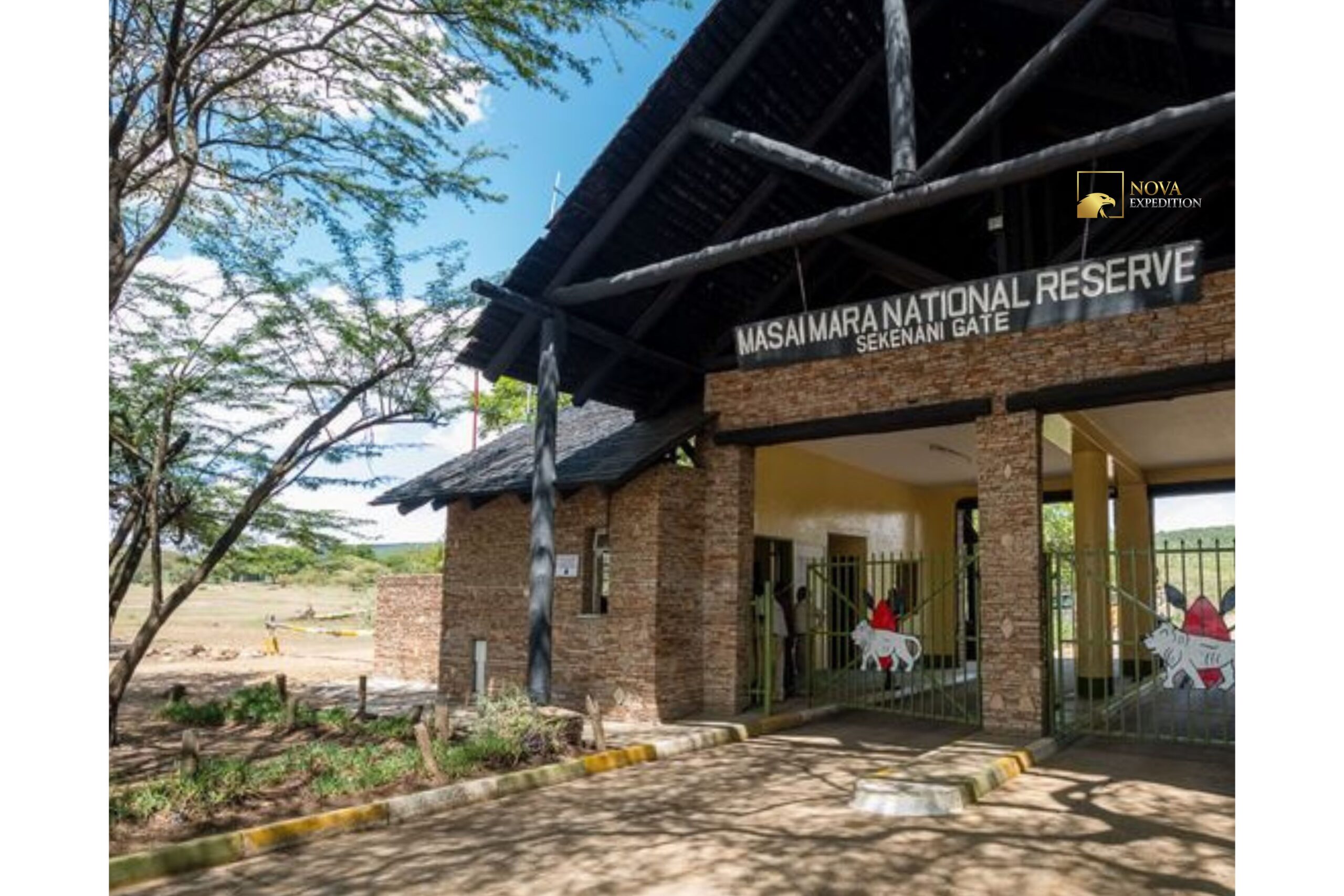
By road — Approximately 5–6 hours from Nairobi via Narok and the Sekenani gate, or 6–7 hours via the western route to the Oloololo gate (for Mara Triangle access). Road conditions have improved significantly in recent years but the final stretch into the Reserve is still rough. Self-drive in private vehicles inside the Reserve has been banned since June 2024 — all game drives must now be conducted in registered safari vehicles operated by licensed tour operators.
Park fees (2026) — Non-resident adults: $100 per person per day from January 1 to June 30; $200 per person per day from July 1 to December 31. Children (9–17): $50 per day. Under 9: free. East African residents pay reduced rates with valid ID. Conservancy fees are separate and typically included in the camp’s all-inclusive rate (usually $80–$150 per person per night).
The 12-hour rule — the trap that costs travellers $200 they didn’t plan for. Since 2023, the Mara National Reserve ticket has been valid for 12 hours, not 24. Practically this means: if your previous day’s ticket expires before you exit on departure morning, you owe another full day’s fee — $200 per person in peak season — paid on the spot at the gate. Most reputable operators schedule the final morning game drive to ensure you reach the exit gate or your airstrip by 10:00 am. If your itinerary includes a late departure or an extended game drive on departure day, confirm in writing with your operator how fees are calculated. The Mara Triangle operates on similar but not identical rules and is cashless-only at the gate.